GRADE & PURITYMoligand™?Moligand™ — Aladdin's line of ligands and bioactive small molecules. Use for receptor, pathway, and binding studies needing defined small-molecule tools.≥97%
This compound belongs to the class of organic compounds known as 1,2-aminoalcohols. These are organic compounds containing an alkyl chain with an amine group bound to the C1 atom and an alcohol group bound to the C2 atom.
External Descriptors
Not available
1. Djoumbou Feunang Y, Eisner R, Knox C, Chepelev L, Hastings J, Owen G, Fahy E, Steinbeck C, Subramanian S, Bolton E, Greiner R, and Wishart DS. ClassyFire: Automated Chemical Classification With A Comprehensive, Computable Taxonomy. Journal of Cheminformatics, 2016, 8:61.
Determine the necessary mass, volume, or concentration for preparing a solution.
Dilution Calculator
Determine the dilution needed to prepare a stock solution.
Reconstitution Calculator
Reviews
Customer Reviews
Application Protocols
No assay-validated biological application protocols (e.g., WB, IHC, IF, flow cytometry) are applicable to this small-molecule reagent.
General laboratory protocols involving L‑Valinol (literature/guidance):
Preparation of L‑valinol hydrochloride:
Bubble dry HCl gas into an anhydrous ether solution of L‑valinol at 0–5 °C until precipitation ceases. Filter under inert atmosphere, wash with cold ether, and dry under vacuum. Use the salt for crystallizations or as an intermediate; free-base regeneration via base.
Oxazoline synthesis (sketch):
To a cooled (0 °C) solution of L‑valinol and DIPEA in dry DCM, add an acid chloride dropwise. After completion, concentrate and treat the amide intermediate with SOCl2 (or POCl3) under reflux to cyclodehydrate. Quench cautiously, neutralize, and purify by column or crystallization. Optimize conditions per substrate.
N‑Boc protection:
In dioxane/water or THF, add Boc2O (1.05–1.2 equiv) and a base (NaHCO3 or DIPEA) at 0–25 °C; monitor by TLC/LC. Work up and dry thoroughly before O‑derivatizations.
These are illustrative only; adapt to your substrate, scale, and safety constraints. Always perform appropriate risk assessments and consult detailed procedures in the primary literature.
Biological Roles
Origin/context (general): L‑Valinol is the reduced alcohol analog of the essential amino acid L‑valine. It is not a canonical metabolite in primary metabolism but can arise in laboratory/bioprocess settings from chemical or enzymatic reduction of L‑valine derivatives.
Retains the L‑valine stereocenter; primary amine imparts basicity and capacity for salt formation with biological acids.
Hydrogen-bonding donor/acceptor; can interact with proteins and membranes similarly to other small alkanolamines, though with limited biological specificity.
Biotransformation (general):
Potential oxidative pathways include oxidation of the primary alcohol to the corresponding aldehyde/acid and transamination of the amine; however, such pathways are not primary in human metabolism and data are limited.
Utility in biochemistry (general research use):
Chiral selector/building block in synthesis of ligands for biocatalysis or affinity tags.
Intermediate to oxazolines/oxazolidines that can serve as chiral auxiliaries for preparing enantiopure probes and standards.
No clinical/therapeutic claims are made for this product. For use strictly in research and laboratory applications, as indicated in the Product Data.
Buffer Applications
L‑Valinol is not a standard laboratory buffer component. As a primary amine with a conjugate-acid pKa typically around 9–10 for amino alcohols (literature), it does not offer strong buffering near physiological pH and lacks a defined, widely adopted buffering system.
When it may be used (general):
As an auxiliary amine to adjust basicity in non-aqueous media or to transiently raise pH in organic–aqueous systems during extractions.
Formation of temporary salts with acids to modulate solubility/crystallization rather than to control pH.
Practical guidance:
For aqueous buffers in the pH 7–9.5 region, prefer established systems (Tris, HEPES, TAPS, CHES). These offer known buffer capacities, ionic strengths, and compatibility profiles.
If L‑valinol-containing solutions are prepared, document pH drift due to CO2 uptake and ensure ionic strength is controlled; however, this is atypical and generally not recommended for critical buffering tasks.
Conclusion: For buffering needs, use dedicated buffer reagents. Refer instead to the Synthetic Utility and Reaction & Applications sections for relevant uses of L‑valinol.
Green Alternatives
For L‑Valinol as a chiral building block, “greener” choices revolve around feedstock origin and process solvents rather than replacing the molecule itself.
Feedstock and sourcing (general):
Bio-based origin: L‑Valinol prepared from natural L‑valine (fermentation-derived) aligns with renewable carbon sourcing and often reduces Scope 3 emissions compared to petrochemical routes.
Catalytic hydrogenation vs. metal hydrides: Reduction of L‑valine derivatives to L‑valinol using catalytic hydrogenation (e.g., Ru/Raney Ni with appropriate protection) can minimize waste relative to stoichiometric hydrides.
Solvent greener choices (for common L‑valinol transformations; literature/general):
Replace DCM with EtOAc, 2-MeTHF, or acetonitrile for acylations/cyclizations when feasible.
Use water/ethanol/isopropanol for salt formations and resolutions; avoid chlorinated solvents during crystallizations.
Employ 2‑MeTHF or CPME as water-tolerant media for azeotropic removals in oxazoline formation.
Work-up and protection strategies:
Select protecting groups that deprotect under catalytic or aqueous conditions (e.g., Boc with CO2-based streams or green acids) rather than harsh reagents.
Apply continuous extraction or membrane dehydration to reduce solvent volumes.
Trade-offs:
More polar green solvents can change selectivity or rate in acylation/cyclization; base strength and temperature may need adjustment.
Replacing DCM/THF with greener ethers or esters may affect stabilizer profiles and peroxide management. Validate stability with the specific ligand/auxiliary synthesis route.
Pharmaceutical Uses
No therapeutic or clinical uses are claimed for this product. In pharmaceutical R&D and process chemistry contexts (non-clinical; research only):
Role as a chiral intermediate (general):
L‑Valinol serves as a versatile chiral building block to access enantiopure ligands, auxiliaries, and side chains that are later incorporated into small-molecule APIs or catalysts for enantioselective steps.
Conversion to oxazolines/oxazolidines or protected derivatives (e.g., Boc‑valinol, Cbz‑valinol) enables robust, scalable routes under GMP when appropriate analytical controls are in place.
Salt and solubility modulation (general):
Formation of pharmaceutically acceptable salts (e.g., hydrochloride, sulfate, tartrate) may be used to adjust handling, crystallinity, or purification of intermediates; such salts are intermediates, not drug products.
Example unit operations (general):
Crystallization of diastereomeric salts for chiral resolution of racemic acids/alcohols.
Reductive amination, carbamate formation, and selective O‑derivatization under conditions compatible with common process solvents (EtOH, isopropanol, acetonitrile).
Regulatory note: Any pharmacopeial status, residual solvent limits, and impurity profiles for a specific lot are Not specified for this item; refer to CoA/Spec Sheet and project-specific quality agreements.
Physical Properties
Appearance (item-specific): Not specified for this item; refer to CoA/Spec Sheet.
Phase/state (literature): Typically a colorless, low- to medium-viscosity liquid at ambient temperature with a faint amine odor.
Acid–base (literature): Primary amine; conjugate acid pKa typically in the 9–10.5 range for amino alcohols. Hydroxyl pKa ~16 (not titratable in water). Amphiprotic, forms salts with mineral/organic acids.
Hydrogen bonding (general): Strong H‑bond donor and acceptor; hygroscopic tendencies are common for small amino alcohols.
Solubility (literature): Miscible with water and polar protic/aprotic solvents (alcohols, ketones, DMF, DMSO). Low solubility expected in nonpolar hydrocarbons.
Volatility (literature): Low to moderate vapor pressure relative to low-MW amines; usually distilled under reduced pressure to limit decomposition/oxidation.
Density/refractive index/boiling/melting points: Not specified for this item; consult literature for indicative values and the CoA for lot-specific data.
Optical rotation (item-specific): Not specified for this item; refer to CoA/Spec Sheet for [α]D and enantiopurity.
Notes for use (general):
Amino alcohols can absorb CO2/H2O from air; measured properties (e.g., mass, titrations) may drift on prolonged exposure. Work under inert atmosphere for analytical accuracy.
The amine’s basicity and the hydroxyl’s nucleophilicity are attenuated in strongly hydrogen-bonding media; reaction rates can vary substantially with solvent and water content.
Quality and Grades
Grade/Purity (from Product Data): Moligand™. Aladdin’s Moligand™ line is intended for use as chiral building blocks, ligand precursors, and stereochemically defined auxiliaries in asymmetric synthesis and catalysis.
What Moligand™ implies (general):
Emphasis on enantiomeric integrity suitable for ligand/auxiliary preparation and stereospecific transformations.
Packaging and handling designed to minimize racemization/oxidation (argon charge noted for this item) and moisture uptake.
Typical QC for this category often includes chiral purity by chiral HPLC/GC and identity by NMR/MS; however, specific acceptance criteria for this item are Not specified for this item; refer to CoA/Spec Sheet.
Stabilizers/impurities: No stabilizer is listed in Product Data. If stabilizers, residual solvents, or salts are critical for your process (e.g., catalytic ligand performance), verify with the item’s CoA/SDS.
Optical rotation/enantiomeric excess: Not specified for this item; refer to CoA/Spec Sheet. For asymmetric catalysis or chiral auxiliary synthesis, confirm ee/er and sign/magnitude of [α]D before use.
Practical guidance:
If trace water or residual acid/base can impact downstream coupling or cyclization to oxazolines/oxazolidines, consider brief drying (e.g., azeotrope) under inert atmosphere after verifying stability.
For method validation work (GMP or regulatory), request lot-specific documentation including analytical methods and impurity profiles.
Reaction and Applications
L‑Valinol is widely used as a chiral building block and ligand precursor due to its L‑valine-derived stereocenter.
Oxazolines and bis(oxazolines) (BOX) from valinol are prevalent ligands for asymmetric catalysis (e.g., enantioselective additions, cyclopropanations, and Diels–Alder reactions). Cyclization with acid chlorides or nitriles affords oxazolines retaining the L‑configuration.
Oxazolidines/imidazolidinones via condensation with carbonyls furnish chiral auxiliaries for asymmetric alkylations and reductions.
Resolution chemistry:
Formation of diastereomeric salts with chiral acids (e.g., tartaric, camphorsulfonic acid) enables resolution of racemic acids and provides tunable crystallization behavior.
Functionalization platform:
N‑Acylation/carbamate formation delivers protected intermediates; O‑alkylation/O‑sulfonylation (e.g., tosylates) sets up subsequent substitution or elimination.
Oxidation of the primary alcohol (e.g., Swern, Dess–Martin) to the corresponding aldehyde enables access to chiral amino aldehydes for further transformations (e.g., Strecker, Ugi reactions).
Borane-mediated reductions and hydroboration:
Valinol-derived oxazolines and amino alcohols can coordinate borane, modulating selectivity in reductions (CBS-type paradigms; valinol scaffolds as surrogates/precursors).
Polymer/crosslinking additives:
As a bifunctional amine–alcohol, it participates in urethane/urea/epoxy chemistries to introduce chirality or tune Tg, though this is more exploratory/materials-focused.
Practical notes:
Maintain inert atmosphere (argon per Product Data) to limit oxidative discoloration and CO2 uptake that can affect salt formation and reactivity.
Control pH and water in condensations; amino alcohols strongly hydrogen-bond and can sequester water, impacting equilibrium.
Reaction Conditions
The following are representative literature/general conditions; optimize for your substrate and consult primary sources.
N‑Acylation to amides/carbamates:
Solvent: DCM, THF, or acetonitrile, anhydrous.
Base: DIPEA or Et3N (1.5–2.5 equiv). Temperature: 0–25 °C. Time: 0.5–4 h. Monitor for O‑acylation; adjust base/solvent to favor N‑acylation.
Oxazoline formation (from acid chloride):
Step 1: Acylate L‑valinol (0–5 °C to RT) in DCM/ACN with acid chloride (1.0–1.2 equiv) and base.
Step 2: Cyclodehydrate with SOCl2 or POCl3 or by heating in toluene/2‑MeTHF with Dean–Stark. Temperatures: 60–110 °C. Times: 2–16 h. Typical isolated yields in literature are substrate-dependent and can be high (60–90%).
Oxazolidine formation (with aldehydes/ketones):
Solvent: toluene, benzene, or 2‑MeTHF; use Dean–Stark or molecular sieves (4 Å).
Catalyst: p‑TsOH (0.5–5 mol%) or Lewis acids. Temp: RT–110 °C. Time: 1–12 h. Reversible; water removal is key.
Reductive amination at the primary alcohol (via aldehyde stage):
Oxidize –CH2OH to –CHO (Swern/DMP), then condense with amines and reduce with NaBH3CN/NaBH(OAc)3 in MeOH/ACN at 0–25 °C.
O‑Sulfonylation (tosylate preparation):
Solvent: DCM or pyridine. Reagents: TsCl (1.1–1.5 equiv), base (pyridine/Et3N). Temp: 0 °C to RT. Time: 1–3 h.
General tips:
Maintain argon atmosphere as per Product Data to prevent CO2 uptake and moisture interference.
Carefully control exotherms upon acid chloride additions; amino alcohols react vigorously.
For scale-up, consider calorimetry and continuous addition to manage heat and selectivity.
Safety and Handling
GHS classification and pictograms (item-specific): Not specified for this item; refer to the Aladdin SDS for authoritative hazard statements and pictograms.
General hazards (literature/general): Primary aliphatic amines and amino alcohols are typically skin/eye/respiratory irritants; may cause sensitization in susceptible individuals. Combustible; vapors may be irritating.
Special risks for amino alcohols (general):
Can form salts with acids; neutralization is exothermic.
Hygroscopic and CO2-absorbing; may form carbamates at the surface on air exposure.
Oxidation on air/light is typically slow but can produce colored byproducts; store under inert gas as specified for this item.
Storage conditions (from Product Data): Store at 2–8 °C, argon charged. Shipped on wet ice.
Incompatibilities (general): Strong oxidizers, acid chlorides/anhydrides (violent acylation), isocyanates, and strong acids/bases without proper controls.
Recommended PPE (general): Lab coat, safety glasses or goggles, and appropriate chemically resistant gloves (e.g., nitrile). Use in a fume hood to minimize inhalation exposure.
First aid (general overview; defer to SDS):
Inhalation: Move to fresh air; seek medical attention if symptoms persist.
Skin: Wash with soap and water; remove contaminated clothing.
Eyes: Rinse cautiously with water for several minutes; remove contact lenses if present and easy; seek medical attention for persistent irritation.
Ingestion: Rinse mouth; do not induce vomiting; seek medical advice.
Spill/cleanup (general): Absorb with inert material, avoid neutralization with strong acids in bulk due to heat evolution; ventilate area, dispose per regulations.
Solvent Selection
L‑Valinol is a small, polar, bifunctional molecule (primary amine + primary alcohol), best treated as a polar protic substrate or reagent.
Polarity/miscibility (literature/general):
Highly miscible with water, lower alcohols, and polar aprotic solvents (DMF, DMSO, acetonitrile).
Limited solubility in nonpolar solvents (hexanes, heptane); solubility improves as a salt in polar solvents or via co-solvents.
Dielectric/ionization considerations (general): The amine is protonated in acidic media, enhancing water/alcohol solubility; in basic media, free-base form is less polar but still hydrogen-bonding.
Selection tips by use case:
N‑Acylation/Carbamoylation: Use dry dichloromethane, THF, or acetonitrile; include a non-nucleophilic base (DIPEA, Et3N). Avoid protic solvents that can compete.
Oxazoline/Oxazolidine formation: Often run in toluene, DCM, or acetonitrile with dehydrating agents or azeotropic water removal.
Reductive amination: Alcohol solvents (MeOH/EtOH) or acetonitrile are common; buffer pH to maintain imine formation while minimizing over-reduction.
Salt formation/resolution: Alcohol–ether mixtures (EtOH/IPA + MTBE/Et2O) enable controlled crystallization of diastereomeric salts with chiral acids.
Brief comparison (general):
Water: green, ideal for work-up and salt manipulations but can suppress nucleophilic acyl substitutions.
MeOH/EtOH: balance solubility and reactivity; easy removal.
ACN/THF/DCM: favor anhydrous acylations/cyclizations; watch for amine–solvent interactions and stabilizers.
Always match solvent dryness to the step’s water sensitivity; amino alcohol reactions are often rate- and selectivity-sensitive to moisture.
Storage and Reconstitution
Storage conditions (from Product Data): Store at 2–8 °C, argon charged. Shipments are on wet ice.
Container/closure (general best practice): Use airtight, chemically compatible containers (e.g., amber glass with PTFE-lined cap). Minimize headspace or backfill with inert gas to maintain the argon blanket upon each use.
Handling to maintain quality (general):
Work swiftly under inert atmosphere to limit moisture and CO2 uptake (which can form surface carbamates and alter apparent basicity/assay).
If necessary, dry by brief vacuum at low temperature or azeotrope with a suitable solvent (e.g., toluene or 2‑MeTHF) after confirming no loss of enantiopurity or decomposition.
Reconstitution (applicability): Not applicable—supplied as a neat small molecule. If a solid or salt form is received, dissolve in a dry, compatible solvent (e.g., anhydrous ethanol, acetonitrile) under inert gas to prepare stock solutions; record concentration and date.
Freeze–thaw: Generally unnecessary and not recommended; repeated freezing can promote condensation with CO2/water upon thawing. Prefer refrigerated storage per Product Data.
Shelf life/quality checks: Not specified for this item; refer to CoA/Spec Sheet. Before critical stereoselective steps, confirm identity and enantiopurity (e.g., 1H/13C NMR, chiral HPLC) especially after extended storage.
Structure and Identity
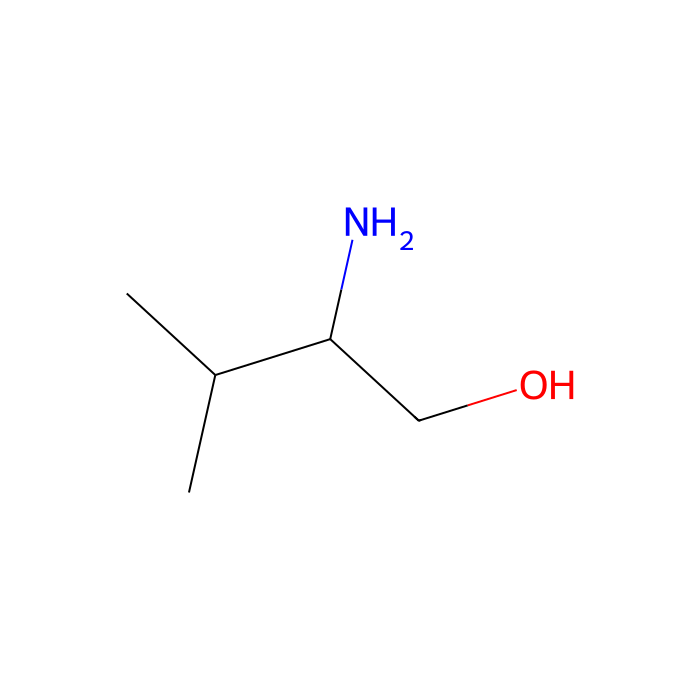
L‑Valinol is the chiral amino alcohol obtained by reducing the carboxyl of L‑valine to a primary alcohol; it is commonly encountered as (S)‑2‑amino‑3‑methyl‑1‑butanol.
Item identifiers (from Product Data)
CAS: 2026-48-4
CID: 640993
SKU: V117153
InChIKey: Not specified for this item; refer to CoA/Spec Sheet.
SMILES: Not specified for this item; refer to CoA/Spec Sheet.
Structure (literature/general)
Preferred IUPAC name (literature): (S)-2-amino-3-methylbutan-1-ol
InChIKey (literature): commonly reported for L‑valinol; verify on CoA/SDS for this lot.
Structural features (general description)
One stereogenic center at C2 with S configuration (L‑series).
Functional groups: primary amine (–NH2) adjacent to a primary alcohol (–CH2OH), isobutyl side chain (–CH(CH3)2).
2D description: a four-carbon backbone where C1 bears –CH2OH, C2 bears –NH2 and a methyl substituent, and the side chain terminates in an isopropyl moiety. The amino and hydroxymethyl groups are vicinal, enabling intramolecular hydrogen bonding and facile formation of five-membered oxazolidines with carbonyls.
Chirality/enantioenrichment
L‑Valinol is the enantiomer derived from L‑valine; its absolute configuration is crucial when used to build chiral auxiliaries/ligands. Specify optical rotation and enantiopurity as needed from the item CoA.
Synthetic Utility
Functional group set: primary amine (nucleophilic/basic) and primary alcohol (nucleophilic after activation). Stereocenter at C2 (S) provides chirality transfer/induction.
Key transformations (literature/general):
Heterocycle formation:
Oxazoline synthesis via acylation of the amine with acid chlorides or activation with nitriles, followed by cyclodehydration. These oxazolines act as chiral ligands (e.g., ValOX/BOX families).
Oxazolidine formation by condensation with aldehydes/ketones; useful as chiral auxiliaries or protecting groups for the amino alcohol.
Protection/activation:
N‑Protection: Boc, Cbz, or Fmoc under standard conditions; preserves alcohol reactivity.
O‑Activation: Tosylates/mesylates enable SN2 displacements (e.g., with azide to access 1,2‑diamines after reduction). Mitsunobu inversion can tailor alcohol configuration in downstream steps.
Oxidation/reduction:
Chemoselective oxidation of the primary alcohol to the aldehyde (Swern, DMP) yields chiral amino aldehydes for Strecker/Ugi chemistry. Borane complexes may enable selective reduction or protection of the amine.
Resolution/derivatization:
Formation of crystalline salts with chiral acids (e.g., (−)-CSA) used to resolve racemic acids or to purify L‑valinol derivatives by diastereomeric salt crystallization.
Retrosynthetic value:
As a chiral synthon, L‑valinol maps onto the L‑valine side chain, enabling projection of isopropyl-bearing motifs into targets. The bifunctionality enables branch points toward amides, carbamates, ureas, and amino ethers while maintaining or relaying stereochemistry.
Target Specificity
This product is a small-molecule chiral amino alcohol, not a biological macromolecule or antibody. Therefore, attributes such as antigen/epitope specificity, clone, isotype, or species reactivity do not apply.
If your use involves forming complexes (e.g., as a chiral ligand coordinated to metals), any “specificity” pertains to the resulting complex and substrate scope in asymmetric catalysis, which must be established experimentally for your system.
Frequently Asked Questions
What is the purity of this product?
This product is supplied at ≥97% purity (chemical assay). Lot-specific values are stated on the Certificate of Analysis.
What is Moligand??
Moligand? is one of Aladdin Scientific's premium product lines, formulated for high-purity applications across multiple workflows. Compared to standard grades in the same workflow, Moligand? products typically offer tighter specifications, more rigorous QC, and stronger lot-to-lot consistency.
How should this product be stored?
Store at 2–8 °C under argon. It is supplied under an argon blanket; reseal under inert gas after each use.
How is this product shipped?
This product ships chilled on wet ice. Unpack on arrival and transfer it to the storage condition stated above.
What are the CAS number, molecular formula and molecular weight?
The CAS Number is 2026-48-4, the molecular formula is C5H13NO, and the molecular weight is 103.16 g/mol. InChIKey NWYYWIJOWOLJNR-RXMQYKEDSA-N.
What documentation is provided?
Available product documentation, including Certificates of Analysis (COA), Safety Data Sheets (SDS), and specification sheets, is shown in the product document area. Document availability and access follow the current site policy.
We use cookies to ensure the website functions properly and, where permitted, to improve your experience. You can manage your preferences at any time in Settings. Learn more in our Cookie Policy.
Shall we send you a message when we have discounts available?
Remind me later
Thank you! Please check your email inbox to confirm.
Products are supplied to verified businesses, institutions, and qualified professionals for research and development use only. Not for use in humans, animals, diagnosis, or therapy.

 B2303611