≥99% for sensitive chromatographic and analytical workflows requiring minimal baseline interference.
🌡
Storage & shipping
Store at -20°C Ships Ice chest + Ice pads Check lot-specific COA for exact specifications.
📋
Quality documents
SDS, COA, datasheet, and spec sheet available for download. Lot-specific COA accessible via lot number lookup.
📚
Literature proof
Cited in 0 peer-reviewed publications across chromatography, organic synthesis, and cross-coupling reactions.
Overview
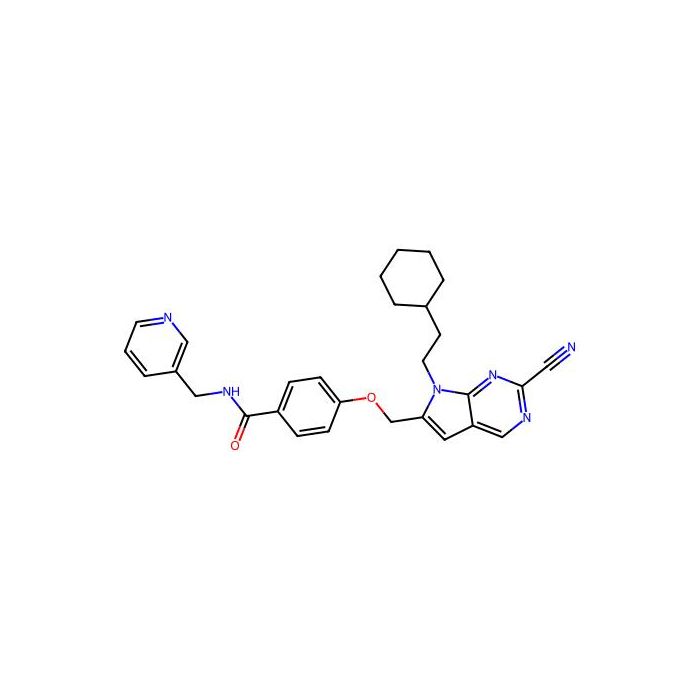
LB-60-OF61 is a NAMPT inhibitor and is a cytotoxic compound with a selectivity towards MYC overexpressing cell lines
In Vitro
LB-60-OF61 is potent against HCT116 cells with an IC 50 around 30 nM as measured in a 384 well format. MCE has not independently confirmed the accuracy of these methods. They are for reference only.
Form:Solid
IC50& Target:NAMPT
Specifications
Specifications & Purity
≥99%
Biochemical and Physiological Mechanisms
LB-60-OF61 is a NAMPT inhibitor and is a cytotoxic compound with a selectivity towards MYC overexpressing cell lines.
Storage
Store at -20°C
Shipped In
Ice chest + Ice pads
This product requires cold chain shipping. Ground and other economy services are not available.
Determine the necessary mass, volume, or concentration for preparing a solution.
Dilution Calculator
Determine the dilution needed to prepare a stock solution.
Reconstitution Calculator
Reviews
Customer Reviews
Application Protocols
Validated application data are not provided for this listing.
General guidance for use in in vitro assays (non-item-specific):
Prepare a fresh master stock in anhydrous DMSO (e.g., 10–20 mM) once solubility is confirmed; filter through a low-binding 0.22 µm membrane if particulate is present and the compound is not adsorbed by the membrane.
Serial dilution: Use DMSO or assay buffer with matched vehicle to prepare a concentration range (e.g., 8–12 points, 3-fold dilutions). Keep final DMSO ≤0.5–1% v/v unless your assay tolerates more.
Controls: Include a vehicle control and, where appropriate, a positive control compound to benchmark assay performance (Z’ factor, S/B).
Interference checks: Assess compound fluorescence/absorbance overlap with assay readouts and consider detergent to mitigate aggregation artifacts.
All steps should be adjusted once the item’s structure and properties are verified, and any specifics not listed here remain “Not specified for this item; refer to CoA/Spec Sheet.”
Biological Roles
No biological function, target, or pathway information is provided for this specific item. As a library compound, it is intended for research screening and method development only.
Item-specific biological roles: Not specified for this item; refer to CoA/Spec Sheet or internal screening data.
General note: Library members may or may not engage known biological targets. Any observed activity in your assays should be validated with counterscreens and orthogonal modalities to rule out assay artifacts (fluorescence interference, redox cycling, aggregation, covalent reactivity).
Research use limitation: For research use only. Not for diagnostic or therapeutic applications.
Buffer Applications
This product is not a buffering agent or solution component with an established pKa range. Specific buffer recipes and capacities are therefore not applicable.
If used in biochemical assays, prepare assay buffers according to the biology under study (e.g., HEPES pH 7.0–7.5, phosphate pH 7.2–7.6, Tris pH 7.5–8.0), and introduce the compound from a DMSO stock to maintain consistent vehicle concentration across wells.
Verify the compound’s stability in the chosen buffer (hydrolytic sensitivity, oxidation) once the structure is confirmed.
Green Alternatives
This item is sold as a discrete screening compound, not a process solvent or bulk reagent for which greener substitutions are typically discussed. Therefore, a direct “green alternative” does not apply in the conventional sense.
General sustainability guidance for handling small-molecule libraries:
Prefer DMSO–water systems over higher-toxicity amide solvents (DMF/NMP) when feasible, and limit DMSO to the minimal assay-compatible percentage (commonly ≤0.5–1% v/v).
Use microscale formats (low-dead-volume plates, acoustic dispensing) to minimize solvent use and chemical waste during screening.
Adopt closed-loop solvent management where possible: recover ACN/IPA used for plate washing/pipette tip rinses through validated distillation or vendor recycling programs.
Implement just-in-time dissolution to reduce wasted solution and to avoid repeated freeze–thaw of large-volume stocks.
Trade-offs (general):
Greener co-solvents (ethanol, isopropanol) may reduce solubility for hydrophobic chemotypes; verify with small test dissolutions and document any precipitation or assay interference.
Pharmaceutical Uses
No pharmacopeial status, excipient role, or formulation guidance is provided for this item, and it is not offered for clinical use.
Intended use: For research use only.
Regulatory status: Not specified for this item; refer to CoA/Spec Sheet.
If used in pre-formulation research (in vitro only), standard practices include preparing DMSO concentrates and diluting into simulated fluids or biorelevant media for physicochemical assessments (solubility, stability). Confirm compatibility and stability experimentally.
Physical Properties
Item-specific physicochemical specifications are not provided with this listing. Do not infer or substitute generic values.
Appearance: Not specified for this item; refer to CoA/Spec Sheet.
Molecular Weight: Not specified for this item; refer to CoA/Spec Sheet.
Melting point (MP): Not specified for this item; refer to CoA/Spec Sheet.
Boiling point (BP): Not specified for this item; refer to CoA/Spec Sheet.
Density: Not specified for this item; refer to CoA/Spec Sheet.
Solubility: Not specified for this item; refer to CoA/Spec Sheet.
LogP / cLogP: Not specified for this item; refer to CoA/Spec Sheet.
pKa: Not specified for this item; refer to CoA/Spec Sheet.
Refractive index / UV cutoff: Not specified for this item; refer to CoA/Spec Sheet.
General guidance (literature/computational; not item-specific):
For screening compounds, initial dissolution is commonly attempted in anhydrous DMSO to create 10–50 mM master stocks, then diluted into aqueous assay buffers with careful DMSO matching across wells.
If ionizable groups are present (to be confirmed from structure), aqueous solubility may be improved by adjusting pH within 1–2 units of the relevant pKa; avoid conditions that risk hydrolysis or epimerization of sensitive motifs (esters, lactams, acylals, sulfonyl fluorides, etc.).
Where possible, compute logS/logD from a verified SMILES prior to large-scale assay preparation, and confirm empirical solubility with a small test dissolution.
Quality and Grades
Grade and purity are not specified in the current listing and should be verified on the CoA/Spec Sheet for the specific lot supplied.
Grade/Purity: Not specified for this item; refer to CoA/Spec Sheet.
Stabilizers/Inhibitors: Not specified for this item; refer to CoA/Spec Sheet.
Guidance on interpretation (general):
For screening library compounds, typical documentation includes purity by HPLC/UPLC (e.g., UV or ELSD detection), characterization by 1H NMR and MS, and residual solvent/volatile content. Confirm acceptance criteria (e.g., ≥95% area by HPLC) that meet your assay’s requirements.
If the compound includes labile functionalities (e.g., aldehydes, acyl chlorides, sulfonyl fluorides), stabilizers or special packaging (amber vials, inert gas backfill) may be used; check the CoA for any such notes.
For bioassays or high-sensitivity screens, low levels of metal contaminants and peroxides may be important; these are not specified for this item and should be evaluated as needed for your application.
Batch-specific documentation:
Request the lot-specific CoA, spectra, and chromatograms to confirm identity and purity, along with water content (Karl Fischer) if relevant to your workflow. Any specification not listed here should be considered “Not specified for this item; refer to CoA/Spec Sheet.”
Reaction and Applications
This product is cataloged as a small-molecule library member rather than a general synthetic reagent. Without a confirmed structure, specific reactivity, named-reaction participation, or catalyst compatibility cannot be provided.
Research/application context (general for library compounds):
Screening and profiling: Employed in biochemical or biophysical assays to explore structure–activity relationships (SAR) and identify tool compounds. Ensure concentration ranges encompass solubility and assay sensitivity, controlling for vehicle effects.
Cheminformatics: Use the verified SMILES (once obtained) to compute descriptors (cLogP, TPSA, modular alerts) prior to screening triage.
Orthogonal confirmation: Positive signals in primary screens should be re-tested with orthogonal readouts to exclude assay interference (aggregation, redox cycling, fluorescence quenching). Consider detergent additives (e.g., 0.01–0.05% Triton X-100) where appropriate.
Not applicable for synthetic deployment:
In the absence of a structure and functional group assignment, it is not appropriate to propose it as a reagent, substrate, or ligand in synthetic transformations. Refer instead to the “Solvent Selection” and “Storage & Reconstitution” tabs for practical handling guidance.
Reaction Conditions
Not applicable. This item is supplied as a discrete screening compound, and no synthetic transformations involving this molecule are specified.
Typical solvents, temperatures, catalysts, or yields for reactions using this compound are not provided and should not be inferred.
If conducting stability studies (non-synthetic), evaluate the compound under relevant conditions (pH, temperature, light) after confirming its structure, and document any decomposition pathways observed by LC–MS/NMR.
Safety and Handling
Hazard classification for this specific item has not been provided; always consult the product’s SDS for authoritative information before use.
GHS Classification: Not specified for this item; refer to SDS.
Signal Word: Not specified for this item; refer to SDS.
Hazard (H) Statements: Not specified for this item; refer to SDS.
Pictograms: Not specified for this item; refer to SDS.
General laboratory precautions (best practice):
Handle in a chemical fume hood; avoid inhalation of dust/aerosols and skin/eye contact.
Wear appropriate PPE: lab coat, safety glasses, and chemical-resistant gloves (e.g., nitrile). For solids, consider double-gloving during weighing.
Avoid incompatible conditions until functional groups are known; generally segregate from strong oxidizers and acids/bases pending confirmation of stability.
If supplied as a dry solid, minimize exposure to ambient humidity; cap promptly after use. If supplied in solution (e.g., DMSO), keep containers tightly sealed to limit solvent absorption of water and to prevent evaporation.
First aid overview (consult SDS/medical professional):
Eye/skin contact: Rinse with water for at least 15 minutes; remove contaminated clothing.
Inhalation: Move to fresh air; seek medical attention if symptoms persist.
Ingestion: Rinse mouth; do not induce vomiting unless directed by medical personnel.
Spill/cleanup:
Avoid dust formation; collect with inert absorbent, seal for disposal per institutional and local regulations.
Solvent Selection
Item-specific solubility data are not provided. Selection should be guided by the verified structure and pilot dissolutions.
General strategy for small-molecule library members:
Primary stock solvent: Anhydrous DMSO is the default for diverse libraries due to broad solvating power and assay compatibility at 0.1–1% v/v.
Co-solvent options: DMF, NMP, ethanol, isopropanol, acetonitrile can assist initial dissolution. For hydrophobic compounds, consider a DMSO:toluene or DMSO:PEG-400 blend for preparing intermediate concentrates before final dilution.
Aqueous use: Dilute DMSO stocks into buffered saline or cell-based media slowly with vortexing/sonication to mitigate precipitation; match DMSO across controls.
pH leverage: If the compound has ionizable groups (to be confirmed), acidic compounds dissolve better near pH ≥ pKa+1; basic compounds near pH ≤ pKa−1. Avoid pH extremes that may induce hydrolysis.
Comparison (general, not item-specific):
DMSO: highest breadth of solubilization; may interfere with certain enzymes at >1%.
DMF/NMP: strong polar aprotic; higher toxicity and regulatory burden.
Ethanol/IPA: greener, but limited for very hydrophobic scaffolds.
Acetonitrile: volatile, good for HPLC compatibility; moderate solvency.
Always verify clarity post-dilution and re-check solubility after freeze–thaw if stocks are stored long-term.
Storage and Reconstitution
Item-specific storage is provided; other details should be confirmed on the CoA/SDS.
Storage Conditions (as provided): Store at −20°C.
Shipping Conditions (as provided): Shipped in ice chest with ice pads.
Container: Keep tightly closed; protect from moisture. Use amber vials if the compound is light-sensitive (item-specific sensitivity not specified).
Reconstitution (general guidance for library compounds; not item-specific):
Allow vial to equilibrate to room temperature in a desiccator before opening to avoid moisture condensation.
Prepare a small DMSO master stock after confirming solubility (e.g., 10 mM); if insoluble, trial co-solvents (DMF, NMP, ethanol) or gentle warming/sonication. Do not exceed temperatures that risk decomposition; stability unknown.
Aliquot stocks into single-use portions to avoid repeated freeze–thaw cycles. Store aliquots at −20°C in tightly sealed, inert-atmosphere vials if feasible.
Avoid prolonged exposure to air and humidity. Recheck clarity upon thaw and after dilution into buffers/media.
Unspecified parameters:
Appearance, purity, water content, and stabilizers: Not specified for this item; refer to CoA/Spec Sheet.
Shelf life and retest date: Not specified for this item; refer to CoA/Spec Sheet.
Structure and Identity
Brief overview: LB-60-OF61 is listed as a small-molecule library member offered for research screening. Item-specific structural identifiers are largely not provided in the current listing.
SKU: L648975
Product Name: LB-60-OF61
CAS: 794461-93-1
PubChem CID: 134692422
InChIKey: 98696 (as provided; note this is not a standard-length InChIKey)
SMILES: Not specified for this item; refer to CoA/Spec Sheet.
Molecular Formula: Not specified for this item; refer to CoA/Spec Sheet.
Molecular Weight: Not specified for this item; refer to CoA/Spec Sheet.
Structural features (general guidance):
Without a provided SMILES/InChI, specific functional groups, ring systems, and stereochemistry cannot be confirmed for this item.
For cheminformatics workflows, users typically fetch the canonical SMILES and full InChI from the referenced registry (e.g., by CAS or CID) to compute descriptors, predict ADME-relevant properties, and plan solubilization and assay conditions.
2D structure description (general):
Not specified for this item; refer to CoA/Spec Sheet. Once the SMILES is available, a 2D depiction can be generated to enumerate heterocycles, heteroatoms (O/N/S/halogens), and potential ionizable centers relevant to solubility and storage.
Synthetic Utility
Without structural information, this compound should not be considered a general-purpose reagent or building block in synthetic chemistry.
Functional group profile: Not specified for this item; refer to CoA/Spec Sheet.
Reactivity: Not specified for this item; refer to CoA/Spec Sheet.
General note:
If your project contemplates derivatization or scaffold hopping based on this item, first obtain and verify the structure (SMILES/InChI) and confirm availability of positions amenable to diversification (e.g., halogens for cross-coupling, carboxylates for amide formation). In the absence of such information, treat the compound as a final entity for screening rather than a starting material.
Target Specificity
No target, mechanism, or selectivity profile is provided for this item.
Target/Pathway: Not specified for this item; refer to internal screening data if available.
Off-target considerations: Without data, broad assertions cannot be made. Employ counterscreens and orthogonal assays to confirm specificity if biological activity is observed in your system.
Frequently Asked Questions
What is the purity of this product?
This product is supplied at ≥99% purity (chemical assay). Lot-specific values are stated on the Certificate of Analysis.
How should this product be stored?
Store at ?20 °C. Freezer storage is required to maintain the specified shelf life.
How is this product shipped?
This product ships in an insulated container with ice pads. Unpack on arrival and transfer it to the storage condition stated above.
What are the CAS number, molecular formula and molecular weight?
The CAS Number is 794461-93-1, the molecular formula is C29H30N6O2, and the molecular weight is 494.59 g/mol. InChIKey GCWGKOCPENDNLZ-UHFFFAOYSA-N.
What documentation is provided?
Available product documentation, including Certificates of Analysis (COA), Safety Data Sheets (SDS), and specification sheets, is shown in the product document area. Document availability and access follow the current site policy.
We use cookies to ensure the website functions properly and, where permitted, to improve your experience. You can manage your preferences at any time in Settings. Learn more in our Cookie Policy.
Shall we send you a message when we have discounts available?
Remind me later
Thank you! Please check your email inbox to confirm.
Products are supplied to verified businesses, institutions, and qualified professionals for research and development use only. Not for use in humans, animals, diagnosis, or therapy.