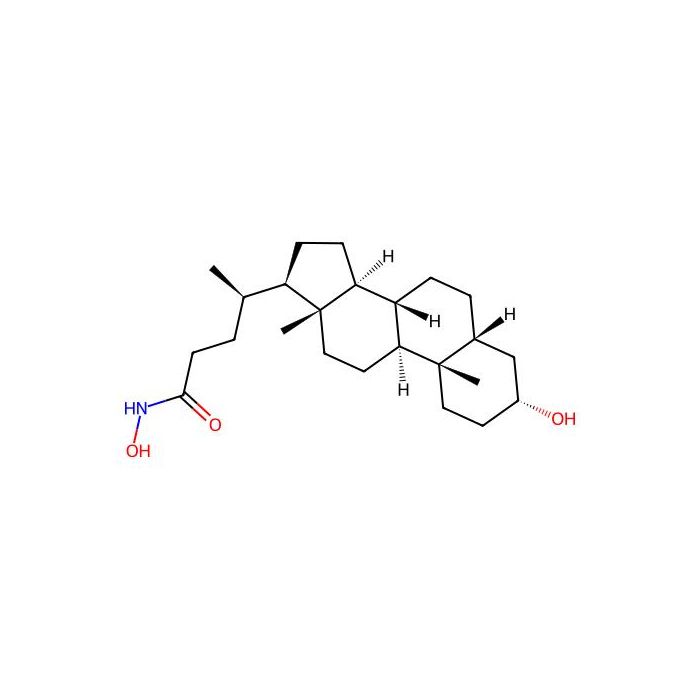
LCAHA (LCA hydroxyamide) is a deubiquitinase USP2a inhibitor with IC 50 s of 9.7 μM and 3.7μM in Ub-AMC Assay and Di-Ub Assay, respectively. LCAHA destabilizes Cyclin D1 and induces G0/G1 arrest by inhibiting deubiquitinase USP2a.
In Vitro
LCAHA inhibits HCT116 wt and HCT116 p53 -/- colon cancer cells viability with GI 50 s of 0.87±0.09 and 0.96±0.29μM, respectively, and the LD 50 s of 27.8±3.9 and 26.5±0.1μM, respectively. MCE has not independently confirmed the accuracy of these methods. They are for reference only. Cell Viability AssayCell Line: HCT116 wt and HCT116 p53 -/- colon cancer cells Concentration: 0.01, 0.1, 1, 10, and 100 μM Incubation Time: 6 days Result: The GI 50 s are 0.87±0.09 and 0.96±0.29 μM for HCT116 wt and HCT116 p53 -/- colon cancer cells, respectively.
Form:Solid
Specifications
Specifications & Purity
≥98%
Biochemical and Physiological Mechanisms
LCAHA (LCA hydroxyamide) is a deubiquitinase USP2a inhibitor with IC 50 s of 9.7 μM and 3.7μM in Ub-AMC Assay and Di-Ub Assay, respectively. LCAHA destabilizes Cyclin D1 and induces G0/G1 arrest by inhibiting deubiquitinase USP2a.
Storage
Store at -20°C
Shipped In
Ice chest + Ice pads
This product requires cold chain shipping. Ground and other economy services are not available.
Action Type
INHIBITOR
Purity
≥98%
Names and Identifiers
Molecular Weight
391.59
Advanced Data
Certificates (CoA,COO,BSE/TSE and Analysis Chart)
C of A & Other Certificates(BSE/TSE, COO):
Analytical Chart:
Chemical and Physical Properties
Solubility
DMSO : 45 mg/mL (114.92 mM; Need ultrasonic)
Solution Calculators
Molarity Calculator
Determine the necessary mass, volume, or concentration for preparing a solution.
Dilution Calculator
Determine the dilution needed to prepare a stock solution.
Reconstitution Calculator
Reviews
Customer Reviews
Application Protocols
While no item-specific tested applications are provided, the following general protocols support common uses of small-molecule library compounds.
A. Preparation of concentrated stock
Warm compound to room temperature in a desiccator. Weigh accurately (analytical balance, draft-shield closed). Dissolve to 10–50 mM in anhydrous DMSO. Vortex; sonicate ≤5 min if needed. Record exact concentration gravimetrically.
B. Serial dilution for assays
Prepare intermediate dilutions in DMSO (e.g., 10-point 3-fold series). Transfer to assay buffer to achieve final test concentrations with ≤0.5–1% DMSO. Mix thoroughly to avoid local supersaturation. Inspect for precipitation; if observed, increase dilution factor, add gentle surfactant, or adjust temperature.
C. Plate handling
Use low-binding, solvent-compatible plates (polypropylene for compound reservoirs). Minimize edge effects by equilibrating plates to assay temperature and using humidified incubators.
D. Stability checks
Short-term: monitor by LC–MS after 24–48 h in assay media. Long-term: store aliquots at −20°C; avoid repeated freeze–thaw.
E. Documentation
Record SKU (L649981), lot number, solvent, concentration, and dilution scheme. Attach CoA to your ELN entry.
Note: Tested applications (e.g., WB, IHC, IF, FC) are not applicable to small molecules and are Not specified for this item.
Biological Roles
Item-specific biological roles, targets, or pathway associations are not provided.
Mechanism/targets: Not specified for this item; refer to CoA/Spec Sheet or associated screening documentation.
General context for library compounds:
Library members are often designed to sample diverse chemotypes and property space (rule-of-five, lead-like) to increase the probability of modulating a range of protein classes (enzymes, GPCRs, ion channels, transporters).
Without a defined target for LCAHA, any functional role should be established empirically via biochemical or cellular assays, backed by orthogonal methods (e.g., CETSA/DSF for binding, CRISPR knockdowns for pathway validation).
Off-target profiling (broad receptor/enzyme panels) and counterscreens (cytotoxicity, redox interference, assay artifact tests) are recommended before drawing conclusions about biological activity.
Important: No medical or clinical claims are made. This material is supplied strictly for research use only.
Buffer Applications
This product is not a buffering agent. However, buffers are commonly used as vehicles for assay dilutions of small-molecule stocks.
Buffer role for this item: as a diluent for DMSO or ethanol stocks during in vitro assays.
Selection tips (general):
Use physiological buffers (e.g., PBS, HBSS, HEPES-buffered saline) for cell assays; maintain osmolarity and pH stability.
Keep final organic solvent ≤0.5–1% v/v to minimize assay interference; confirm tolerance for your system.
To mitigate precipitation: add compound stock to buffer slowly with mixing; consider 0.01–0.05% non-ionic surfactant or 0.1% BSA if assay-compatible.
For pH-sensitive chemotypes (acids/bases), adjusting pH near the ionized state can improve aqueous solubility; exact pKa for this item is Not specified for this item.
Formulation note: Always filter buffers (0.2 µm) and equilibrate to assay temperature before use to avoid temperature-induced precipitation.
Green Alternatives
Green chemistry substitution is generally discussed for solvents and reagent classes. For LCAHA, which is supplied as a discrete small-molecule library compound rather than a process solvent or auxiliary, the “greener alternative” concept is not typically applicable.
General considerations for greener practice when working with small molecules:
Use minimal DMSO volumes and favor aqueous assay conditions when solubility allows.
Choose ethanol or water-cosolvent systems in place of more hazardous solvents (DMF, DMAc, NMP) where compatible with the assay.
Consolidate screening plates and minimize single-use plastics; select low-binding, recyclable labware when feasible.
Optimize storage to reduce waste from degradation (aliquoting to avoid freeze–thaw cycles).
If you intend to employ this compound as a reagent in synthesis (uncommon for library items), a green-by-design assessment would first require confirmed identity and functional group analysis; in the absence of that, no specific greener substitute can be recommended for this item.
Pharmaceutical Uses
No pharmacopeial status, excipient role, or formulation use is provided for this item, and it is sold strictly for research use only.
Regulatory/compendial listing: Not specified for this item; refer to CoA/Spec Sheet. This product is not offered for GMP manufacturing or clinical applications.
Typical research context: screening/lead-finding, mechanistic studies, and tool-compound exploration in non-clinical settings.
If formulation experiments are conducted for research:
Characterize solubility and stability across pH 2–9 in simulated media; assess photostability and oxidative stability if chromophores/oxidation sites are suspected.
Consider enabling formulations (cyclodextrins, lipid carriers) only after confirming that vehicle components do not confound biological readouts.
Important: No therapeutic claims are made for LCAHA. Any preclinical formulation work should remain within research-use-only boundaries.
Physical Properties
Item-specific physicochemical data have not been provided.
Appearance: Not specified for this item; refer to CoA/Spec Sheet.
Melting point / boiling point: Not specified for this item; refer to CoA/Spec Sheet.
Density, refractive index: Not specified for this item; refer to CoA/Spec Sheet.
pKa, logP/logD, PSA: Not specified for this item; refer to CoA/Spec Sheet.
Solubility: Not specified for this item; refer to CoA/Spec Sheet.
General guidance for library compounds (literature/practice):
Solubility screening workflow: begin with dry DMSO (≥99.9%, water ≤0.05%) to prepare 10–50 mM stocks; if insoluble, test DMF, ethanol, or 1:1 DMSO:water cosolvent, then buffered aqueous media with surfactants (e.g., 0.01–0.05% Tween-80) as compatible with the assay.
Thermal behavior can be mapped by DSC/TGA to identify melting transitions and potential solvates; this helps in selecting formulation conditions for screening or storage.
Partitioning assessments (e.g., shake-flask logD7.4 or chromatographic hydrophobicity index) guide assay dilution strategies to avoid precipitation and adsorption losses.
Note: Do not treat any general values as specifications. For definitive numbers used in reports or regulatory filings, rely exclusively on the item’s CoA/Spec Sheet and SDS.
Quality and Grades
Item-specific grade and purity are not stated in the provided data.
Grade/purity: Not specified for this item; refer to CoA/Spec Sheet.
Context for small-molecule/compound library materials:
Typical QC package includes HPLC purity (often ≥95% for screening use), LC–MS/MS or HRMS for identity, and 1H NMR to confirm structure and assess major impurities/solvate content. Exact tests and limits vary; consult the CoA for this SKU (L649981).
Residual solvents, water (KF), and inorganic content may be reported when relevant; if such limits are critical for your workflow (e.g., biophysical assays), request the detailed QC sheet. If values are not on the CoA for this lot, they are Not specified for this item.
Stabilizers/salts: Library compounds may be provided as free bases/acids, salts, or solvates to enhance stability/handling. Salt form and counter-ion—if any—must be verified on the CoA and label to ensure correct molar dosing.
Suitability: Unless otherwise labeled, library compounds are intended for in vitro research, hit-finding, and mechanistic studies, not for GMP or clinical use.
Recommendation: Prior to critical screening runs, confirm purity and identity by in-house LC–MS using your assay mobile phase to detect matrix-specific coeluting impurities.
Reaction and Applications
This product is categorized as a small-molecule library compound and is typically used for research screening rather than as a bulk reagent or solvent in synthetic transformations.
Applications (general for library compounds):
Biochemical and biophysical assays: enzyme activity screens, thermal shift (DSF), SPR/BLI binding assessments, and fluorescence-based target engagement.
Cell-based phenotypic screens: pathway modulation studies, reporter assays, and high-content imaging, with attention to DMSO tolerance and cytotoxicity controls.
In silico and in vitro ADME profiling: permeability, metabolic stability (microsomes/S9), and plasma protein binding to support triage decisions.
Not typically applicable for this item without identity:
Named synthetic reactions, catalytic roles, or stoichiometric transformations cannot be advised because the functional groups and reactivity patterns are unknown for this specific compound.
Practical tips:
Prepare accurate DMSO stocks (10–50 mM), verify by UV or quantitative NMR if the extinction coefficient or an internal standard is available.
Perform precipitation checks after aqueous dilution (visual, nephelometry, or light scattering) and keep final DMSO ≤0.5–1% in biological assays.
Include vehicle controls and, where possible, a well-characterized positive control compound relevant to the assay.
Reaction Conditions
Not applicable. This product is not provided as a reagent for chemical synthesis, and no structural/functional information is available to propose reaction conditions.
General laboratory handling for assay preparation (as a practical alternative):
Dissolution: prepare 10–50 mM stock in anhydrous DMSO; vortex and sonicate briefly if required. Avoid heating unless stability is verified.
Dilution: add stock to pre-warmed assay buffer with vigorous mixing to the desired final concentration, maintaining ≤0.5–1% DMSO.
Controls: include vehicle-only controls and, where available, a known active comparator for the assay class.
Any synthetic reaction planning would first require confirmed structure and reactivity data from the CoA/SDS—otherwise, no evidence-based conditions can be recommended.
Safety and Handling
Hazard classification for this specific item has not been provided in the product data.
GHS classification: Not specified for this item; refer to SDS.
Signal word / pictograms: Not specified for this item; refer to SDS.
H-statements: Not specified for this item; refer to SDS.
General laboratory precautions for small-molecule library compounds:
PPE: lab coat, safety glasses, and appropriate chemically resistant gloves (e.g., nitrile). Work in a certified fume hood when handling powders/solutions.
Incompatibilities: Until structure is confirmed, avoid strong oxidizers/reductants, strong acids/bases, and ignition sources. Keep away from moisture if the substance is hygroscopic or hydrolytically labile (verify on CoA/SDS).
First aid (general): In case of skin/eye contact, rinse with water for ≥15 minutes; remove contaminated clothing. If inhaled, move to fresh air. If ingested, rinse mouth and seek medical attention. Always follow site-specific EHS procedures and SDS instructions.
Spill response: Avoid dust formation; absorb solutions with inert material. Collect in labeled waste per local regulations.
Peroxide formation/other special risks: Not assessed for this item; consult SDS.
Authoritative source: Always defer to the product’s SDS and institutional safety policies for final hazard and handling guidance.
Solvent Selection
Because structure and solubility parameters for LCAHA are not provided, begin with a conservative, assay-compatible dissolution strategy typical for screening compounds.
Recommended approach (general practice):
Primary stock solvent: use anhydrous DMSO to prepare 10–50 mM stocks. Filter (0.2 µm PTFE) if needed. Record final concentration gravimetrically for precision.
Alternative/co-solvents: DMF or ethanol for initial dissolution; then dilute into aqueous buffers (PBS, HBSS) keeping final organic content ≤0.5–1% v/v to minimize assay interference.
Solubility enhancers: small amounts of non-ionic surfactants (e.g., 0.01–0.05% Tween-80 or Pluronic F-127), cyclodextrins, or serum proteins (in cell assays) may improve apparent solubility; validate for assay compatibility.
Adsorption mitigation: use low-binding polypropylene plates/tubes; include 0.1% BSA when appropriate to reduce wall loss for hydrophobic entities.
Comparison (general considerations):
DMSO: highest solvency for diverse chemotypes; may affect biological assays at >0.5–1%.
Ethanol: good for moderately lipophilic compounds; higher cytotoxicity thresholds than DMSO in some cells but higher volatility.
Aqueous buffers: best for polar/ionizable compounds; risk of precipitation upon dilution from organic stock.
Note: Verify final solvent system empirically for your target assay. Item-specific solubility is Not specified for this item; refer to CoA/Spec Sheet.
Storage and Reconstitution
Item-specific storage conditions are provided; reconstitution guidance is general for small-molecule library compounds.
Storage (item-specific): Store at −20°C.
Shipping: Shipped in an ice chest with ice pads (cold chain maintained).
General best practices:
Keep container tightly closed in a dry, inert environment (desiccant recommended). If the compound is moisture- or light-sensitive (Not specified for this item), protect accordingly.
Upon receipt: allow to equilibrate to room temperature inside a desiccator before opening to prevent condensation.
Aliquoting: Immediately prepare single-use aliquots (solid or solution) to avoid repeated freeze–thaw cycles. For solutions, use anhydrous DMSO; label with SKU, lot, concentration, and date.
Reconstitution: For assay use, dissolve to 10–50 mM in dry DMSO. If aqueous use is required, dilute into buffer with vigorous mixing, keeping final organic solvent ≤0.5–1%.
Stability: Long-term stability, water content, and impurity limits are Not specified for this item; refer to CoA/Spec Sheet and confirm experimentally (e.g., periodic LC–MS purity checks).
Disposal: Follow institutional chemical waste procedures; do not discharge to drains. Research use only, not for human or animal use.
Structure and Identity
Brief overview: LCAHA (SKU: L649981) is listed under our small-molecule/compound library collection. Detailed structural identifiers are not provided in the product data.
Chemical name: Not specified for this item; refer to CoA/Spec Sheet.
CAS: 117094-40-3 (provided)
Synonyms: Not specified for this item; refer to CoA/Spec Sheet.
Molecular formula: Not specified for this item; refer to CoA/Spec Sheet.
Molecular weight: Not specified for this item; refer to CoA/Spec Sheet.
SMILES: Not specified for this item; refer to CoA/Spec Sheet.
InChI / InChIKey: Not specified for this item; refer to CoA/Spec Sheet.
Structural description (general):
Without SMILES or name, the exact functional groups, ring systems, and stereochemistry cannot be specified for this item.
For screening-library compounds such as this, typical structures range from heteroaromatic scaffolds to aliphatic/aryl hybrids with H-bond donors/acceptors tailored for lead-like space; confirm the exact features from the CoA.
Practical identity guidance:
Cross-reference the CAS (117094-40-3) with the Certificate of Analysis and internal catalog record to retrieve definitive identifiers (SMILES, formula, MW).
If needed for informatics or inventory systems, request the SDF/molfile from Aladdin Scientific technical support, citing SKU L649981.
Ensure any assay or analytical method (LC–MS, NMR) is parameterized only after confirming the exact structure from the product’s documentation.
Synthetic Utility
Due to the absence of a disclosed structure, functional groups, or reactivity profile, this item is not presented as a synthetic reagent and specific synthetic applications cannot be advised.
Functional-group guidance: Not specified for this item; refer to CoA/Spec Sheet.
Named reactions/cross-couplings: Not applicable without structural information.
General recommendations if used in method-development studies (uncommon for library items):
Confirm identity and purity by LC–MS and NMR prior to use.
If derivatization or immobilization is intended (e.g., for target pull-downs), obtain the exact structure to identify attachment vectors and avoid perturbing the pharmacophore.
For most users, LCAHA should be treated as a screening compound rather than a building block or reagent.
Target Specificity
Target information for LCAHA is not provided.
Primary target/pathway: Not specified for this item; refer to CoA/Spec Sheet or internal screening notes.
Species selectivity, isoform preference, or binding constants: Not specified for this item.
Guidance for users:
If target engagement is discovered in your assays, confirm with orthogonal techniques (e.g., biophysical binding, chemical proteomics) and evaluate selectivity across relevant family members.
Document exact lot number and solution conditions to ensure reproducibility of any observed specificity.
Frequently Asked Questions
What is the purity of this product?
This product is supplied at ≥98% purity (chemical assay). Lot-specific values are stated on the Certificate of Analysis.
How should this product be stored?
Store at ?20 °C. Freezer storage is required to maintain the specified shelf life.
How is this product shipped?
This product ships in an insulated container with ice pads. Unpack on arrival and transfer it to the storage condition stated above.
What are the CAS number, molecular formula and molecular weight?
The CAS Number is 117094-40-3, the molecular formula is C24H41NO3, and the molecular weight is 391.59 g/mol.
What documentation is provided?
Available product documentation, including Certificates of Analysis (COA), Safety Data Sheets (SDS), and specification sheets, is shown in the product document area. Document availability and access follow the current site policy.
We use cookies to ensure the website functions properly and, where permitted, to improve your experience. You can manage your preferences at any time in Settings. Learn more in our Cookie Policy.
Shall we send you a message when we have discounts available?
Remind me later
Thank you! Please check your email inbox to confirm.
Products are supplied to verified businesses, institutions, and qualified professionals for research and development use only. Not for use in humans, animals, diagnosis, or therapy.