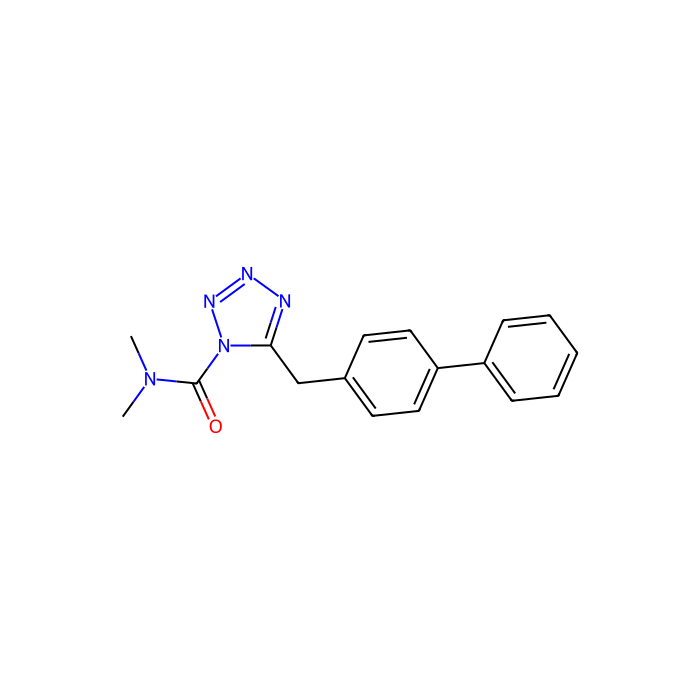
This compound belongs to the class of organic compounds known as biphenyls and derivatives. These are organic compounds containing to benzene rings linked together by a C-C bond.
External Descriptors
Not available
1. Djoumbou Feunang Y, Eisner R, Knox C, Chepelev L, Hastings J, Owen G, Fahy E, Steinbeck C, Subramanian S, Bolton E, Greiner R, and Wishart DS. ClassyFire: Automated Chemical Classification With A Comprehensive, Computable Taxonomy. Journal of Cheminformatics, 2016, 8:61.
Solvent:DMSO, Max Conc. mg/mL: 30.74, Max Conc. mM: 100; Solvent:ethanol, Max Conc. mg/mL: 15.37, Max Conc. mM: 50 with gentle warming
Molecular Weight
307.350 g/mol
XLogP3
3.000
Hydrogen Bond Donor Count
0
Hydrogen Bond Acceptor Count
4
Rotatable Bond Count
3
Exact Mass
307.143 Da
Monoisotopic Mass
307.143 Da
Topological Polar Surface Area
63.900 Ų
Heavy Atom Count
23
Formal Charge
0
Complexity
388.000
Isotope Atom Count
0
Defined Atom Stereocenter Count
0
Undefined Atom Stereocenter Count
0
Defined Bond Stereocenter Count
0
Undefined Bond Stereocenter Count
0
The total count of all stereochemical bonds
0
Covalently-Bonded Unit Count
1
Solution Calculators
Molarity Calculator
Determine the necessary mass, volume, or concentration for preparing a solution.
Dilution Calculator
Determine the dilution needed to prepare a stock solution.
Reconstitution Calculator
Reviews
Customer Reviews
Application Protocols
No tested application protocols are provided in the Product Data for this item.
General small-molecule handling protocols (not item-specific):
Stock preparation: Weigh the required amount quickly to minimize ambient moisture exposure. Prepare 10–50 mM DMSO stocks. Aliquot into low-bind tubes or 96-well plates to avoid repeated freeze–thaw.
Storage and use: Store aliquots at −20°C. Thaw on ice and keep protected from light if chromophoric functional groups are suspected. Discard aliquots showing precipitation or discoloration.
QC on receipt: Verify identity via LC-MS and, when feasible, 1H NMR. Record retention time and MS adducts to aid future analyses.
For assay-specific protocols (e.g., enzyme inhibition, cell-based phenotyping), develop conditions empirically and consult peer-reviewed literature only after confirming the structure and form of your specific lot.
Biological Roles
Specific biological targets, pathways, or roles are not provided in the Product Data for this item. To avoid speculation and ensure compliance with research-use-only labeling, no target-related claims are made here.
General considerations for small molecules in research (not item-specific):
Small molecules are commonly used to probe biochemical pathways, modulate enzyme activity, or serve as reference comparators in assay development. Any such use should be preceded by confirmation of identity/purity and accompanied by appropriate controls.
When literature indicates activity for a named compound, confirm that the structural identity and salt/formulation exactly match your lot before extrapolating conditions or potencies.
For cellular work, evaluate cytotoxicity and solvent tolerance independently of any putative pathway effect to deconvolute assay artifacts.
Compliance reminder:
For research use only. Not for human or veterinary use, diagnostic procedures, or clinical applications.
Buffer Applications
This product is a discrete small molecule rather than a buffering reagent. It is not typically used to establish or maintain solution pH.
Practical notes (general):
If preparing assay solutions, use established buffer systems (e.g., PBS, HEPES, Tris) appropriate to your biology/chemistry. Maintain organic cosolvent (e.g., DMSO) at the lowest level that prevents precipitation.
Verify compound stability across the working pH range by LC-UV/MS, as hydrolysis or ionization can affect solubility and assay readouts.
For buffer recipes, refer to standard laboratory references; no buffer-specific parameters apply to this item.
Green Alternatives
For this product—listed as a discrete research-use small molecule—“green alternatives” typically refer to greener handling solvents and workflows rather than a different active compound.
Greener handling considerations (general):
Prefer aqueous-buffered systems with minimal DMSO where assay tolerance permits (e.g., ≤0.5% v/v DMSO).
When organic cosolvents are required, consider ethanol or isopropanol in place of DMF/NMP if compatible with your assay, acknowledging their lower solvating power for very hydrophobic compounds.
For analytical sample prep, acetonitrile often offers a favorable EHS profile over chlorinated solvents and can be readily removed by evaporation.
Trade-offs:
Lower-toxicity solvents (EtOH, IPA) may not fully dissolve lipophilic solids, necessitating higher percentages or reversion to DMSO/DMF.
Avoid chlorinated solvents for routine handling unless required for specific chromatographic or stability reasons.
Example comparison (general solvent perspective):
DMSO: high solvency; moderate EHS; broad assay compatibility at low %.
Ethanol/IPA: greener profile; may require higher volumes; potential enzyme interference at elevated %.
DMF/NMP: powerful but less preferred from EHS standpoint; reserve for cases where other solvents fail.
Note: Since the compound’s structure is undisclosed here, a compound-for-compound “green substitute” cannot be recommended.
Pharmaceutical Uses
No pharmacopeial grade, excipient role, or formulation designation is provided in the Product Data. This product is supplied strictly for research use only.
General guidance (not item-specific):
If the compound will be used in pre-formulation research, document polymorph/solvate state, residual solvents, water content (KF), and stability in intended vehicles. These data are not specified here and must be determined experimentally or obtained from the CoA.
For in vivo exploratory studies (preclinical research only), ensure the vehicle composition is justified for the compound’s solubility and stability, and that dosing solutions are freshly prepared and filtered where appropriate. Observe institutional and regulatory requirements.
Regulatory note:
Not for human use. No claims are made regarding therapeutic utility, safety, or efficacy. No pharmacopeial monograph is cited for this item.
Physical Properties
Item-specific physicochemical constants are not provided in the Product Data for this SKU. For experimental planning, please refer to the CoA/Spec Sheet or request a technical data package.
Appearance: Not specified for this item; refer to CoA/Spec Sheet.
Melting point: Not specified for this item; refer to CoA/Spec Sheet.
Boiling point: Not specified for this item; refer to CoA/Spec Sheet.
Density: Not specified for this item; refer to CoA/Spec Sheet.
Solubility: Not specified for this item; refer to CoA/Spec Sheet.
logP/logD: Not specified for this item; refer to CoA/Spec Sheet.
pKa: Not specified for this item; refer to CoA/Spec Sheet.
Refractive index: Not applicable to solids; if liquid, not specified for this item; refer to CoA/Spec Sheet.
General laboratory guidance (not item-specific):
For small-molecule library members, initial dissolution is commonly performed in anhydrous DMSO (e.g., 10–50 mM stock), followed by aqueous dilution with solvent systems that prevent precipitation (e.g., ≤1–2% DMSO final).
If the compound is crystalline, a sharp melting point determined under dry nitrogen provides a quick check of identity/purity. If amorphous, DSC/TGA may be more informative.
If spectroscopic cutoffs are needed for analytical method development (e.g., LC-UV), request UV/Vis data from the CoA to avoid detector saturation and optimize wavelength selection.
Note: Where specific numerical values are required for regulatory documentation or method validation, only use the values from the lot-specific CoA/SDS.
Quality and Grades
Grade/Purity: Not specified for this item; refer to CoA/Spec Sheet.
Interpretation and implications:
In the absence of a stated grade (e.g., “≥98% (HPLC)” or “Screening grade”), end-users should consult the CoA for the exact purity assay, analytical method (HPLC/UPLC, GC), and reference standard used.
For screening collections, suppliers often target high chemical purity, but residual solvent content, water (KF), and counter-ion/stoichiometry (if a salt) may vary by lot. Verify these on the CoA when sensitive assays (e.g., biophysics, cellular phenotypic screens) are planned.
If UV transparency or LC-MS compatibility is critical, request chromatograms and mass spectra for the specific lot to confirm single-component profiles and adduct behavior.
Stabilizers/Inhibitors: Not specified for this item; refer to CoA/Spec Sheet. If present, stabilizers can affect bioassays or polymerization tests; plan appropriate blank controls.
Recommended verifications (general best practice):
Identity: 1H NMR and LC-HRMS against supplier spectra. If no reference spectra are provided, collect your own and retain for audit trail.
Purity: Orthogonal methods (HPLC-UV at multiple wavelengths, ELSD, and MS detection) to confirm absence of non-chromophoric impurities.
Reaction and Applications
This catalog entry is a research-use small molecule intended primarily as a screening/chemical biology tool or reference standard. It is not typically deployed as a reagent or catalyst in synthetic transformations.
As a characterized small molecule for in vitro assay development, HTS follow-up, or analytical spike/recovery experiments, provided that identity and purity are confirmed by the lot-specific CoA.
As a reference for developing LC-MS/MS quantification methods in complex matrices (e.g., establishing retention time, ionization behavior), after obtaining or confirming the exact structure.
Not typically applicable:
Named reaction chemistry or stoichiometric use in synthesis is generally not relevant unless the structure supports such transformations (not disclosed here). If your use case requires derivatization or immobilization, request the structural file to assess reactive handles.
Practical tips:
Verify stability in your intended solvent and at your working temperature. Perform a short-term stability study (e.g., 0, 4, 24, 48 h) by LC-MS to monitor degradation or adsorption losses.
For plate-based work, pre-wet plasticware with dilute DMSO to minimize nonspecific binding of hydrophobic molecules.
All uses are strictly for research and laboratory purposes only, as indicated by the Product Data.
Reaction Conditions
Not applicable in the typical sense: this item is supplied as a discrete research-use small molecule rather than a reagent or catalyst.
General laboratory handling conditions (not item-specific):
Solution preparation: Dissolve in anhydrous DMSO to 10–50 mM; vortex and, if needed, sonicate briefly. Filter through a 0.22 µm PTFE membrane for particulate removal if purity allows and adsorption is minimal.
Assay dilution: Add DMSO stock to buffered media to a final solvent content typically ≤1–2% v/v, monitoring for precipitation.
Stability checks: Assess at relevant temperatures (on ice, room temp, 37°C) over 24–48 h by LC-MS/UPLC to detect degradation.
Where actual synthetic reaction conditions are required (e.g., for conjugation or immobilization), obtain the structural details from the CoA/technical file to identify feasible chemistries.
Safety and Handling
Safety information in the Product Data is incomplete for this item. Always consult the SDS provided with your shipment for definitive guidance.
GHS classification: Not specified for this item; refer to SDS.
Signal word and H-statements: Not specified for this item; refer to SDS.
Pictograms: Not specified for this item; refer to SDS.
General PPE: Laboratory coat, safety glasses or splash goggles, and appropriate chemically resistant gloves (e.g., nitrile). Handle in a fume hood to control exposure to dusts/vapors.
Storage conditions: Store at −20°C (as provided in Product Data). Keep tightly closed in the original container. Allow cold shipments to equilibrate in a desiccator before opening to minimize condensation.
Incompatibilities: Without a disclosed structure, treat as a general organic compound. Avoid strong oxidizers, strong acids/bases, and ignition sources. Segregate from reactive reagents until compatibility is confirmed.
Special risks (general):
Avoid aerosol generation; weigh solid compounds in a ventilated balance enclosure.
If hygroscopic or air-sensitive behavior is suspected, handle under dry inert gas and reseal with desiccant.
First-aid overview (general): If inhaled, move to fresh air; if on skin, wash with soap and water; if in eyes, rinse cautiously with water for several minutes; if ingested, rinse mouth and seek medical attention. Provide SDS to responders.
Note: For risk assessments (COSHH/IBC), use the lot-specific SDS and any available toxicology data from the supplier.
Solvent Selection
Without a disclosed structure, solvent choice should follow pragmatic screening-compound handling practices aimed at achieving complete dissolution and maintaining stability.
Primary stock solvent (general best practice):
Anhydrous DMSO is preferred for initial 10–50 mM stocks due to broad solvating power and assay compatibility at ≤1–2% v/v in final wells.
Secondary solvents/co-solvents:
DMF or NMP can be used if DMSO solubility is insufficient, with caution regarding cell-based assay tolerance.
For preparative work, consider MeCN, MeOH, EtOH, or IPA based on polarity tests; confirm stability by LC-MS after dissolution.
Aqueous compatibility:
Use cosolvent systems (e.g., PBS or assay buffer with 0.5–2% DMSO) to prevent precipitation upon dilution.
Practical workflow:
Start with small-scale solubility checks (1–2 mg) across DMSO, MeCN, MeOH, and buffered aqueous mixtures, then select the minimal cosolvent needed for your assay.
Comparison guidance (general):
DMSO: highest solvency; widely accepted in HTS; may interfere with some enzymatic assays above 1–2%.
MeCN: volatile, LC-friendly; lower solvency for highly lipophilic solids.
MeOH/EtOH: good for many mid-polar compounds; watch for assay interference in alcohol-sensitive systems.
Note: Document the final solvent composition in all assay records to ensure reproducibility.
Storage and Reconstitution
Storage conditions (item-specific):
Store at −20°C (from Product Data).
Shipped in an ice chest with ice pads to maintain a low temperature during transit (from Product Data). Inspect immediately upon receipt.
Reconstitution (general guidance, not item-specific):
Allow the container to equilibrate to room temperature in a desiccator before opening to prevent condensation.
Prepare concentrated stocks in anhydrous DMSO (e.g., 10–50 mM). Vortex and, if necessary, sonicate briefly to aid dissolution.
Optional: Sterile-filter solutions (0.22 µm PTFE) if required for cell-based work and if the compound is stable under brief filtration.
Aliquoting and freeze–thaw:
Dispense into single-use aliquots in low-bind vials or plates to avoid repeated freeze–thaw cycles.
Minimize headspace and flush with inert gas if the compound is known or suspected to be air/moisture sensitive.
Stability notes:
Appearance, water content, purity, and stabilizers are not specified for this item; refer to CoA/Spec Sheet.
If long-term storage in solution is required, validate stability by LC-UV/MS at the intended concentration and solvent composition.
Research use only: Not for human or veterinary use.
Structure and Identity
Brief overview: This entry refers to a cataloged small-molecule screening compound. The Product Data do not include a disclosed structure.
SKU: L127467
Product Name: LY2183240 (research-use small molecule)
CAS: 874902-19-9 (as provided)
PubChem CID: 11507802 (as provided)
InChIKey: 115643 (as provided; note: not in the typical 27-character InChIKey format)
SMILES: Not specified for this item; refer to CoA/Spec Sheet.
Molecular formula: Not specified for this item; refer to CoA/Spec Sheet.
Molecular weight: Not specified for this item; refer to CoA/Spec Sheet.
Structural features (general note):
The structure is not supplied in the Product Data. Without a verified structure (SMILES/InChI), a definitive description of functional groups, ring systems, or stereochemistry cannot be provided for this specific lot. Please consult the Certificate of Analysis (CoA) or reach out to Aladdin Scientific for the structure file (SDF/Mol) if required for computational or analytical work.
Data source labeling:
All identifiers listed above are taken from the Product Data field of this catalog page. Where an item-specific value is missing, we explicitly state: “Not specified for this item; refer to CoA/Spec Sheet.”
Synthetic Utility
This catalog entry represents a finished small molecule, not a general synthetic building block or reagent. In the absence of a disclosed structure, detailed discussion of functional-group reactivity or derivatization routes would be speculative and is therefore omitted.
How it may be used in a chemistry context (general):
As an analytical standard or spike-in control for developing or validating separation and detection methods (e.g., LC-MS), after obtaining the exact structural file and ionization behavior.
If analog synthesis is planned, request the structural information to enable retrosynthetic analysis, identification of potential diversification points, and SAR planning.
Non-applicable aspects:
Named reactions, protecting-group strategies, or coupling chemistries cannot be assigned without structural information. Treat the compound as a terminal entity unless you have documentation to support derivatization.
Target Specificity
Target, epitope, species reactivity, clone, and related immunochemical details are not applicable to this product class. No target information is provided in the Product Data for this small-molecule item.
Target/Pathway: Not specified for this item; refer to CoA/Spec Sheet.
Tested activities or binding data: Not specified for this item; refer to CoA/Spec Sheet.
Note: To maintain accuracy and compliance, we do not infer targets or activities without explicit item-specific documentation.
We use cookies to ensure the website functions properly and, where permitted, to improve your experience. You can manage your preferences at any time in Settings. Learn more in our Cookie Policy.
Shall we send you a message when we have discounts available?
Remind me later
Thank you! Please check your email inbox to confirm.
Products are supplied to verified businesses, institutions, and qualified professionals for research and development use only. Not for use in humans, animals, diagnosis, or therapy.

 C23081387