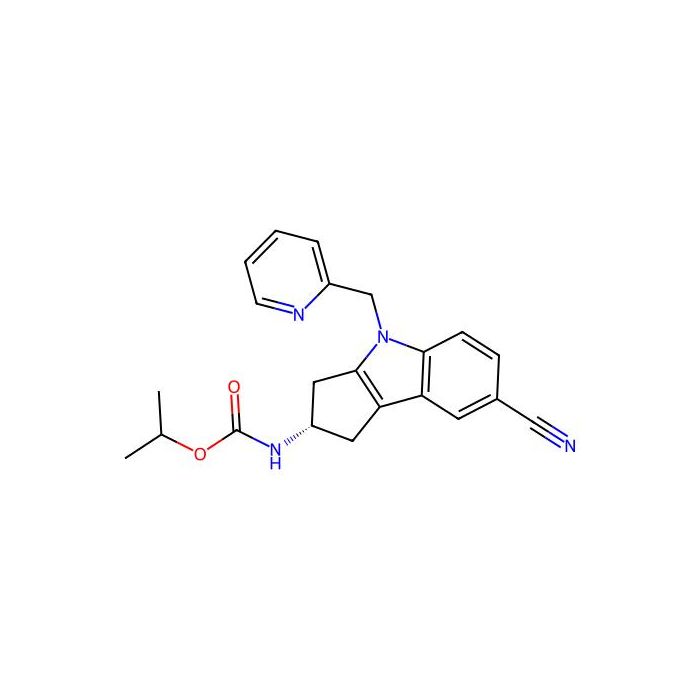
LY2452473 is an orally bioavailable, selective androgen receptor modulator (SARM).
In Vivo
LY2452473 is a selective androgen receptor modulator being developed for the treatment of disorders related to hypogonadism. LY2452473 is absorbed rapidly (time to reach maximum plasma concentration for both LY2452473 and total radioactivity is 2-3 h) and cleared slowly (plasma terminal t 1/2 of 27 h for LY2452473 and 51 h for the total radioactivity) . MCE has not independently confirmed the accuracy of these methods. They are for reference only.
IC50& Target:Androgen receptor
Specifications
Specifications & Purity
10mM in DMSO
Biochemical and Physiological Mechanisms
LY2452473 is an orally bioavailable, selective androgen receptor modulator (SARM).
Storage
Store at -80°C
Shipped In
Dry ice packs + Cold packs
This product requires cold chain shipping. Ground and other economy services are not available.
Determine the necessary mass, volume, or concentration for preparing a solution.
Dilution Calculator
Determine the dilution needed to prepare a stock solution.
Reconstitution Calculator
Reviews
Customer Reviews
Application Protocols
No tested application protocols are provided for this item.
General guidance for small-molecule assay use (not item-specific):
Prepare a sterile-filtered primary stock (commonly 10–50 mM in DMSO) and store as single-use aliquots at −80°C to avoid freeze–thaw cycling.
Determine dose–response across a wide range (e.g., 10-point 1:3 serial dilution) with appropriate vehicle controls.
Include orthogonal readouts to mitigate assay interference (e.g., fluorescence vs luminescence; biochemical vs cellular).
Confirm compound integrity over assay time by post-assay LC–MS of representative wells or recovery samples.
Biological Roles
The Product Data do not specify a molecular target, pathway, or biological role for LY2452473.
General considerations for LY-designated research compounds (not item-specific):
LY-series molecules are typically explored as modulators of protein targets (e.g., enzymes, GPCRs, transporters) during discovery campaigns. Actual target and mechanism must be confirmed from primary literature or CoA notes for this item, if available.
Prior to biological testing, establish compound identity and purity, then confirm assay interference liabilities (autofluorescence, redox activity, aggregation) using counterscreens.
Document physicochemical properties (pKa, logD, solubility) where available to inform cell permeability, non-specific binding, and formulation.
Research Use Only notice:
Supplied strictly for research use only. No clinical/diagnostic/food or household use. Biological activities, if any, should be validated independently under your laboratory conditions.
Buffer Applications
This item is a small molecule research compound rather than a buffering agent. As such, buffer formulation guidance is not typically applicable.
Practical note (general):
When dosing into biological assays, prepare concentrated organic stocks (commonly DMSO) and dilute into the assay buffer to a low final cosolvent percentage (often ≤0.1–1% v/v), verifying that the buffer composition maintains compound solubility and target activity.
If the compound possesses ionizable groups (unknown here), pH adjustment of the assay buffer near the relevant pKa can influence solubility and apparent potency; confirm experimentally.
Green Alternatives
Green chemistry considerations are most relevant to the choice of solvent system for preparing stocks, running assays, and performing any ancillary synthesis or purification.
Greener solvent choices (general guidance; not item-specific):
Prefer ethanol or isopropanol where feasible (safer, bio-based options) for handling and cleaning steps.
Consider propylene carbonate or Cyrene (dihydrolevoglucosenone) as higher-boiling, greener dipolar aprotic alternatives to DMF/NMP when compatible with the compound.
Use water-buffer systems whenever solubility and stability permit; optimize pH and ionic strength to reduce organic cosolvent demand.
Small comparison (general):
DMF/NMP: strong solvency, but reproductive toxicity concerns; disposal burdens.
DMSO: broad solvency and assay-friendly; moderate EHS profile; persistent odor.
Ethanol/iPrOH: greener, but limited maximum concentrations for hydrophobic molecules.
Operational practices:
Minimize organic solvent volumes, use microscale dosing (acoustic or positive-displacement), and implement closed-vial dilution schemes to limit exposure and waste.
Capture and segregate solvent waste; assess solvent recovery where appropriate.
Always confirm compound solubility and stability in greener media before large-scale adoption.
Pharmaceutical Uses
No pharmacopeial status, excipient role, or manufacturing use is provided for this product. LY2452473 is offered for research use only and is not intended for formulation development for human or veterinary use.
General information (not item-specific):
If used as a reference material in pharmaceutical analytical method development (e.g., LC–MS/MS), establish traceable characterization (purity by qNMR or certified reference methods) and define storage/handling controls to maintain integrity over study timelines.
For stability-indicating methods, stress samples under thermal, oxidative, and photolytic conditions to map potential degradants and ensure accurate quantitation.
Physical Properties
Item-specific physico-chemical data are not disclosed in the Product Data and should be confirmed from the CoA/SDS.
Appearance: Not specified for this item; refer to CoA/Spec Sheet.
Molecular Weight: Not specified for this item; refer to CoA/Spec Sheet.
Melting point / Boiling point: Not specified for this item; refer to CoA/Spec Sheet.
Density / Refractive index: Not specified for this item; refer to CoA/Spec Sheet.
pKa / logP / logD: Not specified for this item; refer to CoA/Spec Sheet.
Solubility: Not specified for this item; refer to CoA/Spec Sheet.
General guidance (literature/practice, not item-specific):
Drug-like screening compounds are commonly soluble in DMSO (10–40 mM stock); aqueous solubility varies with ionization state and functional groups.
If needed, perform a small solubility screen (DMSO, DMF, ethanol/MeOH, aqueous buffer with cosolvent or pH adjustment) and confirm by visual inspection and LC–UV.
When exact melting/boiling points are unknown, treat as a thermally sensitive organic solid and avoid prolonged heating or exposure to moisture/air until characterization is complete.
Quality and Grades
Item-specific grade and purity are not listed in the Product Data.
Grade/Purity: Not specified for this item; refer to CoA/Spec Sheet.
Context and expectations for screening compounds (general guidance):
Library/lead-like materials are typically supplied with chromatographic purity by HPLC/UPLC and identity verified by MS and/or NMR. Review the CoA for acceptance criteria (e.g., percent purity, residual solvents, water content) before use in biological screening.
If UV transparency or low background is required (e.g., for photoassays or LC–MS quantitation), request or determine UV spectra and MS cleanliness.
For quantitative assays, establish a reference standard by confirming purity (qNMR or external-standard HPLC) and document lot-to-lot comparability.
If stabilizers or salt forms are present, they will be listed on the CoA. None are specified here; therefore, assume none until verified.
This product is positioned as part of a small molecule and compound library for research use. No manufacturer-specified reaction applications are provided.
Research uses (general, not item-specific):
Screening/Profiling: Tool compound candidate for biochemical, cellular, or phenotypic screens. Suitable for generating concentration–response curves, target deconvolution workflows, or chemogenomic panels.
Analytical reference: Can serve as an LC–MS reference for method development, retention-time locking, and MS tuning if a standard is established.
Mechanistic studies: If the target is known from literature, LY-designated compounds are often used to interrogate enzyme/receptor pathways; verify the target before designing assays.
Practical tips:
Prepare a primary DMSO stock under dry, inert conditions if instability to moisture/oxygen is suspected; aliquot to minimize freeze–thaw cycles.
Document assay vehicle composition (final DMSO %, surfactant) and confirm that observed effects are not vehicle-driven.
For SAR or benchmarking, include positive/negative controls and confirm activity using orthogonal readouts.
Note: Specific synthetic reaction use (as a reagent or building block) is not indicated for this catalog entry.
Reaction Conditions
Specific reaction conditions are not applicable as the product is not supplied as a reagent and no transformation context is given.
If users plan to derivatize or label the compound (general guidance, not item-specific):
Establish the functional group map (NMR, IR, HRMS) and identify potential labile motifs (esters, anilides, benzylic positions) before selecting conditions.
For bioconjugation handles (if present), typical conditions include: copper-catalyzed azide–alkyne cycloaddition (CuAAC) at room temperature in mixed aqueous/organic media; or strain-promoted variants (SPAAC) in purely aqueous buffers.
For amide couplings, use mild coupling systems (HATU/HOAt or EDCI/HOBt alternatives) at 0–25°C in DMF/DCM with base (DIPEA) while monitoring by LC–MS.
Because the structure and functional groups are not specified for this item, all conditions must be empirically verified on a milligram scale before scale-up.
Safety and Handling
Safety classification for this specific item is not provided in the Product Data and must be taken from the SDS for your lot.
GHS Classification / Pictograms / H-Statements / Signal Word: Not specified for this item; refer to SDS.
General laboratory precautions (best practice for drug-like small molecules):
Handle in a chemical fume hood; avoid inhalation of dust or aerosols.
Wear appropriate PPE: lab coat, safety glasses, and nitrile gloves; double-glove when preparing concentrated DMSO stocks.
Avoid skin/eye contact; wash thoroughly after handling. Prevent environmental release; collect waste in appropriate organic waste streams.
First-aid overview (consult SDS for authoritative guidance):
Inhalation: Move to fresh air; seek medical attention if symptoms occur.
Skin/Eye contact: Rinse with water for ≥15 min; remove contaminated clothing; seek medical advice if irritation persists.
Ingestion: Rinse mouth; do not induce vomiting; obtain medical attention.
Storage incompatibilities and stability (general):
Store under the provided condition (−80°C). Keep container tightly closed, protected from light and moisture. Allow vials to equilibrate to room temperature before opening to minimize condensation.
Avoid strong oxidizers and extremes of pH unless stability has been verified for your application.
Solvent Selection
Item-specific solvent recommendations are not provided. For small, drug-like compounds, a rational solvent strategy improves handling and assay performance.
General guidance (not item-specific):
Start with DMSO for primary 10–50 mM stocks due to broad solubilizing power and compatibility with screening assays. Filter if needed (0.2 µm PTFE) to remove particulates.
If DMSO is unsuitable, consider DMF or NMP (higher solvency), or EtOH/MeOH for less polar structures. Use aqueous buffers with cosolvent (≤1–2% DMSO/EtOH) after preparing a concentrated organic stock.
For kinetic or biophysical assays, pre-test compound stability in the chosen vehicle (time-course LC–MS) to detect hydrolysis, oxidation, or adsorption.
Comparative considerations (general):
DMSO vs DMF: DMSO is more assay-compatible; DMF offers higher solvency but is less preferred biologically.
Alcohols: good volatility and ease of removal, but may limit maximum concentration.
Aqueous buffers: suitable only if the compound is sufficiently ionizable/hydrophilic; adjust pH near pKa to enhance solubility (if known).
Always confirm solubility and stability empirically for your lot and application.
Storage and Reconstitution
Follow the item-specific storage and shipping guidance to preserve compound integrity.
Storage Conditions (provided): Store at −80°C.
Shipped In (provided):Dry ice packs + Cold packs to maintain ultra-low temperature in transit.
Best practices (general, not item-specific):
Upon receipt, inspect packaging for temperature excursions; promptly transfer vials to −80°C.
Allow vials to equilibrate to room temperature before opening to prevent condensation ingress. Work quickly and under low-humidity conditions if the compound is hygroscopic.
For solution use, prepare a concentrated stock (commonly in dry DMSO) and aliquot into single-use portions. Avoid repeated freeze–thaw cycles; keep working solutions on ice and return unused aliquots to −80°C promptly.
Protect from light and moisture; use amber vials if photolability is suspected.
Document preparation details (solvent, concentration, date, lot) and verify stability periodically by LC–MS or HPLC.
Any additional item-specific instructions (appearance, exact solubility, stabilizers) are Not specified for this item; refer to CoA/Spec Sheet.
Structure and Identity
LY2452473 is supplied as a research-use small molecule entry in our small-molecule/compound library offering.
SMILES: Not specified for this item; refer to CoA/Spec Sheet.
InChIKey: Not specified for this item; refer to CoA/Spec Sheet.
Molecular Formula: Not specified for this item; refer to CoA/Spec Sheet.
Molecular Weight: Not specified for this item; refer to CoA/Spec Sheet.
Structural description (general):
LY-compounds are typically drug-like small molecules developed as research leads or tool compounds. Without a provided structure, specific features (aromaticity, heterocycles, stereocenters, H-bond donors/acceptors) cannot be detailed for this specific lot.
Identification and traceability:
Verify identity by CAS, CID, and supplier documentation (CoA, NMR, LC–MS).
For rigorous confirmation, orthogonal methods such as 1H/13C NMR, HRMS, and HPLC/UPLC purity profile are recommended prior to use in screening or mechanistic assays.
Synthetic Utility
No information indicates that LY2452473 is intended as a synthetic reagent or building block in preparative chemistry. It is supplied as a discrete small-molecule research compound.
If synthetic manipulation is planned (user-driven research):
First, confirm the structure (obtain SMILES/InChI from CoA or literature) and evaluate functional group compatibility for desired transformations.
Typical derivatizations for small-molecule probes may include salt formation (to modify solubility), prodrug masking of ionizable groups, or installation of reporter handles (e.g., alkyne/azide for click-chemistry, biotin) for target engagement studies.
Conduct small-scale scouting reactions to assess stability toward bases/acids, oxidants/reductants, and common coupling conditions before committing valuable material.
Given the absence of structural details in the Product Data, users should avoid assuming reactivity or compatibility without prior characterization.
Target Specificity
Target, mechanism of action, and selectivity profile are not specified in the Product Data for LY2452473.
No target annotations (enzyme, receptor, transporter, etc.) are provided.
Users should consult primary literature or in-house data if a biological target is presumed, and validate on-target activity using orthogonal assays and appropriate counter-screens (selectivity panels, off-target liabilities) before drawing conclusions.
Frequently Asked Questions
How should this product be stored?
Store at ?80 °C. Ultra-low temperature storage is required to maintain the specified shelf life.
How is this product shipped?
This product ships frozen with dry ice and cold packs. Unpack on arrival and transfer it to the storage condition stated above; handle dry ice with insulated gloves in a ventilated area.
What are the CAS number, molecular formula and molecular weight?
The CAS Number is 1029692-15-6, the molecular formula is C22H22N4O2, and the molecular weight is 374.44 g/mol.
What documentation is provided?
Available product documentation, including Certificates of Analysis (COA), Safety Data Sheets (SDS), and specification sheets, is shown in the product document area. Document availability and access follow the current site policy.
We use cookies to ensure the website functions properly and, where permitted, to improve your experience. You can manage your preferences at any time in Settings. Learn more in our Cookie Policy.
Shall we send you a message when we have discounts available?
Remind me later
Thank you! Please check your email inbox to confirm.
Products are supplied to verified businesses, institutions, and qualified professionals for research and development use only. Not for use in humans, animals, diagnosis, or therapy.