GRADE & PURITYMoligand™?Moligand™ — Aladdin's line of ligands and bioactive small molecules. Use for receptor, pathway, and binding studies needing defined small-molecule tools.10 mM in DMSO
Determine the necessary mass, volume, or concentration for preparing a solution.
Dilution Calculator
Determine the dilution needed to prepare a stock solution.
Reconstitution Calculator
Reviews
Customer Reviews
Application Protocols
Only tested/validated application details from the Product Data may be reported. None are provided for this item.
Tested applications (e.g., WB, IHC, IF, FC) and recommended dilutions: Not specified for this item; refer to CoA/Spec Sheet.
General guidance for small-molecule probe handling (literature/practice):
Prepare single-use DMSO aliquots (e.g., 10–50 mM), store at −80 °C, protected from light, under inert gas.
Thaw immediately before use; avoid repeated freeze–thaw.
Verify activity window with a short concentration–response curve in your specific assay system.
For detailed, assay-specific protocols (cell lines, buffers, readouts), consult primary literature employing LY83583 in comparable experimental contexts.
Biological Roles
Research context only (literature/general):
Pathway focus: nitric oxide (NO)–soluble guanylyl cyclase (sGC)–cGMP signaling. LY83583 is widely used as a tool compound to suppress cGMP formation, enabling dissection of upstream NO signaling and downstream cGMP-dependent protein kinase (PKG) effects in cells and tissues.
Primary experimental roles reported:
Inhibits sGC activity in biochemical and cellular assays, leading to reduced cGMP accumulation following NO donor stimulation.
Used to differentiate cGMP-mediated responses from cAMP or Ca2+-mediated pathways by pharmacological blockade.
Phenomenology in vitro:
Alters vascular smooth muscle signaling, platelet function readouts, and neuronal signaling markers in model systems by modulating cGMP availability (assay-dependent; research use only).
Selectivity considerations:
Quinone-type probes may exhibit redox-related off-target effects at higher concentrations; careful titration and orthogonal controls are recommended.
Experimental cautions:
Light sensitivity and potential redox cycling suggest preparing fresh, protected solutions and minimizing exposure to reducing agents that could impact activity.
No clinical or therapeutic claims are made. All roles above describe uses as a laboratory probe compound in controlled in vitro/ex vivo research.
Buffer Applications
This product is not a buffering agent. It does not define a pH range or buffering capacity. Practical notes for assay buffers involving LY83583 (general/literature):
Vehicle: DMSO stocks diluted into physiological buffers (e.g., HEPES- or phosphate-buffered saline) are common; keep final DMSO ≤0.1–0.2% v/v to preserve cell health.
Light protection: wrap tubes/plates in foil to limit photolysis.
Redox composition: minimize strong reducing agents (e.g., DTT) unless experimentally required, as quinone scaffolds may be affected.
For actual buffer recipes and pH control, use standard biological buffers appropriate to your assay; LY83583 is an additive, not a buffer.
Green Alternatives
Because LY83583 is a specific bioactive ligand rather than a commodity solvent or reagent, “green alternatives” focus on greener handling and formulation practices rather than substituting the active itself.
Greener handling strategies (general):
Formulation
Use minimal DMSO: prepare the most concentrated feasible stock and dilute to ≤0.1% v/v in assays to reduce solvent burdens.
Consider microvolume dispensing to minimize waste (acoustic or positive-displacement systems).
Solvent choices for any auxiliary operations
Prefer ethanol or water-miscible, lower-toxicity solvents for cleaning and intermediate dilutions when compatible with assays.
Storage and stability
Aliquot once to avoid repeated freeze–thaw, reducing degradation and waste of expired material.
Procurement and use-phase
Right-size vial quantities to match experimental scope, minimizing surplus inventory and disposal impact.
Comparison note (context):
Where the scientific question allows, alternative literature probe compounds targeting the same pathway (e.g., other sGC modulators) may have different hazard profiles; however, substituting LY83583 changes pharmacology and should be justified experimentally. Always evaluate EHS profiles and data suitability before switching probes.
Pharmaceutical Uses
This product is supplied strictly for research use only. It is not formulated or approved for human or veterinary use.
Role in formulations: none; not an excipient. No pharmacopeial monograph is indicated.
Discovery-stage context (general):
Used as a reference/positive-control or pathway tool compound in early discovery biology and pharmacology to interrogate NO–sGC–cGMP signaling.
Manufacturing/CMC notes: not applicable. No dosage form development information is provided or implied.
For any regulated application, a different grade and full GMP documentation would be required; this listing does not provide that.
Physical Properties
Item-specific specifications are not provided in the Product Data. Do not use the values below as item specifications; consult the CoA/SDS for authoritative information.
Appearance: Not specified for this item; refer to CoA/Spec Sheet.
Molecular weight (item-specific): Not specified for this item; refer to CoA/Spec Sheet.
Molecular formula (item-specific): Not specified for this item; refer to CoA/Spec Sheet.
Melting point, boiling point, density, refractive index, UV-cutoff, water/peroxide/metal limits: Not specified for this item; refer to CoA/Spec Sheet.
LY83583-like quinone-aromatic scaffolds are typically solids with high aromatic content and low volatility.
Solubility profile (literature/general): sparingly soluble in water; readily soluble in polar aprotic organic solvents such as DMSO and DMF; solubility in alcohols and chlorinated solvents varies with form and purity. For cell-based work, concentrated DMSO stocks (e.g., 10–50 mM) are commonly prepared and diluted into aqueous media to low micromolar final concentrations, keeping final DMSO ≤0.1–0.2% v/v.
LogP/cLogP (qualitative, literature): aromatic quinone–anilide motifs tend to be moderately lipophilic; expect substantial protein binding and membrane partitioning in biological systems.
Note: Actual numerical values for this specific lot may differ; verify with the CoA for experimental planning.
Quality and Grades
Grade/Purity (from Product Data): Moligand™.
What Moligand™ implies (general description):
A screening-/ligand-grade small molecule suitable for discovery chemistry, target engagement studies, probe development, and high-throughput/medium-throughput assays.
Emphasis on identity confirmation (e.g., NMR/HRMS/UPLC as applicable) and impurity control compatible with biological screening. Low moisture/oxygen exposure is supported by argon charging and low-temperature storage.
What is not specified for this item:
Numeric purity, residual solvent profile, water content, metals, UV cutoff, specific stabilizers: Not specified for this item; refer to CoA/Spec Sheet.
Practical implications for users:
For quantitative SAR, biophysics, or in vivo-relevant research, request the latest CoA and consider orthogonal QC (HPLC purity, HRMS) on receipt.
For chromatography-based readouts, verify UV background of the lot if needed (not provided here).
Maintain inert, light-protected handling to preserve assay-relevant integrity of quinone-containing scaffolds.
Reaction and Applications
This product is primarily a bioactive tool compound rather than a general-purpose synthetic reagent. Accordingly, its most relevant applications are in chemical biology and pharmacology experiments (research use only).
Used as a probe compound in cyclic nucleotide signaling studies; widely cited as an inhibitor affecting soluble guanylyl cyclase (sGC) activity and downstream cGMP-dependent pathways in cell and tissue models.
Employed to dissect NO–cGMP signaling, vascular smooth muscle responses, and kinase readouts (e.g., PKG substrates) under controlled in vitro conditions.
Experimental design tips:
Prepare fresh DMSO stock solutions and protect from light; minimize freeze–thaw cycles by aliquoting at first use.
Include appropriate controls: vehicle (DMSO), unrelated scaffold negative control, and—if relevant—orthogonal pathway modulators to confirm on-pathway effects.
Consider redox environment: quinone scaffolds can be sensitive to reducing agents (e.g., DTT, β-mercaptoethanol) that may alter apparent activity.
Data quality considerations:
Verify lot identity/purity by LC–MS prior to critical studies (especially quantitative SAR or chemoproteomics).
Assess potential assay interference (absorbance/fluorescence overlap) by recording UV–vis spectra of working concentrations in the chosen buffer.
Note: No medical or clinical use is intended or implied. Reported activities refer to in vitro or ex vivo research contexts (literature).
Reaction Conditions
This section is interpreted in the context of experimental use rather than chemical synthesis, since LY83583 is primarily a biological probe.
General assay-use conditions (literature/guidance; not item specifications):
Stock preparation: dissolve in anhydrous DMSO to 10–50 mM under low light; vortex/sonicate briefly if needed. Filter (0.22 μm PTFE) only if particulate persists.
Working concentrations: low micromolar to tens of micromolar in cells or biochemical assays (typical literature ranges). Always perform a concentration–response to identify the appropriate window and to check for off-target effects.
Temperature/time: incubations from minutes to hours at ambient temperature or 37 °C depending on assay kinetics.
Controls: include NO donors or sGC activators as positive controls where appropriate; vehicle (DMSO) negative controls are essential.
Light and redox: protect from light during incubations; avoid strong reducing agents that may chemically modify quinone motifs.
If using LY83583 in synthetic chemistry (uncommon), no standardized “reaction conditions” are recommended; consult primary literature specific to the intended transformation.
Safety and Handling
Authoritative safety information must be taken from the product SDS. The following are general considerations for quinone-containing, bioactive small molecules and the storage instructions provided in the Product Data.
GHS classification, signal word, H-statements, pictograms: Not specified for this item; refer to SDS.
Known hazards (literature/general): quinones can be irritants and may participate in redox cycling; avoid inhalation, ingestion, and skin/eye contact. Handle as a potentially harmful research chemical.
Storage conditions (from Product Data):
Store at −80 °C, protected from light.
Supplied argon charged; maintain an inert atmosphere to limit oxidative degradation.
PPE (general best practice): lab coat, safety glasses, and disposable nitrile gloves; use in a chemical fume hood or biosafety cabinet when preparing solutions or weighing powders.
Incompatibilities (general): strong reducing or oxidizing agents may impact quinone integrity; avoid prolonged exposure to bases/acids if not intended; protect from moisture and light.
First aid (overview; defer to SDS):
Skin/eye contact: rinse with water for ≥15 min; remove contaminated clothing; seek medical attention if irritation persists.
Inhalation: move to fresh air; seek medical attention if symptoms occur.
Ingestion: rinse mouth; do not induce vomiting; seek medical attention.
Waste disposal: collect solutions and contaminated disposables as halogen-free organic waste unless otherwise directed by local regulations; follow institutional hazardous waste protocols.
Solvent Selection
Applicability: LY83583 is a solid, bioactive small molecule used as a ligand/probe. Solvent selection focuses on preparing concentrated stock solutions and achieving compatible final assay media.
DMSO: preferred for high-concentration stocks (e.g., 10–50 mM) due to broad solubility and assay compatibility at ≤0.1–0.2% final v/v.
DMF: alternative for stocks if DMSO is unsuitable; verify cell compatibility.
Co-solvent strategies:
For aqueous assays, dilute DMSO stocks into buffer/media with vigorous mixing; add last to minimize local supersaturation.
For biophysical assays, include 0.01–0.05% nonionic surfactant (e.g., Pluronic F-127) only if aggregation is observed; validate controls.
Solvent polarity/miscibility (general): DMSO and DMF are fully miscible with water; ethanol or acetonitrile may aid in intermediate dilutions but assess assay tolerance.
When to avoid:
Avoid nonpolar solvents (hexanes, toluene) for aqueous biology; avoid neat strong bases/acids that can modify quinone functionality unless part of a deliberate reaction.
Comparison (general):
DMSO vs DMF: DMSO offers better biocompatibility and lower volatility; DMF may improve solubilization for some hydrophobic solids but is less favored in live-cell systems.
Storage and Reconstitution
Storage conditions (from Product Data):
Store at −80 °C.
Protect from light.
Argon charged; maintain an inert atmosphere after opening (e.g., re-flush headspace with argon or nitrogen before re-sealing).
Stability notes (general): quinone-containing aromatics can be sensitive to light and redox environment; minimize exposure to air, moisture, and elevated temperature. Track cumulative time at room temperature.
Reconstitution (general guidance for research use):
Solvent: dissolve in anhydrous DMSO to prepare a concentrated stock (e.g., 10–50 mM), mixing until fully dissolved. Alternative: anhydrous DMF if required by the assay.
Filtration: if particulates remain, a brief spin and transfer or 0.22 μm PTFE filtration can be used; avoid cellulose ester filters with strong organic solvents.
Aliquoting: dispense single-use volumes (e.g., 10–50 μL) into light-protected, inert-atmosphere vials or PCR tubes; flash-freeze and store at −80 °C.
Thawing: thaw immediately before use; avoid repeated freeze–thaw cycles.
Aqueous dilution: add DMSO stock to well-mixed buffer/media last, with vigorous pipetting to prevent local supersaturation; maintain final DMSO at minimal levels compatible with your system.
For lot-specific stability and retest dates, consult the CoA/Spec Sheet and SDS.
Structure and Identity
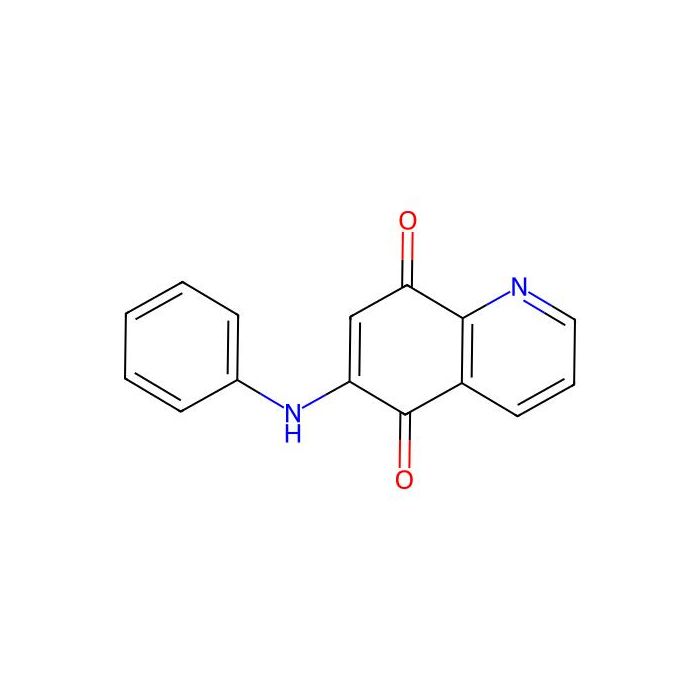
Brief overview: LY83583 is a well-known small-molecule research ligand used primarily as a pharmacological probe in cyclic nucleotide signaling research (literature). It is cataloged here as a Moligand-grade screening compound.
Item identifiers (from Product Data)
SKU: L1500472
Product Name: LY83583
CAS: 91300-60-6
PubChem CID: 3976
Structural identifiers
SMILES: Not specified for this item; refer to CoA/Spec Sheet.
InChIKey: Not specified for this item; refer to CoA/Spec Sheet.
Composition
Molecular formula: Not specified for this item; refer to CoA/Spec Sheet.
Molecular weight: Not specified for this item; refer to CoA/Spec Sheet.
Structural features (literature/general description)
LY83583 is commonly described in the literature as an anilino-substituted quinoline-5,8-dione (quinone) scaffold. The core is a fused bicyclic heteroaromatic (quinoline) bearing two carbonyl groups in a 1,4-quinone-like arrangement, with an anilino substituent on the ring.
Functional groups: aromatic heterocycle, conjugated diketone (quinone), anilide/arylamine linkage. No chiral centers typically reported.
2D structure description (literature)
A planar quinoline ring system with carbonyls at positions analogous to 5 and 8 (quinone), substituted by a para-phenyl anilino moiety; extended π-conjugation supports redox and stacking interactions.
Synthetic Utility
LY83583 is sold as a bioactive probe rather than a synthetic building block, so it is not commonly used as a reagent or intermediate. For completeness, the underlying scaffold’s reactivity is summarized in general terms (literature/general chemistry):
Functional groups: heteroaromatic quinoline fused system bearing a quinone (1,4-dicarbonyl) motif and an anilino substituent.
Reactivity characteristics:
Quinone carbonyls are conjugate-electrophilic and can participate in nucleophilic additions or redox processes (e.g., reduction to hydroquinone forms under strong reducing conditions).
The anilino linkage is typically robust but may engage in hydrogen bonding or, under forcing conditions, undergo substitution.
Extended π-system enables π–π stacking and potential charge-transfer interactions, pertinent to biophysical binding studies rather than synthesis.
Named reactions/context:
Quinone chemistry includes Michael-type additions and redox cycling; however, such transformations would alter the probe and are generally avoided in biological applications.
Bottom line: treat LY83583 as a finished tool compound; if derivatization is desired (e.g., for probes/handles), plan de novo synthesis or parallel scaffolds rather than modifying the purchased material.
Target Specificity
Only item-specific target data from the Product Data may be reported here.
Target/antigen name, epitope, species reactivity, clone/isotype: Not specified for this item; refer to CoA/Spec Sheet.
General literature context (not item-specific): LY83583 is widely used as a pharmacological tool impacting soluble guanylyl cyclase (sGC) signaling in research models, but no validated, item-specific target binding parameters are provided in this listing.
Need help choosing the grade?
Our grade selection guide covers purity, stabilizer status, and application suitability for all variants in our catalog.
We use cookies to ensure the website functions properly and, where permitted, to improve your experience. You can manage your preferences at any time in Settings. Learn more in our Cookie Policy.
Shall we send you a message when we have discounts available?
Remind me later
Thank you! Please check your email inbox to confirm.
Products are supplied to verified businesses, institutions, and qualified professionals for research and development use only. Not for use in humans, animals, diagnosis, or therapy.