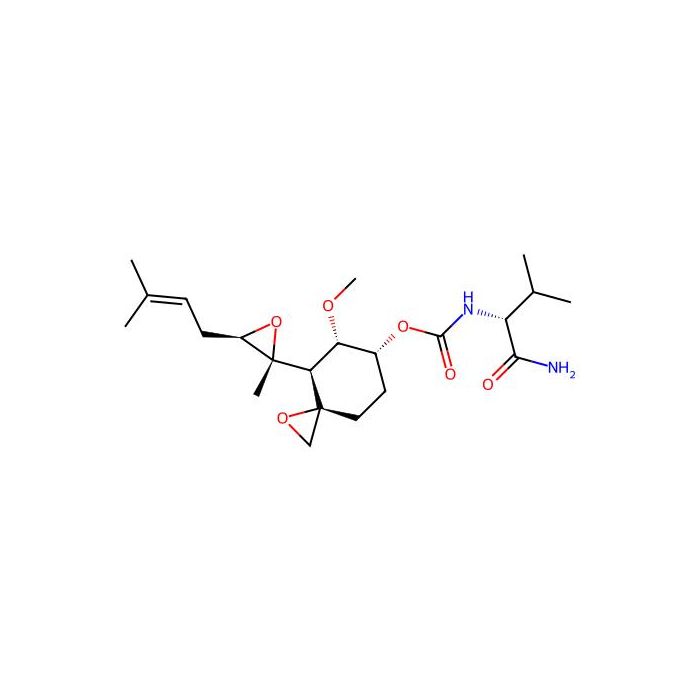
Metapro , CAS No.431077-35-9

CAS: 431077-35-9 Cat. No.: M668988 Formula: C22H36N2O6 Molecular Weight: 424.5 PubChem CID: 6918653
AVAILABLE TO ORDER
Synonyms
PPI-2458|Metapro|PPI 2458|Carbamic acid, ((1R)-1-(aminocarbonyl)-2-methylpropyl)-, (3R,4S,5S,6R)-5-methoxy-4-((2R,3R)-2-methyl-3-(3-methyl-2-butenyl)oxiranyl)-1-oxaspiro(2.5)oct-6-yl ester|(3R,4S,5S,6R)-5-methoxy-4-((2R,3R)-2-methyl-3-(3-methylbut-2-en-1-yl)oxiran-2-yl)-1-oxaspiro[2.5]octan-6-yl ((R)-1-amino-3-methyl-1-oxobutan-2-yl)carbamate|Carbamic acid, N-[(1R)-1-(aminocarbonyl)-2-methylpropyl]-, (3R,4S,5S,6R)-5-methoxy-4-[(2R,3R)-2-methyl-3-(3-methyl-2-buten-1-yl)-2-oxiranyl]-1-oxaspiro[2.5]oct-6-yl ester|[(3R,4S,5S,6R)-5-methoxy-4-[(2R,3R)-2-methyl-3-(3-methylbut-2-enyl)oxiran-2-yl]-1-oxaspiro[2.5]octan-6-yl] N-[(2R)-1-amino-3-methyl-1-oxobutan-2-yl]carbamate|2-{[Hydroxy({5-methoxy-4-[2-methyl-3-(3-methylbut-2-en-1-yl)oxiran-2-yl]-1-oxaspiro[2.5]octan-6-yl}oxy)methylidene]amino}-3-methylbutanimidic acid
Storage
Room temperature
★
Size
Germany (EU)
USA*
Price
Qty
1mg
M668988-1mg
Made to order · 8–12 wks

€496.26

€744.43
Save €248.17 (33.34%)
5mg
M668988-5mg
Made to order · 8–12 wks

€1,735.39

€2,603.13
Save €867.74 (33.33%)
Enter a quantity for the sizes you want to add.

Specifications

Synonyms
PPI-2458 | Metapro | PPI 2458 | Carbamic acid, ((1R)-1-(aminocarbonyl)-2-methylpropyl)-, (3R,4S,5S,6R)-5-methoxy-4-((2R,3R)-2-methyl-3-(3-methyl-2-butenyl)oxiranyl)-1-oxaspiro(2.5)oct-6-yl ester | (3R,4S,5S,6R)-5-methoxy-4-((2R,3R)-2-methyl-3-(3-methylbut-2-en-1-yl)oxiran-2-yl)-1-oxaspiro[2.5]octan-6-yl ((R)-1-amino-3-methyl-1-oxobutan-2- Show more
Storage
Room temperature
Action Type
INHIBITOR
Product Properties
alogp
2.4
Names and Identifiers
Canonical Smiles
CC(C)C(C(=O)N)NC(=O)OC1CCC2(CO2)C(C1OC)C3(C(O3)CC=C(C)C)C
IUPAC Name
[(3R,4S,5S,6R)-5-methoxy-4-[(2R,3R)-2-methyl-3-(3-methylbut-2-enyl)oxiran-2-yl]-1-oxaspiro[2.5]octan-6-yl] N-[(2R)-1-amino-3-methyl-1-oxobutan-2-yl]carbamate
InChIKey
QBDVVYNLLXGUGN-XGTBZJOHSA-N
INCHI
1S/C22H36N2O6/c1-12(2)7-8-15-21(5,30-15)18-17(27-6)14(9-10-22(18)11-28-22)29-20(26)24-16(13(3)4)19(23)25/h7,13-18H,8-11H2,1-6H3,(H2,23,25)(H,24,26)/t14-,15-,16-,17-,18-,21+,22+/m1/s1
Isomeric SMILES
CC(C)[C@H](C(=O)N)NC(=O)O[C@@H]1CC[C@]2(CO2)[C@H]([C@@H]1OC)[C@@]3([C@H](O3)CC=C(C)C)C
PubChem CID
6918653
Molecular Weight
424.5

Advanced Data

Taxonomic Classification

Taxonomy Tree

KingdomOrganic compounds
SuperclassOrganic acids and derivatives
ClassCarboxylic acids and derivatives
SubclassAmino acids, peptides, and analogues
Intermediate Tree Nodes Amino acids and derivatives - Alpha amino acids and derivatives
Direct ParentValine and derivatives
Alternative Parents Fatty amides  Carbamate esters  Primary carboxylic acid amides  Organic carbonic acids and derivatives  Oxacyclic compounds  Epoxides  Dialkyl ethers  Organopnictogen compounds  Organonitrogen compounds  Organic oxides  Hydrocarbon derivatives  Carbonyl compounds  
Molecular FrameworkAliphatic heteropolycyclic compounds
Substituents Valine or derivatives - Fatty amide - Fatty acyl - Carbamic acid ester - Carboxamide group - Carbonic acid derivative - Primary carboxylic acid amide - Dialkyl ether - Oxirane - Ether - Organoheterocyclic compound - Oxacycle - Organonitrogen compound - Organopnictogen compound - Organic oxygen compound - Organic nitrogen compound - Organooxygen compound - Organic oxide - Hydrocarbon derivative - Carbonyl group - Aliphatic heteropolycyclic compound
DescriptionThis compound belongs to the class of organic compounds known as valine and derivatives. These are compounds containing valine or a derivative thereof resulting from reaction of valine at the amino group or the carboxy group, or from the replacement of any hydrogen of glycine by a heteroatom.
External Descriptors Not available
3D Structure
Interactive Chemical Structure Model


Associated Targets(Human)
METAP2 Tchem Methionine aminopeptidase 2 (1 Activities)
Activity TypeActivity Value -log(M)Mechanism of ActionActivity ReferencePublications (PubMed IDs)
METAP2 Tchem Methionine aminopeptidase 2 (1512 Activities)
Activity TypeRelationActivity valueUnitsAction TypeJournalPubMed IddoiAssay Aladdin ID
CYP3A4 Tclin Cytochrome P450 3A4 (53859 Activities)
Activity TypeRelationActivity valueUnitsAction TypeJournalPubMed IddoiAssay Aladdin ID
Homo sapiens (32628 Activities)
Activity TypeRelationActivity valueUnitsAction TypeJournalPubMed IddoiAssay Aladdin ID
Liver (3974 Activities)
Activity TypeRelationActivity valueUnitsAction TypeJournalPubMed IddoiAssay Aladdin ID
Associated Targets(non-human)
Rattus norvegicus (775804 Activities)
Activity TypeRelationActivity valueUnitsAction TypeJournalPubMed IddoiAssay Aladdin ID
Mechanisms of Action
Certificates (CoA,COO,BSE/TSE and Analysis Chart)
C of A & Other Certificates(BSE/TSE, COO):
Analytical Chart:
Chemical and Physical Properties
Molecular Weight424.500 g/mol
XLogP32.400
Hydrogen Bond Donor Count2
Hydrogen Bond Acceptor Count6
Rotatable Bond Count9
Exact Mass424.257 Da
Monoisotopic Mass424.257 Da
Topological Polar Surface Area116.000 Ų
Heavy Atom Count30
Formal Charge0
Complexity706.000
Isotope Atom Count0
Defined Atom Stereocenter Count7
Undefined Atom Stereocenter Count0
Defined Bond Stereocenter Count0
Undefined Bond Stereocenter Count0
The total count of all stereochemical bonds0
Covalently-Bonded Unit Count1
Citations of This Product
Solution Calculators
Reviews

Customer Reviews

Application Protocols

No validated application protocols are provided for this SKU. This listing contains no assay formats or recommended dilutions.

General handling protocol for small-molecule library stocks (not item-specific)

  • Stock preparation: Dissolve in anhydrous DMSO to a convenient concentration (e.g., 10–50 mM) after confirming solubility; vortex and, if necessary, sonicate briefly. Filter through a 0.22 µm PTFE filter if particles persist and if compatible.
  • Aliquoting: Dispense single-use aliquots into low-binding tubes or 384/96-well plates to avoid repeated freeze–thaw and moisture uptake. Seal with solvent-resistant films.
  • Storage: Store aliquots at recommended conditions (see Storage & Reconstitution tab). Record preparation date, solvent, and concentration.
  • Assay dosing: Thaw at room temperature, mix thoroughly, and dilute into assay buffer to the required final concentration, keeping DMSO within assay-compatible limits.
  • QC check: Periodically assess stock integrity by LC–MS or HPLC to ensure no degradation or evaporation.

Please adapt the above to your assay and consult the CoA/SDS for any item-specific constraints.

Biological Roles

Item-specific biological information

  • No biological targets, pathways, or roles are provided for this item. It is supplied strictly for research use within screening or discovery workflows.

General considerations for small-molecule library members (not item-specific)

  • Potential roles: Depending on structure, small molecules may interact with enzymes, receptors, ion channels, or nucleic acids. Any observed activity must be validated for specificity, potency, and mechanism.
  • Liability assessment: Screen for pan-assay interference behaviors (PAINS), redox cycling, chelation, colloidal aggregation, autofluorescence, or reactivity with assay components. Apply orthogonal assays and counterscreens to deconvolute artifacts.
  • ADME profiling: For hits proceeding to follow-up, evaluate physicochemical descriptors (pKa, logP, solubility), stability (chemical and metabolic), and permeability (e.g., PAMPA or Caco-2) alongside microsomal clearance, all contingent on structural information.

Documentation and reproducibility

  • Record the exact lot/CoA and solvent composition for every biological test. Confirm integrity of DMSO stocks by periodic LC–MS.

Disclaimer

  • No clinical or therapeutic claims are made or implied. Any biological function of Metapro has not been specified in the Product Data and must be determined experimentally by the end user.
Buffer Applications

This product is a small molecule from a compound library and is not a buffering reagent. No pKa or buffering range data are provided for this item.

Guidance (general; not item-specific)

  • If the compound must be formulated into aqueous buffers for assays, select a compatible buffer system (e.g., PBS, HEPES, MES) based on the biological target and pH requirements. Keep DMSO or co-solvent content low to maintain buffer capacity and assay fidelity.
  • Where the compound is weakly basic or acidic and you intend to dose as a salt, determine pKa and prepare an appropriate counterion salt to enhance solubility and stability without compromising buffer chemistry.

For true buffering needs, use dedicated buffering agents with defined pKa values and validated purity grades rather than this item.

Green Alternatives

Sustainability considerations (general; not item-specific)

  • Stock solutions: Prefer water or buffered aqueous media when chemically feasible and compatible with the compound; otherwise, DMSO is often preferred over DMF/NMP for reduced worker exposure concerns and better biodegradability profile.
  • Process solvents: If scaling up any synthesis or modification involving this compound, consider greener ether/ester options such as 2-MeTHF and ethyl acetate over traditional THF/CH2Cl2 when reaction scope allows.

Illustrative comparison (general guidance)

  • DMSO: Broad solvency, low volatility; potential assay effects at higher v/v. Worker-friendly compared to DMF/NMP. Disposal as organic waste required.
  • Ethanol: Renewable feedstock, readily biodegradable; limited solvency for very nonpolar compounds and can perturb biological systems at modest percentages.
  • 2-MeTHF vs THF: 2-MeTHF is bio-based, less miscible with water (easier phase separation), forms peroxides more slowly; THF is fully miscible with water but has higher peroxide risk and petrochemical origin.

Operational tips

  • Minimize solvent volumes by preparing higher-concentration stocks within solubility limits.
  • Use microdosed additions and modular dilution schemes to reduce waste in screening campaigns.
  • Implement proper solvent recovery where feasible.

Always balance green metrics against data quality and compound integrity; confirm compatibility with Metapro by small-scale testing, as structure-specific constraints are not provided in this listing.

Pharmaceutical Uses

No pharmacopeial status, excipient role, or formulation guidance is provided for this item. It is supplied for research use only.

General R&D context (not item-specific)

  • Preformulation screening: If this compound is pursued as a tool compound or lead, early assessment may include salt/screening (various counterions), polymorph evaluation, hygroscopicity, and stability under ICH-like stress conditions (light, heat, humidity, oxidative).
  • Vehicle selection for in vivo research: Where ethically and legally permitted in preclinical settings, typical vehicles include PEG400, Captisol, or aqueous buffers with co-solvents/surfactants; all such uses require structure-specific compatibility and are outside the scope of this product listing.
  • Regulatory: Not intended for human or veterinary use. No claims of safety, efficacy, or GMP compliance are made.

For any formulation development or scale-up, obtain the complete structural and analytical profile (CoA/SDS) for the exact lot of Metapro (SKU: M668988) and conduct appropriate qualification tests.

Physical Properties

Item-specific properties

  • Appearance: Not specified for this item; refer to CoA/Spec Sheet.
  • Grade/Purity: Not specified for this item; refer to CoA/Spec Sheet.
  • Density: Not specified for this item; refer to CoA/Spec Sheet.
  • Melting point (MP): Not specified for this item; refer to CoA/Spec Sheet.
  • Boiling point (BP): Not specified for this item; refer to CoA/Spec Sheet.
  • Refractive index (nD): Not specified for this item; refer to CoA/Spec Sheet.
  • pKa/logP/solubility: Not specified for this item; refer to CoA/Spec Sheet.

General guidance (literature/practice; not item specifications)

  • Small-molecule screening compounds are often supplied as solids (powders) or neat oils; dissolution screening commonly starts with DMSO (50–100 mM stock), followed by aqueous dilution with co-solvent (e.g., 1–2% DMSO) as needed.
  • If the compound bears ionizable groups, solubility can often be improved by pH adjustment (acidic compounds in basic media; basic compounds in acidic media) or by using co-solvent mixtures (DMSO, DMF, ethanol, acetonitrile) depending on compatibility with the bioassay or process.
  • Hygroscopicity, polymorphism, and glass transition behavior can impact handling and measured properties; verify on the CoA before setting storage or processing conditions.

Important

  • Do not treat any numerical value as a product specification unless it appears on the CoA/Spec Sheet for SKU M668988. For definitive property data (including water content, residual solvents, or assay), consult the item’s certificate.
Quality and Grades

Item-specific grade and purity

  • Grade/purity: Not specified for this item; refer to CoA/Spec Sheet.
  • Stabilizers/inhibitors: Not specified for this item; refer to CoA/Spec Sheet.

Interpreting grades (general guidance; not item-specific)

  • Screening library grade: Emphasizes identity confirmation (e.g., ≥95% by HPLC/LC–MS) adequate for discovery biology and SAR. Low levels of UV-active impurities may be acceptable depending on use.
  • Analytical/AR grade: High chemical purity and low inorganic residues; suitable for most analytical work.
  • HPLC/LC–MS grade solvents/reagents: Ultra-low UV background and particulate content; chosen for trace analysis.

Quality control recommendations

  • Verify identity on receipt using LC–MS or 1H NMR if the compound is critical to your study. Reference the exact CAS (431077-35-9) and SKU M668988 on records.
  • If your application is sensitive to residual water, metals, or stabilizers, request lot-specific CoA details (e.g., assay, water, residual solvents, counterions, salt form, and stereochemical purity where applicable).
  • For structure-activity studies, maintain chain-of-custody and retain aliquots for reanalysis to correlate bioactivity with compound integrity over time.

Documentation

  • Always cite the Aladdin Scientific lot number and SKU in publications to ensure reproducibility. Where specifications are required by QA, attach the CoA to your method files and procurement documentation.
Reaction and Applications

Manufacturer application note

  • The product page lists no specific applications. This item is categorized under small molecules and compound libraries and is intended for research use only.

Typical research uses for library members (general guidance)

  • High-throughput and fragment screening: Evaluate biochemical or cell-based responses to identify preliminary hits. Maintain standardized stock concentration and solvent composition across plates to minimize artifacts.
  • Mechanistic probes: Use as a chemical tool candidate to interrogate pathways after confirming identity, purity, and stability. Profile off-target interference (e.g., fluorescence, redox cycling, PAINS motifs) before concluding activity.
  • Analytical standards: If appropriate and sufficiently pure, can serve as an internal or external standard in method development after qualification.

Practical tips

  • Solubility/aggregation: Confirm solubility at the working concentration in assay buffer. Use nephelometry or visual checks to avoid false negatives due to precipitation.
  • Plate handling: Use low-binding polypropylene plates/tubes to reduce adsorption. Pre-wet tips with DMSO stocks to improve transfer accuracy at microliter volumes.
  • Stability: Conduct short-term stability checks in the chosen solvent at ambient and assay temperatures (e.g., 24–72 h) by LC–MS to ensure consistent exposure.

Note: No synthetic or named-reaction applications are provided for this SKU; if you intend to use it as a reagent, request structural data and assess functional group compatibility first.

Reaction Conditions

No reaction conditions are specified for this product. Because the structure and functional groups are not provided, standardized conditions cannot be recommended for transformations involving this compound.

General experimental guidance (not item-specific)

  • Stability scouting: Before any reaction or long incubations, evaluate compound stability in common solvents (DMSO, MeOH, ACN, toluene) and at relevant temperatures (ambient to 60–80 °C) by LC–MS.
  • Atmosphere and moisture: If the CoA/SDS indicates air or moisture sensitivity, operate under inert gas (N2/Ar) with anhydrous solvents. Absent such data, default to standard dry techniques for sensitive chemistry.
  • Catalysis: If cross-coupling or functionalization is intended (structure-dependent), screen catalysts/ligands under milder conditions first and monitor for decomposition or ligand binding to the substrate.
  • Workup: Use quench conditions compatible with potential functionalities (avoid strong acid/base if unsure). Small-scale trials with analytical monitoring are crucial when structural data are incomplete.

Please obtain the structural details for Metapro (CAS 431077-35-9) to select appropriate conditions confidently.

Safety and Handling

Authoritative safety information is provided on the SDS. The present listing does not include GHS classifications for this SKU.

Item-specific safety data

  • GHS signal word: Not specified for this item; refer to SDS.
  • Hazard statements (H-codes): Not specified for this item; refer to SDS.
  • Precautionary statements (P-codes): Not specified for this item; refer to SDS.
  • Pictograms: Not specified for this item; refer to SDS.

General laboratory precautions (best practice; not item-specific)

  • Handle in a fume hood or well-ventilated area. Avoid inhalation of dust/fumes and contact with skin/eyes. Use standard PPE: lab coat, safety glasses, and appropriate chemical-resistant gloves (e.g., nitrile). Avoid ingestion; do not pipette by mouth.
  • Prevent cross-contamination: dedicate spatulas/caps, and close the container promptly after sampling. If the material is moisture- or air-sensitive per CoA/SDS, use inert-atmosphere techniques and anhydrous tools.
  • First aid (overview): In case of skin contact, wash with soap and water; eye contact, flush with water for 15 minutes and seek medical attention; inhalation, move to fresh air; ingestion, seek medical advice. Always follow SDS instructions.
  • Incompatibilities and reactivity: Unknown for this item. Until confirmed, avoid strong oxidizers/reductants, strong acids/bases, and reactive metals. Do not heat above recommended limits without evaluating thermal stability (e.g., by DSC/TGA if needed).

Waste and spills

  • Collect waste in a properly labeled container for organic hazardous waste unless otherwise directed by the SDS. For spills, absorb with inert material, avoid dust generation, and ventilate the area.
Solvent Selection

Without structure-specific data, initial dissolution screening should follow a tiered solvent strategy commonly used for small-molecule libraries (general guidance; not item specifications):

  • Primary stock vehicle: DMSO is typically the first-line solvent due to broad solvency and assay compatibility. Prepare concentrated stocks (e.g., 10–100 mM), then dilute into the assay buffer while keeping final DMSO ≤0.1–1% v/v as compatible.
  • Alternative organic solvents: DMF, NMP, ethanol, methanol, or acetonitrile can be used where DMSO is unsuitable, considering cytotoxicity or protein stability in bioassays.
  • Aqueous compatibility: If the compound is ionizable, adjust pH or use co-solvents and surfactants (e.g., 0.01–0.1% Tween 80) to aid dispersion while ensuring no assay interference.
  • Miscibility and polarity: Choose solvent polarity based on compound polarity. In the absence of logP data, begin with polar aprotics (DMSO/DMF) and step toward less polar media if precipitation occurs on aqueous dilution.

Comparison (general considerations)

  • DMSO vs ethanol: DMSO offers superior solvency but can impact some enzyme assays at >0.5–1% v/v; ethanol is more volatile and often limited to ≤0.1–0.5% v/v in cells.
  • Acetonitrile vs methanol: Both are LC-compatible; ACN has lower viscosity and higher elution strength, while MeOH is more protic and can influence ionization.

Always confirm final solvent choice with small-scale compatibility tests and consult the CoA/SDS for any solvent restrictions for this item.

Storage and Reconstitution

Item-specific storage data

  • Storage conditions (as supplied): Room temperature (per Product Data).
  • Shipped in: Not specified for this item; refer to CoA/Spec Sheet.
  • Appearance at receipt: Not specified for this item; refer to CoA/Spec Sheet.

General best practices (not item-specific)

  • Protect from excessive heat, moisture, and direct light unless the CoA/SDS indicates otherwise. Keep container tightly closed. For long-term retention samples, consider desiccated storage.
  • If preparing DMSO stocks: Store sealed aliquots at −20 °C to preserve integrity and limit water uptake; bring to room temperature before opening to prevent condensation. Avoid repeated freeze–thaw by using single-use aliquots.
  • Aqueous solutions: If aqueous stocks are prepared, store refrigerated (2–8 °C) or frozen per stability testing. Filter-sterilize if sterility is required for biological assays.

Reconstitution guidance

  • Solvent choice and concentration depend on solubility; DMSO is a common starting point. If insoluble, consider co-solvents (DMF, ethanol) or salt formation if ionizable.
  • Document solvent, concentration, and lot/aliquot IDs. Check clarity and absence of precipitate before use.

For definitive instructions (including any light/air sensitivity or stabilizers), consult the lot-specific CoA and SDS for SKU M668988. Research use only.

Structure and Identity

Brief overview: Metapro (SKU: M668988) is listed in our small-molecule/compound library category. The current item record does not include full structural identifiers.

Item-specific facts (from Product Data)

  • Product name: Metapro
  • CAS: 431077-35-9
  • PubChem CID: 6918653
  • InChIKey: Not specified for this item; refer to CoA/Spec Sheet. (Product Data field provided is not a valid InChIKey)
  • SMILES: Not specified for this item; refer to CoA/Spec Sheet.
  • Molecular formula: Not specified for this item; refer to CoA/Spec Sheet.
  • Molecular weight: Not specified for this item; refer to CoA/Spec Sheet.

Structural features

  • Functional groups, ring systems, stereochemistry: Not specified for this item; refer to CoA/Spec Sheet.

2D structure (verbal description)

  • A precise 2D description requires the structural formula (SMILES/InChI). As this is not provided in the listing, please consult the accompanying CoA/SDS or contact Aladdin Scientific for the definitive structural representation linked to CAS 431077-35-9 / CID 6918653.

Notes

  • Where multiple registry mappings exist in public databases, always prioritize the structure and identifiers given on the Aladdin CoA/SDS for this exact SKU to ensure traceability in regulated or data-critical workflows.
Synthetic Utility

Item-specific reactivity and functional group information are not provided for this product. Without a known structure, predictive synthetic roles cannot be assigned.

General guidance for using library compounds in synthesis (not item-specific)

  • If repurposing as a building block, first confirm the exact structure (including stereochemistry and salt form) via CoA and independent analysis (NMR, LC–MS, elemental analysis). Identify reactive handles (e.g., halides, boronates, amines, acids) to plan cross-couplings, amidations, or substitutions.
  • Protecting-group strategy: Evaluate whether latent functional groups or protecting groups are present that could complicate downstream chemistry under acidic/basic or redox conditions.
  • Compatibility: Test small-scale reactions to probe stability toward bases, nucleophiles/electrophiles, oxidants/reductants, or transition-metal catalysts.
  • Purification: Anticipate need for reverse-phase or normal-phase chromatography depending on polarity/logP; LC–MS-guided fraction collection is recommended when identity confirmation is critical.

If you require a specific functional group configuration for synthesis, please contact Aladdin Scientific for a structurally defined analog from our catalog with documented specifications.

Target Specificity

Not applicable. This product is not an antibody, protein, or nucleic-acid probe, and no biological target information is provided in the Product Data.

  • No antigen/epitope, species reactivity, clone, or isotype data apply.
  • If used as a putative chemical probe, any target specificity must be established experimentally (e.g., biochemical IC50/Ki, cellular target engagement, chemoproteomics), which is outside the scope of this listing.

Frequently Asked Questions

How should this product be stored?
Store at room temperature.
What are the CAS number, molecular formula and molecular weight?
The CAS Number is 431077-35-9, the molecular formula is C22H36N2O6, and the molecular weight is 424.5 g/mol. InChIKey QBDVVYNLLXGUGN-XGTBZJOHSA-N.
What documentation is provided?
Available product documentation, including Certificates of Analysis (COA), Safety Data Sheets (SDS), and specification sheets, is shown in the product document area. Document availability and access follow the current site policy.

Shall we send you a message when we have discounts available?

Remind me later

Thank you! Please check your email inbox to confirm.

Oops! Notifications are disabled.