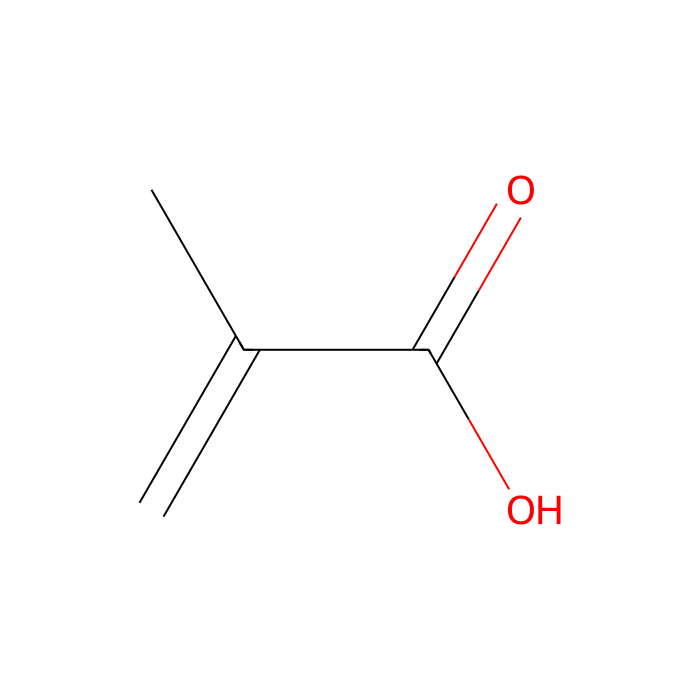
Methacrylic acid - for synthesis, stabilized with hydroquinone monomethyl ether , CAS No.79-41-4

CAS: 79-41-4 Cat. No.: M434201 Formula: C4H6O2 Molecular Weight: 86.09 Beilstein Registry Number: 1719937 EC Number: 201-204-4
AVAILABLE TO ORDER
GRADE & PURITY for Synthesis ? Synthesis grade — practical purity for chemical synthesis and preparative work. Use as a cost-effective reagent when analytical purity isn't required. stabilized with hydroquinone monomethyl ether
Synonyms
2-Methylpropensaeure|METHACRYLIC ACID [HSDB]|PROPENIONIC ACID, 2-METHYLENE|.alpha.-Methylacrylic acid|METHACRYLIC AC ID|Methacrylic acid, inhibited|UN 2531 (Salt/Mix)|Methacrylic acid (glacial)|Propionic acid, 2-methylene-|Methacrylic acid, inhibited [UN2531] [Corrosive]|Methyl acrylic acid|Methylacrylic acid|2-Propenoic acid, 2-methyl-|GE 110|2-Methacrylic Acid|METHACRYLIC ACID|Acido metacrilico [Spanish]|Acide methacrylique [French]|Methacrylsaeure|2-Methylenepropionic acid|2-methylprop-2-enoic acid|Kyselina methakrylova|METHACRYLIC ACID [MI]|2-Methylpropenoic acid|Propenoic acid, 2-methyl|Acide methacrylique|alpha-Methacrylic acid|METHACRYLIC ACID [WHO-DD]|Methacrylic acid glacial|Acrylic acid, 2-methyl-|alpha-Methylacrylic acid|METHACRYLIC ACID [INCI]|.alpha.-Methacrylic acid|2-Methylacrylic acid|2-Methyl-acrylic acid|Methacrylic acid, inhibited (Salt/Mix)|methacrylicacid|Methakrylsaeure|No Lift Nails Primer|Kyselina methakrylova [Czech]|Methacrylic acid (inhibited)|Acido metacrilico
Storage
Room temperature
Shipped In
FedEx DG Service
★
Size
Germany (EU)
USA*
Price
Qty
100ml
M434201-100ml
Made to order · 8–12 wks
€11.19
500ml
M434201-500ml
1 In stock
3 In stock
€22.47
Enter a quantity for the sizes you want to add.

Specifications

Synonyms
2-Methylpropensaeure | METHACRYLIC ACID [HSDB] | PROPENIONIC ACID, 2-METHYLENE | .alpha.-Methylacrylic acid | METHACRYLIC AC ID | Methacrylic acid, inhibited | UN 2531 (Salt/Mix) | Methacrylic acid (glacial) | Propionic acid, 2-methylene- | Methacrylic acid, inhibited [UN2531] [Corrosive] | Methyl acrylic acid | Methylacrylic acid | 2-Pr Show more
Specifications & Purity
for synthesis, stabilized with hydroquinone monomethyl ether
Storage
Room temperature
Shipped In
FedEx DG Service
Grade
for Synthesis
Names and Identifiers
Pubchem Sid
Pubchem Sid Url
https://pubchem.ncbi.nlm.nih.gov/substance/504750744
SMILES
CC(=C)C(=O)O
IUPAC Name
2-methylprop-2-enoic acid
InChIKey
CERQOIWHTDAKMF-UHFFFAOYSA-N
InChI
1S/C4H6O2/c1-3(2)4(5)6/h1H2,2H3,(H,5,6)
Isomeric SMILES
CC(=C)C(=O)O
WGK Germany
1
RTECS
OZ2975000
UN Number
2531
Packing Group
II
Molecular Weight
86.09
Beilstein
1719937
Reaxys
1719937
Reaxys-RN_link_address
https://www.reaxys.com/reaxys/secured/hopinto.do?context=S&query=IDE.XRN=1719937&ln=

Advanced Data

Taxonomic Classification

Taxonomy Tree

KingdomOrganic compounds
SuperclassOrganic acids and derivatives
ClassCarboxylic acids and derivatives
SubclassCarboxylic acids
Intermediate Tree Nodes Not available
Direct ParentCarboxylic acids
Alternative Parents Monocarboxylic acids and derivatives  Organic oxides  Hydrocarbon derivatives  Carbonyl compounds  
Molecular FrameworkAliphatic acyclic compounds
Substituents Monocarboxylic acid or derivatives - Carboxylic acid - Organic oxygen compound - Organic oxide - Hydrocarbon derivative - Organooxygen compound - Carbonyl group - Aliphatic acyclic compound
DescriptionThis compound belongs to the class of organic compounds known as carboxylic acids. These are compounds containing a carboxylic acid group with the formula -C(=O)OH.
External Descriptors alpha,beta-unsaturated monocarboxylic acid
3D Structure
Interactive Chemical Structure Model


Mechanisms of Action
Certificates (CoA,COO,BSE/TSE and Analysis Chart)
C of A & Other Certificates(BSE/TSE, COO):
Analytical Chart:

Find and download the COA for your product by matching the lot number on the packaging.

51 results found

Lot NumberCertificate TypeDateItem
I2610365I2610365Certificate of AnalysisSep 15, 2026 M434201
I2610366I2610366Certificate of AnalysisSep 15, 2026 M434201
I2610367I2610367Certificate of AnalysisSep 15, 2026 M434201
G2627353G2627353Certificate of AnalysisAug 01, 2026 M434201
G2627356G2627356Certificate of AnalysisJul 31, 2026 M434201
G2627354G2627354Certificate of AnalysisJul 31, 2026 M434201
G2609172G2609172Certificate of AnalysisJul 15, 2026 M434201
G2609167G2609167Certificate of AnalysisJul 14, 2026 M434201
G2609166G2609166Certificate of AnalysisJul 14, 2026 M434201
E2625195E2625195Certificate of AnalysisMay 30, 2026 M434201
E2625187E2625187Certificate of AnalysisMay 30, 2026 M434201
E2625194E2625194Certificate of AnalysisMay 30, 2026 M434201
C2631159C2631159Certificate of AnalysisApr 13, 2026 M434201
C2631160C2631160Certificate of AnalysisApr 13, 2026 M434201
C2631166C2631166Certificate of AnalysisApr 13, 2026 M434201
C2603217C2603217Certificate of AnalysisMar 09, 2026 M434201
C2603210C2603210Certificate of AnalysisMar 07, 2026 M434201
C2603229C2603229Certificate of AnalysisMar 07, 2026 M434201
L2522262L2522262Certificate of AnalysisDec 27, 2025 M434201
L2522266L2522266Certificate of AnalysisDec 27, 2025 M434201
B2323556B2323556Certificate of AnalysisDec 09, 2025 M434201
I2526163I2526163Certificate of AnalysisOct 11, 2025 M434201
I2526164I2526164Certificate of AnalysisOct 11, 2025 M434201
D2523122D2523122Certificate of AnalysisMay 17, 2025 M434201
D2523120D2523120Certificate of AnalysisMay 17, 2025 M434201
D2523121D2523121Certificate of AnalysisMay 07, 2025 M434201
B2527184B2527184Certificate of AnalysisMar 05, 2025 M434201
B2527176B2527176Certificate of AnalysisMar 05, 2025 M434201
B2527171B2527171Certificate of AnalysisMar 05, 2025 M434201
L2403305L2403305Certificate of AnalysisDec 09, 2024 M434201
L2403319L2403319Certificate of AnalysisDec 09, 2024 M434201
J2424672J2424672Certificate of AnalysisNov 01, 2024 M434201
J2422273J2422273Certificate of AnalysisOct 24, 2024 M434201
J2421784J2421784Certificate of AnalysisOct 21, 2024 M434201
F2411038F2411038Certificate of AnalysisJun 22, 2024 M434201
F2411040F2411040Certificate of AnalysisJun 17, 2024 M434201
F2406362F2406362Certificate of AnalysisJun 12, 2024 M434201
F2406373F2406373Certificate of AnalysisJun 12, 2024 M434201
F2406361F2406361Certificate of AnalysisJun 12, 2024 M434201
B2419888B2419888Certificate of AnalysisMar 04, 2024 M434201
B2419887B2419887Certificate of AnalysisMar 04, 2024 M434201
A2424084A2424084Certificate of AnalysisFeb 18, 2024 M434201
A2424085A2424085Certificate of AnalysisFeb 05, 2024 M434201
A2424086A2424086Certificate of AnalysisFeb 01, 2024 M434201
J2318815J2318815Certificate of AnalysisOct 31, 2023 M434201
J2318828J2318828Certificate of AnalysisOct 30, 2023 M434201
J2318829J2318829Certificate of AnalysisOct 26, 2023 M434201
G2325039G2325039Certificate of AnalysisMar 03, 2023 M434201
F23161159F23161159Certificate of AnalysisMar 03, 2023 M434201
B2323554B2323554Certificate of AnalysisMar 03, 2023 M434201
B2323555B2323555Certificate of AnalysisFeb 25, 2023 M434201
Chemical and Physical Properties
x_freezing_point15 °C
x_refractive_index1.4295-1.4315
x_flash_point_drop_fahrenheit168.8 ℉
x_flash_point_drop_centigrade76°C
x_boil_point_char163°C
x_melt_point_char16°C
Molecular Weight86.09
XLogP30.900
Hydrogen Bond Donor Count1
Hydrogen Bond Acceptor Count2
Rotatable Bond Count1
Exact Mass86.0368 Da
Monoisotopic Mass86.0368 Da
Topological Polar Surface Area37.300 Ų
Heavy Atom Count6
Formal Charge0
Complexity83.500
Isotope Atom Count0
Defined Atom Stereocenter Count0
Undefined Atom Stereocenter Count0
Defined Bond Stereocenter Count0
Undefined Bond Stereocenter Count0
The total count of all stereochemical bonds0
Covalently-Bonded Unit Count1
Safety and Hazards(GHS)
x_symbol
GHS05,   GHS06,   GHS08
x_signal_word
Danger
x_hazard_statements

H227:Combustible liquid

H311:Toxic in contact with skin

H314:Causes severe skin burns and eye damage

H335:May cause respiratory irritation

H402:Harmful to aquatic life

H302+H332:Harmful if swallowed or if inhaled

x_precautionary_statements

P260:Do not breathe dust/fume/gas/mist/vapors/spray.

P264:Wash hands [and …] thoroughly after handling.

P270:Do not eat, drink or smoke when using this product.

P280:Wear protective gloves/protective clothing/eye protection/face protection.

P321:Specific treatment (see ... on this label).

P330:Rinse mouth.

P363:Wash contaminated clothing before reuse.

P301+P330+P331:IF SWALLOWED: Rinse mouth. Do NOT induce vomiting.

P302+P352:IF ON SKIN: wash with plenty of water.

P304+P340:IF INHALED: Remove person to fresh air and keep comfortable for breathing.

P362+P364:Take off contaminated clothing and wash it before reuse.

P405:Store locked up.

P501:Dispose of contents/container to an approved waste disposal plant.

P301+P317:IF SWALLOWED: Get medical help.

P305+P354+P338:IF IN EYES: Immediately rinse with water for several minutes. Remove contact lenses if present and easy to do. Continue rinsing.

P317:Get emergency medical help.

P302+P361+P354:IF ON SKIN: Take off Immediately all contaminated clothing. Immediately rinse with water for several minutes.

P316:Get emergency medical help immediately.

x_wgk_germany
1
x_rtecs
OZ2975000
x_reaxy_rn
1719937
x_reaxys_rn_link_address
https://www.reaxys.com/reaxys/secured/hopinto.do?context=S&query=IDE.XRN=1719937&ln=
x_cas_class
8
x_merck_index
5941
FAQs and Articles
Stimulus-responsive materials for intelligent drug delivery systems
RAFT Polymerization
“For Synthesis” grade — a clear and practical guide
Materials Can “Switch”: How Smart Polymers Respond to Temperature, pH, and Light (with Experimental Selection Tips & Product Navigation)
How Organic Acids “Stabilize a System”: Selection Logic via the pH Window, Salt Forms, and Metal-Ion Management (with a navigation guide to Tables A–E)
Application and Selection Guide for Alkyd Resin Coatings: Advantages, Limitations, Formulation Control, and Modification Directions
Structural and Performance Design of Acrylic Resins for Coatings: Monomer Composition, Key Parameters, and Film Formation/Curing Mechanisms
When Should You Choose Silicone Resin? Selection Comparison with Epoxy, Acrylic, Polyurethane, Fluororesin, and Other Coating Resins
Vinyl Acetate-Acrylic Emulsion (Vinyl Acrylic Emulsion): A Cost-Performance Balance Solution for Architectural Coatings
Vinyl Ester Resin Systems: Structural Features, Curing Mechanism, and Key Application Considerations
VC/VAc Resins and Their Modification: An Analysis of VC/VAc Vinyl Resins for Coatings and Inks
How to Select Vinyl-Related Resins: Building Formulation Judgment Based on Substrate, Performance Targets, and Failure Risks
Waterborne Resin Technology Explained: Waterborne Forms, Performance Balance, and a Technology Map
Guide to Common Waterborne Resin Types and Application-Based Selection: How to Choose Acrylics, PUD, Waterborne Epoxy, Waterborne Alkyd, VAE, and Related Chemicals
From Water to Film: Film-Formation Mechanisms and Performance Development of Waterborne Emulsions and Dispersions
Diagnosis of Coating Performance Issues and Selection of Resin Modification Routes
Structural Design Logic of Common Resin Modification Technologies: Molecular Chain Structure, Functional Groups, Phase Structure, Crosslinked Networks, and Hybrid/Functional Design
Resin Polarity in Coating Formulations: From Molecular Structure to Dissolution, Compatibility, Interfacial Interactions, and Formulation Design
From Structure to Rheology: How Carbomer Forms Gel Structures and Enables Thickening, Suspension, and Auxiliary Emulsion Stabilization
Key Variable in the Long-Term Stability of Waterborne Pigment Concentrates: How Dispersant Molecular Weight Distribution (MWD) Affects Pigment Dispersion, Surface Adsorption-Layer Formation, and Storage Stability
Citations of This Product
Solution Calculators
Reviews

Customer Reviews

Frequently Asked Questions

What does for synthesis mean?
for synthesis indicates that the material has been processed and tested for specialty industrial processing. Specifications focus on the impurities that affect performance in that application — for example, metal content for electronics, particle size for batteries, refractive index for optics, or moisture content for moisture-sensitive processes.
How should this product be stored?
Store at room temperature.
How is this product shipped?
This product is classified as dangerous goods and ships via FedEx DG Service. Ground and other economy services are not available, and delivery to some destinations or address types may be restricted.
What are the CAS number, molecular formula and molecular weight?
The CAS Number is 79-41-4, the molecular formula is C4H6O2, and the molecular weight is 86.09 g/mol. InChIKey CERQOIWHTDAKMF-UHFFFAOYSA-N.
What documentation is provided?
Available product documentation, including Certificates of Analysis (COA), Safety Data Sheets (SDS), and specification sheets, is shown in the product document area. Document availability and access follow the current site policy.

Shall we send you a message when we have discounts available?

Remind me later

Thank you! Please check your email inbox to confirm.

Oops! Notifications are disabled.