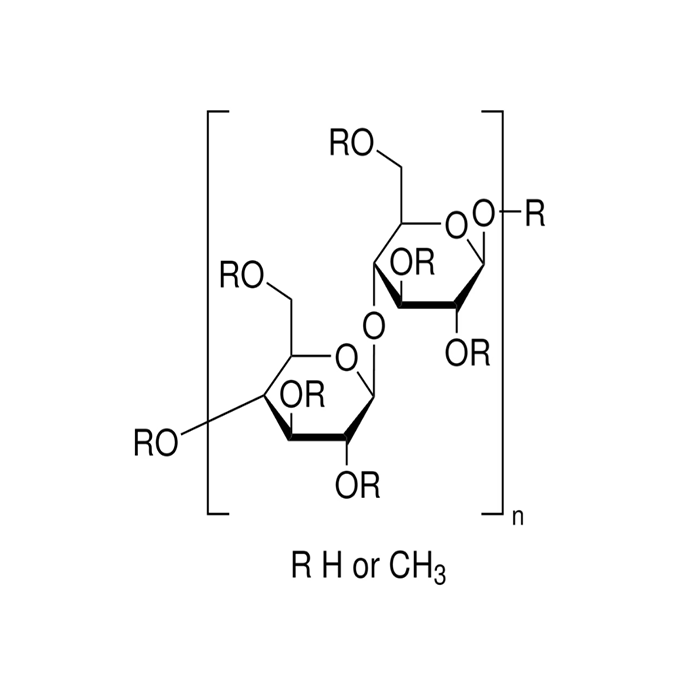
Methyl cellulose(MC) - 400mPa.s , CAS No.9004-67-5

CAS: 9004-67-5 Cat. No.: M112866 EC Number: 618-391-7 PubChem CID: 51063134
AVAILABLE TO ORDER
GRADE & PURITY 400mPa.s
Synonyms
MC | Methocel 181 | Metilcellulosa | MRJ667KA5E | Hydrolose | Methocel 4000CPS | Cesca MC 25S | UNII-ME8KD9K6LP | 9-Fluoro-11beta,17,21-trihydroxy-16beta-methylpregna-1,4-diene-3,20-dione-17-valerate | Celacol M 2500 | Napolone | Celacol WA | EMP-H | FEMA
Storage
Argon charged,Room temperature
Shipped In
Normal
★
Size
Germany (EU)
USA*
Price
Qty
100g
M112866-100g
6 In stock
In stock ≥10

€19.00

€24.21
Save €5.21 (21.51%)
500g
M112866-500g
—
In stock ≥10

€49.37

€59.79
Save €10.41 (17.42%)
12×500g
M112866-12×500g
Made to order · 8–12 wks
€571.75
Enter a quantity for the sizes you want to add.
🧪
Why this grade

400mPa.s for sensitive chromatographic and analytical workflows requiring minimal baseline interference.

🌡

Storage & shipping

Argon charged,Room temperature Ships Normal Check lot-specific COA for exact specifications.

📋

Quality documents

SDS, COA, datasheet, and spec sheet available for download. Lot-specific COA accessible via lot number lookup.

📚

Literature proof

Cited in 162 peer-reviewed publications across chromatography, organic synthesis, and cross-coupling reactions.

Overview

Product Introduction

Methyl-cellulose powder helps to prevent and manage nasal symptoms.


Application

Methyl cellulose has been used:

in total gastrointestinal transit

in in vitro motility assay

in the measurement of gastric emptying by phenol red method

Specifications

Synonyms
MC | Methocel 181 | Metilcellulosa | MRJ667KA5E | Hydrolose | Methocel 4000CPS | Cesca MC 25S | UNII-ME8KD9K6LP | 9-Fluoro-11beta,17,21-trihydroxy-16beta-methylpregna-1,4-diene-3,20-dione-17-valerate | Celacol M 2500 | Napolone | Celacol WA | EMP-H | FEMA
Specifications & Purity
400mPa.s
Storage
Argon charged,Room temperature
Shipped In
Normal
Names and Identifiers
Pubchem Sid
Canonical Smiles
[*]OC[C@H]1O[C@@H](O[C@@H]2[C@@H](CO[*])O[C@@H](O[*])[C@H](O[*])[C@H]2O[*])[C@H](O[*])[C@@H](O[*])[C@@H]1O[*]
IUPAC Name
(5R)-2,3,4-trimethoxy-6-(methoxymethyl)-5-[(2S)-3,4,5-trimethoxy-6-(methoxymethyl)oxan-2-yl]oxyoxane
InChIKey
YLGXILFCIXHCMC-JHGZEJCSSA-N
INCHI
1S/C20H38O11/c1-21-9-11-13(23-3)15(24-4)18(27-7)20(30-11)31-14-12(10-22-2)29-19(28-8)17(26-6)16(14)25-5/h11-20H,9-10H2,1-8H3/t11?,12?,13?,14-,15?,16?,17?,18?,19?,20+/m1/s1
Isomeric SMILES
COCC1[C@H](C(C(C(O1)OC)OC)OC)O[C@H]2C(C(C(C(O2)COC)OC)OC)OC
WGK Germany
1
RTECS
FJ5959000
PubChem CID
51063134

Documentation

📋 Safety Data Sheet (SDS)

Comprehensive hazard, handling, storage, and regulatory compliance document.

<<<<<<< HEAD Download SDS → ======= Download SDS → >>>>>>> release248-p3

✅ Certificate of Analysis (COA)

Lot-specific quality data. Enter your lot number to retrieve the exact COA.

Look up COA →

📊 Datasheet

Quick-reference summary of product specifications and applications.

View datasheet →

🔬 Specification Sheet

Full quality attributes and acceptance criteria for this grade.

View spec sheet →

Advanced Data

Taxonomic Classification

Taxonomy Tree

KingdomOrganic compounds
SuperclassOrganic oxygen compounds
ClassOrganooxygen compounds
SubclassCarbohydrates and carbohydrate conjugates
Intermediate Tree Nodes Glycosyl compounds
Direct ParentO-glycosyl compounds
Alternative Parents Disaccharides  Oxanes  Oxacyclic compounds  Dialkyl ethers  Acetals  Hydrocarbon derivatives  
Molecular FrameworkAliphatic heteromonocyclic compounds
Substituents O-glycosyl compound - Disaccharide - Oxane - Oxacycle - Organoheterocyclic compound - Ether - Dialkyl ether - Acetal - Hydrocarbon derivative - Aliphatic heteromonocyclic compound
DescriptionThis compound belongs to the class of organic compounds known as o-glycosyl compounds. These are glycoside in which a sugar group is bonded through one carbon to another group via a O-glycosidic bond.
External Descriptors Not available
3D Structure
Interactive Chemical Structure Model


Certificates (CoA,COO,BSE/TSE and Analysis Chart)
C of A & Other Certificates(BSE/TSE, COO):
Analytical Chart:

Find and download the COA for your product by matching the lot number on the packaging.

37 results found

Lot NumberCertificate TypeDateItem
H2626542H2626542Certificate of AnalysisJun 22, 2026 M112866
H2626543H2626543Certificate of AnalysisJun 22, 2026 M112866
G2514282G2514282Certificate of AnalysisMar 24, 2025 M112866
I2525686I2525686Certificate of AnalysisMar 24, 2025 M112866
I2525685I2525685Certificate of AnalysisMar 24, 2025 M112866
I2525684I2525684Certificate of AnalysisMar 24, 2025 M112866
F2609082F2609082Certificate of AnalysisMar 13, 2025 M112866
D2502317D2502317Certificate of AnalysisMar 13, 2025 M112866
D2502314D2502314Certificate of AnalysisMar 13, 2025 M112866
B2510435B2510435Certificate of AnalysisJan 11, 2025 M112866
B2510437B2510437Certificate of AnalysisJan 11, 2025 M112866
B2510436B2510436Certificate of AnalysisJan 11, 2025 M112866
K2404415K2404415Certificate of AnalysisSep 27, 2024 M112866
J2414690J2414690Certificate of AnalysisSep 27, 2024 M112866
J2414692J2414692Certificate of AnalysisSep 27, 2024 M112866
K2404413K2404413Certificate of AnalysisSep 27, 2024 M112866
K2404414K2404414Certificate of AnalysisSep 27, 2024 M112866
C2506226C2506226Certificate of AnalysisSep 27, 2024 M112866
B2418440B2418440Certificate of AnalysisJan 08, 2024 M112866
B2418441B2418441Certificate of AnalysisJan 08, 2024 M112866
B2418444B2418444Certificate of AnalysisJan 08, 2024 M112866
B2418445B2418445Certificate of AnalysisJan 08, 2024 M112866
H2321719H2321719Certificate of AnalysisJun 25, 2023 M112866
H2321732H2321732Certificate of AnalysisJun 25, 2023 M112866
H2419023H2419023Certificate of AnalysisJun 25, 2023 M112866
J2312158J2312158Certificate of AnalysisJun 25, 2023 M112866
J2312157J2312157Certificate of AnalysisJun 25, 2023 M112866
E2305627E2305627Certificate of AnalysisApr 21, 2023 M112866
E2305609E2305609Certificate of AnalysisApr 21, 2023 M112866
E2305634E2305634Certificate of AnalysisApr 21, 2023 M112866
I2227513I2227513Certificate of AnalysisJun 25, 2022 M112866
I2227512I2227512Certificate of AnalysisJun 25, 2022 M112866
I2227494I2227494Certificate of AnalysisJun 25, 2022 M112866
B2301199B2301199Certificate of AnalysisJun 25, 2022 M112866
B2222574B2222574Certificate of AnalysisJan 22, 2022 M112866
B2222573B2222573Certificate of AnalysisJan 22, 2022 M112866
B2222560B2222560Certificate of AnalysisJan 22, 2022 M112866
Chemical and Physical Properties
SolubilitySoluble in cold water.
SensitivityMoisture sensitive.
Molecular Weight454.500 g/mol
XLogP3-1.000
Hydrogen Bond Donor Count0
Hydrogen Bond Acceptor Count11
Rotatable Bond Count12
Exact Mass454.241 Da
Monoisotopic Mass454.241 Da
Topological Polar Surface Area102.000 Ų
Heavy Atom Count31
Formal Charge0
Complexity496.000
Isotope Atom Count0
Defined Atom Stereocenter Count2
Undefined Atom Stereocenter Count8
Defined Bond Stereocenter Count0
Undefined Bond Stereocenter Count0
The total count of all stereochemical bonds0
Covalently-Bonded Unit Count1
FAQs and Articles
Microcrystalline Cellulose (MCC): A Comprehensive Primer and Selection Guide—Structural Features, Key Performance Metrics, and Application Scenarios
Materials Can “Switch”: How Smart Polymers Respond to Temperature, pH, and Light (with Experimental Selection Tips & Product Navigation)
Understanding Hydrophilic Polymers in Aqueous Systems: Hydration Mechanisms, Structural Knobs, and Task-Oriented Selection Guide (Including Tables 1–3)
FGF2-Induced Angiogenesis Model: Standard Operating Procedure (Protocol)
Functional Framework of Starch Metabolism-Related Enzymes in Food Science Research and Mechanistic Analysis of Quality Regulation
Key Judgments in Medical Hydrogel R&D: From Polymer Source and Crosslinking Strategy to Sterilization Planning, Scale-Up Feasibility, and Quality Control
Injectable Thermosensitive Gels: Gelation Behavior, Rheological Properties, and Drug Release Characteristics
From Structure to Rheology: Thickening, Stabilization, and Selection Logic of Cellulose Ethers for Personal Care Applications
Analysis of the Production Process of Hydroxypropyl Methylcellulose (HPMC) for Putty: Understanding Differences in Substitution Structure and Gelation Temperature from High-Ratio and Low-Ratio Formulations
Types, Mechanisms of Action, Key Quality Indicators, and Selection and Application of Common Cellulose Ethers in Wall Putty
Influencing Factors and Control Strategies for Blistering in Neutral Wall Putty: An Experimental Analysis Based on HPMC Dosage, Viscosity, and Ground Calcium Carbonate Fineness
How to Select Binding/Gel Materials for Neutral Wall Putty? A Comparison of Pregelatinized Starch, PVA, and Redispersible Polymer Powder Based on Four Application Trials
Causes and Mechanism Analysis of Delamination During Sanding of Water-Resistant Putty
What Are the Differences Between Polyvinyl Alcohol 1788, 2488, and 2699? Understanding Workability, Bonding Strength, and Relative Water Resistance from the Perspective of Degree of Polymerization and Degree of Hydrolysis
Why Do Rust Spots Appear on Neutral Wall Putty? Iron Sources, Moisture Migration, Oxidative Color Development, and Prevention Measures
Common Problems and Formulation Adjustment Strategies for Neutral Putty Under High Summer Temperatures
Differences and Application Selection of Cassava- and Corn-Based Pregelatinized Starch in Neutral Putty Formulations
The Role, Selection, Cracking Risk Analysis, and Dosage Control of Bentonite in Neutral Putty
Experimental Applications of Carboxymethyl Cellulose (CMC) Solution in Enzyme Assays, Suspension Systems, and Functional Materials
Citations of This Product
Solution Calculators
Reviews

Customer Reviews

Related Products

Methyl cellulose(MC) - 1500mPa.s , CAS No.9004-67-5
Methyl cellulose(MC) - 100000mPa.s , CAS No.9004-67-5
Methyl cellulose(MC) - 15mPa.s , CAS No.9004-67-5
Methylcellulose(MC) - 40000 mPa.s , CAS No.9004-67-5
Hydroxypropylmethylcellulose(HPMC) - Substitution type 2208, viscosity: 4000mPa. s, methoxy group: 19-24%; Hydroxypropyl group: 4.0-12% , CAS No.9004-65-3
Hydroxypropylmethylcellulose - type I,viscosity :100mPa.s , CAS No.9004-65-3
Hydroxypropylmethylcellulose - Type I, viscosity: 400mPa. s , CAS No.9004-65-3
Hydroxypropylmethylcellulose - 30mPa.s, Methoxy group: 28-30%; Hydroxypropyl group: 7.5-12% , CAS No.9004-65-3
Hydroxypropylmethylcellulose - type II,viscosity :100mPa.s , CAS No.9004-65-3
Hydroxypropylmethylcellulose - Substitution type 2208, viscosity: 100000mPa. s, methoxy group: 19-24%; Hydroxypropyl group: 4.0-12% , CAS No.9004-65-3
Hydroxypropylmethylcellulose - Substitution type 2208, viscosity: 15000mPa. s, methoxy group: 19-24%; Hydroxypropyl group: 4.0-12% , CAS No.9004-65-3
Hydroxypropylmethylcellulose - USP2910,2%viscosity :15mPa.s,methoxyl:28-30%;hydroxyl:7.0-12% , CAS No.9004-65-3
(Hydroxypropyl)methyl cellulose (HPMC) - USP2910,2%viscosity :50mPa.s,methoxyl:28-30%;hydroxyl:7.0-12% , CAS No.9004-65-3
Hydroxypropylmethylcellulose - USP2910,2%viscosity :3mPa.s,methoxyl:28-30%;hydroxyl:7.0-12% , CAS No.9004-65-3
Hydroxypropylmethylcellulose - Type II, viscosity: 400mPa. s , CAS No.9004-65-3
Hydroxypropylmethylcellulose - Substituted Type 2910, Viscosity: 4000 mPa·s, Methoxy: 28-30%; Hydroxypropyl: 7.0-12% , CAS No.9004-65-3
Hydroxypropyl methyl cellulose(HPMC) - 2%viscosity :6mPa.s,methoxyl:28-30%;hydroxyl:7.0-12% , CAS No.9004-65-3
CROSCARMELLOSE SODIUM - Degree of substitution: 0.60-0.85 , CAS No.74811-65-7
Carboxymethyl Cellulose Sodium(CMC) - Type II, M.W. 250000 (DS=1.2), 1500-3100mPa. s , CAS No.9004-32-4
Carboxymethyl Cellulose Sodium(CMC) - M.W. 250000(DS=0.7) ,1500-3100mPa.s , CAS No.9004-32-4
Carboxymethyl Cellulose Sodium(CMC) - DS=0.7 ,200-500mPa.s , CAS No.9004-32-4
Carboxymethyl Cellulose Sodium(CMC) - Type I, M.W. 700,000 (DS=0.9), 2,500 - 4,500 mPa·s, used for CMC can be used as a binder in the preparation of graphene nano-platelet based inks for the fabrication of dye sensitized solar cells (DSSCs). It can also b
Carboxymethyl Cellulose Sodium(CMC) - Type V, M.W. 90000 (DS=0.7), 50-100mPa. s , CAS No.9004-32-4
Carboxymethyl Cellulose Sodium(CMC) - Type III, M.W. 250000 (DS=0.9), 1500-3100mPa. s , CAS No.9004-32-4
Carboxymethyl Cellulose Sodium - Viscosity: 600-3000 mpa.s , CAS No.9085-26-1
Carboxymethyl Cellulose Sodium(CMC) - viscosity : 300-800mpa.s , CAS No.9004-32-4
Carboxymethyl Cellulose Sodium(CMC) - viscosity : 600-1000mpa.s,USP grade , CAS No.9004-32-4
Carboxymethyl Cellulose Sodium(CMC) - viscosity : 800-1200mpa.s ,USP grade , CAS No.9004-32-4
Carboxymethyl Cellulose Sodium(CMC) - low viscosity,viscosity:50-200mPa.s , CAS No.9004-32-4
Carboxymethyl Cellulose Sodium(CMC) - viscosity :1000-1400mpa.s,USP grade , CAS No.9004-32-4
(Hydroxypropyl)methyl cellulose(HPMC) - average Mn ~10,000 , CAS No.9004-65-3
Hydroxypropylmethylcellulose(HPMC) - average Mn ~90,000 , CAS No.9004-65-3
Hydroxypropylmethylcellulose(HPMC) - average Mn ~120,000 , CAS No.9004-65-3
(Hydroxypropyl)methyl cellulose(HPMC) - average Mn ~86,000 , CAS No.9004-65-3
Carboxymethyl Cellulose Sodium(CMC) - 800-1000 mPa.s , CAS No.9004-32-4
Microcrystalline Cellulose and Carboxymethylcellulose Sodium - Ph.Eur., E 460(i), E 466, NF
Croscarmellose Sodium - JP, Ph.Eur., NF , CAS No.74811-65-7

Shall we send you a message when we have discounts available?

Remind me later

Thank you! Please check your email inbox to confirm.

Oops! Notifications are disabled.