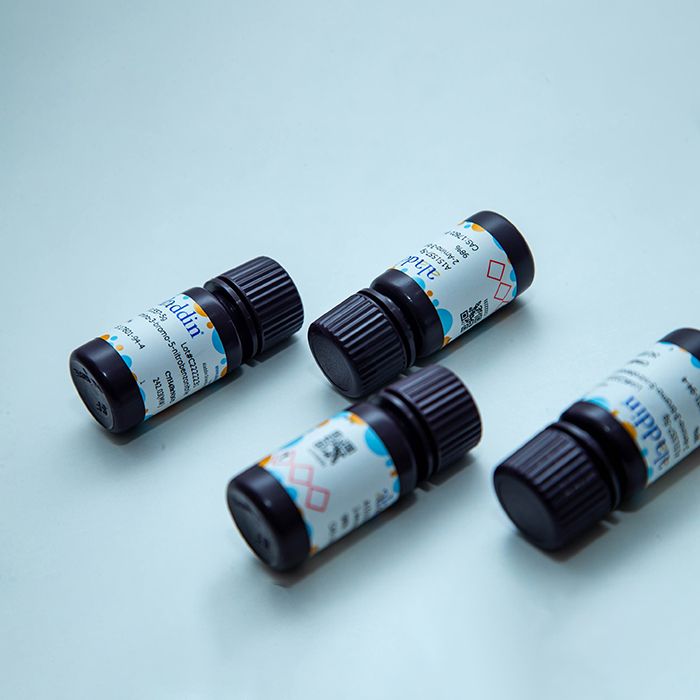
Mongersen (GED-0301) is a specific and orally active SMAD7 antisense oligonucleotide. Mongersen restores TGF-β1 activity leading to inhibition of inflammatory signals. Mongersen can attenuate Crohn's disease-like experimental colitis in mice.
In Vivo
Mongersen (125 μg/mouse; p.o. twice a week for 3 weeks) reduces TNBS- or DSS-induced colonic inflammation and colonic fibrosis of mice. MCE has not independently confirmed the accuracy of these methods. They are for reference only. Animal Model: Eight-week-old female BALB/c mice were treated with TNBSDosage: 125 μg/mouse Administration: Oral gavage, twice a week starting from week 5 or week 9 for 3 weeks Result: Reduced Smad7 protein expression. Attenuated the ongoing colonic inflammation. Significantly reduced TNF-α and IL-6 RNA expression. Attenuated colonic fibrosis.
Form:Solid
Specifications
Specifications & Purity
≥95%
Biochemical and Physiological Mechanisms
Mongersen (GED-0301) is a specific and orally active SMAD7 antisense oligonucleotide. Mongersen restores TGF-β1 activity leading to inhibition of inflammatory signals. Mongersen can attenuate Crohn's disease-like experimental colitis in mice.
Storage
Store at -20°C,Desiccated
Shipped In
Ice chest + Ice pads
This product requires cold chain shipping. Ground and other economy services are not available.
Determine the necessary mass, volume, or concentration for preparing a solution.
Dilution Calculator
Determine the dilution needed to prepare a stock solution.
Reconstitution Calculator
Reviews
Customer Reviews
Application Protocols
Per the instructions, only product-validated protocols should be included here. The Product Data do not provide application methods, dilutions, or tested assay types for this SKU.
Tested applications: Not specified for this item; refer to CoA/Spec Sheet.
Recommended working concentrations: Not specified for this item; refer to CoA/Spec Sheet.
Positive controls and assay conditions: Not specified for this item; refer to CoA/Spec Sheet.
If you plan to use an antisense oligonucleotide in cell culture or biochemical assays, consult internal SOPs and literature for delivery (lipid-based transfection, electroporation), dose–response design, and qPCR/RNA-seq readouts. However, no item-specific guidance can be provided here.
Biological Roles
General (literature) overview for antisense oligonucleotides (ASOs):
Mechanism: ASOs hybridize to complementary RNA targets through Watson–Crick base pairing. Depending on chemistry and binding site, they can recruit RNase H to degrade RNA, block ribosome assembly, or modulate splicing by steric hindrance.
Cellular trafficking: Uptake can occur via endocytosis; delivery reagents (lipid nanoparticles, cationic polymers) are often used to enhance cytosolic/nuclear access. Chemical modifications (e.g., phosphorothioate linkages, 2′-O-alkyl, constrained nucleic acids) can influence protein binding, stability, and distribution.
Stability: Backbone and sugar modifications typically increase nuclease resistance and binding affinity; salt form and sequence determine duplex melting temperature (Tm) and pharmacokinetic behavior in biological systems.
Literature context specific to mongersen: Reported as an antisense oligonucleotide directed against SMAD7 mRNA. This information is provided for biochemical context only; no medical or clinical use is implied. Exact sequence and modification pattern are not provided in the Product Data for this SKU.
Note: Experimental outcomes (e.g., knockdown efficiency) depend on sequence, chemical modifications, delivery method, and cell type. For this catalog item, no target sequence, modification map, or performance data are specified; consult CoA/Spec Sheet where applicable.
Buffer Applications
ASO handling typically relies on nuclease-free aqueous buffers. Item-specific buffer recommendations are not provided; the following are general, literature-based practices.
Common stock solutions:
Nuclease-free water: Prepare 100–1000 µM stocks depending on assay needs; filter sterilize if required.
TE buffer (10 mM Tris-HCl, 1 mM EDTA, pH 7.5–8.0): Enhances stability by chelating Mg2+/Ca2+ that promote nuclease activity. Avoid EDTA if downstream enzymes require divalent cations.
pH range (general): Neutral to slightly basic (pH 7.0–8.0) is typical for ASO stability; avoid acidic conditions that can promote depurination.
Working solutions:
Dilute into cell culture media immediately before use; minimize time at room temperature to limit nuclease exposure.
For hybridization assays, use ionic strength (e.g., 0.3–1× SSC) and temperature settings based on the ASO–RNA Tm; compute Tm from the specific sequence where known.
Practical notes:
Always use RNase/DNase-free plastics and reagents.
If turbidity/precipitation occurs upon dilution into saline-rich buffers or media, add gradually with mixing and verify compatibility of counterions.
No item-specific buffer compositions or recipes are provided in the Product Data.
Green Alternatives
Green chemistry considerations for oligonucleotides differ from those for organic solvents or small molecules.
Material choice:
ASOs enable gene modulation without using plasmids/viral vectors, potentially reducing biological hazard waste compared to certain vector-based workflows (literature/general). However, they often require specialized delivery reagents.
Process considerations:
Prefer aqueous buffers (nuclease-free water, PBS, TE) over organic cosolvents. Avoid halogenated solvents entirely for stock solutions.
Lyophilization can enable shipment/storage at reduced cold-chain intensity if stability permits (sequence-dependent; not item-specified).
Waste minimization:
Prepare concentrated stocks and aliquot to reduce repeated thawing and disposal of degraded material.
Use micro-scale assays (qPCR, BLI) to minimize reagent consumption.
Comparison (general):
ASO vs. siRNA: Both are water-based; siRNAs often require similar buffers. Choice depends on mechanism (RISC vs. RNase H) and may influence off-target profiles and dosing.
ASO vs. small-molecule inhibitors: Small molecules may need organic solvents (DMSO), increasing VOC footprint; ASOs typically avoid VOCs but may need cold-chain energy.
Note: No item-specific green certifications or solvent-use data are provided. Implement institutional green lab best practices for storage, handling, and waste.
Pharmaceutical Uses
This product is supplied strictly for research use only; it is not intended for human or veterinary use.
General formulation context for oligonucleotides (literature; not specific to this item):
Salt form and counterion selection (e.g., sodium) influence isotonicity and stability in aqueous formulations.
Excipients such as buffers (citrate, phosphate), tonicity adjusters (NaCl, mannitol), and antioxidants (as appropriate) may be used in developmental formulations; selection depends on sequence and chemistry.
Lyophilization is commonly employed to enhance long-term stability and enable storage at low temperature with desiccation.
Sterile filtration (0.22 µm) may be applied to solutions when compatible with concentration and viscosity; aseptic technique is required.
No pharmacopeial monograph, dosage form, clinical indication, or cGMP status is provided for this SKU. Do not infer therapeutic suitability or equivalence from this research listing. For any development work, comprehensive stability studies (pH, ionic strength, temperature, light, agitation) and impurity profiling are essential and must be sequence- and modification-specific.
Physical Properties
Item-specific physicochemical properties are not provided in the Product Data.
Appearance: Not specified for this item; refer to CoA/Spec Sheet.
Molecular weight: Not specified for this item; refer to CoA/Spec Sheet.
Molecular formula: Not specified for this item; refer to CoA/Spec Sheet.
Melting point, boiling point, density, refractive index: Not specified for this item; refer to CoA/Spec Sheet.
Solubility (literature, general for ASOs): Typically freely soluble in nuclease-free water and aqueous buffers (e.g., PBS, TE) due to polyanionic backbone; solubility can depend on counterion (e.g., sodium) and sequence content.
pKa/logP (literature, general): Not typically defined as for small molecules; overall behavior governed by multiple ionizable phosphate groups leading to high hydrophilicity and negligible logP relevance.
Hygroscopicity (literature, general): Oligonucleotides and their salts can be hygroscopic and benefit from desiccated storage.
Important: Where precise numerical values are required for experimental design (e.g., extinction coefficient for concentration determination), consult the sequence-specific documentation (CoA/Spec Sheet) or measure empirically (UV at 260 nm using calculated ε for the specific sequence). No item-specific values are provided here.
Quality and Grades
Grade/Purity: Not specified for this item; refer to CoA/Spec Sheet.
Research Use Note: For research use only.
Interpretation and context for oligonucleotide-quality terminology (literature/general):
Crude vs. desalting vs. HPLC/UPLC-purified: Higher-purity ASOs (e.g., ion-pair RP-HPLC) reduce n−1/n+1 species and minimize synthetic impurities that can affect bioassays or hybridization stringency.
Identity confirmation: Typically via MALDI-TOF or ESI-MS (intact mass), with optional sequence verification by LC–MS or enzymatic digestion mapping.
Residual solvents/salts: ASOs may carry counterions (e.g., Na+, TEA) and residual protecting group byproducts; rigorous purification reduces these.
UV purity: Monitoring A260/A280 ratio provides a crude assessment of nucleobase/impurity profile but is sequence-dependent.
What is specific to this listing:
No explicit grade, purity percentage, or stabilizer is declared in the Product Data. Do not assume a given modification state or salt form. For publication-grade work or regulated studies, request the CoA/Spec Sheet for: purification method, residual solvent/salt profile, identity (MS), and moisture content.
Storage and logistics per this item: Stored at −20°C, desiccated; shipped in an ice chest with ice pads to maintain a cold chain.
Reaction and Applications
This product is positioned in a compound/chemical library. For oligonucleotide-class materials (literature), laboratory applications focus on nucleic-acid hybridization and gene expression studies rather than small-molecule synthetic reactions.
Research applications (literature, general for ASOs):
Sequence-specific binding to complementary RNA to modulate RNA function (e.g., RNase H-mediated knockdown or splicing modulation), in cell-free or cellular assays.
Tool compound for target validation, pathway interrogation, and phenotypic screening where gene suppression is desired.
Assay contexts:
In vitro hybridization studies (Tm determination, binding kinetics by SPR/biolayer interferometry).
Cellular assays using transfection reagents (electroporation, lipid-based carriers) to assess transcript-level effects by qPCR or RNA-seq.
Practical tips (general):
Use nuclease-free consumables; include EDTA in storage buffers to suppress nuclease activity.
Determine concentration by A260 using the sequence-specific extinction coefficient (ε, literature-calculated); absent item-specific ε, compute from sequence if known.
Avoid repeated freeze–thaw; aliquot upon first reconstitution.
Manufacturer Applications: Not provided in Product Data. If you require specific validated uses or assay conditions for this exact SKU, consult the CoA/Spec Sheet or contact technical support.
Reaction Conditions
Not typically applicable. As supplied, Mongersen is intended for use in biological or biophysical assays, not as a substrate/reagent for chemical reactions.
General laboratory handling (literature):
Reconstitution: Nuclease-free water or appropriate buffer at neutral pH; gentle mixing avoids shear.
Thermal considerations: ASO duplex formation with complementary strands follows standard nucleic-acid hybridization thermodynamics; annealing protocols (e.g., heat to 65–70°C then slow cool) are used when preparing duplexes with complementary oligos.
Enzymatic treatments: If used in assays with nucleases or polymerases, ensure buffer compatibility (Mg2+, salts) and consider backbone chemistry effects on enzyme activity.
No item-specific reaction conditions, catalysts, or yields are provided for this SKU.
Safety and Handling
Safety data specific to this catalog item are not provided in the Product Data.
GHS classification, signal word, pictograms, H-statements: Not specified for this item; refer to SDS.
General ASO handling guidance (literature/good lab practice):
Use standard lab PPE: lab coat, safety glasses, nitrile gloves.
Work with nuclease-free techniques to prevent degradation (RNase/DNase-free tubes, tips, and solutions).
Avoid aerosol generation; handle powders in a clean area to minimize inhalation and cross-contamination.
Prevent skin/eye contact and ingestion. Wash thoroughly after handling.
Incompatibilities (general): Strong oxidizers and bases/acids may degrade oligonucleotides. Avoid nucleases and biological contamination. Store away from moisture.
First aid (general guidance; defer to SDS):
Inhalation: Move to fresh air; seek medical attention if symptoms occur.
Skin/eye contact: Rinse with water for several minutes; remove contaminated clothing; seek medical attention if irritation persists.
Ingestion: Rinse mouth; do not induce vomiting; seek medical attention.
Spill response (general): Collect solids by gentle sweeping with minimal dust; for solutions, absorb with inert material. Dispose according to institutional and local regulations.
Always consult the product-specific SDS for authoritative hazard classification and response procedures.
Solvent Selection
Applicability: Mongersen, as an oligonucleotide-class material (literature), is typically handled in aqueous systems rather than organic solvents.
Primary solvents (general for ASOs):
Nuclease-free water: Preferred for stock solutions; adjust pH only with nuclease-free reagents.
Buffers: TE (10 mM Tris, 1 mM EDTA, pH 7.5–8.0), PBS (pH ~7.2–7.4). EDTA helps chelate divalent cations that catalyze nuclease activity.
Miscibility/solubility (literature, general): High solubility in water; insoluble in most nonpolar organics. Limited compatibility with high percentages of alcohols or salts that can induce precipitation depending on sequence.
When to choose alternatives:
For transfection or delivery studies, aqueous stocks are often diluted into cell-culture media; avoid serum nucleases where possible or use delivery reagents per vendor protocols.
For lyophilization/reconstitution workflows, use low-salt, nuclease-free solutions to enhance stability.
Comparison (general):
Water/TE vs. PBS: TE offers nuclease suppression (via EDTA) but EDTA may interfere with Mg2+-dependent enzymes; PBS is isotonic and cell-compatible but lacks chelation.
Note: No item-specific solubility, counterion, or extinction coefficient is provided; verify solution preparation based on the sequence/salt form in the CoA/Spec Sheet if available.
Storage and Reconstitution
Item-specific storage and shipping:
Storage Conditions: Store at −20°C, desiccated.
Shipped In: Ice chest + ice pads.
General reconstitution and handling (literature/good practice for ASOs):
Reconstitution solvent: Use nuclease-free water or buffer (e.g., TE pH 7.5–8.0). Item-specific concentration is not provided; typical lab stocks are 100–1000 µM according to need.
Mixing: Allow vial to equilibrate to room temperature in a desiccated environment before opening to prevent moisture condensation. Add solvent along the vial wall, gently pipette to dissolve; avoid vigorous vortexing of highly concentrated, long sequences.
Aliquoting: Divide into single-use aliquots to minimize freeze–thaw cycles. Label aliquots with concentration and date.
Storage of solutions: Short term (days to a week) at 2–8°C; longer term at −20°C or below. Protect from repeated freeze–thaw and from nuclease contamination. For very long-term storage, consider sterile filtration and/or lyophilization if compatible.
Light and moisture: Protect from moisture uptake; store tightly capped under desiccation. Light sensitivity is generally low for oligonucleotides, but store in amber vials if photosensitive labels are present (not specified for this item).
Any stabilization additives, salt form, or extinction coefficient are not specified for this item; consult the CoA/Spec Sheet for details.
Structure and Identity
Brief description: Mongersen is supplied as a research-use small-molecule/compound-library entry; it is known in the literature as an antisense oligonucleotide (ASO). Item-specific structural identifiers are not provided in the Product Data.
SKU: M648664 (Category: 全部 / 可售 / 小分子和化合物库)
Product Name: Mongersen
CAS: 1443994-46-4
PubChem CID: 121490254
Molecular formula: Not specified for this item; refer to CoA/Spec Sheet.
Molecular weight: Not specified for this item; refer to CoA/Spec Sheet.
SMILES: Not specified for this item; refer to CoA/Spec Sheet.
InChIKey: Not specified for this item; refer to CoA/Spec Sheet.
Structural class (literature): Reported as an antisense oligonucleotide designed to hybridize to a specific mRNA sequence; ASOs commonly feature a phosphorothioate backbone and 2′-O-modifications for stability.
2D structure (descriptive, literature-general): A linear polyanionic chain comprising repeating sugar–phosphate units with pendant heteroaromatic nucleobases capable of Watson–Crick base pairing; sequence-specific but not item-specified here.
Note: Exact sequence, modifications, and stereochemistry determine identity and performance for any given ASO; these details are not provided for this catalog entry and should be confirmed from the CoA/Spec Sheet if applicable.
Synthetic Utility
Not typically applicable. Mongersen, as an oligonucleotide-class material (literature), is a final bioactive sequence-specific polymer rather than a small-molecule building block or reagent.
General notes (literature):
ASOs are produced via solid-phase phosphoramidite synthesis using protected nucleoside monomers, with sulfurization/oxidation steps defining backbone chemistry.
Post-synthetic processing includes deprotection, cleavage from solid support, desalting, and purification (e.g., HPLC).
Because this item is positioned for research use as a functional nucleic-acid material, it is not routinely employed as a precursor in organic synthesis or as a catalyst/ligand. If your project instead requires monomeric phosphoramidites or linkers, consult nucleoside building-block sections of the catalog.
Target Specificity
Only item-specific data should be listed here. The Product Data for this SKU do not provide target, sequence, clone, or specificity details.
Target/sequence: Not specified for this item; refer to CoA/Spec Sheet.
Species reactivity: Not specified for this item; refer to CoA/Spec Sheet.
Validation data: Not specified for this item; refer to CoA/Spec Sheet.
Note: While literature sources describe “mongersen” as an antisense oligonucleotide reported to target SMAD7 mRNA, that information is not confirmed for this exact catalog item. Rely on the product’s CoA/Spec Sheet for definitive target and sequence information.
We use cookies to ensure the website functions properly and, where permitted, to improve your experience. You can manage your preferences at any time in Settings. Learn more in our Cookie Policy.
Shall we send you a message when we have discounts available?
Remind me later
Thank you! Please check your email inbox to confirm.
Products are supplied to verified businesses, institutions, and qualified professionals for research and development use only. Not for use in humans, animals, diagnosis, or therapy.