GRADE & PURITYMoligand™?Moligand™ — Aladdin's line of ligands and bioactive small molecules. Use for receptor, pathway, and binding studies needing defined small-molecule tools.≥98%
Product Describtion: 1-Methyl-4-phenylpyridinium (MPP+) induces neurotoxicity by inhibiting mitochondrial redox functions in the striatal synaptosomes. It is a potential neurotoxin and induces Parkinson′s disease in animal models. It mediates apoptosis by the generation of reactive oxygen species in cerebellar granule neurons and neuroblastoma cells. MPP+ modulates the distribution of dopamine. It elicits neurotoxicity by activating neuronal nitric oxide synthase (nNOS), resulting in excess nitric oxide.
Product Application:MPP+ iodide has been used:to induce oxidative stress in zebrafish embryosfor the inhibition of glutamate uptake in mitochondria of astrocytesin testing cell viability using MTT (3 (4,5-dimethylthiazol)-2-yl-2,5-diphenyltetrazolium bromide) in microglia (BV2) cells
MPP+ iodide is an active metabolite of dopaminergic neurotoxin MPTP.Dopaminergic selective neurotoxin. Active MPTP metabolite. Interferes with oxidative phosphorylation and induces mitochondrial dysfunction. Deplete cellular ATP. Shows Parkinson effects i
Storage
Room temperature
Shipped In
Normal
Grade
Moligand™
Note
Unstable; make up solutions fresh and use immediately. Toxic, refer to SDS for further information. Need more advice on solubility, usage and handling? Please visit our frequently asked questions (FAQ) page for more details.
This compound belongs to the class of organic compounds known as phenylpyridines. These are polycyclic aromatic compounds containing a benzene ring linked to a pyridine ring through a CC or CN bond.
External Descriptors
Not available
1. Djoumbou Feunang Y, Eisner R, Knox C, Chepelev L, Hastings J, Owen G, Fahy E, Steinbeck C, Subramanian S, Bolton E, Greiner R, and Wishart DS. ClassyFire: Automated Chemical Classification With A Comprehensive, Computable Taxonomy. Journal of Cheminformatics, 2016, 8:61.
Determine the necessary mass, volume, or concentration for preparing a solution.
Dilution Calculator
Determine the dilution needed to prepare a stock solution.
Reconstitution Calculator
Reviews
Customer Reviews
Application Protocols
Only item-specific, validated protocols should be reported here. For this product, no application protocols are provided in the Product Data.
Tested applications, recommended concentrations/dilutions, positive controls: Not specified for this item; refer to CoA/Spec Sheet and primary literature.
General guidance should be developed under your lab’s SOPs, with small-scale pilot experiments to establish dose–response and exposure parameters appropriate to your system.
Biological Roles
General biochemical context (literature; non-clinical)
MPP+ (1-methyl-4-phenylpyridinium) is a permanently cationic, lipophilicity-modulated aromatic species known to interact with mitochondrial pathways. In cell biology, it is widely used as a chemical probe for studying electron transport chain function, particularly NADH:ubiquinone oxidoreductase (complex I)–dependent processes, redox balance, and ATP production.
Due to its positive charge and aromatic character, MPP+ can accumulate across the mitochondrial membrane potential, enabling focused perturbation of mitochondrial function in vitro. This property underlies its frequent use in models interrogating oxidative stress, ROS generation, apoptosis signaling, and mitophagy.
In neurochemistry research, MPP+ is employed to investigate transporter-mediated uptake phenomena (e.g., cationic biogenic amine transporters) and to dissect downstream cellular responses in neuronal cell lines.
Experimental considerations (general)
Stock solution preparation often uses water or DMSO; final working concentrations and exposure times vary by cell type and endpoint (viability, ROS, bioenergetics). Pilot titrations are recommended to map dynamic ranges and avoid off-target cytotoxicity.
Analytical readouts commonly include respirometry, TMRE/TMRM for membrane potential, ATP assays, NADH/NAD+ ratios, and targeted proteomics/metabolomics to trace pathway impacts.
Note: The above describes literature roles of MPP+ as a research probe. It does not constitute usage recommendations or specifications for this specific catalog item; consult primary literature and your institutional approvals.
Buffer Applications
Not a buffering agent. MPP+ iodide does not provide acid–base buffering capacity.
Practical notes (general)
Dissolution: Can be prepared in water or common biological buffers (e.g., PBS, HBSS) for research use, provided compatibility with your assay is confirmed.
pH impact: As a quaternary ammonium salt, it does not titrate within biological pH ranges; solutions will reflect the pH of the diluent.
Item-specific buffer guidance is not provided; refer to your assay SOPs and the CoA/SDS for compatibility details.
Green Alternatives
Context: “Green alternatives” generally address solvent/reagent substitution to reduce environmental or safety impact. MPP+ iodide is a bioactive research compound (salt), not a process solvent or common reagent; direct greener substitutes are not applicable.
If your objective is to study related biochemical mechanisms with improved handling properties, consider:
Using lower-hazard mitochondrial modulators where scientifically appropriate (literature-driven choice), and implement micro-scale assays to minimize quantities.
Selecting water as the primary solvent for stocks when feasible to reduce reliance on high-boiling polar aprotics (e.g., DMSO), provided stability and assay design permit.
Operational green practices
Minimize scale; adopt microscale and high-throughput formats to reduce chemical use and waste.
Employ aqueous workups and LC–MS-compatible mobile phases to avoid halogenated solvents in analytics.
Because this product functions as a specific research probe, substitution affects scientific outcomes; prioritize data needs while applying standard green chemistry principles in handling and waste management.
Pharmaceutical Uses
No excipient or manufacturing use is indicated for this product.
Pharmacopeial status: Not specified for this item; refer to CoA/Spec Sheet.
Formulation role: None stated. This material is offered strictly for research use (as noted in Product Data) and is not intended for human or animal administration.
If a formulation-like context is needed for in vitro research (e.g., preparing defined solutions), follow laboratory reagent preparation practices and do not infer any pharmaceutical applicability from this listing.
Physical Properties
Item-specific specifications
Appearance: Not specified for this item; refer to CoA/Spec Sheet.
Molecular Formula: Not specified for this item; refer to CoA/Spec Sheet.
Molecular Weight: Not specified for this item; refer to CoA/Spec Sheet.
Literature/general reference values (non-binding; for context only)
Physical state: Typically a crystalline solid (literature)
Solubility: High aqueous solubility expected for quaternary ammonium salts; readily soluble in water and polar organics such as methanol and DMSO (literature)
Partition behavior: Strongly cationic; logP for the neutral organic scaffold is not applicable; overall compound behaves hydrophilic due to permanent charge (literature)
pKa: Not applicable; quaternary ammonium is permanently charged and does not undergo acid–base equilibrium at physiological pH (general chemistry)
UV/Vis: Aromatic cation shows π→π* absorbance in UV region; exact λmax depends on counterion/solvent; commonly monitored at ~254–262 nm (literature)
Melting point, density, refractive index, vapor pressure: Not specified for this item; see CoA/Spec Sheet. If needed, consult primary literature for approximate ranges.
Practical notes (general)
Hygroscopicity: Many pyridinium salts are moderately hygroscopic; minimize exposure to ambient humidity. Confirm for your batch via CoA.
Thermal behavior: Quaternary salts are non-volatile; decomposition may occur before boiling.
Context: Moligand™ denotes a small-molecule/library compound offering intended for research and screening applications. Such materials are typically provided to support medicinal chemistry, phenotypic screening, target validation, and chemical biology workflows where identity and suitability for research are prioritized.
Implications for users: While high chemical identity and consistency are expected, specialized performance attributes such as low-UV “HPLC grade” solvent specs, trace-metal limits at ppb levels, or pharmacopeial compliance are not implied by the Moligand™ designation unless explicitly stated on the CoA.
Purity reporting
Specific assay/purity percentage, residual solvents, water content, or stabilizer usage: Not specified for this item; refer to CoA/Spec Sheet.
Documentation and QC suggestions
Request the batch CoA for confirmation of identity (e.g., 1H NMR/LC–MS) and purity.
For high-sensitivity bioassays, consider in-house verification by LC–MS and orthogonal NMR where practical.
If using for screening, document the exact batch ID in data records to support reproducibility.
Stabilizers/additives
None stated. If stabilizers or form-specific attributes (hydrate/solvate, particle size) are critical to your application, verify on the CoA.
Reaction and Applications
Chemical reaction utility
MPP+ iodide is not typically employed as a synthetic reagent or catalyst. As a quaternary pyridinium salt, it has limited nucleophilicity/basicity and is mainly valued as a bioactive research probe rather than as a building block.
Research applications (general; non-clinical)
Widely used in vitro to study mitochondrial bioenergetics, oxidative stress responses, and cellular pathways sensitive to complex I inhibition in neuronal and non-neuronal cell models (literature). These uses center on its cationic, aromatic structure and well-characterized interactions with mitochondrial components.
Analytical/assay notes
The permanent positive charge provides robust MS detectability in positive ESI. UV detection around 254–262 nm is common due to the conjugated aromatic system (literature). Matrix effects should be assessed when quantifying in complex biological samples.
If your goal is chemical synthesis, consider that MPP+ iodide is not a practical synthon for cross-coupling or nucleophilic substitutions under standard conditions; alternative pyridinium derivatives (e.g., Katritzky salts engineered as redox-activated esters) are more suitable for transformations.
Reaction Conditions
Not typically used as a reagent or catalyst; therefore, standard “reaction condition” windows are not applicable.
General handling conditions for solution preparation (literature/practice)
Solvents: Water or DMSO are commonly used for stock solutions.
Temperature: Ambient conditions for dissolution; avoid prolonged heating.
Atmosphere: No special inert-atmosphere requirements for simple dissolution; protect from contamination.
For any transformations intentionally involving pyridinium salts, consult reaction-specific literature; do not extrapolate from the biological use of MPP+.
Safety and Handling
Item-specific hazard information
GHS Classification, Signal Word, H-Statements, Pictograms: Not specified for this item; refer to the product SDS for authoritative safety information.
General laboratory safety guidance (non-binding; follow your institutional SOPs and SDS)
Toxicological caution: Quaternary pyridinium salts can exhibit biological activity. Handle MPP+ iodide as a potentially harmful substance; avoid inhalation, ingestion, and skin/eye contact.
PPE: Lab coat, safety glasses, and appropriate chemically resistant gloves (e.g., nitrile). Use a certified chemical fume hood for weighing and solution preparation.
First aid (overview): In case of skin/eye contact, rinse with plenty of water for at least 15 minutes and seek medical attention. If inhaled, move to fresh air; if ingested, do not induce vomiting—seek medical attention. Always consult SDS for detailed instructions.
Handling: Prevent dust generation; keep containers tightly closed. Use dedicated tools to avoid cross-contamination.
Incompatibilities: Strong oxidizers or strong reducing agents may lead to undesired reactions with organic salts; avoid contact with strong bases/acids that could promote decomposition. Iodide can be oxidized by strong oxidants (general chemistry).
Environmental: Prevent release to the environment; collect aqueous/organic waste according to local regulations.
Storage: As per Product Data, store at room temperature in a tightly sealed container; protect from excessive humidity and prolonged light exposure.
Always defer to the SDS and institutional risk assessments for definitive hazard classifications and emergency procedures.
Solvent Selection
Applicability: MPP+ iodide is a polar, permanently cationic organic salt; solvent choice centers on dissolution for stock preparation and compatibility with bioassays or analytical workflows.
Polarity/miscibility (literature/general)
Readily soluble in water and polar protic solvents (e.g., water, methanol, ethanol).
Highly soluble in polar aprotic solvents such as DMSO; often used for concentrated stocks in screening assays.
Poorly soluble in nonpolar solvents (e.g., hexanes, toluene) due to ionic nature.
Practical selection guidance
For biological assays: Use sterile water, PBS, or culture media-compatible cosolvent systems. If DMSO stocks are used, dilute to keep final DMSO ≤0.1–0.5% v/v as assay-appropriate.
For analytical work: Water or water–acetonitrile with volatile modifiers (formic acid) are suitable for LC–MS; ensure the counterion/ionic strength are compatible with your ionization mode.
DMSO: highest stock concentration; watch for hygroscopic uptake and final assay solvent limits.
Alcohols (MeOH/EtOH): intermediate option for spectroscopy or certain extractions; confirm compatibility with downstream systems.
Note: Solubility limits are batch- and condition-dependent; verify experimentally. No item-specific solubility specifications are provided for this product.
Keep tightly sealed in the original container. Protect from excessive humidity and prolonged exposure to light. Minimize repeated opening to avoid moisture uptake and contamination.
Reconstitution/preparation
Item-specific reconstitution instructions: Not specified for this item; refer to CoA/Spec Sheet.
Literature/practice (non-binding): Dissolve in water or DMSO to prepare stock solutions. Filter-sterilize through 0.22 µm if sterility is required for cell-based assays. Record exact solvent and concentration for reproducibility.
Stability considerations (general)
Aqueous solutions: Use freshly prepared solutions where possible; if storage is necessary, aliquot and refrigerate or freeze according to assay needs, avoiding repeated freeze–thaw cycles. Verify stability by analytical checks (e.g., LC–MS or UV) before critical experiments.
Always consult the SDS for safe handling and the CoA for any lot-specific notes on stability, water content, or special precautions.
Structure and Identity
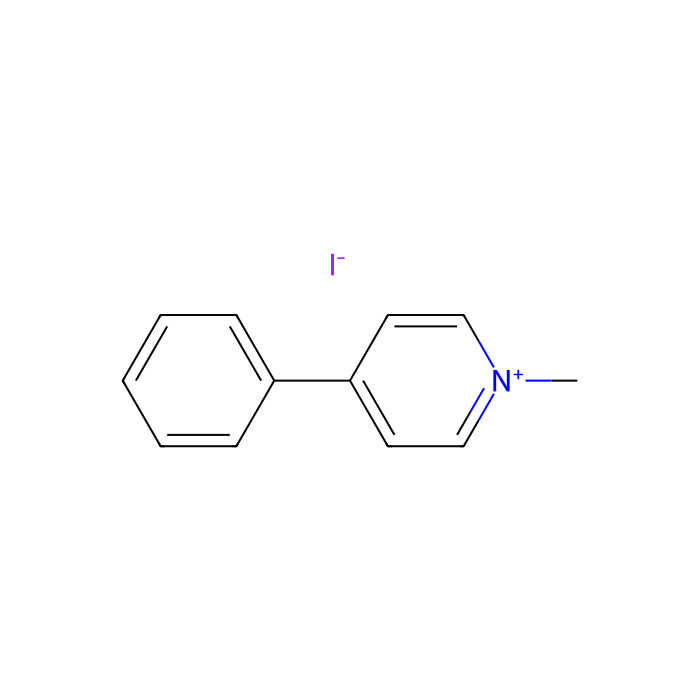
Brief description: MPP+ iodide is the quaternary ammonium salt of 1-methyl-4-phenylpyridinium paired with iodide, widely used as a research tool compound.
Item-specific identifiers (from Product Data)
SKU: N137206
CAS: 36913-39-0
InChIKey: 314784 (as provided)
Grade: Moligand™
Storage: Room temperature; shipped under normal conditions
Canonical identifiers (literature/general reference, not item-specific)
Quaternary pyridinium cation bearing a N-methyl group and a para-phenyl substituent (4-phenylpyridinium); counterion: iodide.
Permanent positive charge localized on the pyridinium nitrogen; aromatic π-system spanning phenyl–pyridinium biaryl.
2D description: a six-membered pyridinium ring with N-methyl at position 1; a phenyl ring attached at the 4-position; iodide anion associated ionically. No stereocenters; planar aromatic substructures.
Note: Where values are marked as literature, they are provided for reference only and are not specifications for this specific item.
Synthetic Utility
Limited synthetic utility. As a quaternary pyridinium salt, MPP+ iodide is:
Non-nucleophilic and only weakly coordinating due to charge delocalization on the aromatic pyridinium nitrogen.
Chemically stable under many neutral conditions but can undergo decomposition under strongly basic/nucleophilic regimes that attack the aromatic system.
Comparative note (general)
While certain pyridinium salts (e.g., Katritzky salts) are engineered as redox-activated intermediates for C–C bond formation, MPP+ lacks the activating features commonly exploited in such transformations and is primarily used as a biochemical probe rather than as a synthon.
Analytical chemistry relevance
The permanently charged cation serves as a convenient internal standard/benchmark for positive-mode ESI-MS method development in some contexts (literature), though dedicated standards are typically preferred.
If your objective is synthetic manipulation of pyridinium frameworks, consider tailored pyridinium leaving-group reagents instead of MPP+ iodide.
Target Specificity
This section applies to bioaffinity reagents (e.g., antibodies, ligands with defined biological targets) with validated specificity metrics. No such item-specific data are provided for this product.
Item-specific target, affinity (Kd), epitope, species reactivity, clone/isotype: Not specified for this item; refer to primary literature if using as a biochemical probe.
Note: While MPP+ is widely employed to perturb mitochondrial complex I activity in research, no validated “target specificity” dataset is provided for this catalog item.
We use cookies to ensure the website functions properly and, where permitted, to improve your experience. You can manage your preferences at any time in Settings. Learn more in our Cookie Policy.
Shall we send you a message when we have discounts available?
Remind me later
Thank you! Please check your email inbox to confirm.
Products are supplied to verified businesses, institutions, and qualified professionals for research and development use only. Not for use in humans, animals, diagnosis, or therapy.

 E2628601