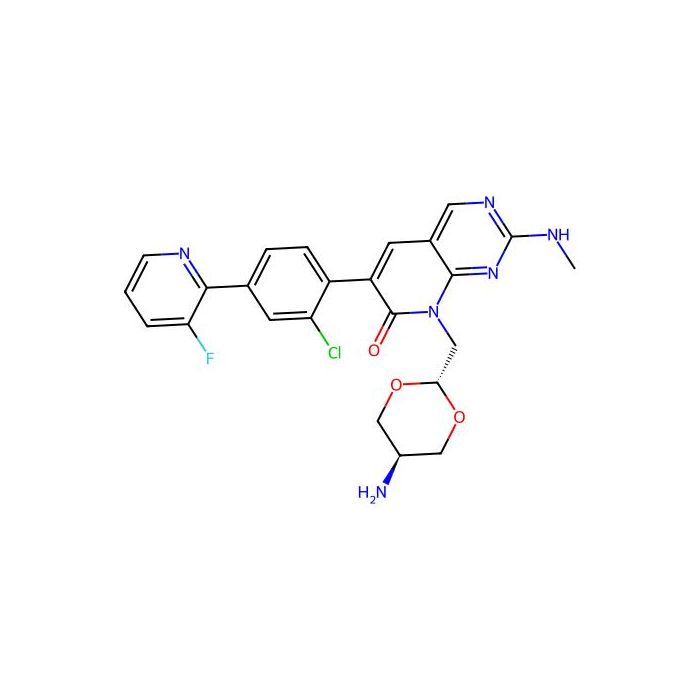
MRIA9 is an ATP-competitive, pan Salt-Inducible kinase (SIK) and PAK2/3 inhibitor, with IC 50 values of 516 nM, 180 nM and 127 nM for SIK1 , SIK2 and SIK3 , respectively
In Vitro
MRIA9 (5 μM) MRIA9 sensitizes SKOV3 cells to paclitaxel treatment through inducing pronounced apoptosis. MRIA9 (5 μM) with paclitaxel (2 nM) significantly enhances cell death in HeLa cells. MRIA9 strongly impedes centrosome function, causes mitotic spindle mispositioning in ovarian cancer cell lines, prevents the centrosome disjunction during the late G2 phase, and sensitized ovarian cancer cells and patient derived 3D-spheroids to paclitaxel treatment. MCE has not independently confirmed the accuracy of these methods. They are for reference only. Cell Viability AssayCell Line: SKOV3 cells. Concentration: 0.5-5 μM (1 nM paclitaxel). Incubation Time: 9 days. Result: Inhibited cell growth.
In Vivo
MRIA9 shows high oral bioavailability (F = 75-80%) . MCE has not independently confirmed the accuracy of these methods. They are for reference only.
Form:Solid
IC50& Target:SIK1 SIK2 SIK3
Specifications
Specifications & Purity
≥98%
Biochemical and Physiological Mechanisms
MRIA9 is an ATP-competitive, pan Salt-Inducible kinase (SIK) and PAK2/3 inhibitor, with IC 50 values of 516 nM, 180 nM and 127 nM for SIK1 , SIK2 and SIK3 , respectively.
Storage
Store at -20°C
Shipped In
Ice chest + Ice pads
This product requires cold chain shipping. Ground and other economy services are not available.
Action Type
INHIBITOR
Purity
≥98%
Names and Identifiers
Molecular Weight
496.92
Advanced Data
Certificates (CoA,COO,BSE/TSE and Analysis Chart)
C of A & Other Certificates(BSE/TSE, COO):
Analytical Chart:
Chemical and Physical Properties
Solubility
DMSO : 66.67 mg/mL (134.17 mM; Need ultrasonic)
Solution Calculators
Molarity Calculator
Determine the necessary mass, volume, or concentration for preparing a solution.
Dilution Calculator
Determine the dilution needed to prepare a stock solution.
Reconstitution Calculator
Reviews
Customer Reviews
Application Protocols
Tested applications and recommended conditions are not specified for this item; refer to CoA/Spec Sheet.
General protocols (for small-molecule research probes):
Stock preparation: Dissolve in anhydrous DMSO to 10–50 mM; vortex and, if needed, sonicate briefly. Filter through 0.22 μm PTFE for sterile applications.
Working solutions: Dilute into assay buffer or culture media, keeping final DMSO ≤0.1–1.0% (v/v) depending on system tolerance. Include a vehicle control at the highest DMSO concentration used.
Dose–response: Prepare at least 8–12 half-log dilutions for robust curve fitting; pre-incubate with biological target as assay requires.
Storage of aliquots: Keep single-use aliquots at −20°C; avoid repeated freeze–thaw.
Any cell line choices, positive controls, or assay windows specific to MRIA9 are not provided in the Product Data and should be established empirically based on your biological system.
Biological Roles
Item-specific biological target and MOA data: Not specified for this item; refer to CoA/Spec Sheet and primary literature.
General context (literature/general):
MRIA9 is cited in chemical biology literature as a small-molecule research probe. Such compounds are typically used to modulate or interrogate specific enzymatic or signaling pathways in vitro or in cellular systems.
When employing MRIA9 in biological studies, validate target engagement with orthogonal assays (e.g., biochemical potency vs. cellular readouts, CETSA, NanoBRET, or phospho-biomarker changes) and verify off-target profiles using selectivity panels when available.
Consider basic ADME properties relevant to your assay design (permeability surrogates, protein binding, chemical stability). These parameters for MRIA9 are not provided here and should be determined experimentally or sourced from the literature/CoA.
Caution:
Do not infer therapeutic relevance from research use; this product is for laboratory research only. Any biological conclusions should be supported by appropriate controls and dose–response analysis.
Buffer Applications
This item is a small-molecule research compound and is not itself a buffering agent.
No buffer capacity, pKa, or recommended buffering systems are specified for this item; refer to CoA/Spec Sheet if ionization data are provided.
For biological assays, prepare compound stocks in DMSO and dilute into your selected buffer (e.g., PBS, HEPES, Tris) keeping DMSO to assay-acceptable levels. Select buffer composition based on the biological system and the compound’s ionization (if known from literature or CoA).
If precipitation occurs upon dilution:
Extend mixing time, adjust ionic strength, or include a small amount of cosolvent (e.g., 0.1–0.5% DMSO or ethanol) compatible with your assay.
No item-specific buffer recipes are provided.
Green Alternatives
Green chemistry considerations typically focus on solvent choice and waste minimization rather than the probe molecule itself.
Stock solution solvent choices (general):
Prefer water or aqueous buffers for final dilutions when feasible.
If an organic cosolvent is required, consider ethanol or 2-propanol before high-boiling aprotics, balancing solubility and assay compatibility.
Minimize DMSO volume while ensuring complete solubilization; DMSO has favorable toxicity and environmental profiles relative to many dipolar aprotic solvents.
Small comparison (general):
DMSO: Excellent solvency; widely accepted in bioassays; readily biodegradable; high boiling point complicates removal.
Ethanol: Renewable, low toxicity; may limit maximum stock concentration; volatility simplifies removal.
2-MeTHF (for synthetic workflows, if derivatization is attempted): Bio-based alternative to THF; not typically applicable to stock preparation for biological assays but greener for any upstream chemistry.
Operational green tips:
Use microscale assay formats (96–1536 well) to cut solvent and compound consumption.
Consolidate analytical runs to reduce mobile-phase waste; favor aqueous-rich LC methods where possible.
Item-specific green metrics (E-factor, solvent maps, LCA): Not specified for this item; refer to CoA/Spec Sheet or internal sustainability assessments.
Pharmaceutical Uses
Formulation/excipient status: Not applicable—MRIA9 is supplied for research use only and is not an approved excipient or active for therapeutic use.
General considerations (research/formulation development only):
If used in pre-formulation studies or in vitro dose-form studies, characterize solubility across biorelevant media (FaSSIF/FeSSIF, pH 1–8 buffers) and assess stability (oxidative, hydrolytic, photolytic).
For in vitro delivery to cells or enzymes, DMSO stock solutions diluted into compatible assay media are typical; verify vehicle controls and adsorption to plastics.
Regulatory notes:
No pharmacopeial monograph or GMP specifications are provided for this item; not intended for human/animal administration.
Item-specific pharmaceutical data (salt form, polymorph, excipients): Not specified for this item; refer to CoA/Spec Sheet.
Physical Properties
Item-specific physico-chemical data:
Appearance: Not specified for this item; refer to CoA/Spec Sheet.
Purity/Grade: Not specified for this item; refer to CoA/Spec Sheet.
Molecular formula: Not specified for this item; refer to CoA/Spec Sheet.
Molecular weight: Not specified for this item; refer to CoA/Spec Sheet.
Melting point: Not specified for this item; refer to CoA/Spec Sheet.
Boiling point: Not applicable for most non-volatile research solids; not specified for this item; refer to CoA/Spec Sheet.
Density: Not specified for this item; refer to CoA/Spec Sheet.
pKa/logP/refractive index/UV cutoff: Not specified for this item; refer to CoA/Spec Sheet.
Solubility: Not specified for this item; refer to CoA/Spec Sheet.
General laboratory guidance (literature/general practice):
Many library compounds dissolve well in anhydrous DMSO to prepare 10–50 mM stocks; aqueous working solutions are often prepared by serial dilution into buffer containing ≤1% DMSO (v/v).
If hydrophobicity is high, cosolvents such as DMF or ethanol can aid dissolution before aqueous dilution; include surfactants (e.g., 0.01–0.05% Tween-20) only if compatible with your assay.
Verify compound identity and purity by orthogonal methods (e.g., LC–MS, 1H NMR) upon receipt if your workflow requires analytical confirmation.
Quality and Grades
Item-specific quality information:
Grade/Purity: Not specified for this item; refer to CoA/Spec Sheet.
Appearance: Not specified for this item; refer to CoA/Spec Sheet.
How to interpret grades (general guidance):
Screening/library grade materials prioritize identity and functional purity suitable for biochemical/phenotypic assays; full spectroscopic characterization may be provided on request or via CoA.
Where “analytical” or “HPLC” grade is indicated, this typically reflects tight control of organic impurities and low background for UV/fluorescence-based assays; for this item, the specific grade is not specified.
Quality control recommendations (best practices):
Verify by LC–MS to confirm molecular ion and assess purity under your assay conditions.
If chiral, confirm enantiomeric/diastereomeric ratio as needed by chiral HPLC or NMR with chiral shift reagents.
Track lot-specific data: Always consult the lot CoA for exact purity, residual solvents, and water content if applicable.
Stabilizers and additives:
Stabilizers, if any, are not specified for this item; refer to CoA/Spec Sheet. If none are listed, assume neat compound and protect from light/moisture as appropriate.
Reaction and Applications
This product is provided as a finished small-molecule research compound rather than a synthetic reagent. As such, it is not typically used as a stoichiometric reagent or catalyst in organic synthesis.
Research applications (general for small-molecule probes):
Chemical biology: Tool compound for interrogating biochemical pathways in cell-free or cellular assays, HTS, or target deconvolution workflows.
Reference standard: May serve as a reference for LC–MS method development, retention time matching, or bioanalytical calibration after proper qualification.
SAR studies: If structural analogs are available, MRIA9 can be profiled alongside to build preliminary structure–activity relationships (SAR).
Good practices:
Confirm identity/purity against CoA before use in quantitative work.
Prepare and store DMSO stocks under inert atmosphere if the compound contains oxidation-sensitive motifs (general precaution; specific sensitivity for this item is not specified).
Record exact solvent composition and final DMSO percentage in assay protocols to ensure reproducibility.
Note: No named synthetic reactions or catalytic roles are associated with MRIA9 in the Product Data; if you intend to derivatize or immobilize the compound, consult structural information from the CoA and primary literature first.
Reaction Conditions
This product is not intended as a reagent for chemical transformations; thus, no reaction conditions are specified.
If you plan to modify MRIA9 (general guidance only):
Solvents: Choose based on known functional groups (e.g., polar aprotics for SNAr on electron-poor aryl halides; alcoholic solvents for O-alkylations). Without structural data, selection must be guided by CoA/literature structure.
Temperatures: Begin with mild conditions (20–60°C) and escalate as needed while monitoring by LC–MS.
Catalysts/bases/acids: Select to match functional group chemistry; use mild bases (K2CO3, DIPEA) or acids (TFA, TsOH) when stability is unknown.
Atmosphere: Use inert gas for air- or moisture-sensitive motifs.
Item-specific reaction parameters, yields, or purification methods: Not specified for this item; refer to CoA/Spec Sheet and literature if undertaking custom synthesis.
Safety and Handling
Regulatory/SDS status:
GHS classification, pictograms, signal word, and H-statements: Not specified for this item; refer to SDS.
Research Use Only: For research use only (not for human or veterinary use).
General laboratory precautions (good practice for small organic molecules):
PPE: Use lab coat, safety glasses, and appropriate chemically resistant gloves (e.g., nitrile). Handle powders in a fume hood to minimize inhalation of dust/aerosols.
Avoid ingestion, inhalation, and skin/eye contact. Wash thoroughly after handling. Prevent environmental release.
Storage incompatibilities: Keep away from strong oxidizers, strong acids/bases, and sources of ignition. Avoid prolonged exposure to light and moisture unless stability data indicate otherwise.
First-aid overview: In case of skin/eye contact, rinse with water for at least 15 minutes and remove contaminated clothing. If inhaled, move to fresh air. If ingested, rinse mouth; do not induce vomiting; seek medical attention. Always consult the SDS for authoritative guidance.
Spill and disposal:
Small spills: Absorb with inert material, collect in chemical waste container. Decontaminate surfaces.
Disposal: Dispose of contents/container in accordance with local/regional/national regulations. Label waste with CAS and product name.
Transport/shipping:
Shipped in ice chest with ice pads to limit thermal excursions; check package promptly upon arrival.
Solvent Selection
Item-specific solubility data: Not specified for this item; refer to CoA/Spec Sheet.
General solvent strategy for small-molecule probes:
Primary solvent: Anhydrous DMSO is the default for preparing concentrated stocks (e.g., 10–50 mM), thanks to its high polarity and broad solvation capability.
Secondary solvents: DMF and ethanol can assist with dissolution for hydrophobic or crystalline compounds. For highly lipophilic compounds, consider NMP or isopropanol as intermediate cosolvents.
Aqueous use: Prepare final working solutions by diluting DMSO stocks into buffer or media, keeping final DMSO ≤0.1–1.0% (v/v) depending on biological tolerance.
Practical tips:
Sonication and gentle warming (e.g., 25–37°C) can aid dissolution; avoid excessive heat that may degrade sensitive scaffolds.
Filter sterilize (0.22 μm PTFE) if sterility is required and the compound is stable.
Check for precipitation upon cooling or aqueous dilution; if observed, increase dilution time, adjust pH (if ionizable groups are known), or add a minimal amount of cosolvent.
Comparison (general):
DMSO vs DMF: DMSO offers broader biocompatibility; DMF sometimes dissolves more stubborn solids but is less favored in cellular assays.
Ethanol: Useful for moderately polar organics; volatility can simplify removal but may limit high stock concentrations.
Storage and Reconstitution
Item-specific storage and shipping (from Product Data):
Storage Conditions: Store at −20°C.
Shipped In: Ice chest + ice pads.
General best practices for small-molecule probes:
Protect from moisture and light. Store in a tightly closed container, preferably under inert atmosphere for oxidation-sensitive scaffolds (specific sensitivity for this item is not specified; refer to CoA/Spec Sheet).
Upon first use, allow container to equilibrate to room temperature before opening to prevent condensation.
Reconstitution (general guidance):
Solvent: Use anhydrous DMSO to prepare a concentrated stock (e.g., 10–50 mM), unless the CoA specifies otherwise.
Technique: Add solvent incrementally with vortexing; brief sonication or gentle warming (25–37°C) can assist dissolution.
Aliquoting: Prepare single-use aliquots to avoid multiple freeze–thaw cycles.
Storage of solutions: Store DMSO stocks at −20°C (or −80°C for long-term) in amber vials; verify stability periodically by LC–MS/LC–UV.
Item-specific stability, hygroscopicity, and solubility limits: Not specified for this item; refer to CoA/Spec Sheet. Always consult the SDS for safe handling during reconstitution.
Structure and Identity
Concise identity summary for a small-molecule screening compound.
SKU: M651167
Product Name: MRIA9
CAS: 2750707-05-0
Category: Small molecules and compound libraries (研究/筛选用途)
Item-specific identifiers (from Product Data):
Molecular formula: Not specified for this item; refer to CoA/Spec Sheet.
Molecular weight: Not specified for this item; refer to CoA/Spec Sheet.
SMILES: Not specified for this item; refer to CoA/Spec Sheet.
InChIKey: Not specified for this item; refer to CoA/Spec Sheet.
Structural description:
Functional groups, ring systems, and stereochemistry: Not specified for this item; refer to CoA/Spec Sheet.
General notes (literature/contextual):
MRIA9 is referenced in the chemical biology literature as a small-molecule research probe. Specific structural features and target annotations should be confirmed from primary references or the product CoA before use in SAR, docking, or analytical method development.
Synthetic Utility
MRIA9 is sold as a finished small-molecule probe, not as a building block or reagent.
Functional groups available for derivatization, handles for bioconjugation, or protecting-group strategies: Not specified for this item; refer to CoA/Spec Sheet.
General guidance if derivatization is contemplated (literature/general):
Confirm the presence and accessibility of potential handles (e.g., anilines, phenols, halides) from structural data before attempting analog synthesis or linker installation.
For SAR exploration, maintain key pharmacophores while varying peripheral substituents; use parallel or microwell synthesis for rapid iteration if permitted by IP and research scope.
If immobilization (e.g., affinity resins) is needed, select an attachment point distal to putative binding motifs to preserve activity; validate with activity assays.
Given the absence of item-specific structural details in the Product Data, no named reactions or routes are recommended here.
Target Specificity
Item-specific biological target(s), selectivity profile, and binding constants are not provided in the Product Data for MRIA9.
Target annotations (e.g., enzyme/receptor/kinase) and selectivity windows: Not specified for this item; refer to CoA/Spec Sheet and peer-reviewed literature.
Species cross-reactivity and off-target screening panels: Not specified for this item; refer to CoA/Spec Sheet.
Note: This section is typically applicable to biologics/antibodies or well-characterized chemical probes with published target data. In the absence of such data here, users should consult primary literature or conduct in-house profiling (e.g., kinase panels, receptor binding assays) as appropriate.
Frequently Asked Questions
What is the purity of this product?
This product is supplied at ≥98% purity (chemical assay). Lot-specific values are stated on the Certificate of Analysis.
How should this product be stored?
Store at ?20 °C. Freezer storage is required to maintain the specified shelf life.
How is this product shipped?
This product ships in an insulated container with ice pads. Unpack on arrival and transfer it to the storage condition stated above.
What are the CAS number, molecular formula and molecular weight?
The CAS Number is 2750707-05-0, the molecular formula is C24H22ClFN6O3, and the molecular weight is 496.92 g/mol.
What documentation is provided?
Available product documentation, including Certificates of Analysis (COA), Safety Data Sheets (SDS), and specification sheets, is shown in the product document area. Document availability and access follow the current site policy.
We use cookies to ensure the website functions properly and, where permitted, to improve your experience. You can manage your preferences at any time in Settings. Learn more in our Cookie Policy.
Shall we send you a message when we have discounts available?
Remind me later
Thank you! Please check your email inbox to confirm.
Products are supplied to verified businesses, institutions, and qualified professionals for research and development use only. Not for use in humans, animals, diagnosis, or therapy.