MRS 1191 - Moligand™, ≥95% , Antagonist of A 1 receptor;Antagonist of A 2A receptor;Antagonist of A 2B receptor;Antagonist of A 3 receptor, CAS No.185222-90-6, Antagonist of A 1 receptor;Antagonist of A 2A receptor;Antagonist of A 2B receptor;Antagonist of A 3 receptor
MRS 1191 - Moligand™, ≥95% , Antagonist of A 1 receptor;Antagonist of A 2A receptor;Antagonist of A 2B receptor;Antagonist of A 3 receptor, CAS No.185222-90-6, Antagonist of A 1 receptor;Antagonist of A 2A receptor;Antagonist of A 2B receptor;Antagonist of A 3 receptor
GRADE & PURITYMoligand™?Moligand™ — Aladdin's line of ligands and bioactive small molecules. Use for receptor, pathway, and binding studies needing defined small-molecule tools.≥95%
A selective A3 adenosine receptor antagonist. Selective for both human and rat.
Specifications
Synonyms
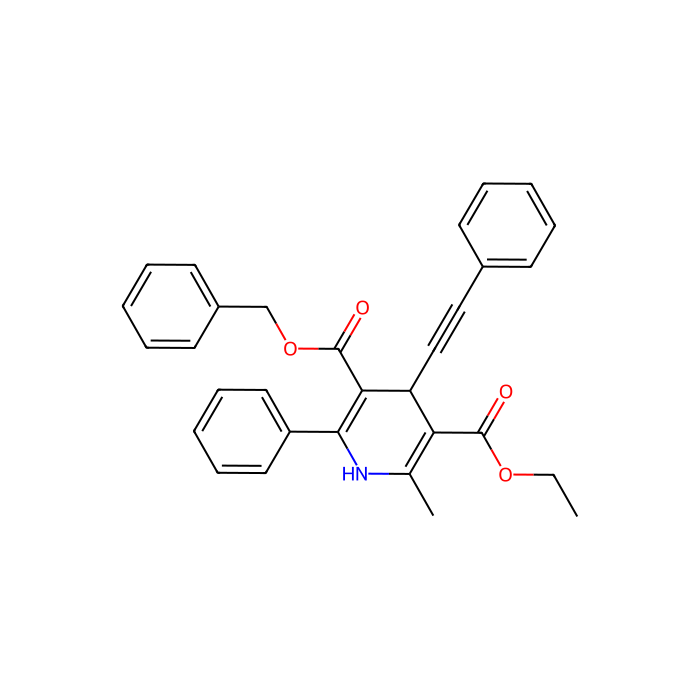
3-Benzyl 5-ethyl 6-methyl-2-phenyl-4-(phenylethynyl)-1,4-dihydropyridine-3,5-dicarboxylate | MRS1191 | MRS-1191 | MRS 1191, solid | 3-Ethyl-5-benzyl-2-methyl-4-phenylethynyl-6-phenyl-1,4-(+/-)-dihydropyridine-3,5-dicarboxylate | 3-Benzyl5-ethyl6-methyl-2-phenyl-4-(phenylethynyl)-1,4-dihydropyridine-3,5-dicarboxylate | MRS 1191 | Danish ag Show more
Specifications & Purity
Moligand™, ≥95%
Biochemical and Physiological Mechanisms
MRS 1191 is putative A3 adenosine receptor antagonist, highly selective for human A3 receptor vs human A1 receptor. MRS 1067, MRS 1191 and MRS 1220 were found to be competitive in saturation binding studies using the agonist radioligand [125I]AB-MECA at cloned human brain A3 receptors expressed in HEK-293 cells. Antagonism was demonstrated in functional assays consisting of agonist-induced inhibition of adenylate cyclase and the stimulation of binding of [35S]guanosine 5′-O-(3-thiotriphosphate) ([35S]GTP-gamma-S) to the associated G-proteins. Activation of the human A3 receptor in A3R-CHO results in markedly impaired cell cycle progression, suggesting an important role for this adenosine receptor subtype in cell cycle regulation and cell growth. Activation of adenosine A3 receptors by Cl-IBMECA (100 nM) increased the magnitude of theta-burst induced LTP (from 1.2+/-0.6% in the control solution to 25.5+/-0.8% in the presence of Cl-IBMECA) and attenuated LTD (from 30.0+/-5.5% decrease in the control solution to 13.6+/-6.6% decrease in the presence of Cl-IBMECA). The selective adenosine A3 receptor antagonist, MRS 1191 (5-10 μM), prevented the effects of Cl-IBMECA. These findings indicate a functional role for adenosine A3 receptors in the modulation of synaptic plasticity.
Storage
Store at -20°C
Shipped In
Ice chest + Ice pads
This product requires cold chain shipping. Ground and other economy services are not available.
Grade
Moligand™
Action Type
ANTAGONIST
Mechanism of action
Antagonist of A 1 receptor;Antagonist of A 2A receptor;Antagonist of A 2B receptor;Antagonist of A 3 receptor
This compound belongs to the class of organic compounds known as cinnamic acid esters. These are compound containing an ester derivative of cinnamic acid.
External Descriptors
Not available
1. Djoumbou Feunang Y, Eisner R, Knox C, Chepelev L, Hastings J, Owen G, Fahy E, Steinbeck C, Subramanian S, Bolton E, Greiner R, and Wishart DS. ClassyFire: Automated Chemical Classification With A Comprehensive, Computable Taxonomy. Journal of Cheminformatics, 2016, 8:61.
We use cookies to ensure the website functions properly and, where permitted, to improve your experience. You can manage your preferences at any time in Settings. Learn more in our Cookie Policy.
Shall we send you a message when we have discounts available?
Remind me later
Thank you! Please check your email inbox to confirm.
Products are supplied to verified businesses, institutions, and qualified professionals for research and development use only. Not for use in humans, animals, diagnosis, or therapy.

 F2525396