GRADE & PURITYMoligand™?Moligand™ — Aladdin's line of ligands and bioactive small molecules. Use for receptor, pathway, and binding studies needing defined small-molecule tools.10 mM in DMSO
Determine the necessary mass, volume, or concentration for preparing a solution.
Dilution Calculator
Determine the dilution needed to prepare a stock solution.
Reconstitution Calculator
Reviews
Customer Reviews
Application Protocols
Validated application protocols, recommended concentrations, and assay formats are not specified for this item.
General guidance for small-molecule research ligands (not item-specific):
Stock preparation: dissolve in anhydrous DMSO to prepare concentrated stocks (e.g., 10–50 mM), verify complete dissolution visually, and store as single-use aliquots at low temperature to avoid multiple freeze–thaw cycles.
Assay dilution: serially dilute in DMSO, then transfer to assay buffer to achieve desired final concentrations, keeping the final DMSO constant across all conditions (commonly 0.1–0.5% v/v in cell-based assays).
Controls: include vehicle controls and, where available, reference ligands to benchmark assay window and signal-to-background.
Analytics: confirm on-plate compound concentration and stability when results are sensitive to exact dosing (e.g., LC/MS of spiked wells or stability samples).
Please consult your institutional SOPs and the item’s CoA/SDS for any handling specifics. For detailed, application-specific protocols, refer to peer-reviewed literature relevant to your assay platform.
Biological Roles
Biological context (general background; not specific to this item):
Adenosine is an endogenous purinergic signaling molecule acting through four GPCR subtypes (A1, A2A, A2B, and A3). These receptors modulate cAMP levels and influence diverse processes including neurotransmission, inflammatory signaling, and vascular tone in a context-dependent manner.
Xanthine derivatives (e.g., caffeine, theophylline) historically serve as chemical probes of adenosine receptor function. Modern derivatives are used in receptor binding and functional assays to interrogate subtype-selective signaling.
In cellular systems, assay readouts commonly include cAMP accumulation, calcium flux (via pathway coupling), beta-arrestin recruitment, and ERK phosphorylation, depending on the engineered pathway.
How such ligands are typically used (general):
As reference tools in receptor pharmacology to define assay performance, examine pathway bias, and benchmark selectivity across receptor panels.
In systems biology, ligands help map network responses under controlled perturbations, enabling quantitative modeling of signaling dynamics.
Important note:
No item-specific biological target, potency, or selectivity data are provided here. Users should consult the primary literature or the item’s CoA/Spec Sheet for definitive, batch-relevant biological characterization before experimental design.
Buffer Applications
This product is a small-molecule research ligand and does not function as a classical buffer component.
General guidance for using small molecules in buffered systems (not item-specific):
Prepare concentrated DMSO stocks and dilute into pre-warmed assay buffers (e.g., HBSS, PBS, or HEPES-buffered media) while maintaining a constant final DMSO percentage across control and treatment wells.
Common biological buffers: HEPES (effective pH ~6.8–8.2), phosphate buffer (PB/PBS; pH ~6.0–8.0), and bicarbonate/CO2 systems for cell culture. Selection depends on assay type and CO2 incubation.
To mitigate precipitation: add compound last with rapid mixing; consider 0.01–0.05% non-ionic surfactant if compatible with the assay.
For analytical buffers (LC/MS):
Volatile systems (water–acetonitrile with 0.1% formic acid or 5–10 mM ammonium acetate) are commonly used for reversed-phase separations of heteroaromatics.
Item-specific buffer recipes, pH ranges, and compatibility are not specified for this product.
Green Alternatives
Because MRS 1754 is a bioactive small molecule rather than a solvent or bulk reagent, “green alternative” discussion focuses on greener handling and solvent strategies in its use.
Greener solvent strategies (general, not item-specific):
Prefer water-based assay buffers with minimal DMSO content (≤0.1–0.5% v/v) while maintaining solubility.
For preparative purification, use water-rich gradients and volatile, less toxic modifiers (e.g., formic acid, ammonium acetate) instead of non-volatile salts.
When feasible, replace DMF/NMP with ethanol or isopropanol co-solvent systems for dissolution and crystallization steps, acknowledging potential solubility limitations.
Small comparison (general solvent considerations):
DMSO vs. DMF: DMSO offers superior biocompatibility at low percentages; DMF is generally avoided in cell-based assays due to higher cytotoxicity.
ACN vs. MeOH for LC: acetonitrile provides lower backpressure and often better peak shape; methanol is more benign but may require higher pressures and can alter selectivity.
Operational green practices:
Aliquot concentrated stocks to reduce freeze–thaw and waste.
Use microscale assay formats (384/1536-well) to minimize solvent and compound consumption.
Apply closed-vial transfers (liquid handlers, pin tools) to limit exposure and evaporative losses.
Pharmaceutical Uses
This product is supplied strictly for research use only and is not intended for human or veterinary use, diagnostics, or as an excipient in commercial formulations.
General, non-clinical context (not item-specific):
Bioactive small molecules are often used in pre-formulation and discovery studies to assess solubility, stability, permeability, and protein binding. Screening of salt forms or co-crystals may be conducted to improve physicochemical properties for research models.
Typical research formulation vehicles for in vivo exploratory work (institutional approval required) include aqueous buffers with limited DMSO, PEG400, or cyclodextrin complexes; however, such practices must follow institutional IACUC/ethics and are outside the scope of this product listing.
Regulatory/compendial status:
No pharmacopeial monograph or excipient status is provided. Any pharmaceutical application would require independent qualification and is not covered by the Moligand™ grade.
Conclusion:
Treat this material solely as a laboratory research chemical. For any application approaching GLP/GMP or clinical development, source material with appropriate regulatory documentation and quality systems.
Physical Properties
Only item-specific physical property data from the Product Data will be listed as such. Where the Product Data is silent, literature or general expectations for small heteroaromatic research ligands are noted and explicitly labeled.
Item-specific (from Product Data):
Appearance: Not specified for this item; refer to CoA/Spec Sheet.
Literature/general expectations for xanthine-like small molecules (not item-specific):
Physical state: often crystalline or amorphous solid.
Solubility: frequently soluble in polar aprotic solvents (e.g., DMSO, DMF) and alcohols; low aqueous solubility at neutral pH is common for hydrophobic xanthine derivatives. Actual solubility for this item must be verified experimentally or via CoA.
pKa/logP: xanthine cores are weakly basic/acidic depending on substitution; many derivatives present moderate lipophilicity (logP ~1–3, literature). Values for this specific item are not provided and may differ.
Melting point, boiling point, density, refractive index: Not specified for this item; refer to CoA/Spec Sheet.
Practical notes (general):
Prepare concentrated stock solutions in anhydrous DMSO when aqueous solubility is limited; dilute into assay buffers with vigorous mixing to prevent precipitation.
Filter (0.2 µm PTFE) if particulate persists after dissolution. Always record final DMSO percentage for biological assay controls.
Quality and Grades
Grade: Moligand™
About Moligand™ grade (general description):
The Moligand™ designation indicates inclusion in a curated small-molecule/compound library format suitable for ligand screening, target interrogation, and SAR studies in discovery research. Typical expectations include verified identity and library-ready presentation; however, exact specifications (e.g., purity threshold, salt form, counterions, residual solvents, water content, or stabilizers) are not itemized here and must be confirmed on the CoA/Spec Sheet for this lot.
What this means in practice:
Identity and format: provided as a research-grade small molecule intended for high-throughput or targeted screening workflows. Aliquoting and barcoding may be used to minimize freeze-thaw.
Analytical package: CoA typically includes identity confirmation (e.g., LC/MS, HPLC/UPLC chromatogram) and may include purity by area %. If specific purity or analytical methods are required (HPLC vs. qNMR), consult the CoA or request documentation prior to experimental use.
Stabilizers: Not specified for this item; refer to CoA/Spec Sheet.
Salt form/hydrate: Not specified for this item; refer to CoA/Spec Sheet.
Recommendations:
If low-UV background or chromatography-grade attributes are critical, perform in-house qualification (UV scan, LC baseline) because the Moligand™ grade prioritizes screening utility rather than chromatographic solvent-grade criteria.
Reaction and Applications
This item is supplied as a research ligand (Moligand™ grade) rather than a synthetic reagent. Consequently, its principal applications are in discovery biology/chemistry workflows rather than as a reaction solvent or reagent.
Typical research uses (general, literature-based; not item-specific):
Tool compound in receptor pharmacology, pathway interrogation, and phenotypic screening.
Benchmark control in bioassays to define assay windows, validate readouts, or calibrate potencies in structure–activity relationship (SAR) studies.
Reference ligand for selectivity profiling panels in GPCR-focused discovery work.
If used in chemical experiments:
Stability considerations: heteroaromatic ligands with multiple H-bond acceptors/donors can undergo hydrolysis or oxidative degradation under strong acidic/basic or oxidative conditions.
Purification: if further derivatization is attempted, reversed-phase preparative HPLC with water/acetonitrile + volatile buffers (e.g., formic acid or ammonium bicarbonate) is commonly effective for polar xanthine derivatives.
Non-applicability note:
This product is not typically employed as a reagent in named organic transformations (e.g., cross-coupling, Grignard). For reaction chemistry guidance, see Synthetic Utility and Reaction Conditions sections for general considerations only.
Reaction Conditions
This product is not supplied for use as a reagent in standard organic transformations. If researchers pursue synthetic modification or analytical method development involving this scaffold, the following general, literature-based guidance applies (not item-specific):
Dissolution for reactions: DMSO, DMF, or acetonitrile are frequent choices for heteroaromatic couplings and amide formations; ensure rigorous drying when moisture-sensitive reagents are used.
Temperatures: many couplings (amide formations, urea/carbamate formations) proceed at room temperature to 80°C depending on coupling system (e.g., HATU, EDCI, or CDI). For cross-couplings on halogenated precursors, 50–120°C with Pd catalysts is typical.
Bases: DIPEA, triethylamine, or inorganic bases (K2CO3, Cs2CO3) depending on transformation and solvent compatibility.
Atmosphere: inert gas (N2/Ar) for moisture/oxygen-sensitive steps; protect from prolonged light exposure when chromophoric substituents are present.
Workup: quench into water, extract with EtOAc or n-BuOH as appropriate, and purify via reversed-phase HPLC when normal-phase silica gives poor recovery.
Note: No reaction yields, kinetics, or item-specific reactivity are specified for this product. Perform small-scale scouting experiments to establish conditions and assess stability.
Safety and Handling
Authoritative safety information is contained in the Safety Data Sheet (SDS). The following guidance is general and not a substitute for the SDS.
GHS/label elements (item-specific):
Signal word: Not specified for this item; refer to SDS.
Hazard statements (H-codes): Not specified for this item; refer to SDS.
GHS classification and pictograms: Not specified for this item; refer to SDS.
General laboratory precautions for small-molecule research ligands:
PPE: wear lab coat, safety glasses, and appropriate chemically resistant gloves (e.g., nitrile). Avoid inhalation of dust and contact with skin/eyes.
Engineering controls: handle powders in a fume hood or ventilated enclosure to minimize airborne dust; use micro-spatulas and antistatic precautions when aliquoting.
Hygiene: wash hands after handling; avoid ingestion and cross-contamination of common equipment.
Incompatibilities: strong oxidizers and strong acids/bases may degrade heteroaromatic compounds; avoid prolonged exposure to light and moisture.
Thermal sensitivity: many bioactive ligands degrade on repeated warming; keep cold during handling and return promptly to storage.
First-aid (general):
Eye/skin contact: rinse with water for at least 15 minutes; remove contaminated clothing.
Inhalation: move to fresh air; seek medical advice if symptoms persist.
Ingestion: rinse mouth; seek medical attention.
Disposal: collect as organic laboratory chemical waste according to institutional and local regulations.
Solvent Selection
Solvent choice for MRS 1754 should be guided by its behavior as a heteroaromatic small molecule typically used in discovery assays.
Item-specific solubility is not provided. The following are general, literature-based practices for xanthine-like bioactive ligands (not item-specific):
Primary stock solvent: anhydrous DMSO is commonly used due to high solvating power for heteroaromatics and compatibility with most biochemical assays up to 0.1–1% v/v.
Alternative solvents: DMF and NMP offer similar solvating strength but may be less compatible with biological systems; ethanol or methanol can be used for intermediate stocks when acceptable.
Aqueous buffers: direct dissolution into water or PBS often leads to precipitation; pre-dissolve in DMSO and dilute with vigorous mixing. Consider co-solvents (≤10% v/v) or surfactants (e.g., 0.01–0.1% Tween-20) if permitted by the assay.
pH adjustment: for ionizable compounds, solubility may improve at basic or acidic pH; verify chemical stability before adjusting.
Quick comparison (general):
DMSO: highest success rate for initial dissolution; widely assay-compatible at low %.
Ethanol: good for intermediate stocks; higher volatility simplifies removal but can affect cells above low %.
DMF/NMP: strong solvents, but greater cytotoxicity risk in bioassays.
Practical tips:
Warm gently (room temperature to 37°C) and vortex/sonicate to aid dissolution; avoid prolonged heating. Filter through 0.2 µm PTFE if needed.
Storage and Reconstitution
Item-specific storage and shipping:
Storage conditions: Store at -80°C (from Product Data). Minimize freeze–thaw by aliquoting.
Shipped in: Dry ice packs + Cold packs (from Product Data). Inspect immediately upon receipt and return to -80°C storage.
General reconstitution guidance for small-molecule library compounds (not item-specific):
Solvent: use anhydrous DMSO to prepare concentrated stock solutions. If aqueous use is required, dilute DMSO stocks into buffer with vigorous mixing. Verify solubility visually; if needed, warm gently and sonicate.
Working stocks: prepare intermediate stocks at convenient concentrations (e.g., 1–5 mM in DMSO) and store as single-use aliquots to avoid repeated freeze–thaw.
Stability: protect from light and moisture. Record preparation date and track cumulative time at room temperature. If precipitation occurs upon dilution, reoptimize solvent composition or concentration.
Containers: use low-bind polypropylene tubes or amber glass vials to reduce adsorption and light exposure.
Expiration/retention:
No item-specific shelf-life is provided; reassess by LC/MS or HPLC before critical experiments if stored for extended periods. Always defer to the CoA for any lot-specific re-test dates.
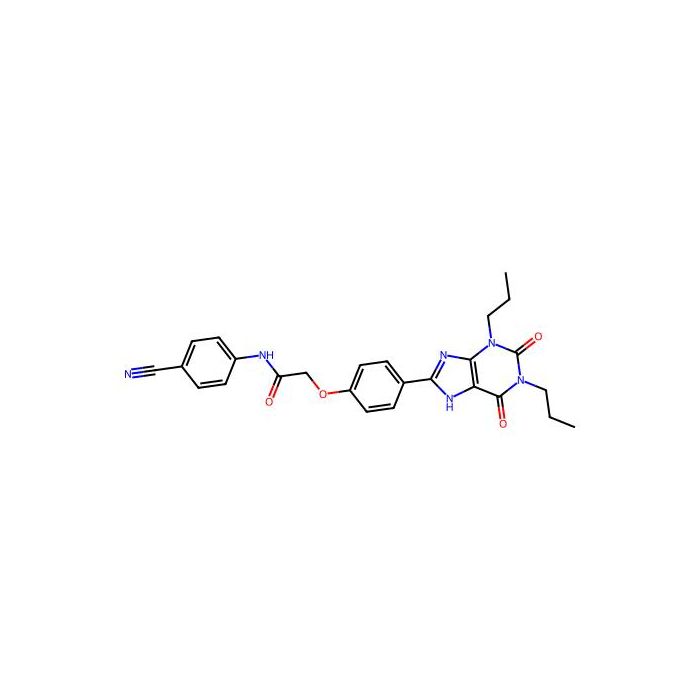
Structure and Identity
Overview of identity for MRS 1754 (SKU M1496877) as supplied by Aladdin Scientific.
Product name: MRS 1754
CAS: 264622-58-4
CID: 6603931 (literature identifier)
Molecular formula: Not specified for this item; refer to CoA/Spec Sheet.
Molecular weight: Not specified for this item; refer to CoA/Spec Sheet.
SMILES: Not specified for this item; refer to CoA/Spec Sheet.
InChIKey: Not specified for this item; refer to CoA/Spec Sheet.
Structural features (general, literature-based, not item-specific):
MRS 1754 is reported in the literature as a xanthine-derived small molecule used as a research ligand. Xanthines feature a fused imidazole–pyrimidinedione core (purine-2,6-dione) with N-1, N-3 substituents and an 8-position aryl/alkyl substituent. Exact substitution patterns and stereochemistry should be confirmed from the item’s CoA/SDS.
Typical 2D depiction (literature): planar heteroaromatic purine-dione core bearing carbonyl groups, appended aromatic/alkyl side chains that modulate polarity and receptor affinity.
Notes:
For definitive structure, confirm the batch-specific documentation (CoA/SDS). All identifiers not explicitly listed above should be treated as literature references rather than item specifications.
Synthetic Utility
As a finished bioactive ligand, MRS 1754 is not primarily intended as a synthetic building block. Nevertheless, general considerations for xanthine-like scaffolds are provided for researchers exploring derivatization (general, not item-specific):
Core reactivity: the purine-2,6-dione (xanthine) core features multiple N-sites that can be selectively alkylated or acylated depending on protecting group strategy and base choice. Electrophilic substitution at the 8-position is commonly exploited via cross-coupling on halogenated precursors.
Late-stage diversification: amide couplings on pendant anilide/benzanilide motifs and urea/carbamate formations enable SAR exploration around H-bond donors/acceptors.
Purification: polar, heteroatom-rich derivatives typically require reversed-phase chromatography; ion-pairing is sometimes used analytically but avoided preparatively in favor of volatile buffers.
Analytical characterization: LC/MS, HRMS, and 1H/13C NMR with DMSO-d6 or CD3OD are standard; variable-temperature NMR can help with conformational exchange broadening.
Caveats:
Precise functional groups and positions for this specific item are not provided here; consult literature and the CoA if derivatization is planned. Verify that any transformations do not compromise the intended bioactivity profile.
Target Specificity
Item-specific target information (e.g., biological target, selectivity profile, binding constants, tested species/cell lines) is not provided in the Product Data for MRS 1754.
Not specified for this item; refer to CoA/Spec Sheet and primary literature for any target-related characterization relevant to your application.
Frequently Asked Questions
What is Moligand??
Moligand? is one of Aladdin Scientific's premium product lines, formulated for high-purity applications across multiple workflows. Compared to standard grades in the same workflow, Moligand? products typically offer tighter specifications, more rigorous QC, and stronger lot-to-lot consistency.
How should this product be stored?
Store at ?80 °C. Ultra-low temperature storage is required to maintain the specified shelf life.
How is this product shipped?
This product ships frozen with dry ice and cold packs. Unpack on arrival and transfer it to the storage condition stated above; handle dry ice with insulated gloves in a ventilated area.
What are the CAS number, molecular formula and molecular weight?
The CAS Number is 264622-58-4, the molecular formula is C26H26N6O4, and the molecular weight is 486.52 g/mol.
What documentation is provided?
Available product documentation, including Certificates of Analysis (COA), Safety Data Sheets (SDS), and specification sheets, is shown in the product document area. Document availability and access follow the current site policy.
Need help choosing the grade?
Our grade selection guide covers purity, stabilizer status, and application suitability for all variants in our catalog.
We use cookies to ensure the website functions properly and, where permitted, to improve your experience. You can manage your preferences at any time in Settings. Learn more in our Cookie Policy.
Shall we send you a message when we have discounts available?
Remind me later
Thank you! Please check your email inbox to confirm.
Products are supplied to verified businesses, institutions, and qualified professionals for research and development use only. Not for use in humans, animals, diagnosis, or therapy.