Determine the necessary mass, volume, or concentration for preparing a solution.
for protein sequencing, ≥99.8%(GC) for Protein sequencing for sensitive chromatographic and analytical workflows requiring minimal baseline interference.
Protected from light,Room temperature Ships FedEx DG Service Check lot-specific COA for exact specifications.
SDS, COA, datasheet, and spec sheet available for download. Lot-specific COA accessible via lot number lookup.
Cited in 69 peer-reviewed publications across chromatography, organic synthesis, and cross-coupling reactions.
Comprehensive hazard, handling, storage, and regulatory compliance document.
Download SDS →Lot-specific quality data. Enter your lot number to retrieve the exact COA.
Look up COA →Full quality attributes and acceptance criteria for this grade.
View spec sheet →Taxonomy Tree
| Kingdom | Organic compounds |
|---|---|
| Superclass | Organoheterocyclic compounds |
| Class | Oxazinanes |
| Subclass | Morpholines |
| Intermediate Tree Nodes | Not available |
| Direct Parent | Morpholines |
| Alternative Parents | Trialkylamines Oxacyclic compounds Dialkyl ethers Azacyclic compounds Organopnictogen compounds Hydrocarbon derivatives |
| Molecular Framework | Aliphatic heteromonocyclic compounds |
| Substituents | Morpholine - Tertiary aliphatic amine - Tertiary amine - Oxacycle - Azacycle - Ether - Dialkyl ether - Organic nitrogen compound - Organic oxygen compound - Organopnictogen compound - Hydrocarbon derivative - Organooxygen compound - Organonitrogen compound - Amine - Aliphatic heteromonocyclic compound |
| Description | This compound belongs to the class of organic compounds known as morpholines. These are organic compounds containing a morpholine moiety, which consists of a six-member aliphatic saturated ring with the formula C4H9NO, where the oxygen and nitrogen atoms lie at positions 1 and 4, respectively. |
| External Descriptors | Not available |
Find and download the COA for your product by matching the lot number on the packaging.
| Lot Number | Certificate Type | Date | Item |
|---|---|---|---|
| Certificate of Analysis | Aug 11, 2025 | M104644 | |
| Certificate of Analysis | Dec 25, 2023 | M104644 | |
| Certificate of Analysis | Dec 25, 2023 | M104644 | |
| Certificate of Analysis | Dec 25, 2023 | M104644 | |
| Certificate of Analysis | Dec 25, 2023 | M104644 | |
| Certificate of Analysis | Dec 25, 2023 | M104644 | |
| Certificate of Analysis | Dec 25, 2023 | M104644 | |
| Certificate of Analysis | Dec 25, 2023 | M104644 | |
| Certificate of Analysis | Dec 25, 2023 | M104644 | |
| Certificate of Analysis | Sep 21, 2022 | M104644 | |
| Certificate of Analysis | Sep 21, 2022 | M104644 | |
| Certificate of Analysis | Sep 21, 2022 | M104644 |
| Solubility | Miscible with water, soluble in benzene. |
|---|---|
| Sensitivity | Light sensitive. |
| x_refractive_index | 1.4332 |
| x_flash_point_drop_centigrade | 12℃ |
| x_boil_point_char | 111-114°C |
| x_melt_point_char | -65°C |
| Molecular Weight | 101.150 g/mol |
| XLogP3 | -0.300 |
| Hydrogen Bond Donor Count | 0 |
| Hydrogen Bond Acceptor Count | 2 |
| Rotatable Bond Count | 0 |
| Exact Mass | 101.084 Da |
| Monoisotopic Mass | 101.084 Da |
| Topological Polar Surface Area | 12.500 Ų |
| Heavy Atom Count | 7 |
| Formal Charge | 0 |
| Complexity | 50.000 |
| Isotope Atom Count | 0 |
| Defined Atom Stereocenter Count | 0 |
| Undefined Atom Stereocenter Count | 0 |
| Defined Bond Stereocenter Count | 0 |
| Undefined Bond Stereocenter Count | 0 |
| The total count of all stereochemical bonds | 0 |
| Covalently-Bonded Unit Count | 1 |
No manufacturer-validated biological assay protocols are provided for this reagent. As a small-molecule base/catalyst, usage is protocol-specific to the reaction.
Illustrative literature-style procedures (for planning; adjust to your system):
Note: These are generalized examples; substrate-specific optimization is essential. For analytical workflows and sequencing, consult your method SOP and ensure compatibility with detection (e.g., remove residual amine prior to LC–MS).
This product is a synthetic tertiary amine used as a reagent; it has no known native biological role.
Biochemical context (literature):
Metabolism/biotransformation: Not a natural metabolite. Aliphatic tertiary amines can undergo N-oxidation (e.g., to N-oxide) or dealkylation under oxidative conditions; these pathways are relevant to environmental fate rather than physiology.
Enzyme/target interactions: No specific enzymatic cofactor or receptor function is associated with NMM.
Note: All uses are for research or laboratory processing; this reagent is not intended for use in humans or animals.
N-Methyl morpholine is not a standard biological buffer. While its conjugate acid has a pKa around 7.4 (literature), making buffering near neutral pH theoretically possible, practical use as a routine buffer is uncommon due to volatility, odor, and interference with enzymes and assays.
For biological samples, choose established Good’s buffers (HEPES, MOPS, PIPES) or phosphate/Tris systems instead. For peptide chemistry and sequencing needs, see Reaction & Applications and Synthetic Utility sections.
Context: N-Methyl morpholine serves mainly as a soluble base/catalyst. Greener selection considers human toxicity, volatility, persistence, and process safety.
Comparison (literature-based; choose per reaction constraints):
Triethylamine (TEA)
DIPEA (Hünig’s base)
DBU/DBN
2-Methyltetrahydrofuran (2-MeTHF) or CPME as solvent choices around the base
Water/ethanol media with phase-transfer or micellar catalysis
Trade-offs:
N-Methyl morpholine is not typically an excipient in finished dosage forms; its main relevance in pharmaceutical contexts is as a process aid in chemical synthesis.
Roles in drug substance/process development (literature):
Regulatory/quality considerations:
Note: No therapeutic or clinical claims are made; this product is for research and manufacturing use in controlled laboratory settings only.
Item-specific specifications: Not specified for this item; refer to CoA/Spec Sheet.
Literature/typical values (for planning purposes only; verify experimentally):
Notes for practitioners:
Item-specific grade: for Protein sequencing (as provided). This indicates elevated purity and low background levels of contaminants that interfere with peptide chemistry and sequencing workflows (e.g., Edman degradation and Fmoc-based coupling/deprotection cycles). Key expectations typically include low UV-absorbing impurities, low amine-reactive contaminants, and tight control of water and volatile basic impurities. Exact numerical specifications are Not specified for this item; refer to CoA/Spec Sheet.
What this means in practice:
Stabilizers/additives: Not specified for this item; refer to CoA/Spec Sheet. If no stabilizer is present, practices such as storing tightly sealed under inert gas minimize CO2 uptake and maintain basicity.
Comparison to general-purpose grades (context):
Documentation: For method validation or regulated environments, retain the lot-specific CoA and, if required, a detailed impurity profile or residual solvent statement from the manufacturer.
N-Methyl morpholine is a versatile tertiary amine base and nucleophilic catalyst widely applied in peptide chemistry and general organic synthesis.
Protein sequencing/peptide chemistry (aligned with grade):
General acylation chemistry:
Catalysis and specialty roles:
Practical tips:
General guidance from literature and practice (verify for your substrate):
Solvents: DCM, DMF, NMP, THF, EtOAc, MeCN, and alcohols are typical. Water can be included for biphasic systems; ensure substrate stability.
Equivalents/loading:
Temperature/time:
Atmosphere/drying:
Workup:
Typical outcomes:
Item-specific hazard labeling: Not specified for this item; refer to SDS for authoritative classification.
General safety information (literature; tertiary aliphatic amine):
Handling recommendations:
N-Methyl morpholine is primarily used as a base/catalyst rather than as a bulk solvent, but its polarity and miscibility profile are relevant for method development.
Polarity/miscibility (literature):
Practical use contexts:
Choosing NMM vs alternatives (literature guidance):
Tip: When used in LC workflows, ensure mobile-phase compatibility; remove residual NMM prior to MS analysis to avoid ion suppression.
Practical guidance:
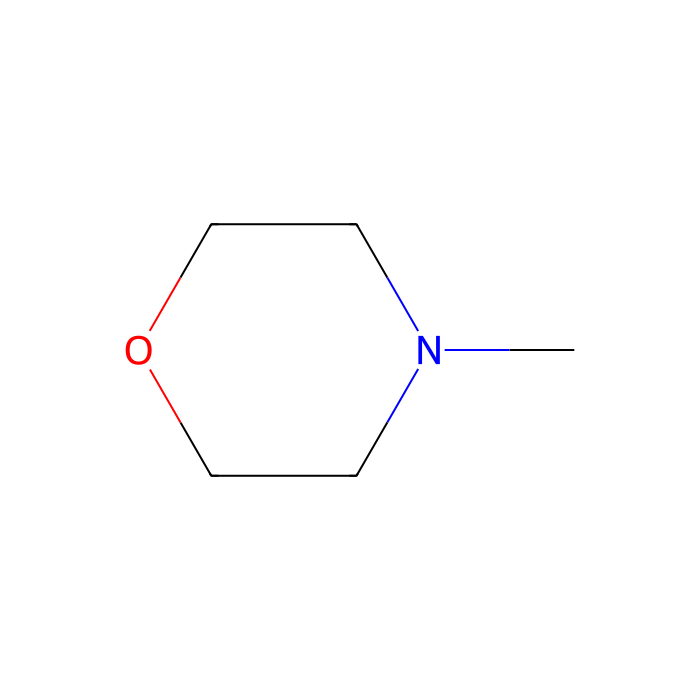
N-Methyl morpholine (NMM) is a six-membered saturated heterocycle (morpholine ring) bearing an N-methyl substituent, containing one ring oxygen and a tertiary amine nitrogen.
Item-specific identifiers (from Product Data):
Literature identity data (for reference; not item specifications):
Research use note: For research use only.
Key functional elements: a tertiary amine and an embedded ether within the morpholine ring. Reactivity is dominated by the amine’s basicity and modest nucleophilicity.
As base (literature):
As nucleophilic catalyst:
Salt formation and phase behavior:
Derivatization/preparative chemistry:
Retrosynthetic value:
Selection guidance: Choose NMM when a water-miscible, moderately strong, operationally simple base is desired, especially in peptide couplings or acylations where low UV background and straightforward removal by aqueous acid are beneficial.
Not applicable. This product is a small-molecule reagent (tertiary amine), not a biological targeting agent or antibody. No antigen/epitope specificity, clone, isotype, or species reactivity is relevant. For application-focused guidance, see Reaction & Applications and Synthetic Utility sections.
Our grade selection guide covers purity, stabilizer status, and application suitability for all variants in our catalog.
View for Protein sequencing grade guide →