≥99%(GC) for sensitive chromatographic and analytical workflows requiring minimal baseline interference.
🌡
Storage & shipping
Room temperature,Argon charged Ships Normal Check lot-specific COA for exact specifications.
📋
Quality documents
SDS, COA, datasheet, and spec sheet available for download. Lot-specific COA accessible via lot number lookup.
📚
Literature proof
Cited in 4 peer-reviewed publications across chromatography, organic synthesis, and cross-coupling reactions.
Overview
N,N-Diethylacetamide was used to investigate the spectroscopic properties ofN,N-diethyl-2-[(4-substituted)phenylsulfinyl] acetamides. It is commonly used as drug solvent.
This compound belongs to the class of organic compounds known as tertiary carboxylic acid amides. These are compounds containing an amide derivative of carboxylic acid, with the general structure RN(R1)C(R2)=O (R1-R2 any atom but H).
External Descriptors
Not available
1. Djoumbou Feunang Y, Eisner R, Knox C, Chepelev L, Hastings J, Owen G, Fahy E, Steinbeck C, Subramanian S, Bolton E, Greiner R, and Wishart DS. ClassyFire: Automated Chemical Classification With A Comprehensive, Computable Taxonomy. Journal of Cheminformatics, 2016, 8:61.
Determine the necessary mass, volume, or concentration for preparing a solution.
Dilution Calculator
Determine the dilution needed to prepare a stock solution.
Reconstitution Calculator
Reviews
Customer Reviews
Application Protocols
Not applicable. No validated antibody/assay protocols (WB, IHC, IF, FC) pertain to this small-molecule solvent.
For chemical applications, see the Reaction & Applications and Reaction Conditions sections for general guidance on using N,N-diethylacetamide as a solvent in synthesis.
Biological Roles
This product is supplied strictly for research/lab use. No medical or clinical uses are claimed.
General biochemical context (literature; not item-specific)
N,N-Diethylacetamide is a small, tertiary amide not known as a natural metabolite. If introduced biologically, tertiary amides can, in principle, undergo slow hydrolysis to acetic acid derivatives and dialkylamines, but rates are typically low without enzymatic or harsh chemical activation.
It can act as a polar aprotic environment modifier in biochemical extraction protocols; however, its use in biological systems is limited due to solvent effects on membranes and proteins.
Protein/ligand interactions: tertiary amides are hydrogen-bond acceptors but not donors; they can disrupt hydrophobic and hydrogen-bond networks in biomacromolecules at sufficient concentrations.
Handling in bioassays
If used as a cosolvent for compound stocks, keep final concentrations low (typically ≤1–2% v/v) and include proper vehicle controls; verify compatibility with cell or enzyme systems.
For any biological experimentation, consult institutional solvent handling guidelines and evaluate cytotoxicity/assay interference empirically.
Buffer Applications
N,N-Diethylacetamide is not a buffering agent and is not commonly used to prepare aqueous pH buffer systems.
Practical note: If employed as an organic cosolvent in a buffered reaction or assay, confirm buffer capacity and pH drift, as polar aprotic solvents can alter activity coefficients and pKa values.
For true buffering needs, select established buffer systems (e.g., phosphate, HEPES, MOPS) appropriate to your target pH and ionic strength.
Green Alternatives
Context: DEAA is an amide-class polar aprotic solvent. Many processes are seeking lower-toxicity or bio-based replacements for DMF/DMAc/NMP. DEAA’s hazard/regulatory profile should be reviewed via SDS; where further improvement is desired, consider the following options (literature/general guidance).
Comparative overview (general; not item-specific)
| Solvent | Class | Polarity (qual.) | Boiling point | Notable pros | Trade-offs |
|---|---|---|---|---|---|
| N,N-Diethylacetamide | Amide | Moderate | High (~206–208 °C) | High-T window; polar aprotic | Amide-class regulatory scrutiny in some settings |
| Propylene carbonate | Carbonate | High | High (~241 °C) | Low vapor pressure; green profile | Higher viscosity; limited base compatibility |
| Cyrene (dihydrolevoglucosenone) | Bio-based ketone | Moderate–high | High (~226 °C) | Renewable; strong dipolarity | Sensitive to strong bases/nucleophiles |
| Dimethyl isosorbide (DMI) | Ether | Moderate | High (~235 °C) | Low toxicity profile | Different solvation vs amides |
| 2-MeTHF | Ether | Low–moderate | Medium (~80 °C) | Biorenewable; easy workup | Lower polarity; lower T range |
| CPME | Ether | Low–moderate | Medium (~106 °C) | Peroxide-resistant; hydrophobic | Lower polarity; limited ionic solvation |
Selection notes
If the chemistry tolerates non-amide solvents, propylene carbonate or DMI can provide greener profiles while maintaining high boiling points.
For strongly basic or nucleophilic systems, test stability of carbonate/biobased alternatives; DEAA may remain preferred for robustness.
Always verify catalyst/solute solubility, base compatibility, and workup feasibility when switching solvents.
Pharmaceutical Uses
No therapeutic claims. Research use only.
Formulation/manufacturing context (general; not item-specific)
As a polar aprotic, high-boiling solvent, N,N-diethylacetamide may be explored in process development for API synthesis steps requiring elevated temperatures (e.g., SNAr, amide couplings) or in crystallization/solvate screening.
Regulatory status/compendia: not commonly monographed in major pharmacopeias as an excipient; if considered for GMP use, residual solvent limits, extractables/leachables, and impurity profiles must be established by process validation.
Workup advantages: low volatility reduces losses during high-T reactions; however, removal may require higher vacuum/temperature or solvent swaps.
Risk management
Conduct full toxicological and ICH Q3C assessment if used in manufacture; define acceptance criteria for residual levels in intermediates/APIs.
Verify compatibility with common elastomers and plastics in equipment (amides can swell certain polymers).
Physical Properties
Item-specific (from Product Data)
Appearance: Not specified for this item; refer to CoA/Spec Sheet.
Molecular formula: Not specified for this item; refer to CoA/Spec Sheet.
Molecular weight: Not specified for this item; refer to CoA/Spec Sheet.
Literature/typical values (for reference; not item specifications)
Phase at ambient conditions: liquid (tertiary amide solvent).
Boiling point: typically ~206–208 °C at 1 atm (literature).
Melting point: typically around −25 to −30 °C (literature).
Density: often reported ~0.92–0.94 g/mL at 20–25 °C (literature).
Refractive index: commonly ~1.435–1.440 at 20 °C (literature).
Vapor pressure: low; on the order of 0.1–0.3 mmHg at 25 °C (literature).
Solubility: miscible with many organic solvents; high affinity for polar aprotic media; significant water miscibility reported (literature), but confirm experimentally for your application.
Dielectric constant: moderate (commonly cited in the ~18–22 range at 20–25 °C; literature), lower than DMF/DMAc but higher than esters/ethers.
logP (octanol/water): modestly negative to near-neutral (literature reports around 0 to −0.5), reflecting polar but hydrophobic character from the ethyl groups.
pKa: amide N is non-basic; conjugate-acid pKa typically <1 (literature). Alpha C–H acidity to carbonyl is weak (requires strong base for enolization).
Notes
Always verify exact values on the batch CoA/Spec Sheet for specifications critical to your process.
Viscosity increases at lower temperature; ensure adequate mixing/heating in scale-up.
Quality and Grades
Item-specific grade/purity (from Product Data)
Grade/Purity: Not specified for this item; refer to CoA/Spec Sheet.
How to interpret common grades for this solvent (general guidance; not item-specific)
General/Technical grade: adequate for many synthetic operations; may contain higher water/UV-active impurities. Use when trace contaminants are not critical.
AR/ACS grade: tighter assay/trace metal limits appropriate for analytical work.
HPLC grade: rigorously controlled UV absorbance and low particulates for chromatographic applications.
Anhydrous grade: specified low water content (e.g., by Karl Fischer). For moisture-sensitive reactions (e.g., organometallics, peptide couplings), confirm ppm water on the CoA.
Stabilizers/impurity profile
Tertiary amides are generally shelf-stable; no stabilizer is typically required. If an inhibitor or antioxidant is listed on the CoA, note its impact on downstream reactions.
Recommended verification before critical use
Check: assay (%), water (KF), UV cut-off/absorbance (if for spectroscopy/HPLC), acidity/alkalinity, color (APHA), and residual solvents.
For catalysis/electronics applications, review trace metals. If not specified for this item, request a detailed specification sheet.
This product is supplied for research use only.
Reaction and Applications
General roles (literature; not item-specific): DEAA serves primarily as a polar aprotic solvent with a high boiling point, enabling elevated-temperature transformations while providing moderate ion-solvation.
Representative reaction classes benefitting from DEAA as solvent
Nucleophilic aromatic substitutions (SNAr) and heteroaryl displacements at 100–170 °C.
Transition-metal-catalyzed cross-couplings (e.g., Suzuki–Miyaura, Buchwald–Hartwig, Sonogashira) where an amide solvent is preferred but extreme polarity (DMF/DMAc) is not required.
Base-promoted condensations (Knoevenagel, Horner–Wadsworth–Emmons) and phase-transfer reactions where moderate polarity supports ion pairing.
Halide exchange (Finkelstein-type on activated substrates) and alkylations of ambident nucleophiles.
Polymerizations and post-polymer modifications where thermal headroom and solvent resistance are needed.
Reactivity considerations
Tertiary amide is weakly coordinating; less ligating than DMF with certain metals, which may benefit selectivity in some catalytic systems.
Lower dielectric constant vs DMF can attenuate side reactions driven by over-solvation of anions.
Practical tips
Dry thoroughly (3 Å sieves or fractional distillation). Water suppresses nucleophilicity and catalyst activity.
For heterogeneous bases (Cs2CO3, K3PO4), mild heating and efficient stirring improve kinetics in DEAA’s more viscous medium.
Monitor for amide participation at very high temperatures with aggressive electrophiles (acid chlorides, strong dehydrating agents)—generally low but possible.
Beyond solvent use
As a substrate, DEAA can undergo alpha-deprotonation (very strong base required) and common amide functional-group interconversions after activation (e.g., to acid chlorides via standard reagents—literature context).
Reaction Conditions
Guidance below is general literature practice for using N,N-diethylacetamide (DEAA) as solvent or substrate; verify for your specific system.
Solvent preparation
Drying: stir over 3 Å molecular sieves (activated) overnight or distill under reduced pressure from CaH2 if compatible with your application. Confirm water by Karl Fischer if moisture-sensitive chemistry is planned.
Typical operating windows (as solvent)
Temperature: ambient to 160–180 °C (sealed vessels) depending on pressure and reagent stability; reflux at ~206–208 °C under atmospheric conditions (literature bp).
Atmosphere: inert (N2/Ar) recommended, consistent with item being argon charged.
Bases: Cs2CO3, K2CO3, K3PO4, t-BuOK, NaH used as appropriate; strong bases may slowly enolize the amide at high T.
Catalysis: compatible with Pd, Ni, Cu systems commonly used in cross-coupling and SNAr. Verify ligand/catalyst solubility.
Workup
Quench hot reactions cautiously; cool to ≤40 °C before aqueous quench.
Removal: rotary evaporation under high vacuum with bath 60–90 °C; co-evaporate with toluene/EtOAc or perform aqueous workup to partition organics, then solvent-swap.
Expected performance (illustrative literature ranges; not item specs)
SNAr/couplings in DEAA often proceed in hours at 80–140 °C with yields comparable to DMF when solubility is adequate; optimization may be required.
Always consult primary literature or pilot experiments to fix exact reagent loadings, temperatures, and times.
Signal word: Not specified for this item; refer to SDS.
H-statements: Not specified for this item; refer to SDS.
GHS classification/pictograms: Not specified for this item; refer to SDS.
General safety guidance for tertiary amide solvents (literature/industry practice; not item-specific)
Likely hazards: eye/skin irritation and respiratory tract irritation possible upon exposure; ingestion may be harmful. Avoid aerosol formation.
PPE: chemical-resistant gloves (e.g., nitrile), lab coat, safety goggles/face shield. Use in a fume hood to avoid inhalation of vapors/mist.
Storage: as specified, store at room temperature under an inert atmosphere (argon charged) to minimize oxidative degradation and moisture uptake. Keep tightly closed in a well-ventilated area, away from heat and ignition sources.
Incompatibilities: strong oxidizers; strong bases may promote amide enolization/condensation; strong dehydrating agents; acid chlorides/anhydrides can acylate adventitious nucleophiles in the presence of the amide.
Spills: absorb with inert material (vermiculite, diatomaceous earth), collect in appropriate waste. Wash area with soap/water while controlling runoff.
First aid overview: eye contact—rinse cautiously with water for ≥15 min; skin—wash with soap/water, remove contaminated clothing; inhalation—move to fresh air, seek medical attention if symptoms persist; ingestion—rinse mouth, do not induce vomiting, seek medical attention.
Waste: dispose according to local regulations as organic solvent waste; segregate from oxidizers.
Always consult the product’s SDS for authoritative, up-to-date hazard and response information.
Solvent Selection
Positioning: N,N-Diethylacetamide (DEAA) is a high-boiling, polar aprotic tertiary amide with moderate dielectric constant—less polar than DMF/DMAc but more polar than esters/ethers.
Miscibility: mixes well with many organics (aromatics, chlorinateds, ethers, ketones). Water miscibility is significant; verify for your system before scale-up.
When to choose DEAA
Need a polar, higher-boiling alternative to DMF/DMAc to push reactions at 120–170 °C without high vapor pressure.
Systems sensitive to very strong solvation (where DMF/DMAc over-stabilize ions); DEAA’s lower polarity can balance reactivity/selectivity.
Processes desiring reduced DMF/DMAc regulatory exposure while keeping an amide solvent class.
Comparisons (general)
Versus DMF/DMAc/NMP: lower polarity, typically lower viscosity than NMP, similar chemical resistance; higher bp than many esters/ethers.
Versus esters (EtOAc) or ethers (THF, 2-MeTHF): far higher thermal stability and polarity; slower evaporation; better for high-T SNAr/couplings.
Practical notes
Drying: 3 Å molecular sieves or distillation under reduced pressure; amides can retain water—verify KF before moisture-sensitive steps.
Removal: vacuum stripping at elevated temperature; co-evaporate with toluene/EtOAc if needed.
Solubility tuning: cosolvents (toluene, MeCN, DCM) can modulate viscosity and polarity.
Keep container tightly closed when not in use to limit moisture uptake and oxidative impurities. Maintain the inert headspace (argon) as supplied; if dispensing large volumes, consider blanketing with inert gas.
Avoid prolonged exposure to heat and direct sunlight. Store away from strong oxidizers and reactive chlorinating agents.
Reconstitution
Not applicable; supplied as a ready-to-use liquid solvent. If solidification occurs at low temperature, gently warm to ambient and mix thoroughly before use.
Stability
Tertiary amides are generally stable under recommended storage. For sensitive applications, verify water content (KF) and UV absorbance prior to use. If long-term storage is planned, periodic QC (assay, color, KF) is advisable.
Container compatibility (general)
Compatible with glass; verify compatibility with plastics/elastomers (some amides can swell certain polymers). Use PTFE-lined caps where possible.
Structure and Identity
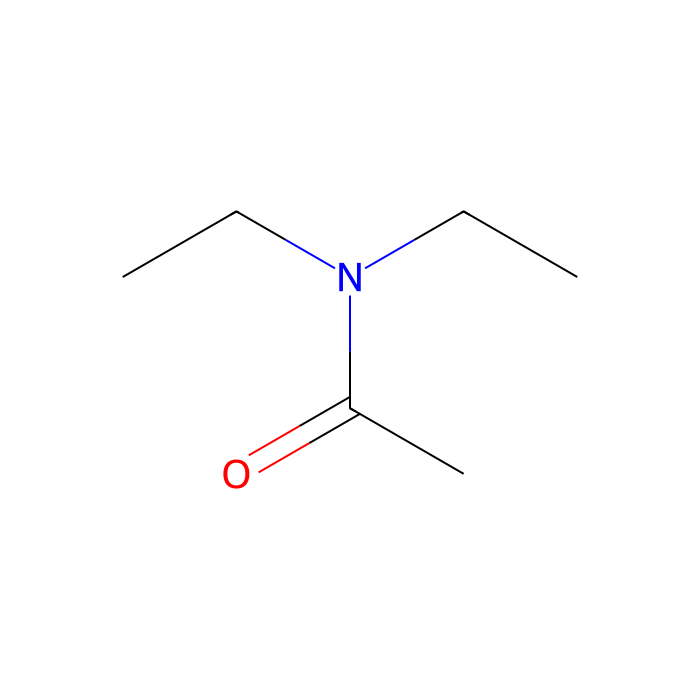
Short description: N,N-Diethylacetamide is a tertiary amide solvent, structurally an acetamide bearing two ethyl substituents on nitrogen.
Typical InChIKey (literature): commonly reported for this structure; verify on CoA/SDS before use.
Structural features (general chemistry description)
Functional groups: one amide carbonyl (tertiary amide), two ethyl substituents on nitrogen, one acetyl methyl.
2D structure in words: an acetyl carbonyl C(=O) bonded to N; the N bears two ethyl chains (–CH2CH3, –CH2CH3); the carbonyl is also bonded to a methyl group (–CH3). No stereocenters, no rings.
Beyond its role as a solvent, several features of N,N-diethylacetamide (DEAA) are synthetically relevant (literature/general):
Functional-group behavior
Tertiary amide: strongly resonance-stabilized C–N bond, low basicity at N; good H-bond acceptor. Resistant to many nucleophiles and bases at moderate temperatures.
Alpha chemistry: the acetyl methyl can, in principle, be deprotonated with very strong bases (e.g., LDA, LHMDS) to give enolates—useful for isotopic exchange or carbon–carbon bond formation after appropriate electrophile trapping.
As a substrate (after activation)
Amide activation (e.g., via chlorinating agents like SOCl2/oxalyl chloride in the presence of catalysts such as DMF) can convert DEAA to the corresponding acid chloride or other acyl-transfer equivalents; subsequent transformations yield esters, acids, or ketones.
Reduction pathways: strong hydride donors (e.g., LiAlH4) can reduce tertiary amides to amines or alcohols depending on conditions.
As a medium influencing reactivity
Moderate dielectric constant can tune ion pairing in base-mediated reactions, sometimes improving selectivity vs more strongly polar amides (DMF/DMAc).
Lower coordinating ability toward certain metal centers may benefit catalytic turnover where DMF acts as a competitive ligand.
Retrosynthetic value
The acetamide motif can serve as a masked acetyl unit; though DEAA itself is not a typical acylating agent, activation/unmasking strategies enable entry to acetyl derivatives under controlled conditions.
Target Specificity
Not applicable. This product is a small-molecule solvent (tertiary amide), not an antibody, enzyme, or biological targeting agent. No antigen/epitope, species reactivity, clone, or isotype data apply.
We use cookies to ensure the website functions properly and, where permitted, to improve your experience. You can manage your preferences at any time in Settings. Learn more in our Cookie Policy.
Shall we send you a message when we have discounts available?
Remind me later
Thank you! Please check your email inbox to confirm.
Products are supplied to verified businesses, institutions, and qualified professionals for research and development use only. Not for use in humans, animals, diagnosis, or therapy.

 D2315427