≥98% for sensitive chromatographic and analytical workflows requiring minimal baseline interference.
🌡
Storage & shipping
Store at -20°C Ships Ice chest + Ice pads Check lot-specific COA for exact specifications.
📋
Quality documents
SDS, COA, datasheet, and spec sheet available for download. Lot-specific COA accessible via lot number lookup.
📚
Literature proof
Cited in 0 peer-reviewed publications across chromatography, organic synthesis, and cross-coupling reactions.
Overview
Information
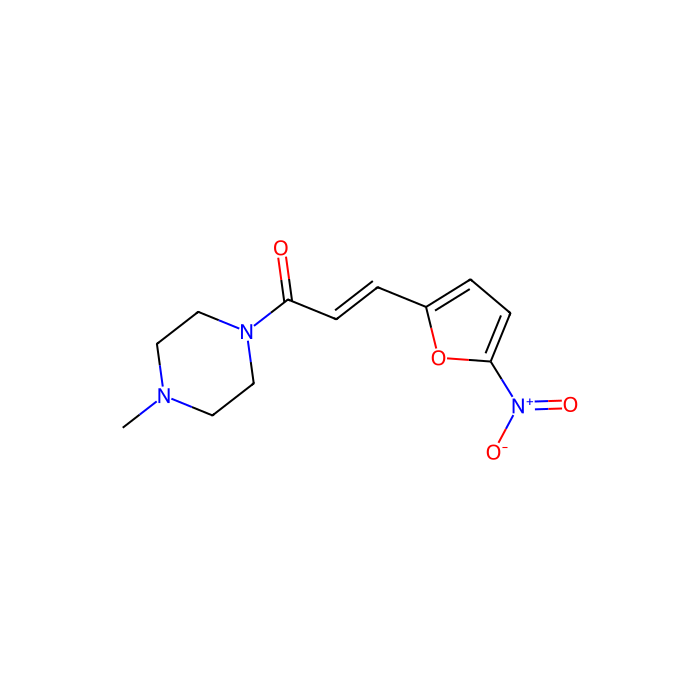
NSC59984 NSC59984 is a p53 pathway activator via induction of mutant p53 protein degradation and p73 activation.
Targets
p53
In vitro
NSC59984 specifically restores p53 pathway signaling and induces p73-dependent cell death in mutant p53-expressing human colorectal cancer cells. NSC59984 also induces cell death in a panel of cancer cell lines bearing different p53 mutations with little or no genotoxicity in normal cells.
In vivo
In nude mice bearing DLD-1 xenograft tumors, NSC59984 (45 mg/kg, i.p.) significantly represses tumor growth in a p73-dependent manner.
This compound belongs to the class of organic compounds known as nitrofurans. These are compounds containing a furan ring which bears a nitro group.
External Descriptors
Not available
1. Djoumbou Feunang Y, Eisner R, Knox C, Chepelev L, Hastings J, Owen G, Fahy E, Steinbeck C, Subramanian S, Bolton E, Greiner R, and Wishart DS. ClassyFire: Automated Chemical Classification With A Comprehensive, Computable Taxonomy. Journal of Cheminformatics, 2016, 8:61.
Determine the necessary mass, volume, or concentration for preparing a solution.
Dilution Calculator
Determine the dilution needed to prepare a stock solution.
Reconstitution Calculator
Reviews
Customer Reviews
Application Protocols
No item-specific, validated protocols are provided in the Product Data. The following outlines general, non‑spec practices for small-molecule tool compounds in cell-based assays. Adjust to your model and verify experimentally.
General cell-based assay workflow (guidance):
Stock solution: Prepare a sterile, anhydrous DMSO stock (e.g., 10–50 mM). Aliquot to minimize freeze–thaw cycles; store at −20 °C.
Plate setup: Seed cells to reach the desired confluence at dosing. Allow attachment/equilibration per cell line norms.
Dosing: Create serial dilutions in assay medium to achieve a final DMSO content consistent across all wells (commonly ≤0.5% v/v). Include vehicle controls and, if available, orthogonal reference compounds.
Exposure: Incubate for an appropriate window (e.g., 2–24 h for acute signaling; 24–72 h for viability/gene expression endpoints), tuned to your endpoint and model.
Readouts: Assess target pathway reporters, qPCR of target genes, immunoblotting/ELISA for protein markers, or phenotypic endpoints. Confirm lack of precipitation and verify compound integrity post‑assay by LC–MS.
Data quality: Monitor Z′ factor and signal-to-background; perform triplicates and independent repeats. Use non‑linear regression for EC50/IC50 estimation when applicable.
Sterility and adsorption considerations:
Filter working solutions if permissible; use low‑bind plastics or glass to reduce adsorption at low μM–nM dosing.
Biological Roles
Intended use: research only. No medical or clinical claims are made. The following summarizes commonly cited, literature-level roles for NSC-series small molecules and, specifically, reports associated with NSC59984; treat as general background and verify in primary sources for your system.
Literature context: NSC59984 is described in publications as a pathway-modulating small molecule investigated in cell-based studies of tumor suppressor signaling. Reports indicate it influences the p53 network, with observations of mutant p53 attenuation and compensatory activation of p53-family transcriptional programs via p73 in certain cellular contexts (literature background; not a specification of this product).
Cellular readouts: Studies commonly assess changes in transcriptional reporters (e.g., p53/p21 response elements), target gene expression, and apoptosis/stress markers following acute exposure. The magnitude and direction of effects are cell‑line and context dependent.
Mechanistic notes (literature): Some work links activity to redox/ERK pathway engagement and proteostasis cues that alter the stability of mutant p53, while enabling p73-driven transcriptional responses. These mechanistic attributions are model‑dependent and should be independently verified in each system.
Selectivity considerations: As with many tool compounds, polypharmacology is possible. Off‑target profiling (kinome/panel screens, CRISPR dependency mapping, CETSA/thermal proteome profiling) is recommended to define on‑ and off‑pathway effects at working concentrations.
Practical guidance:
Include vehicle controls and orthogonal probes (e.g., genetic perturbations) to corroborate pathway attribution.
Benchmark exposure windows and concentrations against published ranges, but titrate de novo in your cell model to identify non‑cytotoxic windows supporting mechanistic readouts.
Buffer Applications
This product is not a buffering reagent and has no defined acid/base pairs for pH control provided in the Product Data. Accordingly, it is not typically used to prepare biological or analytical buffers.
Practical note (general):
When using this small molecule in biochemical or cell-based assays, prepare working solutions by diluting a concentrated organic stock (commonly DMSO) into your pre‑selected buffer or medium. Maintain consistent final organic content across treatments and controls. Validate that the buffer composition (salts, proteins, detergents) does not precipitate or degrade the compound over the assay timeframe.
Green Alternatives
Because this item is a discrete small molecule tool compound (not a process solvent or reagent), “green alternatives” mainly concern solvent choices and handling practices in downstream assays rather than replacement of the compound itself.
Greener handling strategies (general guidance):
Prefer aqueous assay buffers with minimal DMSO carryover (≤0.1–0.5% v/v) where assay tolerance allows; this reduces VOC and operator exposure.
Use high‑boiling, low‑volatility solvents (DMSO) for stock solutions to minimize evaporative losses and inhalation exposure relative to lower‑boiling alcohols or chlorinated solvents.
Consolidate stock concentrations to reduce total solvent volume and packaging waste; aliquot into recyclable glass vials when compatible.
Implement microscale assay formats (e.g., 384- or 1536-well plates) to reduce total solvent and compound consumption.
Illustrative comparison (general, not specs):
DMSO vs ethanol for stock prep: DMSO often allows lower total solvent use due to higher solubility; ethanol is more volatile and flammable, increasing ventilation and fire-safety burdens.
Avoid DMF, NMP, and chlorinated solvents in biological workflows where possible due to higher hazard profiles; reserve for specialized solubilization only when validated.
Waste minimization:
Collect small residual volumes from screening campaigns into combined halogen‑free organic waste streams to reduce container count; adopt solvent recovery where permitted.
Note: No greener “substitute compound” is proposed here; biological activity is structure‑specific and should not be interchanged without experimental justification.
Pharmaceutical Uses
No pharmacopeial status, excipient role, or formulation use is specified for this item. It is supplied strictly for research use only.
Context (general):
Small molecules like this are used in discovery research, target validation, and mechanism-of-action studies. They are not provided with GMP documentation or clinical-use authorization in this listing.
If performing pre‑formulation or ADME experiments in vitro, qualify lot-specific purity, counter‑ion content, and stability in relevant media. Any development beyond research use would require separate sourcing, quality systems, and regulatory evaluation.
Statement of use:
Research Use Only (RUO). Not for human or veterinary use, not for diagnostic procedures, and not for therapeutic applications.
Physical Properties
Item-specific physicochemical specifications are not provided in the current listing. Do not treat the following as specifications; verify on the CoA or SDS before use.
Appearance: Not specified for this item; refer to CoA/Spec Sheet.
Melting point: Not specified for this item; refer to CoA/Spec Sheet.
Boiling point: Not applicable/reported for solids; Not specified for this item; refer to CoA/Spec Sheet.
Density: Not specified for this item; refer to CoA/Spec Sheet.
Refractive index: Not applicable for solids; Not specified for this item; refer to CoA/Spec Sheet.
Solubility: Not specified for this item; refer to CoA/Spec Sheet.
LogP, pKa: Not specified for this item; refer to CoA/Spec Sheet.
General/literature guidance (non‑spec):
Screening library small molecules of this class are commonly supplied as solids and are typically dissolved in anhydrous DMSO to prepare concentrated stocks (e.g., 10–50 mM), then diluted into assay buffers or media. Actual solubility and stability must be verified experimentally for each lot.
If working in aqueous systems, incremental co‑solvent addition (DMSO, ethanol) with vigorous mixing and filtration (0.22 μm) is often used to prepare clear solutions at low final organic percentages (<0.5–1% v/v DMSO), subject to cell/assay tolerance.
Analytical qualification (recommendation):
Prior to use, confirm identity and purity by LC–MS and orthogonal methods (e.g., 1H NMR where feasible) using reference spectral data from the CoA or the cited literature identifier (PubChem CID) as a guide.
Quality and Grades
Grade/Purity: Not specified for this item; refer to CoA/Spec Sheet.
Interpretation and best practices (general guidance):
For small-molecule screening compounds, suppliers commonly report an HPLC chromatographic purity (e.g., area% at 254 nm) and confirm identity by MS and/or NMR. In the absence of a declared grade here, treat the material as research-grade and verify suitability for your application.
If using in quantitative biology or medicinal chemistry workflows, establish a minimal QC panel in-house: LC–MS purity and exact mass confirmation, water content by Karl Fischer (if hygroscopic behavior is suspected), and assessment of counter‑ions/salts.
UV background and residual solvents can impact assay readouts; consider running blank solvent controls matched to the specific lot.
Trace stabilizers, form (free base/salt), and polymorph can influence solubility and bioassay performance; confirm on the CoA or via your own pre-formulation screen.
What is specific to this listing:
Storage at −20 °C and cold-chain shipment indicate preservation of chemical integrity. No additional stabilizers, salt form, or assay grade are stated in the Product Data; verify on the CoA for your lot if these parameters are critical.
Reaction and Applications
This product is supplied as a screening small molecule/tool compound rather than a synthetic reagent. As such, it is not typically used as a stoichiometric reactant or catalyst in preparative organic synthesis.
Applicable research applications (general, non‑spec):
Chemical biology and phenotypic screening: Evaluate pathway modulation, stress responses, or transcriptional activity using reporter assays, target engagement (e.g., CETSA/thermal shift), or phospho‑protein readouts.
Mechanistic studies: Time‑course and concentration–response experiments in cell lines or lysates to map signaling changes. Pair with proteomics or transcriptomics to contextualize pathway effects.
Assay development: Positive/negative control benchmarking, signal window testing, and robustness assessments (Z′, S/B) in HTS or focused screens.
Practical tips:
Prepare fresh working solutions from frozen aliquots to minimize freeze–thaw cycles and oxidative degradation; include vehicle controls at matched DMSO percentages.
Confirm compound integrity over assay time by post‑assay LC–MS of the working solution.
Run adsorption checks in plasticware vs glass, particularly at low nM–μM levels; add low levels of inert surfactant if acceptable for the assay to reduce nonspecific binding.
If your intended use is synthetic chemistry:
This compound lacks declared functional groups and reactivity data in the current listing; it is not recommended as a general reagent. Choose purpose-built building blocks or catalysts with documented specifications for synthetic transformations.
Reaction Conditions
Not typically applicable. This product is not intended as a reagent or catalyst for chemical synthesis, and the Product Data includes no reactivity profile, kinetic parameters, or catalytic applications.
For laboratory handling in biological experiments (general guidance; non‑spec):
Stock preparation: Dissolve in anhydrous DMSO to an empirically determined concentration (commonly 10–50 mM in screening practice), vortex and, if needed, gentle sonication to clarify.
Working dilution: Add to assay buffer or culture medium to the desired final concentration, maintaining a consistent final DMSO percentage across all wells/conditions.
Stability checks: Assess solution stability over the experiment duration by LC–MS or HPLC at the working concentration and matrix.
If you intended to use this material in a chemical reaction:
Select a reagent with a documented functional group profile and reaction scope; no such information is provided for this item.
Safety and Handling
Safety designations specific to this item are not provided in the current data. Always consult the product SDS for authoritative information.
Provided conditions
Storage: Store at −20 °C (as provided in Product Data).
Shipping: Ice chest with ice pads (cold-chain preserved).
GHS and hazard statements
Signal word: Not specified for this item; refer to SDS.
H-statements: Not specified for this item; refer to SDS.
GHS classification and pictograms: Not specified for this item; refer to SDS.
General laboratory precautions (good practice; non‑spec):
Handle in a fume hood, avoiding inhalation, ingestion, and skin/eye contact.
Wear appropriate PPE: lab coat, safety glasses, and chemical-resistant gloves (e.g., nitrile). Change gloves regularly when handling DMSO solutions (DMSO can facilitate dermal uptake of solutes).
Avoid dust generation and aerosols; use closed containers and secondary containment for stock solutions.
Incompatibilities will depend on functional groups; until verified, avoid strong oxidizers/reductants, strong acids/bases, and light/moisture if instability is suspected. Protect from prolonged ambient exposure.
First aid (overview; defer to SDS):
Skin/eye contact: Rinse with water for at least 15 minutes; remove contaminated clothing; seek medical advice.
Inhalation: Move to fresh air; seek medical attention if symptoms occur.
Ingestion: Rinse mouth; do not induce vomiting; seek medical attention.
Waste handling:
Collect solutions and contaminated disposables as organic hazardous waste per institutional and local regulations.
Solvent Selection
This product is a research small molecule typically handled as concentrated organic stock solutions.
Item-specific solubility is not provided; the following are general, non‑spec recommendations:
Primary solvent (general practice):
DMSO is commonly used to prepare 10–50 mM stocks due to broad solvating power for drug‑like molecules and compatibility with cell‑based assays at ≤0.5–1.0% v/v.
Secondary solvent options (screen as needed):
DMF (anhydrous) or ethanol for cases where DMSO solubility is limited; confirm assay compatibility.
For biochemical assays, co‑solvent systems (e.g., DMSO + aqueous buffer with surfactant like 0.01–0.05% Tween‑20) may improve dispersion at low micromolar working concentrations.
Aqueous media:
Direct aqueous solubility is often limited for hydrophobic screening compounds; titrate the organic co‑solvent slowly under vortex/sonication, targeting minimal final organic content tolerated by your assay.
Comparison (general guidance):
DMSO vs ethanol: DMSO provides higher solubility for polar/apolar structures and is less volatile; ethanol may reduce compound carry‑through risk via skin but can perturb membranes and enzymes.
DMSO vs DMF: DMF offers similar solvency but is less favored in live cell assays; prefer DMSO unless a DMF-only solubilization benefit is demonstrated.
Analytical tip:
Always filter stock dilutions (0.22 μm PTFE) if precipitates are suspected; visually inspect plates/vials post‑dilution to avoid dose-artifacts from microprecipitation.
Storage and Reconstitution
Item-specific instructions provided:
Storage Conditions: Store at −20 °C (per Product Data).
Shipped In: Ice chest with ice pads (maintains cold chain during transit).
Additional guidance (general; not item‑specific specifications):
Protect from repeated freeze–thaw cycles. Upon receipt, allow the container to equilibrate to room temperature in a desiccated environment before opening to avoid moisture condensation.
Reconstitution: If supplied as a solid, dissolve in anhydrous DMSO to prepare a concentrated stock (e.g., 10–50 mM), vortex/sonicate gently until clear. If supplied as a solution, verify solvent and concentration on the CoA before aliquoting.
Aliquoting: Dispense into small, single‑use vials or tubes under dry inert gas (optional) to limit air/moisture/light exposure. Store aliquots at −20 °C or colder as appropriate.
Working solutions: Prepare fresh on the day of use. Keep on ice and minimize ambient light if the compound is chromophoric; discard any solutions showing turbidity or color change.
Stability: No lot-specific stability data are provided here. Confirm short‑ and long‑term stability under your storage and assay conditions by LC–MS/HPLC.
Use note:
For research use only. Not for diagnostic or therapeutic applications.
Structure and Identity
NSC59984 is supplied as a research small molecule from the NCI/NSC series and is offered here for screening and mechanistic studies in the small-molecule and compound library category.
SKU: N413909
Product name: NSC59984
CAS: 803647-40-7
PubChem CID: 5356520 (literature identifier for structural reference)
InChIKey: 299573 (as provided; appears truncated — verify on CoA or trusted databases)
SMILES: Not specified for this item; refer to CoA/Spec Sheet.
Molecular formula: Not specified for this item; refer to CoA/Spec Sheet.
Molecular weight: Not specified for this item; refer to CoA/Spec Sheet.
Structural features (general/literature context):
NSC59984 is referenced in the literature as a discrete organic small molecule used as a pathway-modulating tool compound. Detailed ring systems, heteroatoms, and stereochemistry should be confirmed from the CoA or authoritative databases (e.g., PubChem CID given above).
2D structure (description):
The exact 2D depiction is not provided in the current product data. Consult the CoA or PubChem record (CID 5356520) for atom connectivity, functional groups, and substitution pattern before method development or analytical work.
Notes
Always reconcile identifiers across sources (CAS, CID, InChIKey) prior to analytical qualification and method validation.
Synthetic Utility
This product is offered as a discrete bioactive small molecule, not as a general synthetic building block or reagent. Without item-specific functional group disclosure, it is not recommended for use in routine synthetic transformations.
If you require a synthetic handle or scaffold:
Select structurally defined building blocks (e.g., aryl halides, boronates, carboxylic acids/amines) with declared purity and reactivity data suited to your intended coupling or functionalization chemistry.
Analytical chemistry utility (general):
The compound may serve as an internal or external standard only after suitable validation of detector response, stability, and matrix compatibility; however, no such application is specified here.
Bottom line:
Treat NSC59984 as a tool compound for biological investigation rather than a reagent for preparative synthesis.
Target Specificity
Antibody/biologic targeting parameters do not apply to this product.
Antigen/epitope, clone, isotype, and species reactivity: Not applicable.
General note (small-molecule context):
For pathway attribution with small molecules, combine biochemical assays, genetic perturbation, and orthogonal chemical probes to define on‑target versus off‑target effects. No target-binding constants or selectivity panels are specified for this item; consult the primary literature on NSC59984 for hypothesis generation and design confirmatory experiments accordingly.
We use cookies to ensure the website functions properly and, where permitted, to improve your experience. You can manage your preferences at any time in Settings. Learn more in our Cookie Policy.
Shall we send you a message when we have discounts available?
Remind me later
Thank you! Please check your email inbox to confirm.
Products are supplied to verified businesses, institutions, and qualified professionals for research and development use only. Not for use in humans, animals, diagnosis, or therapy.

 H2220357