GRADE & PURITYMoligand™?Moligand™ — Aladdin's line of ligands and bioactive small molecules. Use for receptor, pathway, and binding studies needing defined small-molecule tools.10 mM in DMSO
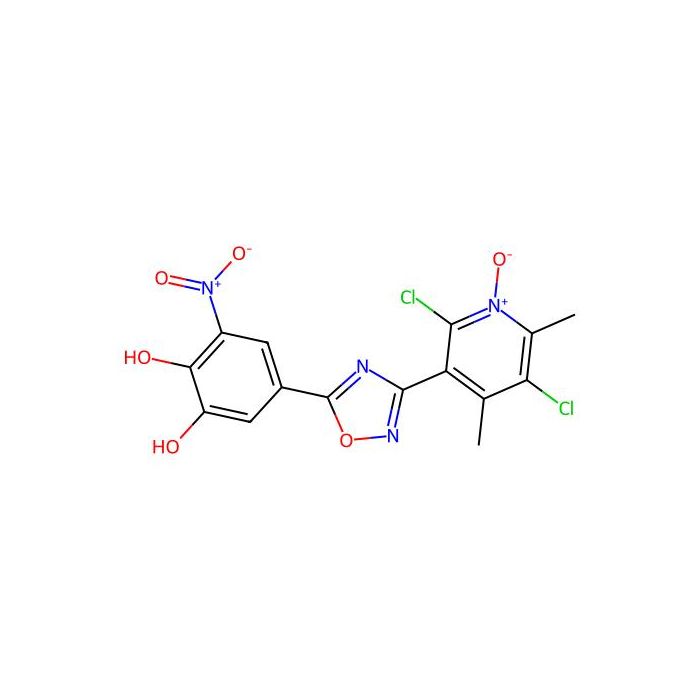
Opicapone (BIA 9-1067) is a potent third-generation catechol-O-methyltransferase ( COMT ) inhibitor for the research of Parkinson's disease and motor fluctuations. Opicapone decreases the ATP content of the cells with an IC 50 of 98 μM.
Specifications
Specifications & Purity
Moligand™, 10 mM in DMSO
Storage
Store at -80°C
Shipped In
Dry ice packs + Cold packs
This product requires cold chain shipping. Ground and other economy services are not available.
Determine the necessary mass, volume, or concentration for preparing a solution.
Dilution Calculator
Determine the dilution needed to prepare a stock solution.
Reconstitution Calculator
Reviews
Customer Reviews
Application Protocols
No manufacturer-validated application protocols are provided for this item. The following are general, literature-informed starting points for research use; optimize for your system.
Preparation of stock solutions
Dissolve Opicapone in anhydrous DMSO to 10–50 mM. Vortex and, if needed, sonicate briefly. Filter through 0.2 μm PTFE if particulates persist. Store single-use aliquots at ≤–20°C to minimize freeze–thaw cycles.
In vitro COMT inhibition assay (endpoint radiometric or LC–MS readout)
Buffer: 50 mM Tris-HCl, pH 7.4; 5 mM MgCl2; 0.01% Tween-20.
Add SAM (e.g., 50–200 μM) and catechol substrate at Km-range concentrations. Maintain constant DMSO (≤1% v/v).
Preincubate enzyme with inhibitor (e.g., 10–30 min), initiate with substrate, quench at defined times, quantify product by LC–MS or radiometric methods. Analyze with appropriate inhibition models (consider tight-binding).
Cell-based assays (target engagement)
Treat cells with serial dilutions prepared from DMSO stocks; keep final DMSO constant. Employ CETSA/thermal-shift or downstream metabolite readouts. Confirm specificity using counterscreens.
Analytical method development
LC–MS/MS method scouting using reversed-phase columns; include stable internal standards and assess matrix effects.
Item-specific tested applications and recommended dilutions: Not specified for this item; refer to CoA/Spec Sheet.
Biological Roles
This section summarizes broad, literature-based biochemical context for Opicapone as a research tool. It does not constitute medical or clinical guidance.
Primary biochemical function (literature): a potent, selective inhibitor of catechol-O-methyltransferase (COMT), an S-adenosyl-L-methionine (SAM)-dependent methyltransferase that catalyzes O-methylation of catechol substrates (e.g., L-DOPA, catecholamines). Nitrocatechol-like motifs typically form strong interactions in the COMT active site, coordinating with the catalytic Mg2+ and engaging SAM.
Mechanistic features: high-affinity binding often exhibits slow-on/slow-off kinetics and tight-binding behavior in enzyme assays. Inhibition is characterized as reversible but may present long residence times.
Isoform considerations: COMT exists as soluble (S-COMT) and membrane-bound (MB-COMT) isoforms; literature indicates inhibitory activity across isoforms with varying potency depending on assay conditions and species source.
Research utility: by modulating COMT, investigators probe catecholamine metabolism, methylation flux, and the contribution of COMT to neurotransmitter catabolism in biochemical and cell-based systems.
Off-target assessment: profiling against methyltransferases and broad enzyme panels is commonly pursued to confirm selectivity; include appropriate orthogonal assays (e.g., thermal shift, CETSA, or SPR) to validate direct target engagement.
Note: Use in living organisms or any clinical context is outside the scope of this product. For research use only.
Buffer Applications
Opicapone is not a buffering reagent. However, buffer choice is critical for enzymology with COMT and related assays.
General guidance (literature/practice):
COMT assay buffers typically employ Tris-HCl, HEPES, or phosphate buffers in the near-neutral range (pH 7.2–7.8), supplemented with Mg2+ (a required cofactor), SAM (co-substrate), and a catechol substrate.
Include 0.01–0.05% nonionic surfactant (e.g., Tween-20) to reduce nonspecific adsorption of hydrophobic ligands to plasticware.
Maintain ionic strength (e.g., 100–150 mM NaCl) for protein stability, unless contrary to your enzyme prep’s requirements.
Control DMSO content (commonly ≤0.1–1% v/v) across all wells, including controls, to minimize solvent effects on enzyme activity.
For fluorescence-based readouts, select buffer components with minimal background fluorescence and avoid primary amines if derivatization chemistries are used downstream.
Item-specific buffer compatibility or stability data: Not specified for this item; refer to CoA/Spec Sheet and SDS.
Green Alternatives
Green chemistry considerations apply chiefly to the handling solvents and workflows used with this research ligand.
Stock and assay solvents
Prefer minimal volumes of DMSO with careful titration into aqueous buffers. Where feasible, reduce final DMSO to ≤0.1% v/v without compromising solubility.
Explore biocompatible co-solvents or additives (e.g., cyclodextrins) to enhance apparent solubility and reduce organic solvent usage.
Waste minimization
Consolidate small-molecule screening into miniaturized assay formats (e.g., 384- or 1536-well plates) to dramatically reduce solvent and compound consumption.
Use sealed plates and low-dead-volume tips to limit evaporation losses and repeat dispensing.
Comparative solvent impact (general guidance)
DMSO: high boiling point, low volatility, widely accepted in bioassays; higher energy input for removal, but reduced inhalation hazard relative to more volatile solvents.
Ethanol: renewable feedstock and lower toxicity profile but can perturb enzymes at modest concentrations; volatility increases lab emissions.
Water-based vehicles with solubilizers (e.g., hydroxypropyl-β-cyclodextrin) can reduce organic solvent use but require compatibility verification.
Item-specific green data (biodegradability, LCI): Not specified for this item; refer to SDS and institutional sustainability guidance.
Pharmaceutical Uses
This catalog item is provided strictly for research use only and is not manufactured to clinical or GMP specifications.
Research and development context (non-clinical):
Serves as a reference standard or tool compound in preclinical formulation screening (e.g., solubility, stability, permeability) and method development (e.g., LC–MS quantitation) within discovery settings.
Can be employed in excipient compatibility studies to evaluate solid-state and solution stability under controlled stress conditions.
Useful for developing bioanalytical methods (calibration curves, system suitability checks) when studying COMT inhibitors in complex matrices.
Regulatory/compendial status:
No pharmacopeial monograph claims are made for this listing. Any suitability for QC release testing against pharmacopeial standards must be established by the end user.
Important disclaimers:
No therapeutic, diagnostic, or human/animal use is implied. This material is not an API for clinical administration.
For any GMP or clinical needs, request a separately qualified supply chain and documentation package.
Physical Properties
Item-specific physicochemical specifications have not been provided for this catalog entry. Where applicable, consult the CoA/Spec Sheet for your lot.
Appearance: Not specified for this item; refer to CoA/Spec Sheet.
Molecular weight (spec): Not specified for this item; refer to CoA/Spec Sheet.
Molecular formula (spec): Not specified for this item; refer to CoA/Spec Sheet.
Melting point: Not specified for this item; refer to CoA/Spec Sheet.
Boiling point: Not applicable for a high-melting, polyfunctional small molecule; Not specified for this item; refer to CoA/Spec Sheet.
Density: Not specified for this item; refer to CoA/Spec Sheet.
Solubility: Not specified for this item; refer to CoA/Spec Sheet.
LogP/LogD: Not specified for this item; refer to CoA/Spec Sheet.
pKa: Not specified for this item; refer to CoA/Spec Sheet.
UV/Vis characteristics: Not specified for this item; refer to CoA/Spec Sheet.
General laboratory guidance (literature/practice; not item specifications):
Many nitrocatechol COMT ligands are sparingly soluble in water and are commonly prepared as concentrated DMSO stocks (e.g., 10–50 mM), followed by dilution into assay buffer ensuring final DMSO ≤1% v/v to minimize enzyme perturbation.
Such scaffolds often show strong UV absorbance in the near-UV due to aromatic/auxochromic groups, which can affect optical assays; blank corrections and matched DMSO controls are recommended.
Hygroscopicity is typically low-to-moderate for neutral, polycyclic small molecules; nonetheless, minimize atmospheric moisture exposure during weighing and solution prep.
Quality and Grades
Grade: Moligand™
What Moligand™ indicates
Moligand™ designates small-molecule ligands curated for discovery screening and biochemical/chemical biology applications. Emphasis is placed on identity confirmation and suitability as a reference/tool compound in enzymology or receptor/target engagement studies.
Typical expectations for this grade include analytical identity verification (e.g., LC–MS and/or NMR) and suitability for preparing assay-ready DMSO stocks. Exact analytical thresholds for this lot are Not specified for this item; refer to CoA/Spec Sheet.
UV cutoffs, trace metals, water, and stabilizers
No item-specific limits or stabilizers are declared in the provided data. If low-UV or trace-impurity constraints are critical for your method, please consult the CoA/Spec Sheet or request additional QC documentation.
Fit-for-purpose commentary
Moligand™ compounds are intended as screening standards, target-validation probes, and internal controls. They are not formulated to pharmacopeial monographs unless explicitly stated.
Batch-to-batch continuity is supported by retained analytical records. If you require matched historical data (e.g., same lot for longitudinal studies), contact us for availability.
Research use
For research use only. Not intended for diagnostic, therapeutic, or clinical applications.
Reaction and Applications
As supplied, Opicapone is a research ligand used primarily as a biochemical tool compound rather than a synthetic reagent. Accordingly, there are no manufacturer-declared synthetic reaction applications for this item.
Research applications (general, literature-informed):
Enzymology: widely used as a high-affinity probe for catechol-O-methyltransferase (COMT) activity studies, supporting kinetic characterization, inhibitor benchmarking, and mechanism-of-inhibition analyses.
Chemical biology: enables target engagement, time-dependent inhibition studies, and structure–activity relationship (SAR) comparisons within nitrocatechol-like chemotypes.
Analytical: can serve as a positive control standard in chromatographic/LC–MS assay development for COMT-inhibitor quantification.
Assay preparation tips (general):
Prepare fresh DMSO stocks under low-light conditions if chromophoric groups are present. Filter stocks through 0.2 μm PTFE when particulate is visible.
Validate linearity with respect to enzyme concentration and preincubation time to mitigate slow-binding effects common to high-affinity COMT ligands.
Include appropriate reference inhibitors and vehicle controls to normalize inter-run variability.
Note: No item-specific catalytic, stoichiometric, or named organic reactions are claimed for this product.
Reaction Conditions
This product is not intended as a reagent for named organic reactions; thus, classical reaction-condition guidance (solvent, catalysts, stoichiometry) is not applicable.
Assay-condition guidance for enzymology (general, literature-informed):
Temperature: many COMT activity assays are run at 25–37°C; choose a temperature compatible with your enzyme preparation and detection method.
Cofactors/substrates: Mg2+ (e.g., 2–10 mM), SAM (co-substrate), and a catechol substrate at concentrations supporting initial-rate conditions. Validate linearity with respect to time and enzyme concentration.
Inhibitor handling: preincubate enzyme with Opicapone (and Mg2+/SAM, as appropriate) to allow equilibration for slow-binding inhibitors; typical preincubation 10–30 min (optimize empirically).
Vehicle: maintain constant DMSO across wells (e.g., 0.1–1% v/v). Include vehicle-only and positive-control inhibitor wells.
Data analysis: use Morrison or tight-binding models when inhibitor potency approaches enzyme concentration; evaluate time-dependence to distinguish slow-onset behavior.
Item-specific kinetic constants, solubility limits, and stability under assay conditions are Not specified for this item; consult primary literature and perform pilot experiments to define optimal parameters in your system.
Safety and Handling
Item-specific hazard classifications were not provided. Always consult the Safety Data Sheet (SDS) for authoritative guidance.
GHS classification, signal word, H/P statements, pictograms: Not specified for this item; refer to SDS.
General laboratory safety (good practice for heteroatom-rich small molecules):
Personal protective equipment: laboratory coat, safety goggles, and appropriate chemical-resistant gloves (e.g., nitrile). Handle in a chemical fume hood to avoid dust or aerosol exposure.
Avoid inhalation and contact with skin/eyes. Wash thoroughly after handling. Do not eat, drink, or smoke in work areas.
Incompatibilities: strong oxidizers/reducers and strong bases/acids may degrade polyfunctional aromatic compounds; avoid exposure to reactive metals and strong nucleophiles without prior compatibility assessment.
Spill/accidental release: avoid dust generation; collect using inert absorbent or HEPA-filtered vacuum. Dispose of according to institutional and local regulations.
First aid (overview; defer to SDS): move exposed individual to fresh air after inhalation; flush eyes/skin with water for at least 15 minutes on contact; seek medical attention if symptoms persist.
Thermal stability: store as instructed; avoid repeated freeze–thaw of solutions to limit degradation.
Note: This product is for research use only; not for human or veterinary use.
Solvent Selection
This product is a discrete research ligand rather than a process solvent. Solvent selection considerations therefore pertain to dissolving and handling the compound for assays, not to its use as a reaction or extraction solvent.
Practical guidance (general, literature-informed; not item specifications):
Primary stock solvent: anhydrous DMSO is commonly used for aromatic, heteroatom-rich ligands. Prepare concentrated stocks (e.g., 10–50 mM), then dilute into assay media.
Aqueous compatibility: many COMT-ligand chemotypes exhibit limited intrinsic water solubility. When diluting DMSO stocks into buffer, maintain final DMSO ≤0.1–1% v/v to reduce assay artifacts; include vehicle controls.
Alternative cosolvents: DMF or ethanol can sometimes aid solubilization, but DMSO typically affords better long-term stability and is more widely tolerated in biochemical assays.
Buffer composition: inclusion of nonionic surfactants (e.g., 0.01–0.05% Tween-20) can help limit adsorption in microplates; monitor for effects on enzyme kinetics.
Comparative notes (general):
DMSO vs ethanol: DMSO offers superior solvating power for polar/aromatic ligands and greater chemical compatibility; ethanol offers easier evaporation but can perturb enzyme activity at lower percentages.
DMSO vs DMF: DMF may be comparable in solvation but is generally less favored in bioassays due to cytotoxicity and hygroscopicity.
Item-specific solubility and extinction coefficients: Not specified for this item; refer to CoA/Spec Sheet.
Storage and Reconstitution
Storage and shipping conditions provided for this catalog item:
Storage conditions: Store at –80°C.
Shipped in: Dry ice packs + Cold packs.
Additional handling guidance (general; not a specification):
Upon receipt, keep the container frozen at –80°C until first use. Allow to equilibrate to room temperature in a desiccated environment before opening to prevent condensation.
If preparing solutions, dispense single-use aliquots to avoid repeated freeze–thaw. Protect from light and moisture as a precaution for polyaromatic ligands.
Solid-state and solution stability, reconstitution solvents, and concentration limits are Not specified for this item; refer to CoA/Spec Sheet and perform a small-scale pilot to confirm stability under your intended conditions.
Reminder: For research use only. Follow your institution’s storage and labeling practices for controlled small-molecule reagents.
Structure and Identity
Opicapone is a well-known small-molecule research ligand supplied in our Moligand™ collection. This section distinguishes item-specific identifiers from general literature information.
Item identifiers
Product name: Opicapone (SKU: O1497569)
CAS: 923287-50-7
PubChem CID: 135565903
Molecular formula: Not specified for this item; refer to CoA/Spec Sheet.
Molecular weight: Not specified for this item; refer to CoA/Spec Sheet.
SMILES: Not specified for this item; refer to CoA/Spec Sheet.
InChIKey: Not specified for this item; refer to CoA/Spec Sheet.
Structural features (general literature description; not a specification for this lot)
Opicapone is described in the literature as a high-affinity, nitrocatechol-type catechol-O-methyltransferase (COMT) inhibitor that engages the enzyme’s active site through bidentate interactions with the metal/cofactor environment.
It is a neutral, non-peptidic, heteroatom-rich small molecule; typical representations show multiple aromatic/heteroaromatic substructures and strongly H-bonding phenolic/nitro-type motifs associated with COMT binding in nitrocatechols.
2D structure (verbal depiction; literature)
A polycyclic, heteroatom-containing scaffold bearing a substituted catechol-like aryl ring featuring electron-withdrawing functionality, connected through a linker to an additional heteroaromatic/amide-like region. This architecture supports chelation/π-stacking in COMT.
Note: Exact structural strings (SMILES/InChI) and elemental analysis for this specific catalog item are not provided here; consult the product’s CoA/Spec Sheet for definitive identity attributes for your lot.
Synthetic Utility
Opicapone is supplied as a finished, discrete small-molecule ligand and is not generally used as a synthetic building block. Consequently, classical synthetic-utility discussions (e.g., functional group interconversions, protecting-group strategies) are not typically applicable.
That said, from a medicinal chemistry standpoint (general literature perspective):
The chemotype exemplifies high-affinity COMT engagement associated with nitrocatechol-like pharmacophores. As such, it can serve as a benchmark for SAR exploration, informing the design of analogs with modulated potency, selectivity, and physicochemical properties.
Comparative profiling against related scaffolds (e.g., other catechol-based COMT ligands) can help delineate the contribution of substituents to binding kinetics, metal coordination, and cofactor interactions.
In derivatization studies, retention of key H-bonding/chelation motifs is often critical; peripheral modifications may be used to tune solubility, metabolic stability, or permeability in probe development.
Item-specific reactive-functional-group content and derivatization handles are not provided in our product data. For any custom chemistry campaigns, please consult primary literature for validated synthetic routes and carry out independent feasibility assessments.
Target Specificity
Item-specific bioassay data are not provided for this lot. The following summarizes general literature context for Opicapone as a research tool.
Primary target: catechol-O-methyltransferase (COMT), a SAM-dependent methyltransferase involved in O-methylation of catechol-containing substrates.
Isoforms: active on both soluble (S-COMT) and membrane-bound (MB-COMT) isoforms; precise potency differentials depend on assay conditions and source.
Selectivity considerations: Literature positions Opicapone as a selective COMT inhibitor; nevertheless, broad off-target profiling (e.g., other methyltransferases, common enzyme counterscreens, and CYP paneling) is advisable for specific applications.
Binding characteristics: Nitrocatechol-like inhibitors typically coordinate the active-site metal and form strong H-bonding/π interactions in the catechol-binding pocket. Slow-binding kinetics and long target residence times have been reported for related chemotypes, which can impact apparent potency and washout behavior in cellular systems.
Note: No claim of target specificity is made for this specific product lot beyond its identity as Opicapone. Verify activity in your assay context using appropriate positive/negative controls.
Frequently Asked Questions
What is Moligand??
Moligand? is one of Aladdin Scientific's premium product lines, formulated for high-purity applications across multiple workflows. Compared to standard grades in the same workflow, Moligand? products typically offer tighter specifications, more rigorous QC, and stronger lot-to-lot consistency.
How should this product be stored?
Store at ?80 °C. Ultra-low temperature storage is required to maintain the specified shelf life.
How is this product shipped?
This product ships frozen with dry ice and cold packs. Unpack on arrival and transfer it to the storage condition stated above; handle dry ice with insulated gloves in a ventilated area.
What are the CAS number, molecular formula and molecular weight?
The CAS Number is 923287-50-7, the molecular formula is C15H10Cl2N4O6, and the molecular weight is 413.17 g/mol.
What documentation is provided?
Available product documentation, including Certificates of Analysis (COA), Safety Data Sheets (SDS), and specification sheets, is shown in the product document area. Document availability and access follow the current site policy.
We use cookies to ensure the website functions properly and, where permitted, to improve your experience. You can manage your preferences at any time in Settings. Learn more in our Cookie Policy.
Shall we send you a message when we have discounts available?
Remind me later
Thank you! Please check your email inbox to confirm.
Products are supplied to verified businesses, institutions, and qualified professionals for research and development use only. Not for use in humans, animals, diagnosis, or therapy.