Dicarboxylic acid or derivatives - Carboxylic acid salt - Organic alkali metal salt - Carboxylic acid - Organic oxygen compound - Organic oxide - Hydrocarbon derivative - Organic potassium salt - Organic salt - Organooxygen compound - Carbonyl group - Aliphatic acyclic compound
Description
This compound belongs to the class of organic compounds known as dicarboxylic acids and derivatives. These are organic compounds containing exactly two carboxylic acid groups.
External Descriptors
Not available
1. Djoumbou Feunang Y, Eisner R, Knox C, Chepelev L, Hastings J, Owen G, Fahy E, Steinbeck C, Subramanian S, Bolton E, Greiner R, and Wishart DS. ClassyFire: Automated Chemical Classification With A Comprehensive, Computable Taxonomy. Journal of Cheminformatics, 2016, 8:61.
Determine the necessary mass, volume, or concentration for preparing a solution.
Dilution Calculator
Determine the dilution needed to prepare a stock solution.
Reconstitution Calculator
Reviews
Customer Reviews
Application Protocols
No assay-specific protocols (e.g., WB, IHC, IF, FC) apply to this inorganic salt. For practical laboratory use, refer instead to the Reaction Conditions, Buffer Applications, and Synthetic Utility sections for detailed, application-relevant guidance on preparing solutions, buffers, and performing precipitation or redox reactions with oxalate systems.
Biological Roles
This product is intended strictly for research use; no clinical or diagnostic use is implied. The following notes summarize general biochemical context of oxalate species.
General/literature context
Oxalate (C2O4²−) is a terminal metabolite in many organisms, arising from pathways involving glyoxylate, ascorbate, or glycolate. It is not further metabolized in humans and is excreted, primarily as the calcium salt.
Hydrogen oxalate (HC2O4−) participates in acid–base equilibria near pH ~4–5; in biological media this speciation determines binding to divalent cations (Ca2+, Mg2+), often reducing free ion activities via complexation/precipitation.
Microbial roles: Certain fungi and bacteria produce oxalate to modulate environmental pH and mobilize minerals via chelation.
Research relevance
Model system for studying calcium oxalate nucleation, growth, and inhibition, relevant to biomineralization research (non-clinical laboratory studies).
Test anion in transport/ion-exchange experiments, given its dianionic, bidentate coordination behavior.
Oxalate as a reductant provides a chloride-free system for redox enzyme mimics and inorganic catalysis models in acidic aqueous media.
Cautions in bio-related work
Oxalate can significantly perturb calcium and magnesium balances in in vitro systems; buffer with care and validate free ion concentrations via ISE or speciation modeling (e.g., with stability constants for oxalate complexes).
Buffer Applications
Item-specific buffer specifications: Not specified for this item; refer to CoA/Spec Sheet.
General/literature guidance
Relevant equilibria (25 °C): H2C2O4 ⇌ H+ + HC2O4− (pKa1 ≈ 1.2); HC2O4− ⇌ H+ + C2O4²− (pKa2 ≈ 4.2). Potassium binoxalate provides HC2O4− directly, enabling buffers near pH 3.8–5.0 when paired with its conjugate base (potassium oxalate) or a suitable base (KOH).
Practical preparation (example approach)
Target pH 4.20: Dissolve an appropriate mass of potassium binoxalate in CO2-free water (degassed, recently boiled and cooled). Titrate with standardized KOH to the desired pH while monitoring with a calibrated pH meter. Adjust ionic strength (e.g., add KCl) if needed for reproducibility across temperatures.
Concentration range: 10–100 mM is typical for laboratory buffers; verify solubility and compatibility with metals and enzymes.
Compatibility notes
Strongly complexes Ca2+ and other divalent cations; may precipitate or sequester essential ions. Avoid where free calcium/magnesium levels are critical.
Avoid phosphate-sensitive systems if switching between oxalate and phosphate buffers; residual oxalate can carry over and alter metal-dependent assays.
Temperature/Ionic-strength effects
Buffer pH shifts modestly with temperature; calibrate at the working temperature. Ionic strength alters activity coefficients; maintain constant I to ensure reproducible pH.
Verification
Standardize buffer capacity by Gran plot or titration if high-precision acidity is required. Document lot-specific normality if using gravimetric preparation.
Green Alternatives
Context
As an inorganic acid salt, potassium binoxalate is aqueous-process friendly and chloride-free. Green considerations focus on toxicity (oxalate handling), persistence, and substitution where feasible.
Alternative choices (general; application-dependent)
Oxalic acid (H2C2O4): Similar functionality with stronger acidity; may reduce salt load but introduces excess protons that can drive corrosion. Being a diacid, it can be dosed to the same pH with smaller mass; however, it lacks the potassium counterion.
Potassium dihydrogen phosphate (KH2PO4) buffers: For pH ~4–5.8 applications where oxalate complexation is undesirable, phosphate systems are more benign to certain metals and have established "green" profiles.
Citrate buffers (potassium citrate/citric acid): Biodegradable, lower acute hazard than oxalates, tunable across pH 3–6; weaker complexation toward some divalent metals compared to oxalate, which can be preferable.
Metal complexation: Oxalate is a strong O,O-chelator, beneficial for precipitation/separations but potentially detrimental when metal leaching is unwanted.
Waste: Aqueous potassium salts are generally manageable; avoid releasing high-oxalate streams into environments where Ca2+ precipitation (scaling) is problematic; neutralize and dilute per regulations.
Practical guidance
When buffering is the only goal, consider citrate/phosphate to reduce oxalate-specific hazards.
When oxalate-specific reactivity (chelation/reduction) is required, minimize concentration, optimize temperature, and recover metals to reduce waste burden.
Pharmaceutical Uses
Item-specific pharmacopeial status and excipient role: Not specified for this item; refer to CoA/Spec Sheet.
General considerations (non-clinical; manufacturing science context)
Potassium hydrogen oxalate is not commonly employed as a pharmaceutical excipient due to oxalate’s toxicity profile and its strong chelation/precipitation with calcium and magnesium, which can destabilize formulations or interact with actives.
In R&D or process development laboratories, oxalate salts may be encountered as analytical reagents (e.g., precipitation of trace metals, stress testing of chelation susceptibility) or as counterion-exchange intermediates in salt screening campaigns—typically for exploratory, non-clinical purposes only.
If considered for any formulation experiments, rigorous risk assessment is required: assess residual oxalate limits, potential for calcium oxalate formation, and compatibility with packaging (avoid reactive metals).
Regulatory and quality notes
No monograph context is provided here. If a pharmacopeial grade were required, impurity controls for heavy metals, loss on drying, and residual acids would be critical. In the absence of such designation for this specific item, treat as a general laboratory reagent.
Handling in GMP-adjacent labs
Segregate from food/contact materials; maintain documented lot traceability and retain SDS/CoA records. Validate cleaning procedures due to oxalate’s strong affinity for metals and surfaces.
Physical Properties
Item-specific specifications
Appearance, purity/grade, exact assay, and detailed physico-chemical specifications: Not specified for this item; refer to CoA/Spec Sheet.
General/literature properties (for reference only; not item specifications)
Physical state: crystalline inorganic salt; often available as a white to off-white solid.
Thermal behavior: hydrogen oxalate salts typically decompose on heating rather than exhibit a true boiling point; stepwise decarboxylation to CO/CO2 occurs upon strong heating. Exact decomposition temperature depends on sample history and humidity; consult primary data before thermal operations.
Solubility: readily soluble in water; limited solubility in most organic solvents. Aqueous solubility increases with temperature and decreases in strongly acidic media due to common-ion/protonation effects.
pKa context (oxalic acid system, literature): pKa1 ≈ 1.2; pKa2 ≈ 4.2 (25 °C, ionic strength dependent). The hydrogen oxalate anion (HC2O4−) is the conjugate base controlling buffering near pH ~4–5.
Hygroscopicity: many alkali hydrogen oxalates can pick up moisture; handle quickly in ambient air when weighing. Verify for your lot on the CoA.
Density, refractive index, logP: Not typically defined for ionic solids in the same manner as molecular solvents; item-specific values are not provided here.
Practical notes
Aqueous solutions are mildly acidic; conductivity is high due to complete ionization of K+. Avoid drying to constant weight unless validated for your method, as bound water and acid-base equilibria can complicate gravimetry.
Quality and Grades
Item-specific grade/purity
Grade/purity and stabilizers: Not specified for this item; refer to CoA/Spec Sheet.
Context and expectations (general guidance)
Analytical/AR grade (if offered for similar salts): Typically indicates low levels of common inorganic impurities (e.g., sulfate, chloride, heavy metals) suitable for titrations and general analytical use. UV-Vis transmittance is usually not a defining parameter for inorganic salts but may be relevant for spectrophotometric work.
Reagent grade: Suitable for routine synthesis and precipitation of oxalate complexes or for pH adjustment in the pH 3–5 range.
Trace metal basis grades: When available for oxalate salts, these support use in catalysis/coordination chemistry where metal background must be minimized.
Verification best practices
Confirm assay (on anhydrous basis), loss on drying (LOD), and insoluble matter on the CoA for your specific lot. Hydrogen oxalate salts can retain adventitious moisture; LOD and Karl Fischer (if reported) are key for stoichiometric work.
For acid-base applications, verify normality by standardization against a primary standard (e.g., standardized base) if high-accuracy buffering is required.
If using for trace analysis or complexometric precipitation, check limits for Na, Ca, Mg, Fe, and sulfate/chloride that could bias results.
Stabilizers/antioxidants
Not typically required for this inorganic acid salt. Any mention of stabilizers should be taken from the item’s CoA/Spec Sheet (none are specified here).
Reaction and Applications
Acid-base and buffering
Serves as a convenient solid source of the hydrogen oxalate anion for preparing buffers around pH 4–5 (literature pKa2 of oxalic acid ≈ 4.2). Useful where a potassium counterion is desired.
Coordination and precipitation chemistry
Precursor for oxalate ligands in the formation of metal–oxalate complexes. In aqueous solution, HC2O4− can deprotonate to C2O4²−, chelating metal centers (e.g., Fe(III), Cr(III), rare earths). Controlled addition can precipitate sparingly soluble oxalates (e.g., CaC2O4) for separations or analytical demonstrations.
Redox chemistry
Oxalate is a classical reductant for high-valent oxidants in acidic media. It is used in kinetic studies and demonstrations of permanganate reduction to Mn2+ with CO2 evolution. Hydrogen oxalate provides a mildly acidic medium without introducing chloride, which can interfere with certain redox systems.
Titrimetric/analytical contexts
Suitable for preparing standard acidic solutions (secondary standards) after standardization. While sodium oxalate is the canonical primary standard for permanganate, hydrogen oxalate salts can participate in back-titrations or in generating controlled oxalate concentrations.
Surface treatment/cleaning (laboratory scale)
Oxalate solutions can complex certain metal ions and modulate surface chemistry; researchers exploit this for etching/cleaning of metal coupons or for test-bed corrosion/complexation studies.
Practical tips
Avoid carbonate contamination (from ambient CO2) when precise acidity is critical; prepare fresh solutions and store sealed.
Control pH carefully; the HC2O4−/C2O4²− ratio is strongly pH-dependent, which tunes coordination/precipitation selectivity.
Reaction Conditions
The following conditions summarize common laboratory practices with oxalate/hydrogen oxalate systems (literature/general guidance; adjust to your system).
Formation of metal oxalates
Solvent: Water; optional co-solvent ethanol or isopropanol to reduce solubility and promote precipitation.
pH: 4.5–6.5 for many divalent metals (Ca2+, Sr2+, Ba2+); maintain above pH ~4 to ensure sufficient C2O4²− while avoiding metal hydroxide formation for more basic cations.
Temperature: 20–60 °C; higher temperatures can increase nucleation/growth rates. Cool slowly for larger crystals.
Stoichiometry: 1–2 equiv oxalate per metal, depending on complex/precipitate targeted. Aging 0.5–4 h often improves yield/crystallinity.
Reductive quench of permanganate (example)
Medium: 0.1–1.0 M sulfuric acid or comparable acidity; avoid chloride. Add aqueous potassium binoxalate solution to excess KMnO4 at 40–60 °C with stirring until decolorization to faint pink, then slight excess to ensure completion. Gas evolution (CO2) expected.
Kinetics: Autocatalytic behavior observed; maintain temperature for reproducibility. Use UV-Vis to monitor MnO4− decay at ~525 nm.
Buffer preparation near pH 4.2
Combine potassium binoxalate with standardized KOH. Use CO2-free water, calibrate pH at working temperature, and verify ionic strength for reproducibility. Typical concentrations: 10–50 mM.
Workup and isolation
Filter precipitated oxalates under inert or ambient conditions as appropriate; wash with cold water then alcohol to remove electrolytes; dry under vacuum at ambient to 60 °C. Note that some oxalates dehydrate or transform on heating—verify by TGA/XRD.
Expected yields
Precipitation processes commonly approach quantitative yields for sparingly soluble oxalates; actual yields depend on supersaturation control and washing losses.
Safety and Handling
Item-specific hazard classification
Signal word, H-statements, GHS classes, and pictograms: Not specified for this item; refer to the SDS for authoritative classification.
General safety considerations (literature/guidance; not item-specific)
Hazard profile: Oxalate salts can be harmful if swallowed and may cause irritation to skin, eyes, and respiratory tract. Ingestion of oxalates can result in systemic effects due to calcium chelation. Hydrogen oxalate is acidic; aqueous solutions are corrosive to some metals (particularly carbon steel, zinc) and may etch glass at high temperatures.
Special risks: Thermal decomposition of oxalates releases CO and CO2; avoid heating in confined systems. Avoid contact with strong oxidizers (e.g., permanganate) under dry conditions; in aqueous acidic media oxalate acts as a reductant.
Incompatibilities: Strong bases (will neutralize to potassium oxalate), strong oxidizers, reactive metals, and hypochlorite (risk of violent reactions in acidic solutions).
Recommended PPE: Lab coat, safety glasses/goggles, and appropriate chemical-resistant gloves (e.g., nitrile). Use in a fume hood to minimize dust exposure and to control acidic vapors from concentrated solutions.
First aid (overview; follow SDS): If inhaled—move to fresh air; seek medical attention for persistent symptoms. Skin/eye contact—rinse with water for ≥15 minutes; remove contaminated clothing. If ingested—rinse mouth; do not induce vomiting; seek medical attention.
Spill/cleanup: Avoid dust; sweep/vacuum with HEPA filtration. Neutralize solutions with suitable base and dilute before disposal per institutional and local regulations.
Solvent Selection
This product is an inorganic acid salt used in aqueous phase; it is not itself a solvent. Solvent choice therefore centers on dissolution and downstream reaction environment.
Aqueous behavior (general)
Readily dissolves in water to give mildly to moderately acidic solutions (presence of HC2O4−/C2O4²− and H+ equilibria). Ionic strength and temperature influence solubility and buffering capacity.
Miscibility profile: As an ionic solid, it is effectively insoluble in nonpolar solvents and only sparingly soluble in most organic solvents (alcohols, ketones). Use water or water–miscible organics (e.g., water/ethanol) for processing.
Choosing media for applications
Buffering near pH 4–5: Use deionized water; adjust pH with KOH/HCl to target the desired HC2O4−/C2O4²− ratio. Maintain moderate ionic strength for stable pH.
Precipitation of metal oxalates: Conduct in water; ethanol addition can decrease solubility of some metal oxalates to drive precipitation.
Redox chemistry (e.g., reduction of MnO4−): Perform in acidic aqueous media. Temperature elevation (40–60 °C) often accelerates reaction kinetics.
Practical comparisons (general)
Potassium binoxalate vs oxalic acid: Binoxalate offers built-in potassium counterion and a milder acidity profile, often easier to meter for pH ~4 systems.
Potassium binoxalate vs sodium binoxalate: Potassium salt may be preferred to avoid introducing sodium in potassium-specific systems (e.g., crystallization or biological ion balance). Sodium variants may have higher water solubility.
Storage and Reconstitution
Item-specific storage and shipping
Storage conditions: Room temperature (per Product Data)
Shipped: Under normal conditions (per Product Data)
General handling guidance
Keep container tightly closed in a dry, well-ventilated place. Minimize exposure to ambient humidity and CO2, which can alter acid-base balance and mass during weighing.
Segregate from strong oxidizers and reactive metals. Use non-metallic scoops when feasible.
Solution preparation (general)
Dissolution: Add the solid to deionized water with stirring. Typical laboratory stock solutions are 0.1–1.0 M; confirm solubility for your target concentration and temperature.
pH adjustment: For buffer applications, titrate with standardized KOH to the desired pH; for oxalate delivery, adjust pH to favor HC2O4− (pH < 4.2) or C2O4²− (pH > 4.2) as required.
Filtration: Clarify solutions through 0.2–0.45 µm membranes if particulates or trace precipitates (e.g., CaC2O4 from hard water) are present.
Storage of solutions
Store in tightly sealed, chemically compatible bottles (e.g., HDPE or glass) at ambient temperature away from light. For sensitive work, prepare fresh solutions regularly; oxalate solutions can slowly change due to microbial growth or CO2 exchange.
Shelf life
No item-specific expiry is provided. For critical applications, rely on CoA and periodic requalification (pH check, concentration standardization, and visual inspection).
Structure and Identity
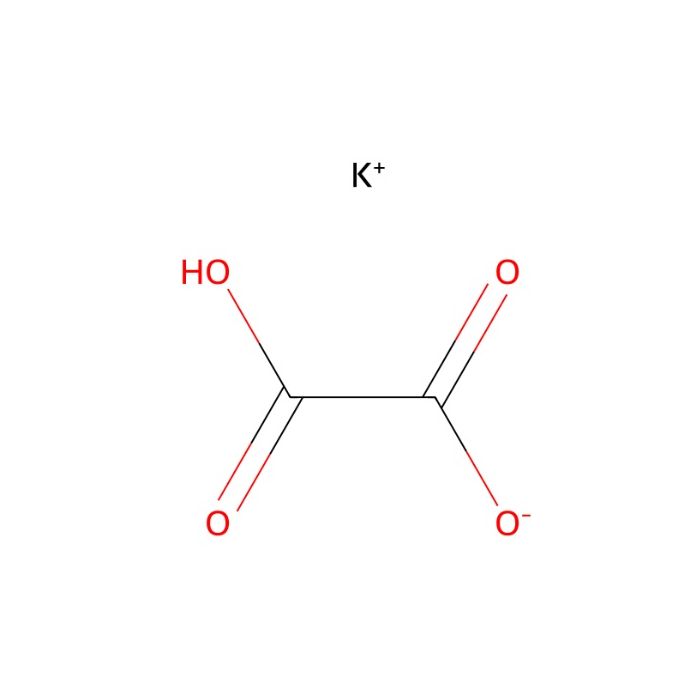
A monobasic oxalate salt providing both potassium cation and the hydrogen oxalate (bioxalate) anion; commonly used as a solid oxalate source and mild acid in the 3–5 pH range.
Item-specific identifiers (from Product Data)
SKU: P1508360
Product name: Potassium binoxalate
CAS: 127-95-7
Storage: Room temperature; shipped under normal conditions
Research use: For research use only
InChIKey: Not specified for this item; refer to CoA/Spec Sheet.
SMILES: Not specified for this item; refer to CoA/Spec Sheet.
Structure (literature/general)
Common chemical identity: Potassium hydrogen oxalate (potassium bioxalate)
Molecular formula: KHC2O4 (literature)
Molecular weight: ~128.11 g/mol (literature)
InChIKey (literature): commonly reported for KHC2O4; consult primary databases for an authoritative identifier.
2D structural description: The anion is the hydrogen oxalate (HC2O4−), comprising two vicinal carboxylate groups linked as an oxalate moiety with one acidic proton retained (–O–C(=O)–C(=O)–O–H). The potassium cation (K+) is charge-balancing and ionically associated; no stereocenters are present.
Functional groups: Dicarboxylate (one carboxylate, one carboxylic acid) within the oxalate framework; ionic potassium counterion.
Notation notes
“Bioxalate/binoxalate” refers to the mono-protonated oxalate anion, HC2O4−. Names such as potassium hydrogen oxalate and potassium binoxalate are used interchangeably in the literature.
Synthetic Utility
Oxalate delivery and chelation
Provides HC2O4− that can deprotonate to C2O4²− in situ, enabling construction of oxalate-bridged complexes (M–(O2C–CO2)–M). Useful for assembling polynuclear coordination polymers, probing magnetic exchange via oxalate bridges, and making precursor salts (e.g., ammonium or transition-metal oxalates).
Selective precipitation/separation
Precipitates sparingly soluble oxalates (e.g., CaC2O4, SrC2O4) from mixed-metal streams. Selectivity can be tuned via pH, temperature, and solvent composition (water/alcohol mixtures), enabling separations or analytical determinations of alkaline earths/lanthanides.
Reductive transformations
Acts as a stoichiometric reductant for high-valent oxo species (e.g., MnO4−, Ce(IV)) in acidic aqueous media, producing CO2. This property is exploited for quenching, redox titrimetry, and kinetic isotope/activation studies without halide interference.
Acid-mediated processes
As a solid, weighable, chloride-free acid source, potassium binoxalate can replace mineral acids in delicate systems where chloride or sulfate are problematic, delivering controlled acidity and chelation simultaneously.
Practical notes
For oxalate complex synthesis, maintain pH where oxalate is predominantly dianionic (≥ pH 5) while avoiding metal hydroxide precipitation; use inert atmospheres if metal centers are air-sensitive.
For precipitation operations, introduce solution slowly with efficient stirring; age precipitates to improve crystallinity; wash with ethanol/water to remove adhering electrolyte.
Target Specificity
Not applicable. This product is a small inorganic salt (potassium hydrogen oxalate) and is not an antibody, oligonucleotide, enzyme, or targeted biological reagent. No antigen/epitope specificity, clone, isotype, or species reactivity pertains to this item.
Frequently Asked Questions
How is this product shipped?
This product ships under standard ambient conditions. No temperature-controlled packaging is required.
What does the trace-metals specification mean?
This product is specified at ≥99.5% on a trace-metals basis. That figure describes metallic impurity content rather than overall chemical assay, so it is the relevant specification for ICP-MS, semiconductor and battery applications. Lot-specific values are stated on the Certificate of Analysis.
How should this product be stored?
Store at room temperature.
What are the CAS number, molecular formula and molecular weight?
The CAS Number is 127-95-7, the molecular formula is KHC2O4, and the molecular weight is 128.12 g/mol. InChIKey JMTCDHVHZSGGJA-UHFFFAOYSA-M.
What documentation is provided?
Available product documentation, including Certificates of Analysis (COA), Safety Data Sheets (SDS), and specification sheets, is shown in the product document area. Document availability and access follow the current site policy.
We use cookies to ensure the website functions properly and, where permitted, to improve your experience. You can manage your preferences at any time in Settings. Learn more in our Cookie Policy.
Shall we send you a message when we have discounts available?
Remind me later
Thank you! Please check your email inbox to confirm.
Products are supplied to verified businesses, institutions, and qualified professionals for research and development use only. Not for use in humans, animals, diagnosis, or therapy.

 C2611757