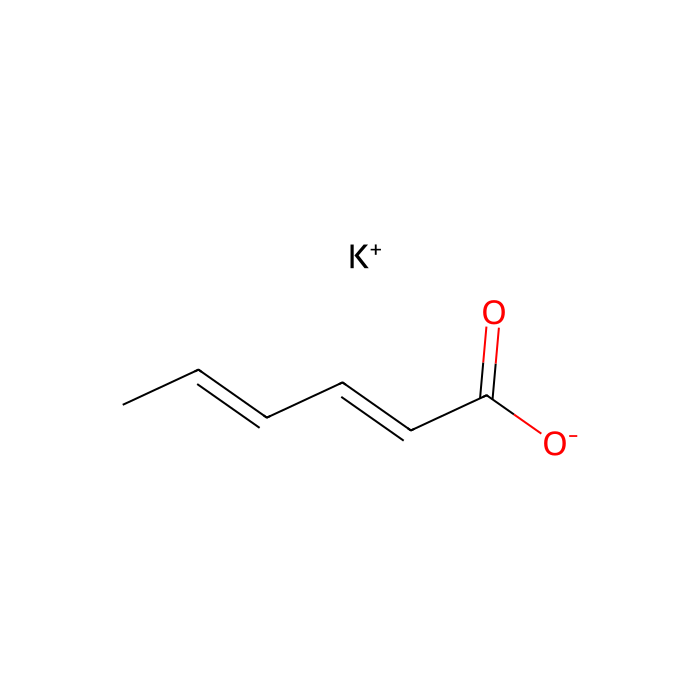
Potassium sorbate - 10mM in Water , CAS No.24634-61-5

CAS: 24634-61-5 Cat. No.: P422842 Formula: C6H7KO2 Molecular Weight: 150.22 Beilstein Registry Number: 5357554 EC Number: 246-376-1
AVAILABLE TO ORDER
GRADE & PURITY 10mM in Water
Synonyms
POTASSIUM SORBATE|24634-61-5|Sorbistat potassium|590-00-1|Sorbistat-K|Potassium (E,E)-sorbate|Sorbic acid potassium salt|potassium (2E,4E)-hexa-2,4-dienoate|Potassium 2,4-hexadienoate|Sorbic acid, potassium salt|BB Powder|Sorbistat-potassium|FEMA No. 2921
Storage
Store at -80°C
Shipped In
Dry ice packs + Cold packs
★
Size
Germany (EU)
USA*
Price
Qty
1ml
P422842-1ml
—
1 In stock
€33.76
Enter a quantity for the sizes you want to add.
🧪
Why this grade

10mM in Water for sensitive chromatographic and analytical workflows requiring minimal baseline interference.

🌡

Storage & shipping

Store at -80°C Ships Dry ice packs + Cold packs Check lot-specific COA for exact specifications.

📋

Quality documents

SDS, COA, datasheet, and spec sheet available for download. Lot-specific COA accessible via lot number lookup.

📚

Literature proof

Cited in 34 peer-reviewed publications across chromatography, organic synthesis, and cross-coupling reactions.

Overview

orbates have been reported to be less toxic than benzoate and have been classified as “Generally Recognized as Safe” (GRAS) additives by the U.S. Food and Drug Administration (FDA).Sorbic acid is metabolised to mainly to carbon dioxide. While the minor amounts are converted to trans,trans-muconic acid (ttMA), which is excreted unchanged into the urine. Urinary ttMA is a biomarker for the occupational and environmental exposure to benzene. Ability of trans,trans-2,4-Hexadienoic acid potassium salt (Sorbic acid potassium salt, Potassium sorbate) to induce chromosome aberrations, sister chromatid exchanges (SCE) and gene mutations in cultured Chinese hamster V79 cells has been examined.Potassium sorbate is reported to be less genotoxic than the sodium salt analog.
Sorbic acid and its potassium salt is commonly employed as food preservative in wide range of foodstuffs, such as cheese, pickles, sauces and wines.

Specifications

Synonyms
POTASSIUM SORBATE | 24634-61-5 | Sorbistat potassium | 590-00-1 | Sorbistat-K | Potassium (E,E)-sorbate | Sorbic acid potassium salt | potassium (2E,4E)-hexa-2,4-dienoate | Potassium 2,4-hexadienoate | Sorbic acid, potassium salt | BB Powder | Sorbistat-potassium | FEMA No. 2921
Specifications & Purity
10mM in Water
Storage
Store at -80°C
Shipped In
Dry ice packs + Cold packs
This product requires cold chain shipping. Ground and other economy services are not available.
Names and Identifiers
Pubchem Sid
Pubchem Sid Url
https://pubchem.ncbi.nlm.nih.gov/substance/528771553
Canonical Smiles
CC=CC=CC(=O)[O-].[K+]
IUPAC Name
potassium;(2E,4E)-hexa-2,4-dienoate
InChIKey
CHHHXKFHOYLYRE-STWYSWDKSA-M
INCHI
1S/C6H8O2.K/c1-2-3-4-5-6(7)8;/h2-5H,1H3,(H,7,8);/q;+1/p-1/b3-2+,5-4+;
Isomeric SMILES
C/C=C/C=C/C(=O)[O-].[K+]
WGK Germany
1
RTECS
WG2170000
Molecular Weight
150.22
Beilstein
5357554
Reaxy-Rn
6087234
Reaxys-RN_link_address
https://www.reaxys.com/reaxys/secured/hopinto.do?context=S&query=IDE.XRN=6087234&ln=

Documentation

📋 Safety Data Sheet (SDS)

Comprehensive hazard, handling, storage, and regulatory compliance document.

Download SDS →

✅ Certificate of Analysis (COA)

Lot-specific quality data. Enter your lot number to retrieve the exact COA.

Look up COA →

📊 Datasheet

Quick-reference summary of product specifications and applications.

View datasheet →

🔬 Specification Sheet

Full quality attributes and acceptance criteria for this grade.

View spec sheet →

Advanced Data

Taxonomic Classification

Taxonomy Tree

KingdomOrganic compounds
SuperclassLipids and lipid-like molecules
ClassFatty Acyls
SubclassFatty acids and conjugates
Intermediate Tree Nodes Not available
Direct ParentMedium-chain fatty acids
Alternative Parents Unsaturated fatty acids  Carboxylic acid salts  Monocarboxylic acids and derivatives  Carboxylic acids  Organic potassium salts  Organic oxides  Hydrocarbon derivatives  Carbonyl compounds  
Molecular FrameworkAliphatic acyclic compounds
Substituents Medium-chain fatty acid - Unsaturated fatty acid - Carboxylic acid salt - Organic alkali metal salt - Monocarboxylic acid or derivatives - Carboxylic acid - Carboxylic acid derivative - Organic oxygen compound - Organic oxide - Hydrocarbon derivative - Organic potassium salt - Organic salt - Organooxygen compound - Carbonyl group - Aliphatic acyclic compound
DescriptionThis compound belongs to the class of organic compounds known as medium-chain fatty acids. These are fatty acids with an aliphatic tail that contains between 4 and 12 carbon atoms.
External Descriptors potassium salt
3D Structure
Interactive Chemical Structure Model


Certificates(CoA,COO,BSE/TSE and Analysis Chart)
C of A & Other Certificates(BSE/TSE, COO):
Analytical Chart:
Chemical and Physical Properties
x_melt_point_char>270°C
Molecular Weight150.220 g/mol
XLogP3
Hydrogen Bond Donor Count0
Hydrogen Bond Acceptor Count2
Rotatable Bond Count2
Exact Mass150.008 Da
Monoisotopic Mass150.008 Da
Topological Polar Surface Area40.100 Ų
Heavy Atom Count9
Formal Charge0
Complexity127.000
Isotope Atom Count0
Defined Atom Stereocenter Count0
Undefined Atom Stereocenter Count0
Defined Bond Stereocenter Count2
Undefined Bond Stereocenter Count0
The total count of all stereochemical bonds2
Covalently-Bonded Unit Count2
FAQs and Articles
Determination of Additives in Beverages
A Practical Guide to Fragrance Compositions: Turning a Black-Box Formula into an Engineerable System—Compatibility, Stability, Controlled Release, Traceability, and Selection
Thickening, Suspension, Auxiliary Stabilization, and Agglomeration Mechanisms of Xanthan Gum in Personal Care Formulations: From Molecular Structure to Processing Applications
Why Are Preservative Systems in Daily Chemical Products Effective? Common Types, Mechanisms of Action, and Factors Affecting Preservation Efficacy
Performance Sources and Formulation Applications of Enzyme-Based Ingredients in Daily Chemical Products: Fermentation Transformation, Enzymatic Reactions, and Application Principles
Why Are Daily Chemical Products Prone to Viscosity Thinning in Summer? Core Mechanisms, Troubleshooting Methods, and Solutions
Citations of This Product
Solution Calculators
Reviews

Customer Reviews

Shall we send you a message when we have discounts available?

Remind me later

Thank you! Please check your email inbox to confirm.

Oops! Notifications are disabled.