
Determine the necessary mass, volume, or concentration for preparing a solution.
Rilmenidine - ≥95% , CAS No.54187-04-1
AVAILABLE TO ORDER
GRADE & PURITY ≥95%
Storage
Store at -20°C
Shipped In
Ice chest + Ice pads
≥95% for sensitive chromatographic and analytical workflows requiring minimal baseline interference.
Store at -20°C Ships Ice chest + Ice pads Check lot-specific COA for exact specifications.
SDS, COA, datasheet, and spec sheet available for download. Lot-specific COA accessible via lot number lookup.
Cited in 0 peer-reviewed publications across chromatography, organic synthesis, and cross-coupling reactions.
Comprehensive hazard, handling, storage, and regulatory compliance document.
Download SDS →Lot-specific quality data. Enter your lot number to retrieve the exact COA.
Look up COA →Full quality attributes and acceptance criteria for this grade.
View spec sheet →Taxonomy Tree
| Kingdom | Organic compounds |
|---|---|
| Superclass | Organoheterocyclic compounds |
| Class | Azolines |
| Subclass | Oxazolines |
| Intermediate Tree Nodes | Not available |
| Direct Parent | Oxazolines |
| Alternative Parents | Isoureas Propargyl-type 1,3-dipolar organic compounds Oxacyclic compounds Carboximidamides Azacyclic compounds Organopnictogen compounds Organooxygen compounds Hydrocarbon derivatives |
| Molecular Framework | Aliphatic heteromonocyclic compounds |
| Substituents | Oxazoline - Isourea - Oxacycle - Azacycle - Organic 1,3-dipolar compound - Propargyl-type 1,3-dipolar organic compound - Carboximidamide - Organic nitrogen compound - Organic oxygen compound - Organopnictogen compound - Hydrocarbon derivative - Organooxygen compound - Organonitrogen compound - Aliphatic heteromonocyclic compound |
| Description | This compound belongs to the class of organic compounds known as oxazolines. These are organic compounds containing 1,3-oxazoline, a five-membered ring with a nitrogen and an oxygen atoms at the 1- and 3-position, respectively. Additionally, it contains two double bonds. |
| External Descriptors | isourea |
| Molecular Weight | 180.250 g/mol |
|---|---|
| XLogP3 | 1.200 |
| Hydrogen Bond Donor Count | 1 |
| Hydrogen Bond Acceptor Count | 2 |
| Rotatable Bond Count | 4 |
| Exact Mass | 180.126 Da |
| Monoisotopic Mass | 180.126 Da |
| Topological Polar Surface Area | 33.600 Ų |
| Heavy Atom Count | 13 |
| Formal Charge | 0 |
| Complexity | 219.000 |
| Isotope Atom Count | 0 |
| Defined Atom Stereocenter Count | 0 |
| Undefined Atom Stereocenter Count | 0 |
| Defined Bond Stereocenter Count | 0 |
| Undefined Bond Stereocenter Count | 0 |
| The total count of all stereochemical bonds | 0 |
| Covalently-Bonded Unit Count | 1 |
No tested application protocols are provided in the Product Data. The following are general, literature-informed suggestions for small-molecule tool compounds like rilmenidine; adapt to your assay and validate in-house.
These are starting frameworks; tailor parameters to your system.
General, literature-based overview (no clinical claims):
Experimental tips (general):
Note: For research use only.
This compound is not a buffering agent and is not typically used to prepare buffer systems. However, buffers are central to its biological and analytical use:
Because rilmenidine does not provide buffering capacity, select buffer systems based on assay biology and analytical detection requirements.
As a solid, nitrogen-rich small molecule used primarily as a research tool compound, rilmenidine itself is not readily replaced by a “green alternative” without altering biological activity. However, greener choices can be made for solvents and workflows surrounding its use.
Greener solvent choices (general guidance):
Process and waste minimization:
Comparison snapshot (general):
Note: The core compound has no “green” substitute without changing its research function; focus sustainability efforts on solvents, scale, and waste.
No clinical or therapeutic claims are made. The notes below address formulation and analytical roles in a research/manufacturing context (literature, general):
Any GMP/GLP or pharmacopoeial use requires grade confirmation, validated methods, and full documentation. For this catalog item, Grade/Purity is not specified; consult the CoA/Spec Sheet before regulated applications.
Item-specific specifications were not provided in the Product Data. Do not treat the following as specifications; they are general/literature guidance to assist method development. Always verify against the lot-specific CoA/Spec Sheet.
Note: If you require precise physicochemical constants for modeling or assay development, consult the lot CoA/SDS or peer-reviewed databases.
Understanding common grades (general guidance):
Documentation and testing suggestions:
Contact Aladdin Scientific for batch-specific CoA and extended analytical data on request.
This product is generally used as a small-molecule probe/ligand in receptor biology and signaling research rather than as a synthetic reagent. Nonetheless, the scaffold’s basic heterocycles inform its handling and potential derivatization.
Research applications (literature, non-clinical):
Analytical applications:
Derivatization/synthesis context (general):
Practical tips:
Because rilmenidine is typically used as a research ligand/standard rather than a reagent, there are no canonical “reaction conditions” for its use. For chemists pursuing analog synthesis or derivatization, general conditions applicable to basic, nitrogen-rich heterocycles are summarized (literature, general):
Expected yields/times are highly substrate- and position-dependent; the above are starting points only. Optimize to the specific substitution pattern of rilmenidine and desired analogs. Always confirm identity/purity by NMR and HRMS.
Hazard information in the Product Data is not specified; consult the SDS for authoritative guidance. The notes below are general best practices for small, basic heterocyclic amines/imidazoline derivatives used in research.
Always defer to the product SDS for definitive hazard and response information.
Rilmenidine is a small, basic heterocycle-rich compound. Without item-specific solubility data, select solvents based on general behavior of imidazoline-class ligands. Always verify with a small test dissolution and your lot’s CoA.
Note: Confirm the supplied form (free base vs. salt) and adjust solvent strategy accordingly.
Item-specific conditions from Product Data:
Additional guidance (general best practices for small-molecule heterocycles; not item-specific specifications):
Always refer to the lot-specific CoA/SDS for definitive guidance on storage stability and reconstitution.
Brief overview: Rilmenidine is a small-molecule imidazoline-class research reagent often used as a pharmacological tool in receptor biology studies (literature). Item-specific identifiers below reflect the catalog entry.
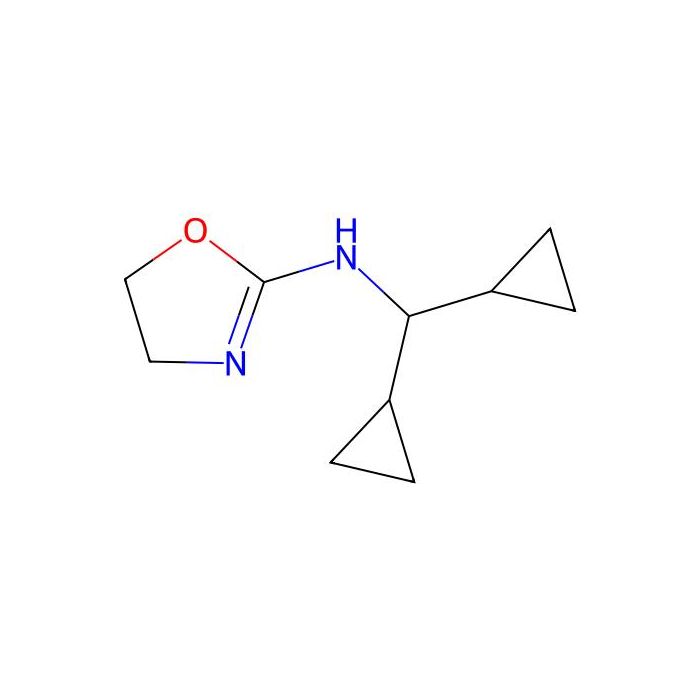
Structural features (general, literature):
2D description in words (literature): a five-membered, partially saturated, di-aza ring (imidazoline-like) bearing an exocyclic amino/heterocyclic substituent; overall a small, basic heterocycle-dense scaffold.
Rilmenidine is primarily a finished small molecule used as a research ligand rather than a building block. Nonetheless, its functional groups suggest possible transformations in a medicinal chemistry context (general, literature-informed):
Caveats:
These are general strategies; specific reaction schemes depend on the exact substitution pattern and supplied form (free base vs. salt).
No antibody or biologic target information is associated with this catalog entry. This product is a small-molecule chemical, not an antibody or protein reagent.
For small-molecule biological studies, consult primary literature for receptor binding profiles, off-target panels, and functional selectivity of rilmenidine under your assay conditions.