GRADE & PURITYMoligand™?Moligand™ — Aladdin's line of ligands and bioactive small molecules. Use for receptor, pathway, and binding studies needing defined small-molecule tools.10 mM in DMSO
Moligand™, 10 mM in DMSO Moligand™ for sensitive chromatographic and analytical workflows requiring minimal baseline interference.
🌡
Storage & shipping
Store at -80°C Ships Dry ice packs + Cold packs Check lot-specific COA for exact specifications.
📋
Quality documents
SDS, COA, datasheet, and spec sheet available for download. Lot-specific COA accessible via lot number lookup.
📚
Literature proof
Cited in 0 peer-reviewed publications across chromatography, organic synthesis, and cross-coupling reactions.
Overview
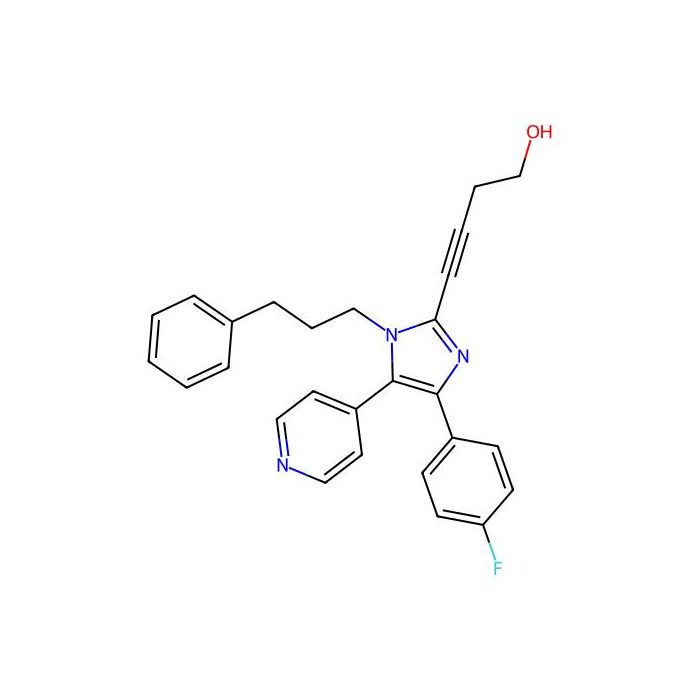
RWJ-67657 (JNJ 3026582) is an orally active and selective p38α and p38β MAPK inhibitor with IC 50 s of 1 and 11 μM, respectively. RWJ-67657 displays no activity at p38γ and p38δ , and exhibits cardio protective effect. Anti-inflammatory and anti-tumor activity.
Specifications
Specifications & Purity
Moligand™, 10 mM in DMSO
Storage
Store at -80°C
Shipped In
Dry ice packs + Cold packs
This product requires cold chain shipping. Ground and other economy services are not available.
Determine the necessary mass, volume, or concentration for preparing a solution.
Dilution Calculator
Determine the dilution needed to prepare a stock solution.
Reconstitution Calculator
Reviews
Customer Reviews
Application Protocols
No validated application protocols (e.g., recommended dilutions, positive controls) are provided in the Product Data for this item.
General guidance for small-molecule ligands:
Prepare fresh DMSO stock solutions, aliquot, and store at −80°C. Avoid repeated freeze–thaw.
Include a vehicle-only control and, where possible, an orthogonal reference compound.
For biochemical assays, pre-incubation times of 10–30 min are common; for cellular assays, exposure times vary (minutes to 24 h) depending on the endpoint.
For item-specific protocols, refer to the CoA/Spec Sheet or contact technical support with your intended use case.
Biological Roles
Item-specific biological targets and mechanisms are not provided in the Product Data. The compound is offered as a Moligand research ligand for discovery applications.
Literature context (for RWJ-67657 as a chemical name in the public domain; not an item-specific claim):
RWJ-67657 has been reported in the literature as a small-molecule modulator used to interrogate stress-activated signaling pathways in biochemical and cellular models. Users commonly employ such ligands to dissect kinase-driven phosphorylation cascades, evaluate pathway-selective transcriptional responses, and benchmark assay performance.
Typical roles for tool ligands include establishing concentration–response relationships, time-dependent effects, and reversibility/washout behavior; these help define target engagement and functional consequences in cellular systems.
Best-practice guidance:
Verify target engagement in your specific system using orthogonal assays (e.g., biochemical inhibition vs. cellular readouts).
Include pathway-relevant positive/negative controls and counter-screens to assess selectivity.
Consider off-target liabilities by employing broad profiling (e.g., enzyme panels or unbiased proteomics) where data quality and interpretability are critical.
Note: The above is general, literature-oriented guidance for small-molecule tool compounds. Consult this product’s CoA/SDS for item-specific details and avoid therapeutic/clinical extrapolations.
Buffer Applications
Not typically applicable. RWJ-67657 is a discrete small-molecule ligand, not a buffering agent.
Practical note:
When preparing assay buffers that will contain DMSO-delivered ligand, verify buffer compatibility with the final DMSO percentage and evaluate potential precipitation or adsorption to plastics. Include vehicle-only controls in all experiments.
Green Alternatives
Green chemistry considerations are more relevant to solvents and bulk reagents than to discrete screening ligands. Nonetheless, you can reduce environmental impact in workflows involving small-molecule tools by:
Minimizing DMSO usage: Prepare higher-concentration master stocks to reduce total solvent volume. Validate assay tolerance to lower final solvent percentages.
Right-sizing: Order quantities aligned to study scope to avoid waste and minimize repeated freeze–thaw cycles.
Greener assay buffers: Use phosphate or HEPES buffers prepared with water-saving practices and verified for low bioburden rather than disposable, pre-filled plastics.
Microplate formats: Employ low-dead-volume plates, acoustic dispensing, or microfluidic systems to cut down on reagent consumption.
Waste segregation: Collect DMSO- and organic-contaminated liquid waste separately for appropriate disposal; avoid unnecessary halogenated solvent usage for cleanup.
Comparison of DMSO handling approaches (general):
Conventional dilution: Simple but may use larger total volumes and plasticware.
Acoustic/echo dispensing: Enables nL–µL transfers from high-concentration stocks, dramatically reducing solvent volumes and waste.
Because this product is not a process solvent or a high-volume reagent, substitution with a “greener alternative” compound is not typically applicable. Focus on greener practices in handling, dispensing, and disposal.
Pharmaceutical Uses
This product is supplied strictly for research use only. It is not formulated, certified, or intended for use as an active pharmaceutical ingredient (API) or as an excipient.
Relevant non-clinical contexts (general):
Preclinical discovery: Tool compound for target/pathway validation, SAR benchmarking, and assay development.
Analytical reference: Potential use as a reference standard in method development/validation for bioanalytical assays, contingent on internal qualification.
Regulatory note:
No pharmacopeial monograph or compendial status is provided for this item. Any cGMP or GLP use would require independent qualification by the user.
Avoid clinical or therapeutic application. For manufacturing or regulated workflows, consult your QA organization and request extended documentation if required.
Physical Properties
The Product Data do not provide physicochemical specifications for this lot.
Item-specific values:
Appearance: Not specified for this item; refer to CoA/Spec Sheet.
Molecular Weight: Not specified for this item; refer to CoA/Spec Sheet.
Molecular Formula: Not specified for this item; refer to CoA/Spec Sheet.
Melting point, boiling point, density, refractive index, UV cutoff, water content, residual solvents, metal content: Not specified for this item; refer to CoA/Spec Sheet.
Solubility (aqueous/organic): Not specified for this item; refer to CoA/Spec Sheet.
General handling guidance for small-molecule screening ligands (literature/best practice):
Many kinase-tool ligands are handled as DMSO stocks (e.g., 10–50 mM) due to limited aqueous solubility; final assay DMSO is often kept ≤0.5–1% v/v to minimize vehicle effects.
Solubility and stability can depend on polymorph, salt form, and hydration state; confirm with the CoA and perform a small-scale solubility check in intended assay buffers.
If UV-Vis readouts are used, determine compound background absorbance in the assay window to avoid interference; similarly, assess intrinsic fluorescence if using fluorescence-based assays.
Important: Do not treat the above as specifications for this product. For exact numeric properties and acceptance criteria, consult the item’s CoA/Spec Sheet and SDS.
Quality and Grades
Grade/Purity for this item: Moligand™ (as provided in Product Data).
About Moligand grade (general description):
Moligand denotes a research-use small-molecule ligand suitable for discovery biology (e.g., HTS, biochemical and cell-based assays, chemoproteomics). Emphasis is typically placed on identity confirmation, batch consistency, and suitability for screening workflows.
Analytical package may include orthogonal identity testing (e.g., LC–MS, 1H NMR) and purity assessment, but the exact methods and pass criteria are batch-dependent.
What is specified for this item vs. where to look:
Item-specific purity percentage, impurity profile, salt/form (free base vs. salt), water content, and residual solvent levels: Not specified for this item; refer to CoA/Spec Sheet.
Stabilizers or additives: Not specified for this item; refer to CoA/Spec Sheet.
Practical implications for users:
For sensitive readouts (kinase assays, biophysical binding, nanoDSF/DSF), verify the CoA purity and perform a quick QC (e.g., analytical HPLC trace) upon receipt if your workflow demands stringent thresholds.
If you require low-UV or LC-MS–compatible grades for direct analytical injection, review the CoA/SDS or contact technical support for guidance on suitability.
For data reproducibility, record batch/lot number and retain an archival aliquot under −80°C conditions.
Reaction and Applications
This listing is for a bioactive small-molecule ligand intended for discovery biology; it is not typically used as a synthetic reagent. Accordingly, classical organic reaction applications (e.g., as a catalyst, base, or coupling partner) are not applicable.
Relevant research applications (general/literature-guided best practices):
Biochemical target validation: Use as a reference tool compound in enzyme inhibition assays or binding assays (e.g., TR-FRET, HTRF, thermal shift/DSF, SPR).
Cellular pharmacology: Profiling of pathway modulation in cells using dose–response curves with appropriate vehicle controls and counter-screens.
Selectivity panels: Broad profiling (e.g., kinome panels) to contextualize on-target vs. off-target interactions.
Mechanistic studies: Time-course experiments, washout designs, and target-engagement assays (CETSA, NanoBRET) to establish MOA in cells.
Chemoproteomics probe development: The scaffold can, in principle, be derivatized (e.g., linker installation) for pull-down or photoaffinity studies; verify that modifications preserve activity.
Note: The above are general research applications for small-molecule ligands. They do not constitute item-specific claims and should be adapted to the end user’s assay system and quality requirements.
Reaction Conditions
Classical synthetic reaction conditions are not applicable; this product is a small-molecule tool compound intended for use as received.
Assay-handling conditions (general best practice for small-molecule ligands):
Stock solutions: Prepare in anhydrous DMSO (e.g., 10–50 mM). Filter through a 0.2 µm PTFE membrane if particulate is observed.
Working concentrations: Establish concentration–response curves spanning at least 8 half-log dilutions; typical top concentrations for screening range from 1–30 µM, subject to solubility and cytotoxicity limits in your model.
Vehicle control: Match DMSO content across all wells; maintain ≤0.5–1% v/v for most live-cell assays unless validated.
Incubation parameters: Time- and temperature-dependence can influence readouts (on-rate/off-rate, pathway feedback). Pilot time-course experiments (e.g., 15 min to 24 h) are recommended.
Adsorption and carryover: Use low-binding plasticware and validate liquid-handling protocols to minimize edge effects and compound precipitation.
All values above are general guidance from literature/common practice, not item-specific specifications. Adjust to your assay design and verify with preliminary experiments.
Safety and Handling
Hazard and classification details are not provided in the Product Data for this item.
Item-specific safety notations:
Signal Word: Not specified for this item; refer to SDS.
H-Statements: Not specified for this item; refer to SDS.
GHS Classification and Pictograms: Not specified for this item; refer to SDS.
General laboratory safety guidance (best practice; defer to SDS for authoritative instructions):
Handle in a chemical fume hood with appropriate PPE: lab coat, safety glasses, and nitrile gloves as a minimum.
Avoid inhalation of dust/aerosols and contact with skin or eyes. Prevent ingestion. Wash thoroughly after handling.
Storage incompatibilities: Keep away from strong oxidizers and strong acids/bases unless compatibility is known. Segregate from moisture if the compound is hydrolytically sensitive.
Thermal sensitivity: Follow storage at ultra-low temperature as specified (−80°C). Minimize freeze–thaw cycles by aliquoting.
First aid overview: In case of skin contact, wash with soap/water; for eye exposure, rinse with water for several minutes and seek medical attention. If inhaled, move to fresh air; if ingested, seek medical advice. Provide the SDS to responders.
Spill/accident: Avoid dust formation; absorb with inert material, collect for disposal. Dispose of waste through approved chemical waste streams.
Always consult the product-specific SDS for definitive hazard, exposure controls, and disposal guidance.
Solvent Selection
This product is a small-molecule research ligand. Item-specific solubility is not provided in the Product Data, so solvent selection should be verified empirically.
General guidance for dissolution (literature/best practice):
Primary solvent: Anhydrous DMSO is typically preferred for small-molecule tool compounds; prepare concentrated stock solutions (e.g., 10–50 mM) and dilute into assay media.
Co-solvents: If precipitation occurs upon dilution, consider serial dilution into water-miscible co-solvents (e.g., DMSO→buffer containing 0.01–0.05% nonionic surfactant) or use intermediate dilution in methanol or ethanol before buffer addition.
Aqueous buffers: Many hydrophobic ligands show limited aqueous solubility; maintain final DMSO ≤0.5–1% v/v for cellular assays and ≤2% v/v for many biochemical assays, unless validated otherwise.
pH effects: Ionizable functional groups (if present) can dramatically alter solubility; conduct a small pH–solubility scan (e.g., pH 6.5–8.0) if permitted by the compound’s stability.
Quick comparison (general):
DMSO: maximal solvating power for diverse scaffolds; may affect some assays at >1%.
Ethanol/MeOH: useful for intermediate dilutions; higher volatility and potential biological effects at >0.5%.
PEG400 or Captisol: can enhance solubility for in vivo method development; for research use only and outside the scope of this listing.
Always confirm solvent choice and working concentrations with a small test dilution and visual inspection for clarity and stability.
Storage and Reconstitution
Storage and shipping (from Product Data):
Storage Conditions: Store at −80°C.
Shipped In: Dry ice packs + Cold packs.
Reconstitution and handling (general best practice for small-molecule ligands):
Solvent: Use anhydrous DMSO to prepare concentrated stock solutions (e.g., 10–50 mM), unless your CoA specifies otherwise. If aqueous solubility is adequate, confirm stability before preparing water-based stocks.
Aliquoting: Dispense into single-use aliquots in low-bind tubes to minimize freeze–thaw cycles and adsorption.
Freeze–thaw: Avoid repeated cycles; thaw on ice immediately before use. Discard any aliquot showing precipitation or discoloration upon thawing.
Light/moisture: If the compound is light- or moisture-sensitive (not specified for this item), protect from light and humidity during handling and storage.
Short-term storage: For frequently accessed aliquots, consider −20°C short-term storage, validating stability in your lab. Long-term storage per Product Data is −80°C.
Stability notes:
No item-specific stability, hygroscopicity, or solution shelf-life data are provided; refer to the CoA/Spec Sheet and SDS. When critical, confirm on-site by analytical QC (e.g., LC–MS) after storage.
Structure and Identity
RWJ-67657 is supplied as a small-molecule research ligand in our Moligand series, commonly used in screening and target-validation workflows.
Item-specific identifiers (from Product Data):
SKU: R1498063
Product Name: RWJ-67657
CAS: 215303-72-3
PubChem CID: 3008319
Structure identifiers for this specific item:
Molecular Formula: Not specified for this item; refer to CoA/Spec Sheet.
Molecular Weight: Not specified for this item; refer to CoA/Spec Sheet.
SMILES: Not specified for this item; refer to CoA/Spec Sheet.
InChIKey: Not specified for this item; refer to CoA/Spec Sheet.
Structural description:
Functional groups, ring systems, and stereochemistry are not provided in the Product Data. Consult the CoA or primary literature for detailed structural features.
Notes on literature resources:
For literature/contextual structure data, refer to public databases associated with PubChem CID 3008319. Any such values are literature references and not item-specific specifications. Always verify against this product's CoA/SDS before use in regulated workflows.
Synthetic Utility
RWJ-67657 is a finished small-molecule ligand; it is not typically employed as a synthetic building block or reagent in preparative chemistry.
Potential R&D utilities (general):
Scaffold derivatization: The core structure (consult literature) may allow appendage modifications for structure–activity relationship (SAR) studies, photoaffinity labeling, or biotinylated/fluorophore-tagged probe development. Such modifications require medicinal chemistry assessment to preserve activity and physicochemical balance.
Analytical control: Can serve as an external standard in LC–MS method development for discovery bioanalysis, following internal qualification.
Considerations before derivatization:
Map tolerated positions using published SAR where available; introduce linkers via metabolically stable bonds.
Monitor impacts on solubility, permeability, and selectivity when increasing molecular weight or polarity.
Re-validate biological activity after any chemical modification.
Note: No item-specific reactivity data, functional group mapping, or protecting group strategies are provided in the Product Data. For synthetic campaigns, consult primary literature associated with PubChem CID 3008319 and related references.
Target Specificity
No target, selectivity profile, or binding data are provided in the Product Data for this item.
Policy note:
To avoid overinterpretation, Aladdin reports target specificity only when supported by item-specific documentation. For exploratory use, consult primary literature linked to PubChem CID 3008319 and perform in-house profiling to confirm target engagement under your assay conditions.
Frequently Asked Questions
What is Moligand??
Moligand? is one of Aladdin Scientific's premium product lines, formulated for high-purity applications across multiple workflows. Compared to standard grades in the same workflow, Moligand? products typically offer tighter specifications, more rigorous QC, and stronger lot-to-lot consistency.
How should this product be stored?
Store at ?80 °C. Ultra-low temperature storage is required to maintain the specified shelf life.
How is this product shipped?
This product ships frozen with dry ice and cold packs. Unpack on arrival and transfer it to the storage condition stated above; handle dry ice with insulated gloves in a ventilated area.
What are the CAS number, molecular formula and molecular weight?
The CAS Number is 215303-72-3, the molecular formula is C??H??FN?O, and the molecular weight is 425.50 g/mol.
What documentation is provided?
Available product documentation, including Certificates of Analysis (COA), Safety Data Sheets (SDS), and specification sheets, is shown in the product document area. Document availability and access follow the current site policy.
Need help choosing the grade?
Our grade selection guide covers purity, stabilizer status, and application suitability for all variants in our catalog.
We use cookies to ensure the website functions properly and, where permitted, to improve your experience. You can manage your preferences at any time in Settings. Learn more in our Cookie Policy.
Shall we send you a message when we have discounts available?
Remind me later
Thank you! Please check your email inbox to confirm.
Products are supplied to verified businesses, institutions, and qualified professionals for research and development use only. Not for use in humans, animals, diagnosis, or therapy.