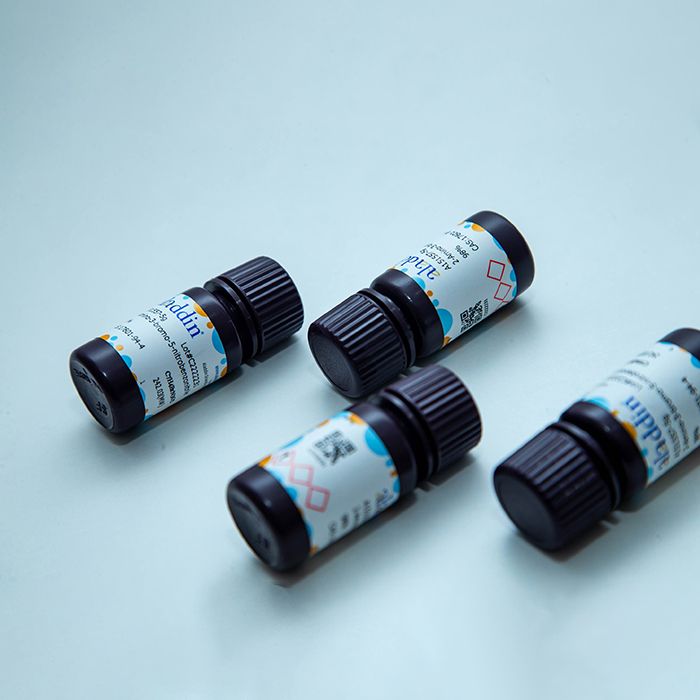
Sofosbuvir impurity L, an diastereoisomer of Sofosbuvir, is the impurity of Sofosbuvir. Sofosbuvir (PSI-7977) is an inhibitor of HCV RNA replication, demonstrates potent anti-hepatitis C virus activity.
Appearance:Solid
IC50& Target:HCV
Biological Activity:Sofosbuvir impurity L, an diastereoisomer of Sofosbuvir, is the impurity of Sofosbuvir. Sofosbuvir (PSI-7977) is an inhibitor of HCV RNA replication, demonstrates potent anti-hepatitis C virus activity.
Specifications
Storage
Store at -20°C
Shipped In
Ice chest + Ice pads
This product requires cold chain shipping. Ground and other economy services are not available.
Determine the necessary mass, volume, or concentration for preparing a solution.
Dilution Calculator
Determine the dilution needed to prepare a stock solution.
Reconstitution Calculator
Reviews
Customer Reviews
Application Protocols
No test application data are provided for this specific item. The following general protocol can be adapted for impurity reference standards in LC/LC–MS workflows.
Example protocol (general):
Stock solution: Accurately weigh 1–5 mg into a low-adsorption vial. Add LC–MS-grade ACN or MeOH to prepare a 1–5 mg/mL stock. If insoluble, dissolve in DMSO, then dilute with mobile phase to ≤1–2% DMSO.
Working standards: Prepare serial dilutions in initial mobile phase to cover expected impurity ranges (e.g., 0.1–100 µg/mL), correcting for potency/purity as per CoA.
System suitability: Inject a mid-level standard; verify retention time, peak symmetry, and resolution from adjacent peaks.
Calibration: Inject at least 5 levels; assess linearity (R2), residuals, and back-calculated concentrations.
Sample analysis: Spike into API/product matrices as needed for recovery and matrix-effect assessments; bracket samples with standards.
Confirmation: Acquire LC–MS spectra of standards and samples; compare exact mass/fragmentation and retention time.
Document any deviations, solvent choices, and observed stability to ensure method traceability and reproducibility.
Biological Roles
No biological roles or functions are assigned to Sofosbuvir impurity L in this catalog context. It is supplied strictly as a research impurity/reference material to support analytical characterization of sofosbuvir-related substances.
General context:
In pharmaceutical development and QC, named impurities are used to establish identification criteria, response factors, and thresholds per ICH guidance. They are not intended for biological assays or as active agents.
If biological testing is contemplated (e.g., mechanistic metabolism research), verify suitability and purity, and develop dedicated handling procedures. However, such use falls outside Aladdin Scientific’s intended research-use scope for this item.
Buffer Applications
Buffer preparation guidance is generally not applicable to this product as a stand-alone reagent. When used in LC/LC–MS methods, buffers or modifiers (e.g., ammonium formate/acetate, formic or acetic acid) may be employed to achieve resolution and ionization efficiency.
For specific buffer recipes and pH ranges, follow your validated analytical method. This listing does not specify any buffer system for Sofosbuvir impurity L.
Green Alternatives
Greener choices primarily concern analytical solvent systems, as the compound’s structure-specific hazards are not provided.
Prefer higher water content in mobile phases where separation allows; water-rich gradients reduce organic solvent consumption.
Methanol vs acetonitrile: MeOH is often viewed as a greener alternative to ACN (renewable feedstock potential, lower toxicity), though at the cost of higher backpressure and sometimes reduced efficiency. Evaluate selectivity and pressure on your column/instrument.
Volatile buffers: Use low concentrations of ammonium acetate/formate instead of nonvolatile phosphate buffers when LC–MS is employed, improving waste compatibility.
Miniaturization: Shift to UHPLC with smaller ID columns and shorter run times to decrease solvent usage without compromising resolution.
Trade-offs (general):
MeOH may change selectivity; method redevelopment may be needed.
Higher aqueous content can increase retention of hydrophobic analytes or worsen peak shape for very polar analytes—tune gradients accordingly.
MeOH/water (0.1% formic acid): greener profile, different selectivity; confirm adequate resolution and acceptable system pressure.
Pharmaceutical Uses
Intended use: reference/impurity standard to support pharmaceutical development and quality control workflows; not for human or veterinary use.
Typical roles in pharma analytics (general):
Qualification of stability-indicating methods: Demonstrate that impurity L is resolved from sofosbuvir and other known impurities/degradants.
Calibration and quantitation: Establish linearity, accuracy, precision, and LOQ/LLOD for impurity L in API and finished product matrices.
System suitability and retention-time indexing: Use as a marker peak to verify column performance and gradient integrity.
Forced degradation mapping: Assist in assigning peaks during oxidative, thermal, hydrolytic, and photolytic stress studies.
Regulatory notes (general):
Maintain traceability to lot-specific CoA, including purity assignment methodology. Document any correction for purity (e.g., water, residual solvents, inorganic residues) when preparing reference solutions.
Ensure use aligns with ICH Q3A/Q3B and applicable pharmacopeial monographs for impurity control of the parent API.
Physical Properties
No item-specific physicochemical constants are provided in the product data. Use the product CoA/Spec Sheet for authoritative values.
Appearance: Not specified for this item; refer to CoA/Spec Sheet.
Melting point (MP): Not specified for this item; refer to CoA/Spec Sheet.
Boiling point (BP): Not specified for this item; refer to CoA/Spec Sheet.
Density: Not specified for this item; refer to CoA/Spec Sheet.
Solubility: Not specified for this item; refer to CoA/Spec Sheet. Practical guidance below.
logP/logD, pKa, refractive index: Not specified for this item; refer to CoA/Spec Sheet.
Practical guidance (general, non–item-specific):
For initial dissolution, start with HPLC-grade acetonitrile (ACN) or methanol (MeOH); if insoluble, try DMSO for concentrated stocks, then dilute into your mobile phase. Always verify chemical compatibility with your analytical method.
Prepare small test aliquots (e.g., 0.5–1 mg) to screen solvents and assess solution stability at your intended concentration and temperature.
For LC–MS work, use LC–MS-grade solvents and filters (PTFE or PVDF) to minimize background and adsorption. Avoid aqueous buffers containing nonvolatile salts if electrospray MS is required.
If hygroscopicity or polymorphism is a concern, equilibrate samples in a controlled low-humidity environment and document handling history for traceability in method validation.
Quality and Grades
Grade/Purity: Not specified for this item; refer to CoA/Spec Sheet.
Context for impurity/reference standards (general):
Identity confirmation typically includes LC–MS (exact mass/fragmentation) and may include 1H/13C NMR and HRMS. The CoA should list test methods and acceptance criteria actually used for the lot.
Purity is commonly reported by HPLC/UPLC area % under a specified method; water and residual solvents may be reported by KF/GC, respectively. For photolabile or labile analytes, purity may be method-dependent.
If a stabilizer is used or if special handling is required (e.g., protection from moisture or light), it will be stated on the CoA; none is specified in the current product data.
For regulated workflows, retain full chain-of-custody documentation, instrument method files, and chromatograms used to qualify the standard on receipt.
Practical recommendations:
Upon delivery, verify appearance, label integrity, and shipping conditions met the specification. Record receipt temperature if monitored.
Run an initial system-suitability injection of the as-received material in your lab’s method to baseline retention time and purity for ongoing comparisons.
Reaction and Applications
This product is intended as an impurity/reference standard rather than a synthetic reagent. Its principal applications are analytical:
Impurity profiling: Assign and track Sofosbuvir-related impurity L in API and drug product using validated LC/LC–MS methods.
Method development: Optimize gradient, column chemistry, and mobile phase to resolve impurity L from the parent and other impurities; use as a marker peak for selectivity assessments.
System suitability: Establish retention time windows, peak symmetry/tailing limits, and relative response factors (when applicable) using this standard.
Calibration/quantitation: Prepare multi-level calibration curves to support determination of reporting, identification, and qualification thresholds per ICH Q3A/Q3B, where applicable.
Stability-indicating studies: Spike stressed samples (acid/base, oxidative, thermal, photolytic) to confirm peak purity and track co-elution under harsh conditions.
Practical tips:
Verify mass spectral fingerprint under your ionization mode (ESI±) and collision energies; archive spectra with chromatographic conditions.
Establish solution stability in your intended diluent and autosampler conditions (time/temperature/light) to prevent drift in response factors.
Reaction Conditions
This product is not intended for use as a reagent in chemical synthesis; therefore, no reaction conditions are specified for transformations.
Analytical conditions (general guidance, literature-style; not item-specific):
Column chemistries: C18 or polar-embedded reversed-phase columns are commonly used for sofosbuvir-related substances. Phenyl-hexyl or HILIC can be evaluated if selectivity or retention is insufficient.
Mobile phases: Water with 0.05–0.1% formic acid or 2–10 mM ammonium formate/acetate (A) and acetonitrile or methanol (B). Start with 5–40% B over 10–20 minutes and adjust to resolve impurity L from adjacent peaks.
Detection: UV at 210–260 nm for general monitoring; LC–MS with ESI± for confirmatory identification and sensitivity. Tune source parameters to minimize in-source fragmentation.
Sample prep: Dissolve in ACN/MeOH or DMSO, then dilute with initial mobile phase. Filter through 0.2 µm PTFE/PVDF where compatible.
System suitability: Define acceptance criteria for resolution (Rs), tailing factor, theoretical plates, and %RSD of replicate injections.
Always finalize methods through robustness/ruggedness studies (flow, temperature, pH, gradient slope) and document acceptance ranges in your SOPs.
Safety and Handling
Hazard classification is not provided in the product data and may vary by batch; consult the product SDS for authoritative safety information.
GHS classification: Not specified for this item; refer to SDS.
Signal word / H-statements / pictograms: Not specified for this item; refer to SDS.
General laboratory precautions (good practice):
Handle in a chemical fume hood; avoid inhalation and contact with skin/eyes. Use appropriate PPE: lab coat, nitrile gloves, splash goggles.
Prevent dust/aerosol generation. For solids, open vials carefully at bench level; for solutions, wipe external surfaces after use.
Storage incompatibilities: Keep separate from strong oxidizers and strong acids/bases unless confirmed compatible. Use amber secondary containment if the compound is light-sensitive.
First aid (overview; defer to SDS): In case of skin/eye contact, rinse with water for at least 15 minutes; remove contaminated clothing. If inhaled, move to fresh air. If ingested, rinse mouth and seek medical advice.
Waste: Collect solutions and rinsates as organic chemical waste per institutional procedures.
Stability: Minimize freeze–thaw cycles; aliquot upon first opening. Monitor for changes in chromatographic purity during extended studies.
Solvent Selection
Because no solubility data are provided for Sofosbuvir impurity L, select solvents empirically, aligned to your analytical method.
General guidance (analytical focus):
Primary solvents: HPLC-grade acetonitrile (ACN) or methanol (MeOH) for stock and working solutions. For difficult solubility, use DMSO to make a concentrated stock, then dilute into mobile phase to ≤1–2% DMSO in final solutions to protect chromatography and MS response.
Aqueous phase: Use purified water (LC–MS grade for MS). If buffering is required for retention or peak shape, choose volatile salts (e.g., ammonium formate/acetate, 2–20 mM) or 0.05–0.1% formic/acetic acid for MS compatibility.
Avoid nonvolatile buffers (phosphates) when LC–MS detection is needed; they can suppress ionization and foul sources.
Adsorption/carryover: For potentially polar or surface-active analytes, low-adsorption vials (glass with certified low-bleed caps; or PP for adsorption-prone compounds) can improve recovery.
Comparative considerations:
ACN generally provides lower viscosity and sharper peaks than MeOH, useful for high-efficiency U(H)PLC separations. MeOH can offer different selectivity and may be preferred for environmental/green considerations when feasible.
If performing preparative isolation or fractionation, consider isopropanol or mixed aqueous organic systems to tune elution strength while maintaining solubility and recovery.
Storage and Reconstitution
Storage and shipping (item-specific):
Storage conditions: Store at -20°C.
Shipped in: Ice chest + ice pads.
General handling guidance:
Allow the sealed container to equilibrate to room temperature before opening to minimize moisture condensation. If the material is moisture- or light-sensitive (check CoA/SDS), handle under low humidity and protect from light.
On first use, subdivide into single-use aliquots in low-adsorption vials to avoid repeated freeze–thaw.
Reconstitution (general; verify with CoA):
Solvent selection: Begin with HPLC-grade acetonitrile or methanol. If necessary, use DMSO to create a concentrated stock, then dilute into your mobile phase.
Concentration: Choose stock levels that ensure on-column mass within your detector’s linear range; correct for purity/potency per CoA.
Filtration: If particulate is present, filter through 0.2 µm PTFE/PVDF compatible with the chosen solvent.
Stability: Establish solution stability at bench, autosampler (4–10°C), and frozen conditions. Discard solutions showing precipitation, discoloration, or new peaks by HPLC.
Research use only: Not for human or veterinary use.
Structure and Identity
Sofosbuvir impurity L is supplied as a research impurity/reference material related to the small-molecule API sofosbuvir. This listing is intended for analytical characterization, method development, and impurity profiling.
Item name: Sofosbuvir impurity L (SKU: S658878)
CAS: S658878 (as provided in product data)
Molecular formula: Not specified for this item; refer to CoA/Spec Sheet.
Molecular weight: Not specified for this item; refer to CoA/Spec Sheet.
InChIKey: Not specified for this item; refer to CoA/Spec Sheet.
SMILES: Not specified for this item; refer to CoA/Spec Sheet.
Structural features: The precise structure and stereochemistry of “impurity L” are not disclosed in the product data. For structural identifiers (2D depiction, stereochemical assignment), please consult the item’s CoA/Spec Sheet.
Notes for users:
Impurity designations (e.g., “impurity L”) typically refer to a specific process-related impurity, degradant, or isomer tracked in validated analytical methods for the parent drug substance.
Matching identity should be confirmed against the supplied CoA (e.g., LC–MS retention time, exact mass, purity profile, and, when available, NMR). Ensure your analytical system reproduces the reference chromatographic behavior under comparable conditions.
Synthetic Utility
This material is not positioned as a synthetic building block. Its value lies in analytical benchmarking rather than in downstream transformations.
Potential uses in R&D (general, non–item-specific):
Mechanistic studies: Serve as a marker to trace specific degradation pathways of the parent API during stress testing, aiding in the proposal of mechanistic schemes.
Reference co-injection: Support peak assignment in complex mixtures and fraction collections, improving confidence in structure elucidation by NMR/HRMS of unknowns.
Response factor determination: Enable evaluation of relative detector response versus parent drug, informing accurate impurity quantitation when certified standards are limited.
If any derivatization or synthetic manipulation is contemplated (e.g., to generate analogs for structural confirmation), validate that such work is necessary and maintain segregated stocks to avoid cross-contamination with analytical reference material.
Target Specificity
Not applicable. This product is a small-molecule impurity/reference standard and is not an antibody, probe, or biologic with defined antigen/target specificity.
Frequently Asked Questions
How should this product be stored?
Store at ?20 °C. Freezer storage is required to maintain the specified shelf life.
How is this product shipped?
This product ships in an insulated container with ice pads. Unpack on arrival and transfer it to the storage condition stated above.
What are the CAS number, molecular formula and molecular weight?
The CAS Number is S658878, the molecular formula is C22H29FN3O10P, and the molecular weight is 545.45 g/mol.
What documentation is provided?
Available product documentation, including Certificates of Analysis (COA), Safety Data Sheets (SDS), and specification sheets, is shown in the product document area. Document availability and access follow the current site policy.
We use cookies to ensure the website functions properly and, where permitted, to improve your experience. You can manage your preferences at any time in Settings. Learn more in our Cookie Policy.
Shall we send you a message when we have discounts available?
Remind me later
Thank you! Please check your email inbox to confirm.
Products are supplied to verified businesses, institutions, and qualified professionals for research and development use only. Not for use in humans, animals, diagnosis, or therapy.