GRADE & PURITYfor Fluorescence analysis?Fluorescence-analysis grade — very low fluorescent impurities for clean spectra. Use in fluorescence assays where background interferes.
for fluorescence analysis, ≥50%(coupling to amines) for Fluorescence analysis for sensitive chromatographic and analytical workflows requiring minimal baseline interference.
🌡
Storage & shipping
Room temperature Ships Normal Check lot-specific COA for exact specifications.
📋
Quality documents
SDS, COA, datasheet, and spec sheet available for download. Lot-specific COA accessible via lot number lookup.
📚
Literature proof
Cited in 0 peer-reviewed publications across chromatography, organic synthesis, and cross-coupling reactions.
Overview
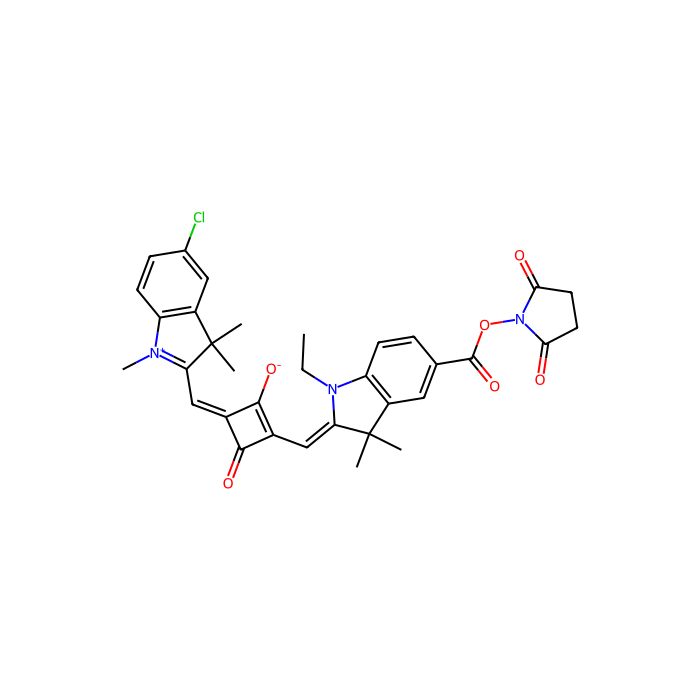
SQ-NHS contains a reactive N-hydroxysuccinimide group, which allows for coupling with amino groups. When conjugated with proteins, SQ-NHS demonstrates a high quantum yield with an absorption maximum at 640 nm and a nanosecond lifetime. Additionally, in the physiological pH range (6-9), the absorbance, emission, and lifetime of SQ-NHS are pH-independent. It is water insoluble
Determine the necessary mass, volume, or concentration for preparing a solution.
Dilution Calculator
Determine the dilution needed to prepare a stock solution.
Reconstitution Calculator
Reviews
Customer Reviews
Application Protocols
No item-specific validated application protocols are provided. The following is a general protocol for amine conjugation with NHS ester dyes (literature/general):
Materials
Amine-containing biomolecule (e.g., IgG) exchanged into 0.1 M sodium bicarbonate, pH 8.3 (amine-free).
SQ-NHS stock solution: 10 mM in anhydrous DMSO (prepare fresh).
Desalting column (e.g., SEC 5–10 mL bed) or spin filter for cleanup.
Procedure (example for 1 mg IgG at 1 mg/mL)
Buffer exchange protein into bicarbonate buffer; quantify by A280.
Add dye stock to achieve 3–6 molar equivalents vs. protein; keep final DMSO ≤10%.
Incubate 30–60 min at room temperature, protected from light, with gentle mixing.
Quench with 20 mM ethanolamine for 10 min.
Purify by SEC into storage buffer (e.g., PBS, pH 7.4). Collect fluorescent protein fractions.
Determine degree of labeling by UV/Vis using dye ε and A280 correction factor from the item’s CoA.
Notes
Avoid Tris/glycine during coupling. Keep solutions dry until mixing. Prepare small aliquots of dye stock to limit freeze–thaw/hydrolysis.
For peptides/surfaces, conduct reactions in DMF or mixed aqueous/DMF with a tertiary amine base (if needed) and monitor by MS/IR/fluorescence.
Biological Roles
This product is a synthetic labeling reagent rather than a native metabolite or cofactor.
Item-specific: No biological roles are specified for this item; it is designated For research use only.
Literature/general context for NHS-activated fluorescent dyes
Function: Provide a covalent fluorescent tag on biomolecules bearing primary amines (e.g., proteins, peptides). The tag enables optical detection, imaging, and assay readouts without altering the target’s genetic content.
Conjugation site preference: Accessible lysine side chains and N-termini; microenvironment and pKa influence reactivity. Site distribution is statistical unless site-specific strategies (e.g., enzymatic handles, orthogonal chemistries) are used.
Post-conjugation behavior: The appended fluorophore can influence protein hydrophobicity, isoelectric point, and aggregation tendencies; careful control of dye-to-protein ratio helps preserve function.
No clinical or in vivo claims are made. All uses are for laboratory research under appropriate approvals.
Buffer Applications
The reagent itself is not a buffering agent. However, buffer choice is critical for successful NHS-ester conjugations (literature/general guidance):
Suitable buffers (no primary amines)
50–100 mM sodium phosphate, pH 7.2–7.8
50–100 mM sodium bicarbonate/carbonate, pH 8.0–8.6
50–100 mM HEPES or borate buffers in similar pH ranges
Avoid: Tris, glycine, ammonium salts, or any additives with free primary amines (e.g., ethanolamine, azides with amine contaminants) during the coupling stage.
Ionic strength: 50–150 mM NaCl often maintains protein solubility; adjust based on target stability.
Cosolvent: Up to ~10% v/v DMSO or DMF is commonly tolerated for many proteins to solubilize the dye; verify for your system.
pH considerations: Reaction rate increases with pH but so does hydrolysis of the NHS ester. pH 7.5–8.5 is a common compromise window; optimize empirically.
Recipes (examples; adjust to need)
0.1 M sodium bicarbonate, pH 8.3; filter-sterilize (0.22 µm); prechill or equilibrate to room temperature; degas if protein is oxidation-sensitive.
After conjugation, exchange into storage buffer (e.g., PBS, pH 7.4) and remove free dye via SEC or dialysis.
Green Alternatives
Green chemistry considerations for handling NHS ester dyes primarily concern solvent choice and process design rather than the reactive moiety itself.
Opportunity areas
Substitute volatile dipolar aprotics with lower-toxicity or biorenewable co-solvents when compatible with your biomolecule and dye solubility.
Reduce solvent volumes via higher-concentration stocks and micro-scale reaction formats.
Employ aqueous micellar systems when feasible to enhance apparent solubility.
DMSO (benchmark): High solvency, fully water-miscible, relatively low volatility; moderate environmental impact; widely biocompatible at ≤10% v/v.
Propylene carbonate: Lower toxicity, biodegradable; high polarity; viscous and slower mixing; can be acceptable up to a few percent with proteins; limited track record for some dyes.
PEG-400 or glycerol: Benign, but high viscosity and potential to perturb protein behavior; use sparingly.
Process improvements
Minimize hydrolysis waste by staged additions of dye stock and short reaction times at room temperature.
Employ solid-phase desalting (SEC cartridges) rather than large-volume dialysis to cut water use.
Note: Optical-grade performance may depend on traditional solvents; any substitution should be piloted at small scale with analytical confirmation of DOL and activity.
Pharmaceutical Uses
No pharmacopeial or excipient status is provided for this item, and it is labeled For research use only.
General, non-clinical context (literature/general)
NHS-activated dyes are used in development-stage analytical assays, process visualization, and preclinical reagent manufacturing as in-process controls, but are not active ingredients or approved excipients without specific regulatory qualification.
If materials of this type are considered for GMP or clinical manufacturing support (e.g., analytical markers), additional controls are typically required: identity and purity by validated methods, impurity profiles, residual solvent limits, and photostability specifications.
No therapeutic, diagnostic, or clinical-use claims are made for this product.
Physical Properties
Item-specific properties (from Product Data)
Appearance: Not specified for this item; refer to CoA/Spec Sheet.
Molecular weight: Not specified for this item; refer to CoA/Spec Sheet.
Literature/general properties for NHS-activated dye esters (for planning only; verify for this item)
Physical state: Often supplied as a dark-colored solid or film; hygroscopic and light-sensitive.
Solubility: Typically soluble in anhydrous, polar aprotic solvents (DMSO, DMF); limited solubility in pure water until converted to a salt or after conjugation. Aqueous stocks can be prepared by first dissolving in DMSO/DMF and diluting into buffer containing the amine target.
Stability: NHS esters hydrolyze in water; half-life decreases as pH increases. Best handled in dry organic solvent and added last to buffered reaction mixtures.
Optical properties: Dyes have characteristic λmax/ε/ΦF values; these are dye-core specific and not provided here. Do not assume values—consult CoA.
Numerical values (bp, mp, density, logP, pKa, nD)
Not specified for this item; refer to CoA/Spec Sheet.
Quality and Grades
Item-specific (from Product Data)
Grade/Purity: for Fluorescence analysis
Interpretation and implications (general guidance)
“For Fluorescence analysis” indicates the item is intended for optical labeling/imaging workflows where high signal-to-background, low particulate matter, and minimized fluorescent impurities are important. While exact purity and spectroscopic specifications (e.g., absorbance at multiple wavelengths, residual NHS content, free acid content) are not provided here, materials in this category are typically optimized to:
Minimize non-emissive quenchers and oligomeric byproducts that reduce quantum yield.
Control hydrolyzed acid/anhydride content that can diminish coupling efficiency.
Provide consistent dye loading and performance in conjugation.
What to verify on receipt (best practices)
Review the CoA/Spec Sheet for: purity assay method, counterion/salt form, residual solvents, extinction coefficient, absorption/emission maxima, and moisture content (if provided). Confirm the stabilizer status; none is specified for this item.
Run a small pilot conjugation to confirm coupling efficiency under your conditions. Assess free-dye removal by SEC/PD-10 or dialysis and verify photophysical behavior on the final conjugate.
Note: If your workflow is HPLC-detection intensive, consider in-house testing of UV/Vis background and particulate levels prior to large-scale conjugation.
Reaction and Applications
Scope (literature/general for NHS ester dyes; verify for this item)
Primary application: Chemoselective labeling of primary aliphatic amines to form stable amide bonds. Typical targets include lysine residues on proteins/antibodies, N-termini of peptides, and amine-functionalized surfaces/polymers.
Bioconjugation strategies:
Direct labeling of proteins in aqueous buffer (pH 7.5–8.5) using a dry DMSO/DMF stock of the NHS ester. Control dye-to-protein ratio by stoichiometry and reaction time.
Solid-phase peptide labeling at the N-terminus after deprotection, in polar aprotic solvents or mixed media.
Surface modification of amine-terminated self-assembled monolayers, polymer films, and nanoparticles.
Practical tips:
Ensure the biomolecule is free of primary-amine buffers and reducing agents. Exchange into PBS or bicarbonate buffer; degas if necessary to minimize oxidative side reactions for sensitive targets.
Maintain anhydrous conditions for the dye stock; add to the reaction last to reduce hydrolysis. Work under subdued light to protect photolabile chromophores.
Quench unreacted NHS ester with ethanolamine after conjugation to cap residual reactive sites and simplify downstream purification.
Analytical verification:
Determine degree of labeling (DOL) by UV/Vis deconvolution using the dye’s ε (literature/CoA value required) and protein A280 with correction factor (CF). Validate by MS or HIC when possible.
Related reactions:
Competitive hydrolysis (unwanted) and aminolysis (desired). Reaction proceeds via nucleophilic acyl substitution with succinimide as the leaving group.
Reaction Conditions
General conditions for NHS-ester aminolysis (literature/general; adjust empirically for your system):
Substrates: Proteins (1–10 mg/mL), peptides, or amine-functionalized small molecules/surfaces in amine-free buffer.
pH/temperature: pH 7.5–8.5 at 20–25°C. Higher pH accelerates reaction but increases hydrolysis of the NHS ester.
Solvent: Prepare dye stock at 5–20 mM in anhydrous DMSO or DMF; add to the aqueous reaction to a final organic content ≤10% v/v.
Stoichiometry/time: For proteins, 2–10 mol equivalents of dye per lysine-accessible site or 2–8 eq per protein as a starting screen; 30–90 minutes is often sufficient. Monitor to avoid overlabeling.
Quench: Add 10–50 mM ethanolamine (or similar) after the desired reaction time to consume residual NHS ester.
Purification: Size-exclusion chromatography (e.g., desalting columns), dialysis (appropriate MWCO), or spin filtration to remove free dye and succinimide byproduct.
Analysis: Determine degree of labeling by UV/Vis using dye ε and A280 correction factor (from CoA). Confirm by MS/HIC/SDS-PAGE with fluorescence imaging.
Expected outcomes
High conversions to amide-linked conjugates when moisture is controlled and compatible pH is used. Side reactions include hydrolysis to the non-reactive dye acid and potential modification of unintended amines if over-equivalented.
Note: No item-specific kinetic or spectroscopic constants are provided for SQ-NHS; consult the CoA for ε, λmax, and CF needed for DOL calculations.
Safety and Handling
Item-specific hazard data (from Product Data)
GHS classification: Not specified for this item; refer to SDS.
Signal word: Not specified for this item; refer to SDS.
H-statements/pictograms: Not specified for this item; refer to SDS.
General safety considerations for NHS-activated dyes (literature/general)
Likely hazards: May cause skin/eye/respiratory irritation. Avoid inhalation of dust and contact with skin/eyes. Some dyes can stain tissues and surfaces.
Hydrolysis sensitivity: NHS esters react with water and alcohols; keep tightly closed and minimize exposure to ambient humidity. Open vials only when ready to prepare stock solutions.
PPE: Laboratory coat, safety glasses or goggles, and appropriate chemical-resistant gloves (e.g., nitrile). Handle powders in a fume hood or ventilated enclosure to avoid dust exposure.
Incompatibilities: Strong bases and nucleophiles (amines, hydroxide) will consume the NHS ester. Avoid amine-containing buffers (e.g., Tris, glycine) during handling and reactions.
First aid (overview; defer to SDS):
Skin/eye contact: Rinse with plenty of water for at least 15 minutes; seek medical attention if irritation persists.
Inhalation: Move to fresh air; seek medical attention if symptoms develop.
Ingestion: Rinse mouth; do not induce vomiting; seek medical attention.
Waste: Collect solutions and contaminated disposables as organic dye-containing hazardous waste per institutional and local regulations.
Always consult the product SDS for authoritative, up-to-date safety and regulatory information.
Solvent Selection
Context for NHS-activated dyes (literature/general)
Polarity and handling
NHS ester dyes are typically handled as dry solids and dissolved in anhydrous, polar aprotic solvents such as DMSO or DMF to make concentrated stocks (e.g., 5–20 mM).
For conjugation, the stock is added to an aqueous buffer (pH 7.5–8.5) containing the amine-bearing biomolecule. Final DMSO/DMF content is commonly kept ≤10% v/v to maintain protein stability.
Miscibility profile
DMSO and DMF are fully miscible with water, enabling straightforward dilution into buffer.
Poor solubility can occur in purely aqueous media before reaction; a cosolvent is recommended.
Buffer compatibility
Avoid primary-amine buffers (Tris, glycine, ammonium salts) and additives with free amines (e.g., certain preservatives). Use phosphate, bicarbonate/carbonate, HEPES, or borate buffers instead.
Comparison (general)
DMSO vs DMF: DMSO is often preferred for bioconjugation due to lower volatility and generally better biocompatibility in small percentages; DMF can give higher solubility for some hydrophobic dyes but may denature sensitive proteins at similar v/v.
Greener options: Propylene carbonate or PEG-400 can sometimes dissolve hydrophobic dyes and are less volatile, but may be too viscous and less compatible with some biomolecules. Validate before scale-up.
Storage and Reconstitution
Item-specific (from Product Data)
Storage conditions: Room temperature
Shipped in: Normal
General handling recommendations (literature/general; align with item guidance)
Protect from moisture and light. Store tightly sealed in the original amber vial with desiccant. Although room-temperature storage is indicated for this item, many users keep NHS esters desiccated at 2–8°C or −20°C for extended shelf life; evaluate according to your usage cadence while adhering to the item’s labeling.
Reconstitution: Prepare fresh, anhydrous stock solutions (e.g., 5–20 mM) in dry DMSO or DMF immediately before use. Dispense through dry, gas-tight syringes to minimize moisture ingress.
Aliquoting: If stock solutions must be stored, aliquot into dry, amber microvials under inert gas. Short-term storage at −20°C can slow hydrolysis; avoid repeated freeze–thaw. Discard any solution showing precipitation or diminished reactivity.
Aqueous solutions: Avoid storing; NHS esters hydrolyze in water. Add to the reaction mixture as the final component and proceed promptly.
Documentation
For exact shelf-life, stabilizers (if any), and specification limits, consult the CoA/Spec Sheet and SDS for this SKU.
Research use only: Not for human or animal therapeutic or diagnostic use.
Structure and Identity
Brief overview: SQ-NHS is sold as an NHS-activated fluorescent labeling reagent, suitable for amine conjugation. Specific structural identifiers for this catalog item are limited in the provided data; consult the CoA/Spec Sheet for definitive structure.
Item-specific (from Product Data)
Product name: SQ-NHS
CAS: 154161-81-6
PubChem CID: 5095317
InChIKey: 324049 (as provided)
SMILES: Not specified for this item; refer to CoA/Spec Sheet.
Molecular formula: Not specified for this item; refer to CoA/Spec Sheet.
Molecular weight: Not specified for this item; refer to CoA/Spec Sheet.
Interpreted/literature context (for orientation; verify against item CoA)
Naming suggests an N-hydroxysuccinimide (NHS) ester of a fluorescent chromophore, commonly used to label primary amines on biomolecules via amide formation.
Structural features typically include: an activated carboxylate as NHS ester, a dye/chromophore core providing strong absorption/fluorescence, and possibly hydrophobic or charged substituents that tune solubility and spectral properties.
2D structure (descriptive, literature-general)
An imide ring (NHS, a succinimide) attached via an ester linkage to a dye-bearing carboxyl group. The dye core is planar, conjugated, and responsible for the optical signature; the NHS moiety is the leaving group during amine coupling.
Note: The exact chromophore identity, substituent pattern, and stereochemistry (if any) are not specified for this item.
Synthetic Utility
From a synthetic perspective, SQ-NHS functions as an activated ester reagent to transfer a dye-bearing acyl group to nucleophiles (literature/general):
Reaction manifold: Nucleophilic acyl substitution by primary amines → amide formation with release of N-hydroxysuccinimide.
Selectivity: Primary aliphatic amines react readily; secondary amines react more slowly; thiols may react under some conditions but are not the primary target.
Utility in materials synthesis: Installation of chromophores onto amine-terminated polymers (PEG-NH2, PAMAM dendrimers), surfaces (APTES-modified silica), and nanoparticles (amine-functionalized AuNPs, silica, polymer beads).
Solid-phase applications: Post-assembly labeling of peptidic scaffolds or amino-functionalized resins in DMF with base scavengers.
Protecting-group compatibility: Typically compatible with neutral conditions; avoid strong bases or nucleophiles that would cause background hydrolysis or transesterification.
Retrosynthetic note
The NHS ester is viewed as a leaving-group masked carboxylic acid. In synthesis planning, the corresponding dye carboxylic acid (free acid) is the retron; activation to the NHS ester is commonly via DIC/DMAP or EDC/NHS in anhydrous media, though this product is the pre-activated form ready for coupling.
Target Specificity
Not applicable for this product type. SQ-NHS is a chemical labeling reagent and does not have biological target specificity (e.g., no antibody epitope or enzyme target) by itself. Specificity in use is determined by the presence and accessibility of primary amines on the chosen substrate.
Need help choosing the grade?
Our grade selection guide covers purity, stabilizer status, and application suitability for all variants in our catalog.
We use cookies to ensure the website functions properly and, where permitted, to improve your experience. You can manage your preferences at any time in Settings. Learn more in our Cookie Policy.
Shall we send you a message when we have discounts available?
Remind me later
Thank you! Please check your email inbox to confirm.
Products are supplied to verified businesses, institutions, and qualified professionals for research and development use only. Not for use in humans, animals, diagnosis, or therapy.