GRADE & PURITYMoligand™?Moligand™ — Aladdin's line of ligands and bioactive small molecules. Use for receptor, pathway, and binding studies needing defined small-molecule tools.≥98%
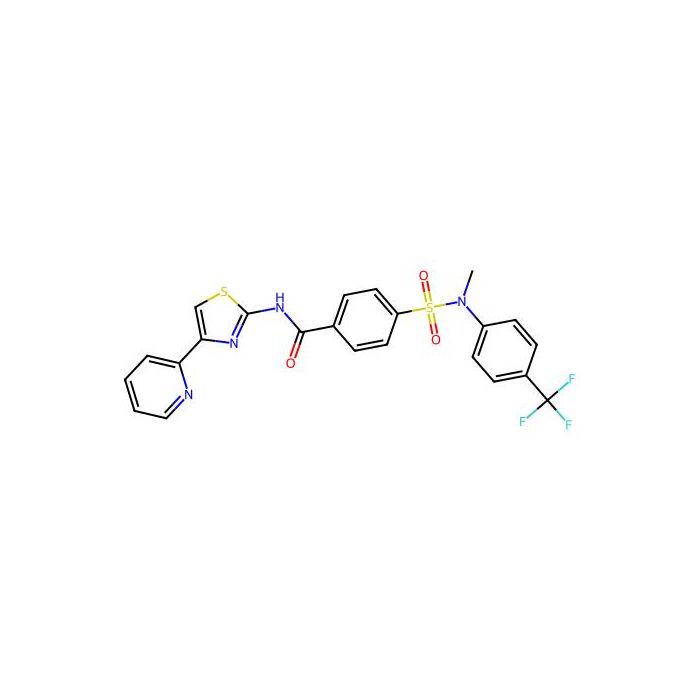
SSTC3 is a casein kinase 1α (CK1α) activator ( K d = 32 nM) that inhibits WNT signaling ( EC 50 = 30 nM). SSTC3 exhibits minimal gastrointestinal toxicity compared to other classes of WNT inhibitors.
Storage
Protected from light,Store at -20°C,Argon charged
Shipped In
Ice chest + Ice pads
This product requires cold chain shipping. Ground and other economy services are not available.
This compound belongs to the class of organic compounds known as sulfanilides. These are organic aromatic compounds containing a sulfanilide moiety, with the general structure RS(=O)(=O)NC1=CC=CC=C1.
External Descriptors
Not available
1. Djoumbou Feunang Y, Eisner R, Knox C, Chepelev L, Hastings J, Owen G, Fahy E, Steinbeck C, Subramanian S, Bolton E, Greiner R, and Wishart DS. ClassyFire: Automated Chemical Classification With A Comprehensive, Computable Taxonomy. Journal of Cheminformatics, 2016, 8:61.
Determine the necessary mass, volume, or concentration for preparing a solution.
Dilution Calculator
Determine the dilution needed to prepare a stock solution.
Reconstitution Calculator
Reviews
Customer Reviews
Application Protocols
No vendor-validated application protocols are provided for this specific item.
General RUO handling protocol for small-molecule ligands (not item-specific; adapt to your assay):
Equilibrate vial to room temperature under subdued light before opening to avoid moisture condensation.
Under inert gas, dissolve the compound in anhydrous DMSO to prepare a master stock at a concentration suitable for your workflow. Mix gently until fully dissolved. If solubility is uncertain, begin with a small volume and titrate solvent as needed.
Clarify the solution by brief centrifugation or 0.2 µm filtration into an amber, inert-gas-flushed vial.
Aliquot single-use volumes to minimize freeze–thaw cycles; overlay with argon and cap tightly.
For assays, dilute the DMSO stock into pre-equilibrated buffer or media with rapid mixing; maintain DMSO within your system’s acceptable limit. Inspect for precipitation.
Record stability by LC–MS of working solutions over the assay time course; protect samples from light.
Notes:
If adsorption or loss in plastics is suspected, use low-bind tips/plates or preconditioned labware.
Establish internal reference spectra (LC–MS, NMR if feasible) to aid troubleshooting and batch-to-batch verification.
For detailed, item-specific protocol parameters, consult the CoA/Spec Sheet or contact Technical Support with your intended application.
Biological Roles
Item-specific biological role: Not specified for this item; refer to primary literature and the CoA/Spec Sheet for any mechanism notes included with the shipment.
General context for small-molecule ligands (not item-specific):
Ligands are used to modulate or probe protein targets (enzymes, receptors, transporters) or pathways in chemical biology. Depending on structure and context, they may act as agonists, antagonists, inhibitors, or allosteric modulators.
In systems biology workflows, ligands serve to perturb nodes in signaling networks, enabling causality inference and validation of biomarkers.
In structural biology, ligands can stabilize conformational states to facilitate crystallography or cryo-EM; co-crystals provide binding poses to guide optimization.
Practical recommendations:
Before deploying in biological assays, verify identity and purity, then confirm solubility and stability in the exact assay medium under study conditions (temperature, light, pH). Monitor compound integrity by LC–MS at relevant time points.
Include orthogonal assays to deconvolute off-target or assay-interference behaviors (e.g., fluorescence quenching, redox activity, aggregation). Use counterscreens like detergent-enhanced assays or DLS as needed.
Use limitation:
For research use only. Not for diagnostic, therapeutic, or in vivo clinical applications. All biological functions and effects should be validated independently in your laboratory according to institutional policies.
Buffer Applications
This product is a small-molecule ligand and is not a buffering reagent. Conventional buffer-system guidance (e.g., phosphate, HEPES, Tris) does not apply directly.
Practical notes for buffer compatibility (general guidance):
Prepare ligand stock solutions in DMSO, then dilute into your assay buffer with vigorous mixing to avoid precipitation. Maintain DMSO at a concentration tolerated by your system.
If precipitation occurs upon dilution, consider adding a small percentage of co-solvent, adjusting ionic strength, or using solubilizing excipients (e.g., 0.01–0.1% nonionic surfactant) appropriate for your assay.
Filter or centrifuge working solutions to remove particulates before use. Protect solutions from light, consistent with the storage instructions.
If your assay requires a specific pH range, select a buffer with suitable capacity independent of the ligand, and verify compound stability at that pH via LC–MS.
Green Alternatives
For a use-ready small-molecule ligand, “greener alternatives” primarily concern solvent choices and workflow design rather than replacing the compound itself.
Solvent considerations (general guidance):
Prefer DMSO over DMF/NMP when feasible for better EHS profiles in bioassays; minimize final DMSO percentage to what your assay tolerates.
For analytical dilutions, use MeOH or EtOH instead of acetonitrile when chromatographically acceptable and compatible with detection.
Replace chlorinated solvents in any auxiliary sample processing with ethyl acetate, MTBE, or heptane mixtures where possible.
Process/waste minimization:
Prepare higher-concentration master stocks to reduce solvent volume over time; aliquot to limit repeated freeze–thaw and compound wastage.
Implement microplate-based assays with low working volumes and automated liquid handling to reduce consumables and chemical waste.
Comparative note (general; not item-specific):
If you plan to derivatize or resynthesize analogs of this ligand, consider greener reaction media (e.g., 2-MeTHF, CPME, propylene carbonate) and catalytic methods that reduce stoichiometric waste. Balance with purity demands and target reaction kinetics.
Documentation:
Track solvent usage and disposal streams in your ELN/LIMS to identify hotspots for substitution and to support internal green chemistry KPIs.
No compound-level “alternative” is proposed here because the listing concerns a specific screening ligand; suitability is driven by your biological question and assay requirements.
Pharmaceutical Uses
No pharmaceutical or clinical formulation uses are claimed or specified for this item. It is supplied strictly for research use only.
Research/formulation context (general; not item-specific):
In preclinical labs, small-molecule ligands may be formulated as DMSO stocks for in vitro assays, or as vehicle-dosed solutions for exploratory in vivo research performed under appropriate approvals. Such activities fall outside the scope of this catalog listing and require institution-specific review.
There is no pharmacopeial status indicated (USP/EP/JP) for this product. Excipient role, dosage-form compatibility, and GMP documentation are not provided.
If you require suitability for regulated use:
Contact Technical Support for availability of expanded documentation (e.g., extended analytical package, impurity profile). Otherwise, this product should be treated as RUO-grade without claims of GMP compliance.
Reminder:
For research use only. Not for human or veterinary use, not for diagnostic procedures, and not for incorporation into products intended for clinical administration.
Physical Properties
Item-specific properties are not provided in this listing.
Item-specific (from Product Data):
Appearance: Not specified for this item; refer to CoA/Spec Sheet.
Molecular Weight: Not specified for this item; refer to CoA/Spec Sheet.
Other physicochemical data (BP/MP, density, pKa, logP, refractive index, UV cutoff): Not specified for this item; refer to CoA/Spec Sheet.
Literature/general expectations for small-molecule ligands (not item-specific):
Physical state: Many discovery ligands are supplied as off-white to yellow solids or films; hygroscopicity and polymorphism may vary (literature/general).
Solubility: DMSO typically provides the highest solvency; DMF, MeOH, EtOH, or 1:1 DMSO–water are frequently used (general practice). Aqueous solubility can vary widely with ionization state and salt form.
pKa/logP: Not known for this item. If mechanistic studies require ionization data, determine experimentally (potentiometric titration) or compute with validated software; confirm with LC–pH profiling (general guidance).
Optical properties: If your assays require absorbance/fluorescence windows, record a UV–Vis spectrum of a freshly prepared solution to locate practical analytical wavelengths and assess aggregate formation (general guidance).
Practical notes:
Prepare small test solutions (e.g., 1–10 mg/mL in DMSO) to empirically check solubility and stability over time and under light exposure, given the storage note “protected from light”. Use amber vials and inert gas overlay during solution studies. Always defer to the lot-specific CoA for authoritative physical data.
Quality and Grades
Item-specific grade (from Product Data):
Grade/Purity: Moligand™.
What Moligand™ indicates (program-level description; not a numerical specification):
Intended use: Small-molecule ligand suitable for screening, SAR exploration, target validation, and chemical biology research.
Typical quality controls for this grade include identity confirmation by LC–MS/HRMS and/or NMR and chromatographic purity assessment (e.g., HPLC), with lot-specific details provided on the CoA. Exact purity percentages, counterions, residual solvent limits, or metal content are not specified here and should be verified in the CoA/Spec Sheet.
Presentation: Often supplied as a dry solid or film for preparation of DMSO stock solutions; appearance is lot-dependent and not specified in this listing.
How to use this information:
For bioassays and screening, confirm identity/purity by an orthogonal method in-house if required by your QA policy.
If low-UV absorbance, LC compatibility, or trace impurity constraints are critical, request extended analytics (e.g., full impurity profile, water content by Karl Fischer). If not present on the standard CoA, contact Technical Support.
Not specified for this item; refer to CoA/Spec Sheet:
Exact purity %, water content, residual solvents, stabilizers, UV cutoff, salt form, and any metal limits.
Reaction and Applications
Item-specific applications (from Product Data):
Manufacturer Applications: Not specified in the catalog entry. This compound is offered as a Moligand™ small-molecule ligand for research use.
General applications for small-molecule ligands in research (not item-specific):
Chemical biology probes: Employed in phenotypic or target-based screens to perturb pathways and generate activity profiles.
Assay development: Used as a reference modulator or tool compound during optimization of biochemical, biophysical, or cell-based assays.
Mechanistic studies: Support kinetic or binding investigations by titrations in biolayer interferometry, SPR, ITC, DSF, or enzymatic assays.
Analytical reference: Serves as a reference standard for LC–MS method development, retention time locking, and stability-indicating methods.
Practical handling notes:
Prepare DMSO stocks under inert atmosphere and low light, consistent with the storage note (argon, light protection). Aliquot to minimize freeze–thaw cycles.
If adsorption to plastics is suspected (common for hydrophobic ligands), precondition labware with assay buffer containing minimal serum/bovine serum albumin or use low-bind plastics.
For SAR or derivatization campaigns, retain a small reserve aliquot as a purity/identity reference for cross-checking newly synthesized analogs.
Not applicable to this item:
No specific named reactions or catalytic roles are associated with this listing as a reagent; SSTC3 is positioned as a use-ready ligand rather than a synthetic building block.
Reaction Conditions
No reaction conditions are specified for this product because it is offered as a screening ligand rather than a reagent for a particular transformation.
If you plan to derivatize the compound (general guidance; not item-specific):
Solvents: Select dry, oxygen-free solvents (e.g., toluene, 2-MeTHF, DCM, DMF) appropriate to the transformation and any sensitive motifs. The product’s storage under argon and protected from light suggests handling under inert atmosphere and minimal light exposure during synthesis.
Temperatures: Many cross-couplings and amide couplings run at 20–100 °C; ensure thermal stability by small-scale trials and in-process LC–MS monitoring.
Catalysts/additives: Choose Pd catalysts/ligands and modern coupling reagents as dictated by the functional groups present in the known structure (not provided here). Validate conditions incrementally.
Workup: Minimize exposure to air and light during quench and purification. Use amber glassware, and consider antioxidant additives if degradation is observed.
Analytical control:
Track conversion and impurity evolution with UPLC–MS and, where feasible, photodiode array detection to detect photoproducts. Archive spectra for batch-to-batch comparability.
These recommendations are general and should be adapted only after obtaining definitive structural information from the CoA/Spec Sheet.
Safety and Handling
Safety information specific to this item is limited in the current listing.
Item-specific (from Product Data):
GHS Classification: Not specified for this item; refer to SDS.
Signal Word: Not specified for this item; refer to SDS.
Hazard Statements (H-): Not specified for this item; refer to SDS.
Pictograms: Not specified for this item; refer to SDS.
Storage: Store at −20 °C, protected from light, under argon (inert atmosphere). Shipped in an ice chest with ice pads.
General laboratory precautions for research ligands (not item-specific; follow your institutional EHS policies):
PPE: Lab coat, safety glasses, and appropriate chemical-resistant gloves (e.g., nitrile). Handle in a fume hood to avoid inhalation of dust or solvent vapors.
Incompatibilities: Avoid oxidizing agents and prolonged exposure to air or moisture if the compound is oxygen- or moisture-sensitive; the argon storage note suggests sensitivity to air/oxidation or photolability.
Light sensitivity: Use amber glassware, minimize bench-top exposure, and keep stock solutions wrapped/foiled.
First aid (overview; consult SDS for specifics): Inhalation—move to fresh air; Skin—wash with soap and water; Eye—rinse cautiously with water for several minutes; Ingestion—rinse mouth; seek medical attention for any exposure.
Spill response: Avoid dust generation; absorb solutions with inert material; clean with appropriate solvent while wearing PPE.
Always consult the product-specific Safety Data Sheet (SDS) for authoritative hazard classification, recommended controls, and emergency procedures before use.
Solvent Selection
Given the lack of item-specific solubility data, select solvents using general best practices for small-molecule ligands.
Primary solvents (general guidance):
DMSO: First-choice for preparing concentrated stocks (e.g., 10–50 mM, general practice). High solvency, miscible with water and most assay buffers in small aliquots.
DMF or NMP: Useful for poorly soluble analytes when DMSO is insufficient. Evaluate compatibility with your assay or materials.
Alcohols (MeOH, EtOH, i-PrOH): Suitable for analytical sample prep and some biophysical assays; watch for protein denaturation in bioassays.
Aqueous work: If aqueous delivery is required, dilute DMSO stocks into buffered media with vigorous mixing; keep final DMSO below assay tolerance. Consider co-solvents or cyclodextrin complexation if precipitation occurs (general strategies).
Polarity/miscibility (not item-specific):
Without a disclosed structure, polarity and ionization are unknown. Empirically screen a small solvent panel to determine workable formulations for your application.
Comparison (general):
DMSO vs DMF: DMSO offers better biocompatibility in many assays but can reduce activity of some enzymes; DMF can have higher solvency yet is less tolerated in biological systems.
Practical tips:
Filter or centrifuge to remove particulates before assays.
Prepare fresh working solutions to minimize degradation; protect from light throughout handling as indicated by storage requirements.
Storage and Reconstitution
Item-specific storage (from Product Data):
Store at −20 °C.
Protect from light.
Argon charged (maintain under inert atmosphere).
Shipped in an ice chest with ice pads.
Reconstitution guidance (general; not item-specific):
Equilibrate the sealed container to room temperature before opening to prevent moisture ingress. Open under inert gas if feasible.
Dissolve in anhydrous, oxygen-free DMSO to make a concentrated master stock appropriate to your assays. If needed, warm gently to aid dissolution while minimizing light exposure (use amber glass and cover).
After dissolution, aliquot into amber vials or tubes, overlay with inert gas, and store at −20 °C. Avoid repeated freeze–thaw cycles.
For short-term use at the bench, keep solutions on ice and protected from light; return unused aliquots promptly to frozen storage.
Stability monitoring:
Verify integrity by LC–MS or HPLC at first use and periodically thereafter. If discoloration, precipitation, or loss of assay activity is observed, prepare a fresh aliquot.
Not specified for this item; refer to CoA/Spec Sheet:
Acceptable concentration ranges for stock solutions, long-term stability limits, and any specific stabilizers or counterions.
Disposal:
Dispose of unused material and solutions according to your institutional chemical waste procedures. Keep logs of storage conditions and usage to ensure traceability.
Structure and Identity
Concise identity information for SSTC3 as listed for this catalog entry.
Item-specific (from Product Data):
SKU: S648238
Product Name: SSTC3
CAS: 1242422-09-8
PubChem CID: 46912682
InChIKey: 129623 (as provided)
SMILES: Not specified for this item; refer to CoA/Spec Sheet.
Molecular Formula: Not specified for this item; refer to CoA/Spec Sheet.
Molecular Weight: Not specified for this item; refer to CoA/Spec Sheet.
Structural features (general guidance):
This item is supplied under the Moligand™ grade, indicating a small-molecule ligand intended for screening and exploratory research. Specific functional groups, ring systems, and stereochemical information are not provided in this listing. Consult the CoA/Spec Sheet for definitive structural data and any stereochemical descriptors.
Practical description of 2D structure (general):
Without an item-specific SMILES or structure diagram, a text description of the 2D connectivity cannot be authoritatively provided here. If you require an annotated 2D structure (atom numbering for NMR assignment, functional group mapping, etc.), request the structure file (SDF/MOL) or refer to the CoA tied to the supplied lot.
Traceability:
Where available, cross-reference the CAS and CID with your internal ELN/LIMS records to ensure concordance of identity across screening datasets and analytical methods (LC–MS, HRMS, NMR).
Synthetic Utility
This listing positions SSTC3 as a ready-to-use small-molecule ligand rather than a synthetic reagent or building block.
Item-specific statement:
No functional-group or reactivity information has been provided for this item; consult the CoA/Spec Sheet if you plan derivatization or analytical method development that depends on reactive handles.
General considerations (not item-specific):
If used as a reference standard in medicinal chemistry, reserve analytical aliquots for LC–MS/NMR comparison during SAR campaigns.
For probe optimization, capture the parent ligand’s spectroscopic and chromatographic fingerprints (1H/13C NMR, HRMS, HPLC/UPLC retention) to benchmark derivatives.
If the structure contains common medicinal chemistry motifs (e.g., heteroaryl scaffolds, amide linkages), typical transformations may include cross-couplings (Suzuki–Miyaura, Buchwald–Hartwig), amide couplings, and heteroatom alkylations; however, applicability to this specific compound is unknown without disclosed structure.
Protection and stability (general guidance):
The argon/light-protected storage suggests potential oxidation or photodegradation liability; plan synthetic manipulations under inert atmosphere and subdued light when working with analogs.
Conclusion:
Treat this material primarily as a tool compound. If synthetic elaboration is intended, request or determine the full structure and confirm reactivity compatibility before route planning.
Target Specificity
Target details are not provided for this item in the catalog listing.
Item-specific:
Target, mechanism of action, and binding parameters: Not specified for this item; refer to CoA/Spec Sheet or primary literature sources.
General guidance for researchers (not item-specific):
If employing this ligand in target-based assays, determine or confirm specificity via a combination of biochemical profiling, orthogonal binding assays (SPR/ITC), and selectivity panels against close homologs.
Consider running counterscreens to exclude assay interference (fluorescence quenchers, redox cyclers, aggregators). Employ detergent and varying protein concentrations to diagnose nonspecific inhibition.
Documentation:
Capture your in-house potency/selectivity metrics, and link to this SKU in your ELN/LIMS so that future resupply does not disrupt continuity of your datasets.
Frequently Asked Questions
What is the purity of this product?
This product is supplied at ≥98% purity (chemical assay). Lot-specific values are stated on the Certificate of Analysis.
What is Moligand??
Moligand? is one of Aladdin Scientific's premium product lines, formulated for high-purity applications across multiple workflows. Compared to standard grades in the same workflow, Moligand? products typically offer tighter specifications, more rigorous QC, and stronger lot-to-lot consistency.
How should this product be stored?
Store at ?20 °C, protected from light, under argon. It is supplied under an argon blanket; reseal under inert gas after each use.
How is this product shipped?
This product ships in an insulated container with ice pads. Unpack on arrival and transfer it to the storage condition stated above.
What are the CAS number, molecular formula and molecular weight?
The CAS Number is 1242422-09-8, the molecular formula is C23H17F3N4O3S2, and the molecular weight is 518.53 g/mol. InChIKey HSFAATUFWDDUGW-UHFFFAOYSA-N.
What documentation is provided?
Available product documentation, including Certificates of Analysis (COA), Safety Data Sheets (SDS), and specification sheets, is shown in the product document area. Document availability and access follow the current site policy.
Need help choosing the grade?
Our grade selection guide covers purity, stabilizer status, and application suitability for all variants in our catalog.
We use cookies to ensure the website functions properly and, where permitted, to improve your experience. You can manage your preferences at any time in Settings. Learn more in our Cookie Policy.
Shall we send you a message when we have discounts available?
Remind me later
Thank you! Please check your email inbox to confirm.
Products are supplied to verified businesses, institutions, and qualified professionals for research and development use only. Not for use in humans, animals, diagnosis, or therapy.

 I2618640