≥98% for sensitive chromatographic and analytical workflows requiring minimal baseline interference.
🌡
Storage & shipping
Store at -20°C Ships Ice chest + Ice pads Check lot-specific COA for exact specifications.
📋
Quality documents
SDS, COA, datasheet, and spec sheet available for download. Lot-specific COA accessible via lot number lookup.
📚
Literature proof
Cited in 0 peer-reviewed publications across chromatography, organic synthesis, and cross-coupling reactions.
Overview
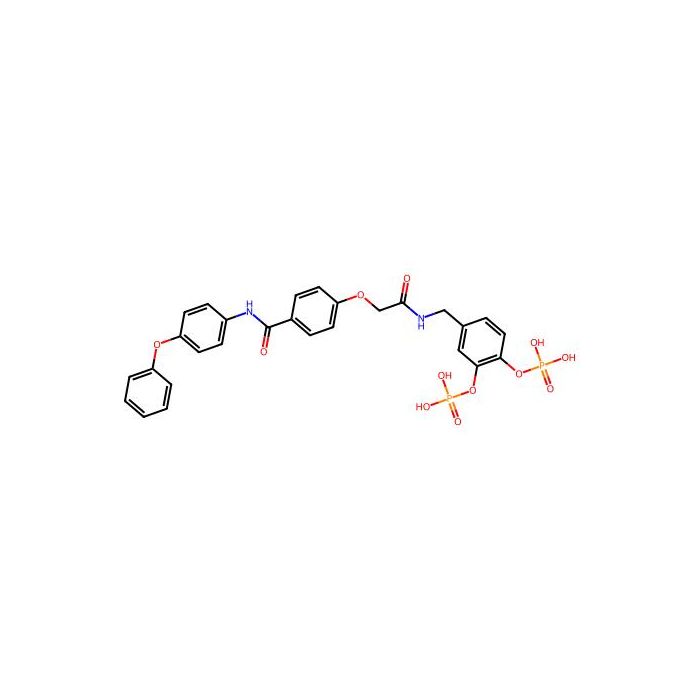
Stafib-2 is a potent and selctive inhibitor of the transcription factor STAT5b , with an IC 50 of 82 nM and 1.7 μM for STAT5b and STAT5a , respectively. Stafib-2 exhibits poor cell permeability
In Vitro
Stafib-2 has an extremely high affinity for STAT5b (K i =8.8 nM). Stafib-2 (3-10 μM; 4-48 h) does not show significant activity in K562 and MDA-MB-231 cells. MCE has not independently confirmed the accuracy of these methods. They are for reference only.
Stafib-2 is a potent and selctive inhibitor of the transcription factor STAT5b , with an IC 50 of 82 nM and 1.7 μM for STAT5b and STAT5a , respectively. Stafib-2 exhibits poor cell permeability.
Storage
Store at -20°C
Shipped In
Ice chest + Ice pads
This product requires cold chain shipping. Ground and other economy services are not available.
This compound belongs to the class of organic compounds known as benzanilides. These are aromatic compounds containing an anilide group in which the carboxamide group is substituted with a benzene ring. They have the general structure RNC(=O)R', where R,R'= benzene.
External Descriptors
Not available
1. Djoumbou Feunang Y, Eisner R, Knox C, Chepelev L, Hastings J, Owen G, Fahy E, Steinbeck C, Subramanian S, Bolton E, Greiner R, and Wishart DS. ClassyFire: Automated Chemical Classification With A Comprehensive, Computable Taxonomy. Journal of Cheminformatics, 2016, 8:61.
Determine the necessary mass, volume, or concentration for preparing a solution.
Dilution Calculator
Determine the dilution needed to prepare a stock solution.
Reconstitution Calculator
Reviews
Customer Reviews
Application Protocols
The Product Data does not include tested applications or protocols specific to Stafib-2.
General small-molecule handling protocol (not item-specific)
Stock preparation: Weigh accurately under dry conditions. Dissolve in anhydrous DMSO to 10–50 mM. Vortex and mild sonication as needed. Sterile-filter through 0.2 µm PTFE if required by the assay.
Aliquoting: Dispense single-use aliquots (e.g., 10–50 µL) into low-bind tubes or plates. Store at −20°C or below.
Working solutions: Dilute into assay buffer or media to the desired concentration keeping final DMSO ≤1–2% v/v unless otherwise validated.
Documentation: Record stock concentration, solvent, preparation date, and freeze–thaw count. Include vehicle controls in all experiments.
Analytical checks
Verify identity/purity by LC-MS/HPLC upon receipt and after extended storage. Perform a 200–800 nm UV scan to detect strong absorbers that might interfere with optical assays.
For any specialized application, consult your internal SOPs and validate with small-scale pilot experiments.
Biological Roles
Item-specific biological role
No biological function, pathway association, or target information is provided for Stafib-2 in the Product Data. Any mechanistic or target claims should be confirmed from peer-reviewed literature or the CoA/technical dossier before use.
General context for small-molecule library members (not item-specific)
Such compounds are commonly employed as tool candidates in discovery biology to probe biochemical pathways, modulate protein function, or serve as starting points for medicinal chemistry optimization.
Typical workflows include target-based screening (enzyme, receptor, ion channel) and phenotypic assays, followed by orthogonal validation (biophysics such as SPR, MST, DSF; cell imaging; genetic perturbation synergy).
Counter-screening against common interference mechanisms (redox cycling, metal chelation, detergent-sensitive aggregation) is recommended to avoid misattribution of biological activity.
Best practices
Establish concentration–response curves with appropriate vehicle controls and determine apparent potency metrics (IC50/EC50) with awareness of solubility/aggregation ceilings.
Assess chemical stability in assay buffers and microsomes (if ADME profiling is planned) and monitor for binding to plasticware or serum proteins.
Note: This product is for research use only. No medical, diagnostic, or therapeutic use is implied.
Buffer Applications
This section is generally not applicable. Stafib-2 is a small-molecule library member rather than a buffering agent.
Item-specific buffer role
None provided.
Practical guidance (general, not item-specific)
When dosing small molecules into aqueous assays, choose a biologically compatible buffer (e.g., HEPES, PBS, Tris) appropriate to the assay pH and ionic strength. Maintain final DMSO ≤1–2% v/v unless the assay demonstrates tolerance to higher levels.
Pre-screen compound stability across buffer choices (pH 6.5–8.0 typical) and monitor precipitation visually and by analytical LC.
For buffering needs, refer to dedicated buffering agents rather than this product.
Green Alternatives
Without item-specific solubility and reactivity, greener choices concern solvent handling and assay design rather than the compound itself.
General greener solvent substitutions (literature/general guidance)
Replace DMF or NMP with safer polar aprotics where feasible: DMSO, propylene carbonate, or Cyrene (dihydrolevoglucosenone) depending on solubility and assay tolerance.
Prefer ethanol or 2-propanol over methanol or chlorinated solvents for workup/cleaning when compatible with analyte stability.
For liquid handling, minimize DMSO usage by high-concentration stocks and acoustic dispensing to reduce total solvent volumes.
Comparison snapshot (general)
DMF vs Cyrene: Similar polarity; Cyrene is biorenewable and lower toxicity but has higher viscosity and potential reactivity with strong bases (trade-off).
Acetonitrile vs EtOH/H2O gradients: EtOH is greener but may increase backpressure and affect selectivity in HPLC.
Operational sustainability
Employ microplate formats and miniaturized assays to reduce waste; adopt sealed plates to limit VOC emissions.
Use energy-efficient cold storage and maintain accurate inventory to avoid unnecessary re-synthesis or procurement.
All substitutions must be verified experimentally for Stafib-2 to ensure stability, solubility, and performance remain acceptable.
Pharmaceutical Uses
No pharmacopeial status, excipient role, or formulation use is provided for Stafib-2 in the Product Data.
Research-only status
Labeled for research use only. Not for human or veterinary use, clinical diagnostics, or as an active pharmaceutical ingredient.
General formulation considerations for research compounds (not item-specific)
For in vitro work, prepare DMSO stocks and dilute into assay media with attention to solvent tolerance and adsorption to plasticware.
For preclinical exploratory studies (in vitro only unless permitted by your institution), develop fit-for-purpose vehicles while confirming compound stability (e.g., DMSO/PEG400/saline or Captisol systems) — ensure alignment with institutional approvals and regulations.
Conduct forced-degradation and photostability studies to inform handling and storage during assay campaigns.
Any claim of pharmaceutical use would require explicit supporting documentation and regulatory-grade data, which are not provided here.
Physical Properties
Item-specific physical constants were not provided in the Product Data.
Item-specific data
Appearance: Not specified for this item; refer to CoA/Spec Sheet.
Melting point (MP): Not specified for this item; refer to CoA/Spec Sheet.
Boiling point (BP): Not specified for this item; refer to CoA/Spec Sheet.
Density: Not specified for this item; refer to CoA/Spec Sheet.
Refractive index: Not specified for this item; refer to CoA/Spec Sheet.
pKa/logP/logD: Not specified for this item; refer to CoA/Spec Sheet.
Solubility: Not specified for this item; refer to CoA/Spec Sheet.
Literature/general guidance (not item-specific)
For small-molecule screening compounds of unknown properties, initial solubility scouting commonly uses DMSO (anhydrous), followed by cosolvent dilution into aqueous buffers (0.1–2% DMSO final). Ethanol or DMF are secondary options when DMSO is insufficient.
If crystalline, differential scanning calorimetry (DSC) and thermogravimetric analysis (TGA) can clarify polymorphism and residual solvent content prior to assay deployment.
UV-Vis scan (200–400 nm) in a nonreactive solvent can identify absorption maxima useful for HPLC/UPLC method development; avoid assuming a fixed UV cutoff without measurement.
Practical note
Always verify solvent compatibility and concentration limits experimentally. For any quantitative work, rely on lot-specific CoA/SDS for definitive specifications.
Quality and Grades
Item-specific grade/purity
Grade/Purity: Not specified for this item; refer to CoA/Spec Sheet.
What grade means (general guidance)
Research grade compounds are suitable for discovery biology and general laboratory synthesis. If labeled as screening or library quality, expectations typically include identity confirmation (NMR/MS/HRMS), indicative purity (often ≥90% by HPLC/UPLC), and controlled storage. HPLC-grade or LC-MS-grade refers to solvents, not to this type of compound; for analytes, “>95%” or “>98%” purity indicates chromatographic area % on a specified method.
Identity and purity confirmation (recommended best practices)
Verify lot-specific identity by orthogonal methods: LC-MS (accurate mass), 1H/13C NMR, and HPLC purity with a reported detection wavelength and method. If salt form or solvate/hydrate is relevant, confirm by NMR/inorganic anion analysis, KF for water, and TGA.
Where UV chromophores are present, include a UV spectrum to support method transfer; for nonchromophoric species, consider ELSD/CAD.
Stabilizers/inhibitors
Stabilizer content: Not specified for this item; refer to CoA/Spec Sheet.
Documentation
Request the batch-specific CoA and, where applicable, a method file for HPLC/UPLC to facilitate QC on receipt and before screening campaigns.
Reaction and Applications
Manufacturer-stated applications
The Product Data lists the category “小分子和化合物库,” indicating use in small-molecule library work. No additional manufacturer applications were provided for Stafib-2.
General research applications (not item-specific)
Screening campaigns: Suitable as a candidate entry in biochemical, biophysical, or cell-based assays to identify hits. Include proper plate mapping, DMSO controls, and concentration–response experiments to establish preliminary potency and solubility ceilings.
Chemoinformatic profiling: With structure in hand (consult CoA/PubChem), compute properties (cLogP, TPSA, MW, HBD/HBA) to anticipate permeability/solubility risks and to guide follow-up analog design.
Analytical method development: Establish LC-MS methods for identity confirmation and stability-indicating HPLC for forced-degradation studies (acid/base, oxidative, thermal, photolytic), enabling assessment of assay liability and storage robustness.
Practical tips
Prepare single-use aliquots to avoid freeze–thaw; document plate freeze–thaw counts.
Where fluorescence or absorbance interference is possible, collect intrinsic spectra and incorporate orthogonal readouts (e.g., HTRF displacement controls or label-free methods such as SPR/DSF).
If aggregation is suspected, employ detergent controls (e.g., 0.01% Triton X-100) and dynamic light scattering; use counterscreens to eliminate PAINS-like behavior.
Note: No specific synthetic or mechanistic reactivity for Stafib-2 can be described without structural information.
Reaction Conditions
This section is not typically applicable because Stafib-2 is supplied as a research compound, not a reagent for promoting specific chemical reactions.
Item-specific catalytic/auxiliary roles
None provided in the Product Data.
General guidance for handling in experimental settings (not item-specific)
If using chemically in transformations (e.g., derivatization for probe synthesis), establish reaction conditions empirically after obtaining the structure and functional group map from the CoA.
Confirm stability toward heat, light, acid/base, and oxidation via small-scale stress tests before committing to multistep chemistry.
For reagent-grade reaction condition guidance, refer to the specific reagents or catalysts intended for those transformations.
Safety and Handling
Safety information specific to this item is not provided in the Product Data and should be taken from the official SDS for Stafib-2.
Item-specific hazard data
GHS Classification: Not specified for this item; refer to SDS.
Signal Word: Not specified for this item; refer to SDS.
H-Statements: Not specified for this item; refer to SDS.
Pictograms: Not specified for this item; refer to SDS.
General laboratory precautions (not item-specific)
Handle in a chemical fume hood wearing appropriate PPE: lab coat, safety glasses, and suitable gloves (e.g., nitrile). Avoid inhalation of dust/aerosols and skin/eye contact.
Prevent environmental release; dispose of waste according to institutional and local regulations.
Avoid incompatible materials until known (strong oxidizers/reductants, strong acids/bases) and segregate from ignition sources if volatile/flammable properties are suspected.
First-aid overview (general)
Inhalation: Move to fresh air; seek medical attention if symptoms persist.
Skin/eye contact: Rinse with water for at least 15 minutes; remove contaminated clothing; seek medical advice if irritation continues.
Ingestion: Rinse mouth; do not induce vomiting unless directed by medical personnel; seek medical attention.
Storage and shipping per Product Data
Store at −20°C. Shipped in an ice chest with ice pads to maintain cold chain. Minimize freeze-thaw cycles by preparing aliquots upon first opening.
Always consult the SDS for authoritative and item-specific safety data.
Solvent Selection
Item-specific solubility and polarity are not provided; the following is general guidance for small-molecule library members and should be verified experimentally.
General solvent strategy (not item-specific)
Primary stock solvent: DMSO (anhydrous) at 10–50 mM is typical for screening collections due to broad solvating power and assay compatibility at ≤1–2% v/v.
Secondary solvents: DMF or ethanol can be useful when DMSO is insufficient; for water-sensitive analytes, use rigorously dry solvents and inert atmosphere.
Aqueous delivery: Dilute DMSO stocks into buffered media while vortexing; consider adding surfactants (e.g., 0.01–0.05% Tween 20) only if assay-tolerated to mitigate precipitation.
Polarity/miscibility context (general)
DMSO: polar aprotic, miscible with water and organic solvents; dielectric constant ~47 (literature).
Ethanol: polar protic, miscible with water; dielectric constant ~25 (literature).
DMF: polar aprotic, high boiling; dielectric constant ~37 (literature).
Practical tips
Conduct a small solubility screen across DMSO, DMF, MeOH, EtOH, acetonitrile at room temperature and 37°C.
Filter through 0.2 µm PTFE prior to LC/UPLC to remove particulates. Avoid nylon if compound may be cationic (adsorption risk).
Record exact solvent composition and concentration for reproducibility across screening plates.
All solvent choices should be confirmed against assay compatibility and validated with the batch-specific material.
Storage and Reconstitution
Item-specific storage (from Product Data)
Storage Conditions: Store at −20°C.
Shipping: Ice chest with ice pads to maintain a cold chain.
Item-specific appearance/solvent recommendations
Appearance: Not specified for this item; refer to CoA/Spec Sheet.
Recommended reconstitution solvent: Not specified for this item; refer to CoA/Spec Sheet.
General reconstitution guidance (not item-specific)
Upon receipt, allow the sealed container to equilibrate to room temperature before opening to prevent moisture condensation. If the compound is hygroscopic or moisture-sensitive (unknown here), handle quickly under dry air or inert gas.
Prepare concentrated stocks in anhydrous DMSO (typical 10–50 mM) unless contraindicated by the CoA. Vortex and, if necessary, gently sonicate. Avoid prolonged heating.
Filter sterilize through a 0.2 µm PTFE membrane if sterility is required by downstream assays.
Aliquot into single-use portions to minimize freeze–thaw cycles. Store aliquots at −20°C or below, protected from light if the compound shows UV/visible absorption.
Track stability by periodic LC/HPLC checks; discard aliquots showing degradation or precipitation that cannot be redissolved reproducibly.
Additional notes
For aqueous use, pre-test solubility and stability across relevant buffers and pH. Always defer to the lot-specific CoA/SDS for any binding, salt form, or stabilizer information.
Structure and Identity
Brief overview: Stafib-2 is listed as a small-molecule/compound-library member. Item-specific structural identifiers are largely not provided in the Product Data.
Item-specific identifiers (from Product Data)
Product Name: Stafib-2
CAS: 2097938-74-2
PubChem CID: 129896883
InChIKey: 200945 (as provided)
SMILES: Not specified for this item; refer to CoA/Spec Sheet.
Molecular formula: Not specified for this item; refer to CoA/Spec Sheet.
Molecular weight: Not specified for this item; refer to CoA/Spec Sheet.
Structural features
Functional groups, ring systems, stereochemistry: Not specified for this item; refer to CoA/Spec Sheet.
2D structure description
Not available from the provided data. Without a SMILES/InChI or structural depiction, a descriptive 2D narrative cannot be supplied for this specific item.
Notes on identifiers
If you require exact connectivity, tautomeric form, or stereochemical assignment, please consult the Certificate of Analysis (CoA) or contact Technical Support with the SKU (S648231). Where a PubChem CID is provided, public databases may offer literature representations; any such data should be verified against the batch-specific CoA prior to use in regulated workflows.
Item-specific functional groups and reactivity are not available from the Product Data; therefore, no definitive synthetic transformations can be described for Stafib-2.
General considerations (not item-specific)
If structural information is obtained (from CoA or databases), evaluate handles for diversification (e.g., aryl halides for cross-coupling, amines/acids for amide couplings, heteroaryl nitrogens for N-oxidation/N-alkylation) to develop SAR.
Establish a convergent route that secures scaffold formation early, followed by late-stage diversification to accelerate library expansion for SAR.
Confirm chemoselectivity and protect sensitive motifs (e.g., aldehydes, enolizable ketones, acid-labile groups) as needed; deploy orthogonal protecting groups for parallel synthesis.
Analytical support
Implement in-process LC/UPLC methods and reaction calorimetry as appropriate. Track impurity profiles and define purge strategies for scale-up.
Until the exact structure is confirmed, treat Stafib-2 as a finished research material rather than a building block for further synthesis.
Target Specificity
No target, pathway, enzyme/receptor, or binding specificity is provided in the Product Data for Stafib-2.
Item-specific data
Target, mode of action, and selectivity panel results: Not specified for this item; refer to CoA/Spec Sheet or supporting literature.
General guidance (not item-specific)
If used in screening, follow up any nominal activity with orthogonal assays and selectivity panels to rule out assay interference and to map preliminary specificity.
Incorporate counterscreens against frequent hitters and PAINS motifs, and include colloidal aggregation controls.
Any specificity claims should be grounded in peer-reviewed data and verified experimentally with the exact lot in use.
Frequently Asked Questions
What is the purity of this product?
This product is supplied at ≥98% purity (chemical assay). Lot-specific values are stated on the Certificate of Analysis.
How should this product be stored?
Store at ?20 °C. Freezer storage is required to maintain the specified shelf life.
How is this product shipped?
This product ships in an insulated container with ice pads. Unpack on arrival and transfer it to the storage condition stated above.
What are the CAS number, molecular formula and molecular weight?
The CAS Number is 2097938-74-2, the molecular formula is C28H26N2O12P2, and the molecular weight is 644.46 g/mol. InChIKey LJGIDZSIOSYQMR-UHFFFAOYSA-N.
What documentation is provided?
Available product documentation, including Certificates of Analysis (COA), Safety Data Sheets (SDS), and specification sheets, is shown in the product document area. Document availability and access follow the current site policy.
We use cookies to ensure the website functions properly and, where permitted, to improve your experience. You can manage your preferences at any time in Settings. Learn more in our Cookie Policy.
Shall we send you a message when we have discounts available?
Remind me later
Thank you! Please check your email inbox to confirm.
Products are supplied to verified businesses, institutions, and qualified professionals for research and development use only. Not for use in humans, animals, diagnosis, or therapy.