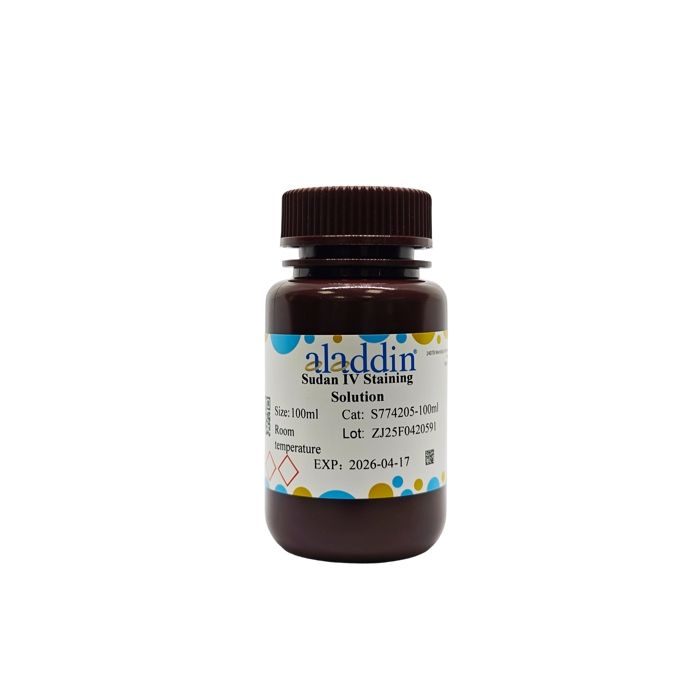
Determine the necessary mass, volume, or concentration for preparing a solution.
BioReagent, Biological Stain, for microscopy, 0.1% Biological Stain,BioReagent,for Microscopy for sensitive chromatographic and analytical workflows requiring minimal baseline interference.
Protected from light,Room temperature Ships Normal Check lot-specific COA for exact specifications.
SDS, COA, datasheet, and spec sheet available for download. Lot-specific COA accessible via lot number lookup.
Cited in 48 peer-reviewed publications across chromatography, organic synthesis, and cross-coupling reactions.
Sudan dyes are more soluble in lipids than in solvents. When the dye comes into contact with lipid-containing specimens, a large amount of dye partitions into lipid structures, staining these structures red. Lipid-soluble dyes such as Sudan dyes, Oil Red O and Nile blue are commonly used to visualize lipids.
Sudan IV stains suberized and cutinized cell walls, fats, volatile oils, resins and other substances red or light red, and serves as a fat stain.
Instructions for Use:
1. Fix in 4% neutral formalin for 24 h.
2. Rinse with water for 10 min.
3. Blot moisture from the tissue.
4. Incubate in Sudan IV staining solution for 5–15 min.
5. Differentiate with 70% ethanol. Optimal result: adipose tissue appears orange-yellow to light red while other tissues remain unstained.
6. Rinse and soak in water to remove excess stain.
7. Mount sections and examine under a microscope.
Staining Results:
Fat: Orange-yellow to light red
Precautions:
1. It is recommended to perform a preliminary test with 1–2 samples when using this reagent for the first time.
2. For personal safety, wear protective equipment such as a lab coat and gloves before handling reagents.
Comprehensive hazard, handling, storage, and regulatory compliance document.
<<<<<<< HEAD Download SDS → ======= Download SDS → >>>>>>> release248-p3Lot-specific quality data. Enter your lot number to retrieve the exact COA.
Look up COA →Full quality attributes and acceptance criteria for this grade.
View spec sheet →Taxonomy Tree
| Kingdom | Organic compounds |
|---|---|
| Superclass | Organoheterocyclic compounds |
| Class | Azobenzenes |
| Subclass | Not available |
| Intermediate Tree Nodes | Not available |
| Direct Parent | Azobenzenes |
| Alternative Parents | Naphthols and derivatives Toluenes 1-hydroxy-2-unsubstituted benzenoids Azo compounds Propargyl-type 1,3-dipolar organic compounds Organopnictogen compounds Organooxygen compounds Hydrocarbon derivatives |
| Molecular Framework | Aromatic homopolycyclic compounds |
| Substituents | Azobenzene - 2-naphthol - Naphthalene - Toluene - 1-hydroxy-2-unsubstituted benzenoid - Benzenoid - Monocyclic benzene moiety - Azo compound - Organic 1,3-dipolar compound - Propargyl-type 1,3-dipolar organic compound - Organic oxygen compound - Organopnictogen compound - Hydrocarbon derivative - Organic nitrogen compound - Organooxygen compound - Organonitrogen compound - Aromatic homopolycyclic compound |
| Description | This compound belongs to the class of organic compounds known as azobenzenes. These are organonitrogen aromatic compounds that contain a central azo group, where each nitrogen atom is conjugated to a benzene ring. |
| External Descriptors | Not available |
Find and download the COA for your product by matching the lot number on the packaging.
| Lot Number | Certificate Type | Date | Item |
|---|---|---|---|
| Certificate of Analysis | Sep 27, 2026 | S774205 | |
| Certificate of Analysis | Feb 10, 2026 | S774205 |
| Sensitivity | Light Sensitive |
|---|---|
| x_melt_point_char | 199°C |
Our grade selection guide covers purity, stabilizer status, and application suitability for all variants in our catalog.
View BioReagent grade guide → View Biological Stain grade guide → View for Microscopy grade guide →