GRADE & PURITYMoligand™?Moligand™ — Aladdin's line of ligands and bioactive small molecules. Use for receptor, pathway, and binding studies needing defined small-molecule tools.10 mM in DMSO
Moligand™, 10 mM in DMSO Moligand™ for sensitive chromatographic and analytical workflows requiring minimal baseline interference.
🌡
Storage & shipping
Store at -80°C Ships Dry ice packs + Cold packs Check lot-specific COA for exact specifications.
📋
Quality documents
SDS, COA, datasheet, and spec sheet available for download. Lot-specific COA accessible via lot number lookup.
📚
Literature proof
Cited in 0 peer-reviewed publications across chromatography, organic synthesis, and cross-coupling reactions.
Overview
Talampanel (LY300164) is an orally and selective α-amino-3-hydroxy-5-methyl-4-isoxazolepropionate (AMPA) receptor antagonis with anti-seizure activity. Talampanel (IVAX) has neuroprotective effects in rodent stroke models. Talampanel attenuates caspase-3 dependent apoptosis in mouse brain.
Specifications
Specifications & Purity
Moligand™, 10 mM in DMSO
Storage
Store at -80°C
Shipped In
Dry ice packs + Cold packs
This product requires cold chain shipping. Ground and other economy services are not available.
Determine the necessary mass, volume, or concentration for preparing a solution.
Dilution Calculator
Determine the dilution needed to prepare a stock solution.
Reconstitution Calculator
Reviews
Customer Reviews
Application Protocols
No validated application protocols are provided for this item in the product data.
Tested applications: Not specified for this item; refer to CoA/Spec Sheet.
Recommended concentrations/dilutions: Not specified for this item; refer to CoA/Spec Sheet.
General suggestions (non-binding):
For biochemical or cellular assays, begin with a DMSO stock and run a broad concentration range to establish potency and solubility limits, including appropriate vehicle controls. Verify assay compatibility empirically.
Biological Roles
Context (literature, general information):
Talampanel is commonly described as a noncompetitive AMPA receptor inhibitor/negative allosteric modulator within the 2,3-benzodiazepine class. It has been used extensively as a reference compound in neuroscience research probing fast excitatory neurotransmission mediated by ionotropic glutamate receptors (AMPA subtype).
Research utility:
Modulates AMPA receptor gating without directly competing at the glutamate binding site, enabling studies of receptor desensitization, channel open probability, and synaptic physiology.
Serves as a pharmacological control in electrophysiology (e.g., patch clamp) and high-content neuronal assays to dissect AMPA vs NMDA/kainate contributions.
Can support target engagement studies, selectivity profiling across iGluR subtypes, and structure–activity relationship work within the 2,3-benzodiazepine chemotype.
Notes and cautions:
Avoid overinterpretation across species or expression systems; receptor subunit composition and auxiliary proteins can influence apparent potency and kinetics.
Ensure vehicle controls and confirm compound is fully solubilized at working concentrations to avoid artifactual reductions in current or apparent potency due to precipitation.
This section reflects general literature knowledge for Talampanel as a tool compound; it does not constitute medical or clinical guidance.
Buffer Applications
Not typically applicable. Talampanel is a small-molecule ligand used in pharmacological assays rather than a buffering agent.
Practical note:
When incorporating Talampanel into assay buffers, control DMSO content and confirm compatibility with buffer components (e.g., salts, BSA) to prevent precipitation and nonspecific binding.
Green Alternatives
Green chemistry substitutions are generally discussed for solvents and reagents; Talampanel is a target-selective small-molecule ligand rather than a reaction solvent or auxiliary. As such, the concept of a “green alternative” is not directly applicable to the compound itself.
Sustainability-minded handling (general):
Optimize assay design to minimize DMSO volumes and plate waste.
Use miniaturized formats (e.g., 384/1536-well) to reduce compound consumption and solvent use.
Implement solvent recycling or proper waste segregation for DMSO/aqueous streams.
If your need is a functional alternative (biological mechanism):
Consider other reference AMPA receptor negative allosteric modulators (NAMs) or competitive antagonists for orthogonal validation, balancing physicochemical profiles and assay interference risk. Selection should be driven by your experimental design rather than environmental metrics.
Pharmaceutical Uses
This product is supplied strictly for research use only. It is not an excipient and is not approved for therapeutic or clinical use.
Research and development context (general):
Talampanel is widely cited in the literature as a reference AMPA receptor negative allosteric modulator used to explore glutamatergic mechanisms in preclinical models and in vitro assays.
Formulation considerations for laboratory studies (general, non-clinical):
Stock solutions are commonly prepared in anhydrous DMSO and diluted into biological media immediately prior to use. For in vitro applications, maintain minimal DMSO levels and include vehicle controls.
For any in vivo research, follow institutional guidelines for vehicle selection and dosing; Aladdin provides no guidance for in vivo use, and this product is not intended for diagnostic or therapeutic applications.
Regulatory note:
No pharmacopeial monograph is indicated for this item. Refer to your institution’s policies for handling investigational small molecules.
Physical Properties
Item-specific physicochemical specifications are not provided in the product data.
Appearance: Not specified for this item; refer to CoA/Spec Sheet.
Melting point: Not specified for this item; refer to CoA/Spec Sheet.
Boiling point: Not applicable for most solid small-molecule ligands; specific value not specified for this item; refer to CoA/Spec Sheet.
Density: Not specified for this item; refer to CoA/Spec Sheet.
Solubility: Not specified for this item; refer to CoA/Spec Sheet.
logP/logD: Not specified for this item; refer to CoA/Spec Sheet.
pKa: Not specified for this item; refer to CoA/Spec Sheet.
Refractive index: Not applicable for solids; not specified for this item.
General, practical guidance (not item-specific):
Screening ligands of this class are commonly prepared as DMSO stocks (e.g., 10 mM) and diluted into aqueous assay buffers with careful control of final DMSO content (typically ≤0.1–1% v/v depending on assay tolerance). Verify actual solubility and stability with a small-scale test and consult the CoA/SDS for definitive specifications.
Quality and Grades
Grade/Purity: Moligand™
What Moligand™ implies (general):
Moligand™ items are curated for small-molecule screening, target validation, and SAR exploration. They are typically provided to support reproducible hit-finding and follow-up characterization. Lot-specific purity and identity verification are provided on the CoA/Spec Sheet (e.g., NMR, LC or LC–MS traces as applicable); consult your lot documentation.
Item-specific clarifications:
Precise purity percentage, residual solvent profile, and any stabilizers are not specified in the product data. Refer to the CoA/Spec Sheet for chromatographic purity, identification data, and acceptance criteria.
Appearance and particle size distribution are not specified for this item; see CoA if provided for your lot.
Analytical notes (general best practices):
Upon receipt, verify identity by LC–MS against the expected mass and retention time if your workflow requires internal qualification.
For screening use, prepare fresh DMSO stocks and minimize freeze–thaw cycles; check for precipitation upon dilution into assay buffers.
For publication-grade work, document the lot number and retain CoA copies with your records.
Reaction and Applications
This product is supplied as a finished small-molecule ligand rather than a synthetic reagent, so it is not typically used as a stoichiometric substrate or catalyst in organic synthesis.
Research applications (general, literature):
Talampanel is widely used as a reference tool compound in glutamatergic pharmacology for studying AMPA receptor function, desensitization, and negative allosteric modulation in biochemical and electrophysiological assays.
Suitable for target validation, benchmarking assay windows, and cross-comparing assay formats (binding, calcium flux, patch clamp) where AMPA receptor activity is interrogated.
Practical considerations:
Prepare fresh DMSO stocks and protect from moisture and repeated freeze–thaw to maintain integrity during screening campaigns.
When comparing activity across systems, normalize for vehicle concentration and confirm that the compound is at true solution (no microprecipitates) at working dilutions.
For plate-based assays, pre-dilute into intermediate aqueous-organic mixes to minimize local supersaturation upon dispensing.
Note: No named organic reactions or catalysis contexts are typically associated with Talampanel; its utility is primarily pharmacological.
Reaction Conditions
Not applicable. Talampanel is supplied as a research ligand, not as a reagent for chemical transformations. There are no standard synthetic “reaction conditions” associated with its use.
Assay handling conditions (general guidance):
Prepare fresh DMSO stocks; equilibrate to room temperature before opening to minimize moisture condensation.
Dilute into assay buffer shortly before measurement, maintaining consistent vehicle content across controls and test wells.
Protect from prolonged light or heat exposure during assay setup unless stability data indicate otherwise.
For authoritative stability and compatibility data, consult the lot-specific CoA and SDS.
Safety and Handling
Hazard information provided for this listing is incomplete.
Signal word: Not specified for this item; refer to SDS.
H-statements: Not specified for this item; refer to SDS.
GHS classification/pictograms: Not specified for this item; refer to SDS.
General laboratory safety (non-authoritative; defer to SDS):
Personal protective equipment: use appropriate lab coat, nitrile gloves, and safety glasses when handling powders and DMSO solutions.
Engineering controls: handle powders in a fume hood or ventilated enclosure to minimize inhalation exposure; avoid aerosolization.
Incompatibilities: avoid strong oxidizers and strong acids/bases until material compatibility is confirmed. Keep away from ignition sources when using organic solvents.
First aid (overview): in case of skin or eye contact, rinse with water for at least 15 minutes; remove contaminated clothing. If inhaled, move to fresh air. If swallowed, rinse mouth and seek medical attention. Always follow institutional SOPs and consult the SDS for Talampanel for authoritative guidance.
Waste: dispose of unused material and solutions as organic chemical waste according to local regulations.
Note: This product is for research use only and not for human or veterinary use.
Solvent Selection
Item-specific solubility parameters are not provided. The following guidance reflects common practice for small-molecule ligands in discovery workflows.
Primary solvent for stocks: DMSO is generally preferred due to broad solvency and assay compatibility at low percentages.
Aqueous dilution: Dilute DMSO stocks into buffer immediately before use; maintain final DMSO at the lowest practical level consistent with solubility (often 0.1–1% v/v). Include vehicle controls.
Alternative organic cosolvents: If needed, consider DMF or ethanol for intermediate concentrates before buffer dilution; confirm assay tolerance and compound stability.
Surfactants: For difficult-to-solubilize chemotypes, minimal amounts of nonionic surfactants (e.g., Tween-20) may aid dispersion; validate for your assay to avoid target interference.
Comparison (general):
DMSO vs DMF: DMSO is more routinely accepted in biochemical and cell assays; DMF has similar solvency but can be harsher on cells and plastics.
DMSO vs ethanol: Ethanol is more volatile and can perturb membranes; acceptable in some electrophysiology or receptor assays at ≤0.1–0.5% v/v.
Tip: Conduct a solubility scout—serially dilute a fixed-concentration DMSO stock into the intended buffer and inspect for turbidity/precipitation over the assay timeframe.
Storage and Reconstitution
Item-specific storage and shipping:
Storage Conditions: Store at -80°C.
Shipped In: Dry ice packs + Cold packs.
Handling recommendations:
Minimize freeze–thaw events. If frequent access is expected, aliquot upon first thaw under dry, inert conditions where feasible.
Allow vials to equilibrate to room temperature before opening to prevent moisture condensation on cold solids.
Reconstitution (general guidance; not item-specific):
Prepare a concentrated stock solution in anhydrous DMSO under clean, dry conditions. Vortex and, if needed, briefly sonicate to ensure complete dissolution.
Filter through a low-binding 0.22 µm membrane only if particulate is observed and the compound is known to be stable; otherwise avoid unnecessary filtration to prevent adsorption losses.
Store DMSO aliquots at ≤ -20°C (or as your SOP dictates) and protect from light; verify stability over the intended usage window.
Always consult the lot-specific CoA and SDS for definitive instructions and stability parameters for Talampanel.
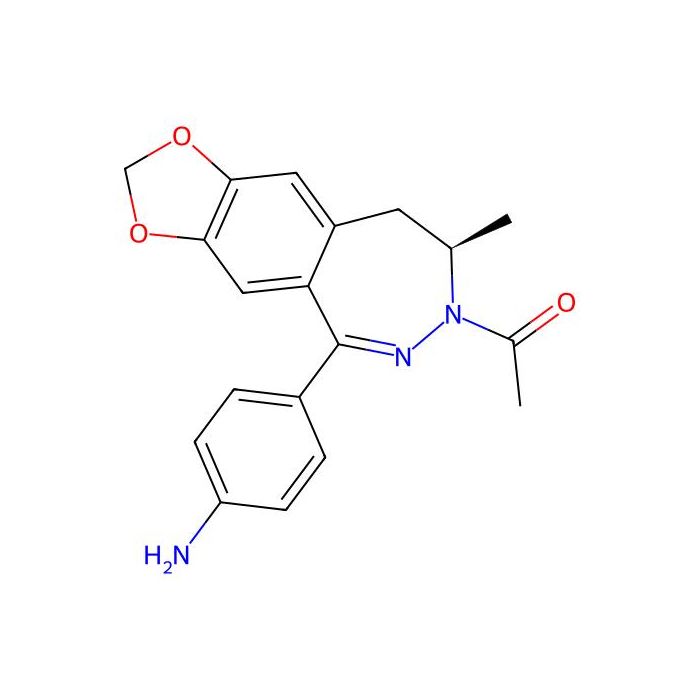
Structure and Identity
Talampanel is a small-molecule ligand offered in our Moligand™ library format for research screening and pharmacology.
SKU: T1497720
Product Name: Talampanel
CAS: 161832-65-1
PubChem CID: 164509
Category: Small molecules and compound libraries (Moligand™)
Molecular Formula: Not specified for this item; refer to CoA/Spec Sheet.
Molecular Weight: Not specified for this item; refer to CoA/Spec Sheet.
SMILES: Not specified for this item; refer to CoA/Spec Sheet.
InChIKey: Not specified for this item; refer to CoA/Spec Sheet.
Structural features (general, literature):
Talampanel is widely described as a 2,3-benzodiazepine-class, noncompetitive AMPA receptor modulator. It typically features an aromatic-rich polycyclic scaffold consistent with this chemotype. Exact substituent pattern should be confirmed from primary references or the CoA/structure file provided with your order.
2D structure (descriptive, literature):
A fused aromatic system bearing heteroatoms within a diazepine-like ring system; substituents on the aromatic core tune receptor interactions. For precise atom connectivity for modeling/registration, please use the structure file supplied by Aladdin Scientific or cross-check with authoritative databases.
Synthetic Utility
Not typically applicable. Talampanel is a finalized small-molecule ligand and is not commonly employed as a building block or reagent in synthetic methodology.
If synthetic interest arises (general):
Researchers investigating the 2,3-benzodiazepine scaffold may use Talampanel as a reference for SAR benchmarking, analytical comparisons (retention time, MS), or as a standard in quantitation methods. Direct functionalization of the intact molecule is uncommon and not generally recommended without thorough route scouting.
Target Specificity
Item-specific target details are not provided in the product data for this listing.
Antigen/target name: Not specified for this item; refer to CoA/Spec Sheet.
Species reactivity/assay applicability: Not specified for this item; refer to CoA/Spec Sheet.
Known off-targets or selectivity panels: Not specified for this item; refer to CoA/Spec Sheet.
Note: While the literature discusses Talampanel in the context of AMPA receptor modulation, any target specificity relevant to this item should be confirmed with your own assay system and documented references.
Frequently Asked Questions
What is Moligand??
Moligand? is one of Aladdin Scientific's premium product lines, formulated for high-purity applications across multiple workflows. Compared to standard grades in the same workflow, Moligand? products typically offer tighter specifications, more rigorous QC, and stronger lot-to-lot consistency.
How should this product be stored?
Store at ?80 °C. Ultra-low temperature storage is required to maintain the specified shelf life.
How is this product shipped?
This product ships frozen with dry ice and cold packs. Unpack on arrival and transfer it to the storage condition stated above; handle dry ice with insulated gloves in a ventilated area.
What are the CAS number, molecular formula and molecular weight?
The CAS Number is 161832-65-1, the molecular formula is C??H??N?O?, and the molecular weight is 337.37 g/mol.
What documentation is provided?
Available product documentation, including Certificates of Analysis (COA), Safety Data Sheets (SDS), and specification sheets, is shown in the product document area. Document availability and access follow the current site policy.
Need help choosing the grade?
Our grade selection guide covers purity, stabilizer status, and application suitability for all variants in our catalog.
We use cookies to ensure the website functions properly and, where permitted, to improve your experience. You can manage your preferences at any time in Settings. Learn more in our Cookie Policy.
Shall we send you a message when we have discounts available?
Remind me later
Thank you! Please check your email inbox to confirm.
Products are supplied to verified businesses, institutions, and qualified professionals for research and development use only. Not for use in humans, animals, diagnosis, or therapy.