GRADE & PURITYMoligand™?Moligand™ — Aladdin's line of ligands and bioactive small molecules. Use for receptor, pathway, and binding studies needing defined small-molecule tools.10 mM in DMSO
Moligand™, 10 mM in DMSO Moligand™ for sensitive chromatographic and analytical workflows requiring minimal baseline interference.
🌡
Storage & shipping
Store at -80°C Ships Dry ice packs + Cold packs Check lot-specific COA for exact specifications.
📋
Quality documents
SDS, COA, datasheet, and spec sheet available for download. Lot-specific COA accessible via lot number lookup.
📚
Literature proof
Cited in 0 peer-reviewed publications across chromatography, organic synthesis, and cross-coupling reactions.
Overview
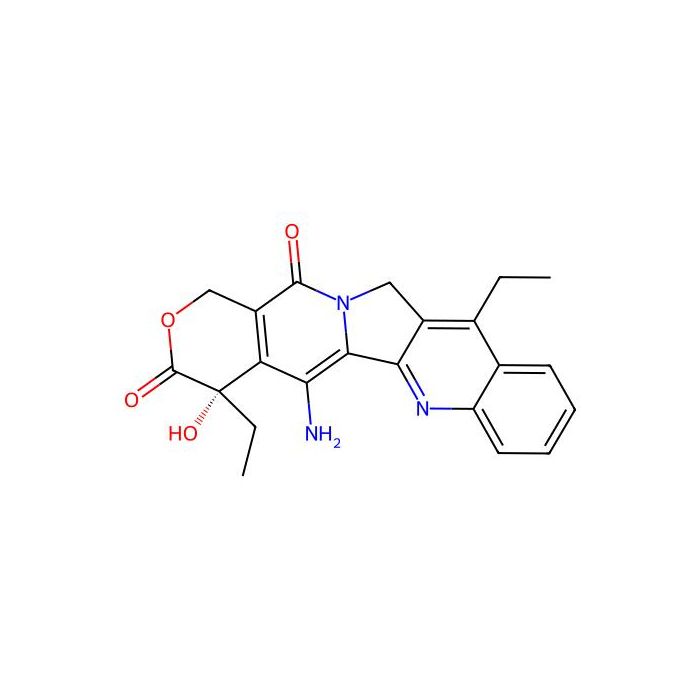
TH1338 (compound 3b), an orally active camptothecin derivative and a potent chemotherapeutic agent for cancer , demonstrates excellent cytotoxic potency against human tumor cell lines in vitro. TH1338 (compound 3b) possesses significant brain penetration, favorable efflux pump properties, and hematological toxicity profile .
Specifications
Specifications & Purity
Moligand™, 10 mM in DMSO
Storage
Store at -80°C
Shipped In
Dry ice packs + Cold packs
This product requires cold chain shipping. Ground and other economy services are not available.
Determine the necessary mass, volume, or concentration for preparing a solution.
Dilution Calculator
Determine the dilution needed to prepare a stock solution.
Reconstitution Calculator
Reviews
Customer Reviews
Application Protocols
The following generic protocols are provided for small-molecule screening compounds in plate-based assays. Item-specific parameters for TH1338 are not provided in this listing; adjust to your assay biology.
Stock solution preparation:
Bring vial to room temperature in a desiccated environment. Briefly centrifuge to collect material. Add anhydrous DMSO to achieve 10–50 mM. Mix gently; sonicate if needed. Record exact concentration.
Aliquoting and storage:
Divide stock into single-use aliquots (amber vials/plates), flush headspace with inert gas if available, and store at -80°C. Avoid repeated freeze–thaw cycles.
Working solutions for biochemical assays:
Prepare a serial dilution in DMSO (e.g., 3-fold) to create an intermediary plate, then transfer to assay buffer to reach final DMSO 0.1–1% v/v. Include vehicle controls and positive/negative controls as appropriate.
Cell-based assays:
Ensure final solvent tolerance for the cell line; keep DMSO ≤0.1–0.5% v/v when possible. Pre-screen for cytotoxicity and solubility/precipitation.
Data quality controls:
Include duplicates/triplicates, Z′-factor assessment, and orthogonal counterscreens to identify assay interference (aggregation, fluorescence quenching, redox cycling).
All parameters above are general best practices; consult your assay SOPs and adapt volumes and timings accordingly.
Biological Roles
Specific biological target(s), modes of action, and pathway roles for TH1338 are not provided in this listing. The following points outline general considerations for small-molecule ligands in research.
Functional role (general): Small molecules can act as enzyme inhibitors/activators, receptor agonists/antagonists, or modulators of protein–protein interactions. Without target data, TH1338 should be treated as an unannotated ligand pending screening results.
Experimental characterization:
Biochemical assays: Determine potency (IC50/EC50), kinetic mechanism (competitive/noncompetitive), and reversibility where relevant.
Cellular assays: Profile efficacy and selectivity using pathway-relevant reporters or phenotypic readouts; measure cytotoxicity in parallel.
ADME/tox in vitro: Assess stability (microsomal, plasma), permeability (PAMPA/MDCK), and off-target liabilities as needed for chemical biology.
Controls and orthogonality: Include counterscreens for assay interference (aggregation, redox cycling, fluorescence quenching) and use orthogonal methods (e.g., SPR, MST) to validate binding.
Data management: Link all results to SKU T1495287 and CAS 1258494-60-8 in your LIMS/ELN to ensure traceability.
Item-specific biological annotations (target class, selectivity panel, pathway mapping): Not specified for this item; refer to CoA/Spec Sheet or request Aladdin’s Technical Package.
Buffer Applications
Not typically applicable. TH1338 is a small-molecule screening ligand, not a buffering agent.
Practical note: Prepare working solutions by diluting DMSO stocks into your assay buffer of choice (e.g., PBS, HEPES, Tris) while maintaining a constant vehicle percentage across wells.
Buffer selection should be based on the biological assay’s requirements (enzyme pH optimum, ionic strength, cofactors) rather than properties of TH1338, which are not specified here.
Green Alternatives
As a screening compound (not a bulk solvent or reagent), “green alternatives” primarily concern solvent choices and lab practices during handling rather than substituting the compound itself.
Greener handling considerations (general):
Prefer aqueous assay media with minimal DMSO carryover (≤0.1–0.5% v/v where biologically tolerated).
When organic co-solvents are required, consider ethanol or isopropanol over higher-toxicity aprotic solvents where compatible with the assay.
Use micro-scale formats (384/1536-well) to reduce chemical usage and waste without compromising data quality.
Implement plate maps that minimize dead volume and enable compound recovery for re-use, reducing material consumption.
Illustrative solvent comparison (general):
DMSO: High solvency, low volatility; widely accepted in screening; dispose as organic waste.
PEG-400 (minor % as co-solvent): Low volatility, improved solubilization for some chemotypes; may affect certain bioassays.
Item-specific environmental hazards and degradability: Not specified for this item; consult the SDS for ecotoxicological information.
Note: If your sustainability goals require minimizing DMSO or DMF, contact us for guidance on assay-compatible solvent systems tailored to the physicochemical profile once the structure/solubility data are confirmed.
Pharmaceutical Uses
No pharmaceutical or clinical use is indicated or implied for this item. For research use only.
Status: Not specified in any pharmacopeia in this listing.
Potential roles in pharma R&D (general, non-clinical):
Tool compound for target validation and pathway interrogation.
Screening hit or lead candidate for medicinal chemistry optimization.
Reference material in nonclinical discovery assays (e.g., benchmark in SAR campaigns) if target annotation becomes available.
Formulation for research assays:
DMSO stock solutions (10–50 mM) with subsequent dilution into compatible assay buffers; limit DMSO carryover to maintain biological relevance.
Any claims regarding therapeutic indications, dosing, or clinical safety are outside the scope of this product and are not provided. For regulated applications, obtain detailed specifications and supporting documents (CoA/Spec Sheet, SDS) for your specific lot.
Physical Properties
Item-specific physicochemical constants are not provided in this listing.
Appearance: Not specified for this item; refer to CoA/Spec Sheet.
Melting point: Not specified for this item; refer to CoA/Spec Sheet.
Boiling point: Not specified for this item; refer to CoA/Spec Sheet.
Density: Not specified for this item; refer to CoA/Spec Sheet.
pKa: Not specified for this item; refer to CoA/Spec Sheet.
LogP/logD: Not specified for this item; refer to CoA/Spec Sheet.
Solubility: Not specified for this item; refer to CoA/Spec Sheet.
Refractive index/UV cutoff: Not specified for this item; refer to CoA/Spec Sheet.
General guidance (literature/common practice for small-molecule screening compounds):
Stock solutions are commonly prepared at 10–50 mM in anhydrous DMSO to ensure solubility across diverse scaffolds. If precipitation is observed during aqueous dilution, increase DMSO to 0.1–1% v/v in the final assay buffer as permitted by your biology.
If the structure contains ionizable groups (unknown here), pH-adjusted co-solvent systems (DMSO:H2O, DMSO:buffer, or DMSO:MeOH:H2O) may improve solubility and stability.
Light and air sensitivity vary by scaffold; as a precaution, minimize exposure to light and elevated temperatures during handling.
Authoritative specifications and release criteria for this item (including purity basis and identity confirmation) are provided on the CoA/Spec Sheet and supersede any generalized guidance above.
Quality and Grades
Supplied grade: Moligand™ (from Product Data)
What Moligand™ means (general description):
Moligand™ denotes Aladdin’s research-grade small-molecule ligands intended for discovery screening, target validation, and chemical biology workflows. These items are offered for research use only and are not intended for diagnostic, therapeutic, or human/veterinary use.
Typical expectations for Moligand™ products include identity confirmation and a suitability focus for biochemical/cellular assays. The exact analytical methods and acceptance criteria for THIS item are not listed here.
Item-specific release tests:
Purity basis, analytical method(s), residual solvent limits, water/peroxide/metal content, and UV characteristics: Not specified for this item; refer to CoA/Spec Sheet.
Implications for use:
Screening-grade materials are selected to balance purity with practicality for HTS/HCS and follow-up assays. If your application requires enhanced specifications (e.g., quantitative bioanalytical reference standard, GMP-like controls, or ultra-low UV background for chromatographic detection), contact us to discuss availability or custom resynthesis/re-purification.
Documentation and traceability:
Each lot ships with or links to a CoA/Spec Sheet detailing item-specific tests and storage guidance. For regulated studies or analytical method validation, request lot-specific raw data (where available) through Technical Support.
Reaction and Applications
This product is offered as a small-molecule ligand for research screening rather than as a synthetic reagent. Consequently, classical synthetic reaction applications (e.g., cross-coupling, oxidations) are not the primary use case.
Applicable use contexts (research screening):
Target engagement studies: Use in biochemical assays (enzyme inhibition/activation, binding assays) and biophysical formats (e.g., DSF, MST, SPR) to evaluate affinity and mechanism, where appropriate controls and orthogonal readouts are employed.
Cellular assays: Evaluate phenotypic responses in cell-based systems; determine cellular potency, cytotoxicity windows, and pathway selectivity with matched vehicle controls.
SAR exploration: Combine activity readouts with analog data (if available) to guide structure–activity relationships and prioritize follow-up chemistry.
Chemical biology: Potential utility as a tool compound for pathway perturbation, probe development, or as a seed in fragment-to-lead workflows.
Practical tips:
Prepare concentrated DMSO stocks (10–50 mM), aliquot, and avoid freeze–thaw.
Confirm stability under assay conditions (time/course at room temp and 37°C; optional LC/MS tracking).
Use counter-screens to flag PAINS-like or redox-interfering behavior if relevant to the assay design.
Any specific mechanistic or target annotations for TH1338: Not specified for this item; refer to Technical Package or literature associated with CAS 1258494-60-8.
Reaction Conditions
Classical reaction conditions (solvent, catalyst, temperature, yields) are not applicable because TH1338 is offered as a screening ligand rather than a reagent or substrate for named transformations.
General handling conditions for assay preparation:
Stock preparation: Dissolve in anhydrous DMSO to 10–50 mM; gentle warming (≤37°C) and brief sonication can aid dissolution.
Working dilutions: Serially dilute in assay buffer, maintaining consistent vehicle concentration across all wells.
Stability checks: Where feasible, assess short-term stability at room temperature and 37°C by LC/MS or HPLC prior to long incubations.
Adsorption/plate effects: Use low-binding plates/tubes and pre-rinse tips with compound solution for low-nanomole dosing accuracy.
Any item-specific reactivity, decomposition pathways, or incompatibilities: Not specified for this item; refer to CoA/Spec Sheet and SDS.
Safety and Handling
Safety profile for TH1338 is not disclosed in this listing. Always consult the SDS for authoritative information.
GHS classification: Not specified for this item; refer to SDS.
Signal word / Hazard statements / Pictograms: Not specified for this item; refer to SDS.
General laboratory precautions for small-molecule research compounds:
PPE: Wear lab coat, nitrile gloves, and safety glasses; use additional protection (face shield, double-gloving) based on risk assessment and SDS guidance.
Engineering controls: Handle powders/solutions in a chemical fume hood or ventilated enclosure to avoid inhalation and aerosol formation.
Avoid: Skin/eye contact, ingestion, and inhalation of dust or vapors. Prevent incompatible mixing until hazards are known.
Incompatibilities: Unknown for this specific item; as a precaution, avoid strong oxidizers/reducers and reactive bases/acids until SDS is reviewed.
First aid overview: In case of contact, rinse affected area with water for at least 15 minutes; remove contaminated clothing. If inhaled, move to fresh air. Seek medical advice and provide the SDS.
Spill response: Absorb with inert material (e.g., vermiculite), collect in a suitable container for disposal per institutional and regulatory requirements.
Waste: Dispose of as organic chemical waste following local regulations.
Storage:
From Product Data: Store at -80°C. Shipments are on dry ice packs + cold packs to maintain integrity.
Protect from repeated freeze–thaw; use aliquots to limit handling cycles.
Solvent Selection
Because item-specific solubility data are not provided, select solvents using standard practices for small-molecule screening compounds.
Primary stock solvent (general best practice):
Anhydrous DMSO is the default for diverse scaffolds due to broad solvating power and assay compatibility at 0.1–1% v/v.
Secondary/auxiliary solvents (if needed):
DMF, methanol, ethanol for co-solvency; water or buffered saline for final dilutions.
Aqueous assay compatibility:
Titrate DMSO carryover to the lowest level compatible with solubility and target biology; include vehicle controls at matched DMSO concentrations.
Troubleshooting precipitation:
Warm gently (≤37°C), sonicate briefly, or use staged dilution (e.g., 100% DMSO → 50% DMSO in buffer → final assay buffer) to avoid crashing out.
Adsorption/low recovery:
Use low-bind plastics or glass; include minimal surfactant (e.g., 0.01–0.05% Tween-20) only if compatible with the assay.
Selection versus alternatives (general):
If hydrophilicity is suspected (ionizable groups), consider pH-adjusted aqueous cosolvents.
For LC/MS-based assays, prefer LC/MS-grade solvents to minimize background.
Item-specific solubility parameters, partition coefficients, and dielectric data: Not specified for this item; refer to CoA/Spec Sheet.
Storage and Reconstitution
From Product Data:
Storage conditions: Store at -80°C.
Shipping: Dry ice packs + Cold packs.
Reconstitution (general guidance for small-molecule screening compounds):
Allow the sealed container to equilibrate to room temperature in a desiccator to prevent moisture condensation.
Briefly spin down the contents. Add anhydrous DMSO to prepare a concentrated stock (typically 10–50 mM). Mix gently until fully dissolved.
If insolubility persists, consider minimal co-solvent adjustments or staged dilution; do not exceed assay-compatible solvent levels.
Aliquoting and stability:
Prepare single-use aliquots in amber vials or low-bind polypropylene to minimize adsorption and photodegradation risks. Label with concentration, date, and lot.
Avoid repeated freeze–thaw; thaw on ice or at room temperature shortly before use and discard any unused thawed aliquot per your SOP.
Light/air sensitivity: Not specified for this item; as a precaution, minimize exposure and cap promptly.
Shelf-life and specifications:
Retest/expiration dating, water content, residual solvents, and purity basis: Not specified for this item; refer to CoA/Spec Sheet.
Note: For long-term storage in DMSO, -80°C is recommended. If preparing aqueous working solutions, use immediately or store short-term at 2–8°C as compatible with your assay and stability data.
Structure and Identity
Brief overview: TH1338 (SKU T1495287) is supplied as a Moligand™ small-molecule screening compound. Item-specific structural identifiers are not disclosed in this listing.
CAS: 1258494-60-8 (from Product Data)
PubChem CID: 53318291 (from Product Data)
InChIKey: Not specified for this item; refer to CoA/Spec Sheet.
SMILES: Not specified for this item; refer to CoA/Spec Sheet.
Molecular formula: Not specified for this item; refer to CoA/Spec Sheet.
Molecular weight: Not specified for this item; refer to CoA/Spec Sheet.
Structural description (general):
Functional groups, ring systems, and stereochemistry are not provided in the Product Data. Where target class or scaffold is important for your work, please consult the CoA/SDS or request the Technical Package.
2D structure (verbal): Not available in this listing. If you require a structure file (SDF/MOL) for informatics workflows, contact Aladdin Technical Support with the SKU.
Identity and traceability:
Each Moligand™ item is indexed by SKU and CAS (when public) to ensure unambiguous ordering and cross-referencing in screening databases.
For cheminformatics integration, use the provided CAS and CID while awaiting full identifiers; harmonize via your ELN/LIMS using SKU T1495287.
Synthetic Utility
Not a typical synthetic reagent. TH1338 is supplied as a small-molecule ligand for screening and chemical biology applications, and its structure and functional groups are not disclosed in this listing.
Reagent use: No item-specific functional group information is available to recommend transformations, protecting-group strategies, or cross-coupling handles.
Derivatization (general): If structure becomes available and IP permits, analog generation may be pursued for SAR; however, this falls under medicinal chemistry development rather than routine reagent use.
Informatics: If you plan to incorporate TH1338 into design-make-test cycles, request structural identifiers (SMILES/SDF) under appropriate confidentiality and IP considerations.
Conclusion: Treat TH1338 as a screening compound rather than a building block or catalyst. For synthetic planning around this scaffold, obtain the structure from the CoA/Spec Sheet or contact Technical Support.
Target Specificity
Item-specific target, selectivity profile, and binding epitope information are not provided in this listing.
Intended use: General small-molecule ligand for discovery screening (from Product Data category: small molecules and compound libraries).
Target annotations (e.g., primary target, off-targets, species selectivity): Not specified for this item; refer to CoA/Spec Sheet or request the Technical Package.
Recommendation:
If target hypotheses exist (e.g., from literature tied to CAS 1258494-60-8), confirm via orthogonal binding assays and cross-screening panels to establish specificity and selectivity.
Need help choosing the grade?
Our grade selection guide covers purity, stabilizer status, and application suitability for all variants in our catalog.
We use cookies to ensure the website functions properly and, where permitted, to improve your experience. You can manage your preferences at any time in Settings. Learn more in our Cookie Policy.
Shall we send you a message when we have discounts available?
Remind me later
Thank you! Please check your email inbox to confirm.
Products are supplied to verified businesses, institutions, and qualified professionals for research and development use only. Not for use in humans, animals, diagnosis, or therapy.