GRADE & PURITYMoligand™?Moligand™ — Aladdin's line of ligands and bioactive small molecules. Use for receptor, pathway, and binding studies needing defined small-molecule tools.≥98%
Moligand™, ≥98% Moligand™ for sensitive chromatographic and analytical workflows requiring minimal baseline interference.
🌡
Storage & shipping
Store at 2-8°C,Protected from light,Argon charged Ships Wet ice Check lot-specific COA for exact specifications.
📋
Quality documents
SDS, COA, datasheet, and spec sheet available for download. Lot-specific COA accessible via lot number lookup.
📚
Literature proof
Cited in 0 peer-reviewed publications across chromatography, organic synthesis, and cross-coupling reactions.
Overview
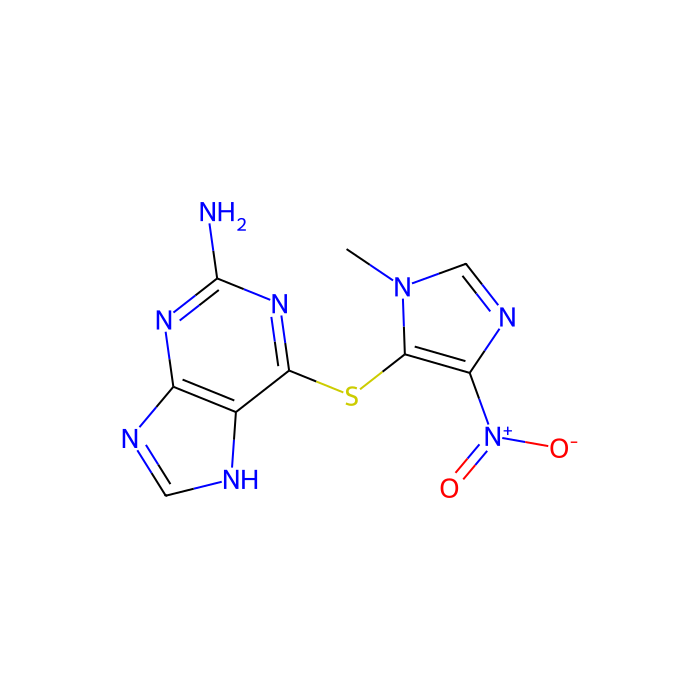
Thiamiprine is a compound related to azathioprine. Its nucleoside forms are similar to the parent compound in terms of cytotoxicity in vitro (except for the arabinoside). In the rat adjuvant arthritis model in vivo, its riboside and 2'-deoxyriboside are less active than the parent compound. The arabinoside is inactive and nontoxic. It has similar potency to the other parent compounds tested, but has a different safety profile.
This compound belongs to the class of organic compounds known as diarylthioethers. These are organosulfur compounds containing a thioether group that is substituted by two aryl groups.
External Descriptors
Not available
1. Djoumbou Feunang Y, Eisner R, Knox C, Chepelev L, Hastings J, Owen G, Fahy E, Steinbeck C, Subramanian S, Bolton E, Greiner R, and Wishart DS. ClassyFire: Automated Chemical Classification With A Comprehensive, Computable Taxonomy. Journal of Cheminformatics, 2016, 8:61.
Determine the necessary mass, volume, or concentration for preparing a solution.
Dilution Calculator
Determine the dilution needed to prepare a stock solution.
Reconstitution Calculator
Reviews
Customer Reviews
Application Protocols
No tested application protocols are provided for this item. The following general procedures can be adapted for small-molecule research use:
Preparation of DMSO stocks:
Weigh compound quickly at room temperature.
Dissolve to 10–50 mM in anhydrous DMSO; vortex and, if needed, sonicate briefly.
Aliquot into amber vials or microtubes to avoid repeated freeze–thaw.
Biochemical assays:
Dilute DMSO stocks into assay buffer to the desired final concentration, maintaining constant DMSO across all wells (typically 0.1–1% v/v).
Include vehicle controls and, where relevant, counter-screens for redox or thiol reactivity.
LC–MS reference solution:
Prepare 0.1–1.0 mg/mL in MeCN/H2O (1:1) with 0.1% formic acid; filter 0.2 µm before injection.
Stability check:
Incubate working solutions at assay temperature and sample at multiple time points for LC–MS purity to confirm stability over the experimental window.
Adapt these steps based on your lab’s SOPs and the stability/solubility data from the CoA.
Biological Roles
Context (general, no clinical claims): Thio-substituted purine analogs are widely used as research tools to probe nucleobase recognition, nucleotide metabolism pathways, and enzyme selectivity (e.g., kinases, phosphoribosyltransferases, deaminases). They can modulate or report on purine-related biochemical processes in vitro.
Mechanistic considerations (literature/general):
Heteroatoms (N, S) in purine-like scaffolds influence tautomerism, H-bonding patterns, and pKa, which in turn affect binding to nucleic-acid-processing proteins.
If a thio group is present, redox state (thiol/disulfide/sulfoxide/sulfone) can alter activity and permeability; verify oxidation state analytically prior to assays.
Assay design tips:
Prepare concentrated DMSO stocks and perform serial dilutions to maintain consistent final DMSO content across wells (commonly 0.1–1% v/v).
Include counter-screens for nucleophile reactivity or redox cycling if sulfur chemistry is suspected.
Monitor stability in assay buffers (LC–MS time-course) to distinguish primary effects from degradation products.
Permeability/transport (general): Purine analogs often rely on nucleoside transporters or passive diffusion depending on substitution; measure apparent permeability (Papp) in cell monolayers if cellular uptake is relevant.
Item-specific biological properties for Thiamiprine are not provided in this listing; consult primary literature and your CoA for definitive characterizations.
Buffer Applications
This product is not a buffering agent. It does not define a conventional pH buffering system.
Practical note: If preparing aqueous assay solutions, use established biological buffers (e.g., PBS, HEPES, Tris) and dissolve the compound via DMSO cosolvent or pH adjustment as compatible with your protocol.
Ensure that buffer components do not react with the compound (e.g., avoid strong oxidants for sulfur-containing molecules). Perform stability checks by LC–MS or HPLC over the relevant assay timeframe.
Green Alternatives
This product is a solid small molecule, not a solvent or reagent typically replaced on “green chemistry” grounds. Nonetheless, you can reduce environmental impact when working with it:
Solvent choice (general): Prefer greener solvents where technically feasible—ethyl acetate, MeTHF, acetone, or water/cosolvent systems—over DMF/NMP/CH2Cl2. Evaluate solubility and reaction performance first.
Work-up and purification:
Minimize chlorinated solvent use; use heptane/EtOAc or MeCN/H2O gradients for chromatography and LC methods when possible.
Employ dry loading or crystallization to reduce silica waste.
Energy efficiency: Avoid extended reflux or high-temperature steps; explore microwave or flow chemistry for rapid, energy-efficient transformations.
Scale and waste: Conduct microscale solubility and stability screens to avoid producing unusable solutions. Capture DMSO/DMF waste in segregated containers for proper disposal.
Because compound-specific hazards are not provided, implement conservative containment and waste minimization practices following your institution’s green chemistry guidelines.
Pharmaceutical Uses
No excipient or pharmacopeial information is provided for this item. This product is supplied strictly for research use only.
Formulation in research settings (general):
Prepare DMSO stock solutions (e.g., 10–50 mM) and dilute into assay media with attention to final organic content.
For in vivo research in laboratory animals (if permitted by your institution), typical vehicles may include PEG400/saline or aqueous solutions with solubilizers; however, such applications require institutional approvals and are outside the scope of this catalog description.
Regulatory status: Not specified; no USP/EP/JP monograph information is provided.
Avoid any use in humans or diagnostics. For cGMP or regulatory applications, obtain a qualified grade and full regulatory documentation, which are not included with this research-use item.
Physical Properties
Item-specific physicochemical constants are not supplied in the Product Data. The following notes distinguish unspecified values from general expectations.
Appearance: Not specified for this item; refer to CoA/Spec Sheet.
Melting point (literature/general): Not available in the provided data; check primary literature or CoA.
Boiling point: Not applicable/rarely reported for non-volatile heteroaromatic solids; item-specific value not provided.
Density: Not specified for this item; refer to CoA/Spec Sheet.
Solubility:
Item-specific solubility: Not specified; refer to CoA/Spec Sheet.
General guidance (literature/general): Purine-like heteroaromatics often show low aqueous solubility at neutral pH and improved solubility in polar aprotic solvents (DMSO, DMF) or under basic/acidic conditions depending on ionizable sites. Verify experimentally.
pKa/logP (literature/general): Not provided for this item; consult literature databases or determine experimentally by potentiometric titration or HPLC–logD.
UV–Vis (literature/general): Purine analogs typically exhibit π–π* absorption in the 250–320 nm range; exact maxima and extinction coefficients are compound-specific and not provided here.
Refractive index: Not applicable to solids; not specified for this item.
Always base method development on your own characterization (NMR, LC–MS, HRMS) using an authenticated reference lot.
Quality and Grades
Grade/Purity: Not specified for this item; refer to CoA/Spec Sheet.
What to expect in the CoA: Lot-specific assay (e.g., HPLC area %), identity confirmation (NMR/LC–MS/HRMS), water content (Karl Fischer) if applicable, and residual solvents.
HPLC/analytical suitability (general): For use as a screening/reference compound, low levels of related impurities and consistent chromatographic behavior are critical. If using for quantitative studies, request a detailed impurity profile and potency correction factor.
UV background (general): If using in UV-detected assays, ensure low baseline drift in the target wavelength range; request UV cut-off data if needed. Not specified for this item; refer to CoA/Spec Sheet.
Stabilizers/Inhibitors: Not specified for this item; refer to CoA/Spec Sheet. If none are present, store strictly as directed to prevent degradation.
Lot-to-lot consistency: For medicinal chemistry or screening campaigns, purchase a single lot or qualify multiple lots via LC–MS retention time, purity, and activity check against an internal standard.
For definitive acceptance criteria and analytical methods, defer to the CoA/Spec Sheet for the specific lot you receive.
Reaction and Applications
Research applications (general):
Chemical biology and medicinal chemistry: Employed as a reference or screening compound in enzyme or cell-based assays examining purine-analog interactions (e.g., nucleobase-processing enzymes). No medical/clinical claims are implied; for research use only.
Analytical standard: Potentially used as a qualitative reference in LC–MS method development for purine-like scaffolds.
Synthetic context (general): Purine analogs serve as scaffolds for SAR exploration via N-alkylation, acylation, S-alkylation/oxidation (if a thio motif is present), and cross-coupling on halogenated derivatives. The exact reactivity of this item depends on its substitution pattern, which is not specified here.
Handling in reactions:
Ensure material is dry; hygroscopic uptake can complicate stoichiometry and chromatography.
Protect from strong oxidants if sulfur-containing; test stability in air/light.
Use polar aprotic solvents (DMSO, DMF, NMP) for nucleophilic substitutions on heteroaromatics.
Characterization: Confirm identity/purity by 1H/13C NMR in DMSO-d6 or CD3OD; LC–MS with ESI is typically suitable for heteroaromatics. Report exact conditions alongside lot information.
Item-specific application notes were not provided; expand based on your target assay or synthetic route and confirm compatibility empirically.
Reaction Conditions
Because the precise functional groups for Thiamiprine are not provided here, the following are general conditions for transformations commonly applied to purine-like, sulfur-containing heteroaromatics (literature/general guidance):
S-alkylation (if thio present): Base (K2CO3–Cs2CO3) in DMF or MeCN, 0–25 °C to reflux, alkyl halide or sulfonate; monitor by LC–MS. Avoid over-alkylation if multiple nucleophilic sites exist.
N-alkylation/acylation: Mild base (NaH, K2CO3) in DMF/THF; selective N9 vs N7 alkylation can be influenced by base/solvent and protecting groups.
Oxidation: m-CPBA (1–2 eq) at 0–25 °C for sulfoxide; excess oxidant or higher temperature for sulfone. Work up carefully to remove residual peracids.
Metal-catalyzed cross-coupling (from aryl/heteroaryl halides): Pd(0) catalysts with biaryl phosphines (e.g., XPhos) in toluene/MeCN/1,4-dioxane with aqueous base (K3PO4) at 60–110 °C.
Analytical monitoring: LC–MS with ESI+, gradient MeCN/H2O (0.1% FA) or MeOH/H2O; confirm by 1H/13C NMR in DMSO-d6 or CD3OD.
Typical yields: Highly substrate-dependent; 40–85% is common for clean S-alkylations or amide couplings under optimized conditions.
These conditions are general literature practices and must be adapted after confirming the actual functional groups present in your lot of Thiamiprine.
Safety and Handling
GHS classification: Not specified for this item; refer to SDS.
Signal word and hazard statements: Not specified for this item; refer to SDS.
Pictograms: Not specified for this item; refer to SDS.
Recommended PPE: Laboratory coat, safety glasses or goggles, appropriate chemical-resistant gloves (e.g., nitrile), and use in a certified chemical fume hood to minimize inhalation exposure.
General hazards (literature/general): Purine analogs and sulfur-containing heteroaromatics may cause irritation to skin, eyes, and respiratory tract. Avoid dust formation and aerosolization. Prevent environmental release.
First-aid overview (general):
Inhalation: Move to fresh air; seek medical attention if symptoms persist.
Skin contact: Wash with soap and water; remove contaminated clothing.
Eye contact: Rinse cautiously with water for several minutes; remove contact lenses if present; seek medical advice if irritation continues.
Ingestion: Rinse mouth; do not induce vomiting; seek medical attention.
Handling practices:
Use in a fume hood; avoid contact and inhalation.
Minimize repeated opening of primary container; weigh quickly to limit moisture uptake and degradation.
For powders, consider anti-static measures to reduce dispersal.
Incompatibilities (general): Strong oxidizers and strong acids/bases may cause decomposition; avoid prolonged exposure to light and moisture pending confirmation of stability data.
Waste: Dispose of in accordance with institutional and local regulations for organic research chemicals.
Authoritative safety information is in the product SDS; always consult it before use.
Solvent Selection
This product is a small-molecule solid, not a solvent. Solvent selection pertains to dissolving and handling it for assays or reactions.
Likely effective solvents (general): DMSO is the default for preparing screening stocks (e.g., 10–50 mM). DMF, acetonitrile, or methanol may also dissolve purine-like heteroaromatics; confirm experimentally.
Aqueous dissolution (general): Solubility in water at neutral pH may be limited. If compatible with your application, adjust pH (mild acid or base) or use cosolvent systems (DMSO→buffer dilution; final organic ≤1–2% for biochemical assays).
Category: Small molecule screening compound (小分子和化合物库)
Molecular formula: Not specified for this item; refer to CoA/Spec Sheet.
Molecular weight: Not specified for this item; refer to CoA/Spec Sheet.
SMILES: Not specified for this item; refer to CoA/Spec Sheet.
InChIKey: Not specified for this item; refer to CoA/Spec Sheet.
Structural description (general/literature context): The name “Thiamiprine” is historically associated with sulfur-containing purine analogs. Such scaffolds typically feature a fused imidazole–pyrimidine (purine-like) core with a thio substituent (e.g., thioether or thiol) and an exocyclic amino group; however, the exact substitution pattern for this catalog item is not provided here. Verify structure using the CoA/SDS before use.
Stereochemistry: No stereochemical information provided for this item.
Registry identifiers: CAS 5581-52-2 confirmed; other identifiers (e.g., CID, full InChIKey) are not provided here—consult the product CoA.
Synthetic Utility
Scaffold value (general): Purine-like heteroaromatics are privileged scaffolds in medicinal chemistry. If Thiamiprine contains a thio substituent (as the name suggests), derivatization via S-alkylation, S-oxidation, and cross-coupling on suitably halogenated positions can diversify analogs for SAR.
Functional handles (item-unspecified): Without a disclosed structure, treat the molecule as a heteroaromatic containing multiple ring nitrogens (potential sites for N-alkylation/acylation) and possibly an exocyclic amino group amenable to amide/urea formation.
Transformations (literature/general):
Nucleophilic substitutions on activated positions using polar aprotic solvents (DMF/DMSO) with alkyl halides or sulfonates.
Oxidation state modulation of sulfur (if present): thioether → sulfoxide/sulfone (m-CPBA, Oxone) to tune polarity and binding.
Cross-coupling from halogenated precursors (e.g., Suzuki, Buchwald–Hartwig) to install aryl/alkyl substituents on the purine core.
Retrosynthetic note: Many purine analogs arise from cyclization of appropriately substituted 4,5-diaminopyrimidines or from imidazole annulation strategies; sulfur groups are introduced via thiolation of chloro intermediates.
The exact reactivity of this catalog item depends on its substitution pattern; consult the CoA/SDS and verify by small-scale test reactions.
Target Specificity
This product is a small molecule and not an antibody or targeted biologic. No target specificity data (e.g., enzyme selectivity, binding constants) are provided in the Product Data.
If used as a reference or probe in biochemical assays, determine target engagement empirically (e.g., enzyme kinetics, ITC, DSF, SPR, or cell-based readouts) and report assay conditions alongside compound lot information.
Any claims of specificity should be supported by your own data or peer-reviewed literature for the exact structure and form used.
Need help choosing the grade?
Our grade selection guide covers purity, stabilizer status, and application suitability for all variants in our catalog.
We use cookies to ensure the website functions properly and, where permitted, to improve your experience. You can manage your preferences at any time in Settings. Learn more in our Cookie Policy.
Shall we send you a message when we have discounts available?
Remind me later
Thank you! Please check your email inbox to confirm.
Products are supplied to verified businesses, institutions, and qualified professionals for research and development use only. Not for use in humans, animals, diagnosis, or therapy.