GRADE & PURITYCarrier Free?Carrier-free — supplied without added carrier protein/stabilizer. Use when carriers (e.g. BSA) would interfere with conjugation or sensitive assays.ExactAb™?ExactAb™ — Aladdin's antibody line emphasizing precision and validated quality. Use for reliable, specificity-validated antibody applications.Azide Free?Azide-free — without sodium azide preservative. Use in conjugations, cell work, or assays where azide is toxic or inhibitory.Validated?Validated grade — performance confirmed in defined applications before release. Use when you want documented assurance the reagent works as stated.PBS Only?PBS-only formulation — supplied in phosphate-buffered saline with no other additives. Use when you need a clean PBS buffer free of stabilizers/carriers.≥95%(SDS-PAGE)See COA
Carrier Free,ExactAb™,Azide Free,Validated,PBS Only,≥95%(SDS-PAGE),See COA Azide Free,Carrier Free,ExactAb™,PBS Only,Validated for sensitive chromatographic and analytical workflows requiring minimal baseline interference.
🌡
Storage & shipping
Store at 2-8°C,Do not freeze Ships Wet ice,Do not freeze Check lot-specific COA for exact specifications.
📋
Quality documents
SDS, COA, datasheet, and spec sheet available for download. Lot-specific COA accessible via lot number lookup.
📚
Literature proof
Cited in 0 peer-reviewed publications across chromatography, organic synthesis, and cross-coupling reactions.
Overview
Rat anti Mouse TIM 4 Antibody, Monoclonal (F31-5G3), could be used for Flow and so on. Application: Flow: Use at an assay dependent concentration. Protein Function Phosphatidylserine receptor that enhances the engulfment of apoptotic cells. Involved in regulating T-cell proliferation and lymphotoxin signaling. Ligand for HAVCR1/TIMD1.
Specifications
Product Name
TIM4 Rat mAb - Primary antibody, specific to TIM 4, Rat IgG1
Synonyms
SMUCKLER antibody | Spleen, mucin-containing, knockout of lymphotoxin protein antibody | T cell immunoglobulin and mucin domain containing protein 4 antibody | T-cell immunoglobulin and mucin domain containing 4 antibody | T-cell immunoglobulin and mucin
Specifications & Purity
Carrier Free,ExactAb™,Azide Free,Validated,PBS Only,≥95%(SDS-PAGE),See COA
25.9 kDa (Light Chain) & 56.7 kDa (Heavy Chain), under reducing conditions; 214.9 kDa, under non-reducing conditions.
Purification Method
Protein G purified
Concentration
See COA
Product Line
biological_products
Storage and Shipping
Shape
Liquid
Storage
Store at 2-8°C,Do not freeze
Shipped In
Wet ice,Do not freeze
Stability And Storage
Shipped at 4°C. Store at 4°C long term (12 months). Do not freeze. Upon receipt, it is recommended to aliquot.
Images
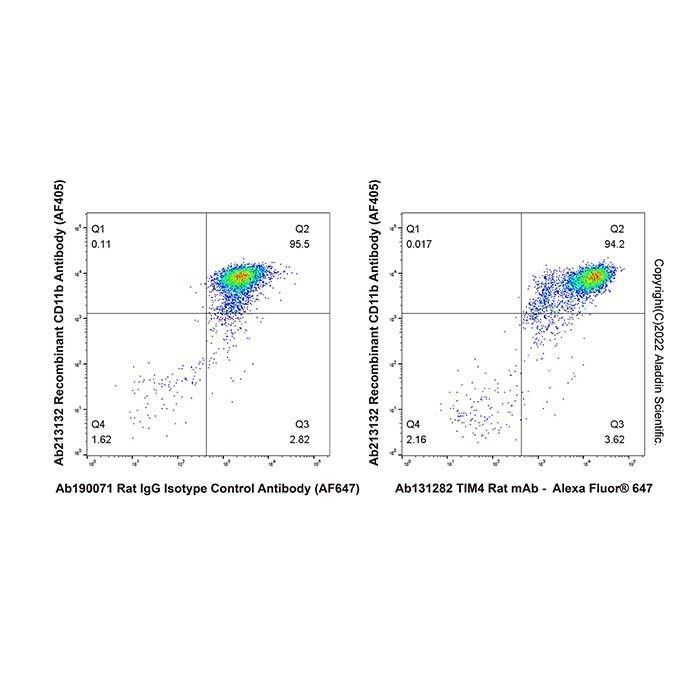
TIM4 Rat mAb (Ab131282) - Flow Cytometry Two-color flow cytometric analysis of TIM4 expression on mouse peritoneal macrophages. C57BL/6 mouse peritoneal macrophages were stained with Recombinant CD11b Antibody (AF405) (Ab213132) and either Rat IgG Isotype Control Antibody (AF647) (Ab190071; Left panel) or TIM4 Rat mAb (Ab131282; Right panel) at 0.5 μg/mL. Two-color flow cytometric dot plots showing the correlated expression of CD11b versus TIM4 (or Isotype control staining) were derived from gated events with the forward and side light-scatter characteristics of viable mononuclear cells.
Application
Application
Dilution info
Flow Cytometry
Use at an assay dependent concentration.
Documentation
📋 Safety Data Sheet (SDS)
Comprehensive hazard, handling, storage, and regulatory compliance document.
Determine the necessary mass, volume, or concentration for preparing a solution.
Dilution Calculator
Determine the dilution needed to prepare a stock solution.
Reconstitution Calculator
Reviews
Customer Reviews
Application Protocols
Tested applications, recommended dilutions, positive controls, and protocol specifics — Not specified for this item; refer to CoA/Spec Sheet and SDS.
General recommendations (not product-specific):
Titrate the antibody in your assay format to determine the minimal effective concentration that provides target-specific signal with acceptable background.
Include appropriate controls: isotype control, secondary-only control (if applicable), and known TIM4-positive/negative samples.
For custom conjugation, validate degree of labeling (DOL) and confirm retention of binding via a small pilot experiment before scaling.
Biological Roles
Target overview (literature; not item-specific to this clone):
TIM4 (T-cell immunoglobulin and mucin domain-containing protein 4; gene HAVCR2/TIMD4 depending on species context) is a type I membrane glycoprotein predominantly expressed on subsets of antigen-presenting cells, such as macrophages and certain dendritic cells.
Canonical function: Acts as a phosphatidylserine (PS) receptor mediating recognition and engulfment of apoptotic cells (efferocytosis). Contributes to maintenance of tissue homeostasis and modulation of immune tolerance.
Ligand interactions: Binds PS on apoptotic membranes; participates in crosstalk with other TIM family members and costimulatory pathways (mechanistic details vary by species and cell type).
Immunobiology: TIM4 engagement influences antigen uptake and presentation, with downstream effects on T-cell activation profiles (context-dependent). It is frequently used as a marker to identify specific macrophage/dendritic subsets in tissues and in flow cytometric panels.
Why an anti-TIM4 mAb is useful (general):
Detection/quantification of TIM4 expression across tissues, during differentiation, and under immune challenge.
Functional interrogation of PS-dependent clearance mechanisms in vitro.
Isolation or depletion of TIM4-positive cells via sorting/IP when clone compatibility is confirmed.
Notes: The exact epitope, affinity, and cross-reactivity of this product are Not specified for this item; consult CoA/Spec Sheet for clone-specific biology.
Buffer Applications
Item-specific buffer details beyond “PBS Only” — Not specified for this item; refer to CoA/Spec Sheet for pH and ionic strength.
General guidance for antibody buffer systems (not item-specific):
Working buffer: Phosphate-buffered saline (PBS, ~pH 7.2–7.6) is standard for immunoassays. Since this product is Carrier Free and Azide Free, users may supplement working aliquots with inert stabilizers (e.g., 0.1–1% BSA) if compatible with the assay.
Blocking buffers: For IHC/IF/FC, use species-appropriate sera or protein blockers to reduce nonspecific binding; avoid blockers that could introduce cross-reactivity.
Enzyme-based detections: Azide-free is compatible with HRP/AP systems; ensure buffers lack azide and peroxides.
Sterility: If sterility is essential, filter working buffers through 0.22 μm low-protein-binding membranes.
Storage buffer adjustments: Do not change the stock buffer unless necessary; if exchanging buffer (e.g., for conjugation), use gentle desalting (e.g., spin columns) under cold conditions.
Green Alternatives
Context for greener lab practice with antibodies (general; not item-specific):
Preservatives: Azide-free formulation (per Product Data) avoids sodium azide, which is acutely toxic to aquatic life and forms heavy-metal azides in plumbing. Trade-off: greater need for sterile handling and cold-chain maintenance.
Packaging and cold chain: Consolidate orders to reduce shipment frequency and cold-pack materials. Use reusable ice packs where possible.
Waste minimization: Prepare only the volumes needed for an experiment; store the remainder at 2–8°C as directed to prolong lifetime and reduce discard.
Carrier-free: Eliminates animal-derived stabilizers (e.g., BSA) from the supplied product, simplifying downstream purification and potentially reducing animal-origin inputs. Users may choose plant-derived or synthetic stabilizers if needed.
Comparison (general):
Azide-preserved antibodies: Longer bench stability but hazardous to aquatic environments and incompatible with certain enzymes/live cells.
Azide-free antibodies (this item): Safer for enzymatic and live-cell work; requires aseptic technique and proper refrigerated storage.
Implementation tips:
Adopt validated sterile technique to forgo biocidal preservatives.
Use low-bind consumables to reduce losses and avoid repeat preparations.
Pharmaceutical Uses
This product is sold for research use only (per Product Data). No clinical or diagnostic use is implied.
General roles of research antibodies in pharmaceutical R&D and manufacturing (not item-specific):
Analytical reagents: Quantification/characterization of target antigens in preclinical samples via ELISA, FC, WB, IHC.
Process development: In-process controls for cell culture characterization (e.g., monitoring cell-surface markers) and purification analytics.
Immunocapture: Affinity enrichment of target proteins from complex matrices to support LC–MS or bioassay workflows.
Companion assays in discovery: Screening of target engagement, pathway modulation, and mechanism-of-action studies in vitro.
Conjugation: Carrier-free format facilitates custom conjugation to enzymes, fluorophores, or solid supports for assay development.
Regulatory note: No pharmacopeial monograph or cGMP status is provided here. Any use in regulated environments requires internal qualification and review of the CoA/Spec Sheet, SDS, and change-control documentation.
Physical Properties
Item-specific physicochemical specifications — Not specified for this item; refer to CoA/Spec Sheet.
General properties for IgG-class antibodies (literature; not item-specific):
Approx. molecular weight: ~150 kDa for full-length IgG (actual may vary with isotype/glycosylation).
Isoelectric point (pI): Typically ~6–9 depending on sequence/glycoform.
Solubility: Highly soluble in aqueous buffers such as PBS; instability may occur at extremes of pH or ionic strength.
Extinction coefficient: Sequence-dependent (ε280 typically 1.3–1.5 mg−1 mL cm−1 for IgG when using A280 = 1.0 ≈ 0.67 mg/mL as a rule-of-thumb; verify by CoA).
Aggregation: Promoted by freeze–thaw, elevated temperature, interfacial stress, and low ionic strength; mitigated by proper buffer and gentle handling.
Formulation notes from Product Data: Grade/Purity states Carrier Free, ExactAb™, Azide Free, PBS Only. This implies an aqueous phosphate-buffered saline vehicle without carrier proteins or sodium azide; concentrations, pH, and any additional excipients — Not specified for this item.
Quality and Grades
Item-specific grades from Product Data:
Carrier Free: Supplied without carrier proteins (e.g., BSA/gelatin). Advantages: precise conjugation, accurate protein quantitation, reduced background in cell-based assays. Consider adding your own stabilizer for long-term working stocks if compatible with your application (general guidance).
ExactAb™: Branded designation indicating a defined, highly consistent antibody preparation. Specific manufacturing/sequence details — Not specified for this item; refer to CoA/Spec Sheet.
Azide Free: No sodium azide preservative. Enables enzyme-based assays (e.g., HRP), live-cell applications, and copper plumbing compatibility. Demands aseptic technique to minimize bioburden.
Validated: Indicates internal application verification by the manufacturer. Exact validated applications, species reactivity, and clone — Not specified for this item.
PBS Only: Formulated solely in phosphate-buffered saline. Buffer composition (pH, ionic strength) — Not specified for this item; consult label/CoA.
What this means in practice:
Analytical use: Carrier-free/PBS-only matrices are ideal for custom labeling (biotin, fluorophores) and for quantitative biophysical assays.
Reproducibility: ExactAb/Validated claims suggest lot-to-lot performance consistency, but users should confirm suitability in their specific assay.
Documentation: For precise concentration, isotype, endotoxin, and purity metrics, refer to the CoA/Spec Sheet. Do not infer values not provided here.
Reaction and Applications
Manufacturer Applications (verbatim): Not provided in Product Data.
General laboratory applications for anti-TIM4 monoclonal antibodies (literature/general guidance; verify in your lab):
Flow cytometry (FC): Detection of TIM4 expression on relevant immune cell subsets; titrate antibody to minimize background. Use azide-free buffers for live-cell staining when needed.
Immunohistochemistry (IHC/IHC-P): Localization of TIM4 in tissue sections; optimize antigen retrieval conditions according to fixation method.
Immunofluorescence (IF): Subcellular localization in cells or tissue; select fluorophore conjugates or perform custom labeling (carrier-free format is suitable for conjugation).
Western blotting (WB): Detection of denatured TIM4; not all mAbs recognize linear epitopes—confirm suitability experimentally.
Functional assays: Blocking or detection of TIM4–ligand interactions in vitro; validate clone-specific blocking capability (epitope/clone not specified for this item).
Practical tips:
Titrate: Determine optimal working concentration via checkerboard titration.
Controls: Include isotype and biological controls (TIM4-positive/negative samples).
Matrix: PBS-only, azide-free formulation is conducive to enzyme-based detections and live-cell protocols.
Reaction Conditions
Not applicable in the synthetic chemistry sense. As an antibody reagent, there are no stoichiometric “reaction conditions.”
Assay-condition considerations (general; not item-specific):
Temperature: Keep on ice or at 2–8°C during setup; perform incubations at recommended temperatures for the assay (e.g., RT or 4°C) to balance kinetics and stability.
Time: Optimize primary incubation times empirically (e.g., 30–60 min for FC at RT; 1–16 h for IHC/IF depending on antigen and matrix).
Concentration: Determine empirically via titration; stock concentration is Not specified for this item.
Buffer: Maintain PBS (per Product Data) unless the assay requires alternative isotonic buffers; avoid azide when using live cells or HRP.
Additives: Include blockers and detergents appropriate to the platform (e.g., 0.05% Tween-20 for washes in ELISA/WB) while verifying compatibility with antibody performance.
Safety and Handling
GHS classification, pictograms, and H-statements — Not specified for this item; consult the product SDS for authoritative safety information.
Practical laboratory guidance (general for protein antibodies; not a substitute for SDS):
PPE: Wear lab coat, gloves, and safety glasses. Avoid inhalation of aerosols and contact with skin/eyes. Work in a clean area to prevent contamination.
Preservatives: Product grade indicates Azide Free. Benefits: avoids azide-related hazards and incompatibility with copper plumbing and certain enzyme applications. Note: without azide, microbial contamination risk is higher if asepsis is not maintained.
Storage incompatibilities: Avoid strong oxidizers, proteases, and extremes of pH. Do not mix with organic solvents or denaturants unless intentionally performing analytical assays.
Special risks for proteins: Repeated freeze–thaw cycles and elevated temperatures cause denaturation/aggregation. Product explicitly states Do not freeze; maintain 2–8°C.
Spills/first-aid (general): Wipe small spills with absorbent, then disinfect surface. In case of skin/eye contact, rinse with water for several minutes; seek medical attention if irritation persists. Not hazardous waste by default, but dispose per institutional biosafety rules.
Transportation: Shipped on wet ice, Do not freeze (per Product Data). Maintain cold chain to preserve activity/structure.
Solvent Selection
This product is an aqueous protein solution (antibody) and is not intended for use in organic solvent systems like typical small-molecule reagents.
Relevant considerations (general guidance):
Compatible medium: PBS (per Product Data: PBS Only). Maintain near-neutral pH and physiological ionic strength to preserve conformation.
Avoid: Water-miscible organic solvents (e.g., acetone, acetonitrile, methanol, DMSO) unless used at very low percentages in validated protocols, as they may denature antibodies. Strong detergents, chaotropes, and extremes of pH can disrupt binding.
Additives: Since Carrier Free and Azide Free, users may optionally add stabilizers (e.g., BSA, trehalose) and low levels of non-ionic detergents for specific assays; ensure compatibility with your detection chemistry (general advice; not item-specific).
Filtration: If sterility is required, use low-protein-binding 0.22 μm filters and gentle pressure to minimize adsorption/denaturation.
Storage and Reconstitution
From Product Data (item-specific):
Storage conditions: Store at 2–8°C. Do not freeze.
Shipping: Shipped on wet ice. Do not freeze in transit.
Formulation: PBS Only, Carrier Free, Azide Free. Exact pH, ionic strength, concentration, and any additional excipients — Not specified for this item; refer to CoA/Spec Sheet.
Practical guidance (general; not item-specific):
Handling: Keep cold and minimize time at room temperature. Mix gently by inversion; avoid vigorous vortexing and foaming.
Asepsis: Because the product is Azide Free, maintain sterile technique to limit bioburden. Consider working in a biosafety cabinet when making aliquots or dilutions.
Aliquoting: If frequent access is expected, prepare sterile working aliquots to reduce cumulative warm exposure. Do not freeze aliquots (per product directive). Use low-protein-binding tubes and tips.
Dilutions: Prepare working solutions in PBS or assay-appropriate buffer immediately before use. If your application benefits from stabilizers (e.g., BSA, sugars), add them only to the working solution after verifying compatibility.
Stability: Shelf-life at 2–8°C and post-opening in-use lifetime — Not specified for this item; monitor performance and consult CoA/Spec Sheet for any lot-specific guidance.
Reconstitution: Not applicable if supplied as a liquid in PBS; if received concentrated, follow CoA instructions for any recommended dilution to working concentration (not provided here).
Structure and Identity
Item-specific structural identifiers (CAS, SMILES, InChIKey, exact sequence) — Not specified for this item; refer to CoA/Spec Sheet.
General/typical for monoclonal antibodies (literature):
Molecule class: Immunoglobulin G (IgG) monoclonal antibody produced in rat (host species per product name). Exact isotype/subclass — Not specified for this item.
Quaternary structure: Two identical heavy chains and two identical light chains linked by disulfide bonds, forming a Y-shaped heterotetramer.
Domain architecture: Each heavy/light chain contains variable (V) domains for antigen recognition and constant (C) domains for effector/structure. Antigen-binding site resides in the VH–VL paratope formed by CDR loops.
Functional group features: Abundant disulfides (intra-/inter-chain), N-linked glycosylation sites on the Fc (isotype-dependent; glycoform distribution varies by production system; Not item-specific).
Molecular formula/SMILES/InChIKey: Not applicable to proteins of undefined exact sequence at catalog level; Not specified for this item.
Antigen: TIM4 (T-cell immunoglobulin and mucin domain-containing protein 4). Epitope and clone ID — Not specified for this item.
2D/structural description in words (general): Y-shaped glycoprotein with two Fab arms for antigen binding and one Fc stem mediating constant-region functions; variable domain CDRs confer specificity to TIM4.
Synthetic Utility
Not typically applicable. This is a biological macromolecule (antibody) used as a binding reagent, not a small-molecule building block or synthetic intermediate.
For experimental planning (general guidance):
Conjugation chemistry: Carrier-free antibodies are suitable for covalent labeling via amine-reactive (NHS esters), thiol-reactive (maleimides after partial reduction or Traut’s reagent), or click-chemistry handles introduced through bifunctional linkers.
Immobilization: Coupling to activated resins (e.g., CNBr-activated Sepharose, NHS-activated agarose) enables immunoaffinity purification of TIM4.
Surface attachment: Passive adsorption to polystyrene (ELISA plates) or covalent attachment to sensor chips (SPR/BLI) for kinetic analyses.
These are generic utilities for antibodies and are not product-specific performance claims.
Target Specificity
Item-specific details drawn only from Product Data:
Antigen/Target: TIM4 (T-cell immunoglobulin and mucin domain-containing protein 4).
Antibody type: Monoclonal antibody (mAb).
Host species: Rat (per product name TIM4 Rat mAb).
The following attributes are Not specified for this item; refer to CoA/Spec Sheet:
Clone ID/name
Isotype/subclass and light-chain type
Species reactivity/cross-reactivity profile
Epitope mapping or blocking capability
Affinity (KD) and kinetics
Functional validation details and application-specific performance
Need help choosing the grade?
Our grade selection guide covers purity, stabilizer status, and application suitability for all variants in our catalog.
We use cookies to ensure the website functions properly and, where permitted, to improve your experience. You can manage your preferences at any time in Settings. Learn more in our Cookie Policy.
Shall we send you a message when we have discounts available?
Remind me later
Thank you! Please check your email inbox to confirm.
Products are supplied to verified businesses, institutions, and qualified professionals for research and development use only. Not for use in humans, animals, diagnosis, or therapy.

 ZJ25F0420802