GRADE & PURITYMoligand™?Moligand™ — Aladdin's line of ligands and bioactive small molecules. Use for receptor, pathway, and binding studies needing defined small-molecule tools.10 mM in DMSO
Moligand™, 10 mM in DMSO Moligand™ for sensitive chromatographic and analytical workflows requiring minimal baseline interference.
🌡
Storage & shipping
Store at -80°C Ships Dry ice packs + Cold packs Check lot-specific COA for exact specifications.
📋
Quality documents
SDS, COA, datasheet, and spec sheet available for download. Lot-specific COA accessible via lot number lookup.
📚
Literature proof
Cited in 0 peer-reviewed publications across chromatography, organic synthesis, and cross-coupling reactions.
Overview
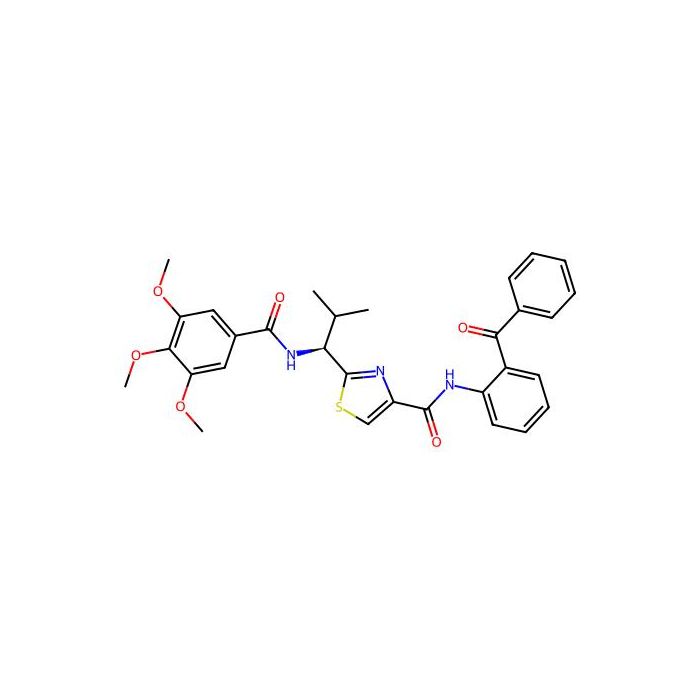
TTT-28 is a synthesized thiazole-valine peptidomimetic, a novel selective inhibitor of ABCB1 (P-gp/MDR1) with high efficacy and low toxicity, which reverses the ATP-binding cassette sub-family B member 1 ( ABCB1 )-mediated multidrug resistance (MDR) by selectively blocking the efflux function of ABCB1.
Specifications
Specifications & Purity
Moligand™, 10 mM in DMSO
Storage
Store at -80°C
Shipped In
Dry ice packs + Cold packs
This product requires cold chain shipping. Ground and other economy services are not available.
Determine the necessary mass, volume, or concentration for preparing a solution.
Dilution Calculator
Determine the dilution needed to prepare a stock solution.
Reconstitution Calculator
Reviews
Customer Reviews
Application Protocols
Validated, product-specific protocols are not provided in the Product Data for TTT-28.
Only general considerations can be offered (non-binding):
Prepare accurately quantified DMSO stocks and include matched solvent controls in all assays.
Establish concentration–response curves with appropriate replicate numbers and independent repeats to ensure robustness.
For cellular assays, confirm compound compatibility with media components and plasticware and monitor cytotoxicity separately from functional readouts.
For any definitive protocols (assay types, dilutions, controls), please refer to documentation supplied with your order or contact technical support. For research use only.
Biological Roles
Item-specific biological function or target information for TTT-28 is not provided in the Product Data.
General context for small-molecule screening compounds (non-clinical, research-only):
Potential roles in research: May serve as a chemical tool candidate to probe biochemical pathways, interrogate protein function, or influence cellular phenotypes when used in exploratory assays.
Target identification: If activity is observed, subsequent chemoproteomics, thermal profiling, affinity capture, or genetic interaction mapping can help elucidate biological partners (general approaches).
Selectivity and off-targets: Unknown for this item; thorough counter-screening and orthogonal confirmation are recommended prior to making mechanistic claims.
ADME/tox considerations: None are provided for this item. For in vitro use, monitor assay interference (e.g., fluorescence/absorbance overlap) and aggregation; for ex vivo models, establish solubility, stability in media, and compound recovery.
No medical, diagnostic, or therapeutic uses are implied or supported. For research use only.
Buffer Applications
This product is not a buffering agent. However, buffers are often required to deploy small-molecule stocks in biological assays.
General practical guidance (assay-focused, not item-specific):
Common buffers: PBS, HEPES, Tris, or assay-specific components (e.g., kinase assay buffers) are frequently used. Select based on target biology and assay enzymes, not the compound itself.
DMSO carryover: Keep final DMSO at the lowest effective percentage (often ≤0.5% v/v) and match across all wells. Include solvent-only controls.
Surfactants: Low levels of nonionic detergents (e.g., 0.01–0.05% Tween-20) can reduce colloidal aggregation artifacts; verify assay compatibility.
pH control: Avoid strong pH shifts in the absence of the compound’s pKa data to prevent unintended degradation or ionization changes.
Filtration/sterility: Use 0.22 µm filtration for cell-based assays if warranted; confirm that filters are compatible with any organic cosolvent.
Item-specific buffer compatibility data are not provided for TTT-28.
Green Alternatives
Because TTT-28 is a small-molecule screening compound (not a process solvent or reagent), “green alternatives” pertain to greener dissolution and assay media choices.
Greener handling considerations (general):
Prefer aqueous buffers with minimal DMSO (≤0.1–0.5% v/v) when compatible with solubility and assay performance.
If organic cosolvent is needed, prioritize ethanol or isopropanol over chlorinated solvents (assuming compound solubility allows), and keep volumes minimal.
Use micro-scale assay formats (384/1536-well) to reduce solvent and compound consumption.
Choose energy-efficient cold storage (consolidated -80°C locations) and limit freeze–thaw cycles through single-use aliquots to minimize waste.
Waste reduction: Segregate halogenated from non-halogenated organic waste to enable lower-impact disposal where permitted.
Illustrative comparison (general):
DMSO vs ethanol for stock solutions:
Solubility window: DMSO typically broader; ethanol more limited but greener.
Assay tolerance: Both usually tolerated at low percentages; verify empirically.
Material compatibility: DMSO can swell some plastics; use compatible labware.
Item-specific environmental metrics (biodegradability, E-factor relevance, etc.) are not specified for this product.
Pharmaceutical Uses
No pharmacopeial status or excipient/formulation roles are provided for TTT-28 in the Product Data.
General research-only positioning:
TTT-28 is supplied for discovery research and screening. Any consideration of preclinical development would require comprehensive characterization (identity, purity, stability), target validation, and nonclinical safety studies—none of which are provided here.
Not for use in humans or animals. Not intended for diagnostic or therapeutic applications.
If utilized in early discovery workflows, maintain rigorous documentation of batch identity (CoA), analytical characterization, and storage history to ensure data integrity.
Item-specific claims regarding dosage forms, GMP status, residual solvents, elemental impurities, or compendial monographs are not available for this product.
Physical Properties
Item-specific physicochemical parameters are not provided in the Product Data for TTT-28.
Appearance: Not specified for this item; refer to CoA/Spec Sheet.
Melting point, boiling point, density, refractive index: Not specified for this item; refer to CoA/Spec Sheet.
Solubility profile: Not specified for this item; refer to CoA/Spec Sheet.
logP/logD, pKa: Not specified for this item; refer to CoA/Spec Sheet.
General guidance for small-molecule screening compounds (literature/practice-based):
Stock preparation: Many screening compounds are prepared at 10–50 mM in anhydrous DMSO due to broad solubilizing power and assay compatibility at ≤0.5% v/v DMSO in the final mixture.
Solubility scouting: If solubility is uncertain, test serially in DMSO, DMF, ethanol, and then aqueous buffers with cosolvent (e.g., 1–10% DMSO). Sonication and gentle warming (≤37°C) can aid dissolution; avoid prolonged heat for unknown stability.
Light/moisture sensitivity: Unknown for this item; protect from light and moisture as a precaution until stability information is available (general laboratory prudence).
Hygroscopicity and polymorphism: Not determined for this item; evaluate empirically if precise dosing or crystallographic work is planned.
Please consult the CoA/Spec Sheet and SDS for lot-specific physical data when available.
Quality and Grades
Supplied grade: Moligand (from Product Data).
What Moligand grade implies (general description):
Intended for ligand discovery, fragment/small-molecule screening, and probe development workflows in medicinal and chemical biology research.
Emphasis on identity and suitability for screening use; specific purity thresholds, residual solvent profiles, and spectroscopic certifications can vary by item and batch. Item-specific numeric specifications are not provided here and should be confirmed on the CoA/Spec Sheet for the lot you receive.
Practical notes for professional users:
Analytical confirmation: Verify identity and purity in-house as needed for SAR or hit-validation (e.g., LC–MS/HRMS, HPLC area %, 1H/13C NMR). Item-specific purity values are Not specified for this item; refer to CoA/Spec Sheet.
UV background/fluorescence: Not specified for this item. For assay formats sensitive to optical interference (absorbance/fluorescence), run counter-screens and inner-filter effect controls.
Stabilizers/inhibitors: Not specified for this item; refer to CoA/Spec Sheet. If absent, assume neat compound.
Regulatory status: For research use only; not for diagnostic, clinical, or human/animal consumption.
Reaction and Applications
TTT-28 is offered as a Moligand small molecule for discovery research; it is not primarily a synthetic reagent. Accordingly, “reaction applications” in the classical synthetic sense are limited.
Research usage contexts (general, non-therapeutic):
Screening and profiling: Suitable for inclusion in biochemical, biophysical (e.g., thermal shift, MST, SPR), and phenotypic assays to identify or validate ligand-like activity.
SAR workflows: If activity is observed, orthogonal assays and analog procurement/synthesis enable structure–activity relationship development.
Mechanistic studies: When a putative target emerges, use target engagement assays (e.g., CETSA, NanoBRET, pull-downs) and competition experiments to refine hypotheses.
Counter-screening: Incorporate cytotoxicity, aggregation (e.g., detergent-rescue, dynamic light scattering), and pan-assay interference (PAINS-like) controls to exclude artifacts.
Formulation for assays: Prepare concentration–response curves from accurately quantified DMSO stocks; include solvent-only controls matched to the highest DMSO percentage.
Not specified for this item:
Specific biochemical targets, pathways, or modes of action are not provided in the Product Data. Avoid inferring selectivity or potency without supporting data for this SKU. Consult the CoA/Spec Sheet and any accompanying technical notes, if available.
Reaction Conditions
Not applicable. TTT-28 is provided as a small-molecule screening compound rather than a reagent for synthetic transformations.
General handling for assay deployment (non-synthetic):
Stock solutions: Commonly prepared in anhydrous DMSO (e.g., 10–50 mM) and stored as single-use aliquots at −80°C (see Storage & Reconstitution).
Assay dilution: Thaw on ice, vortex briefly, and dilute into assay buffer immediately before use. Keep final DMSO low and constant across conditions.
Stability during assays: Unknown for this item; minimize exposure to elevated temperatures and light. Include time-matched solvent controls to identify potential instability artifacts.
No reaction temperatures, catalysts, or yields are applicable for this product.
Safety and Handling
Safety information specific to TTT-28 has not been provided in the Product Data.
GHS classification, signal word, pictograms, H-statements: Not specified for this item; refer to SDS.
General laboratory precautions (good practice for small organic molecules):
Handle in a fume hood to avoid inhalation of dusts/aerosols. Avoid skin/eye contact and ingestion.
Prevent environmental release; collect waste according to institutional and regulatory requirements.
Storage incompatibilities (general):
Keep away from strong oxidizers and strong acids/bases unless compatibility is known.
Protect from light and moisture as a precaution for unknown stability profiles.
First-aid overview (defer to SDS for authoritative guidance):
Inhalation: Move to fresh air; seek medical attention if symptoms occur.
Skin/eye contact: Rinse with water for at least 15 minutes; remove contaminated clothing; seek medical attention if irritation persists.
Ingestion: Rinse mouth; seek medical attention.
Peroxide formation/pyrophoricity: No evidence provided; treat as non-peroxide-forming and non-pyrophoric unless specified in SDS.
Thermal hazards: Unknown; avoid heating above 37°C unless thermal stability is documented.
Always consult the official SDS for TTT-28 prior to use. For research use only.
Solvent Selection
This product is a small-molecule screening compound rather than a laboratory solvent. Solvent considerations therefore focus on dissolution for assay or stock preparation.
General guidance (literature/practice-based):
Primary solvent: DMSO is commonly preferred for 10–50 mM stocks due to wide solubility coverage and compatibility in biochemical and cell assays at low final percentages (often ≤0.5% v/v; verify assay tolerance).
Alternatives: DMF or ethanol can be used if DMSO is unsuitable; test for assay compatibility and cytotoxicity. Co-solvent strategies (e.g., 10–20% DMSO in buffer) may assist aqueous delivery.
Aqueous media: Direct dissolution in water/PBS is compound-dependent; if attempted, titrate pH only if the compound’s acid/base properties are known. Without pKa information, avoid strong pH adjustments that may induce degradation.
Filtration: For particulate removal, sterile 0.22 µm PTFE/NYLON filters are often compatible with organic cosolvents; confirm filter compatibility with chosen solvent.
Adsorption losses: For hydrophobic compounds, pre-rinse plasticware with solvent or use low-bind tubes/plates to minimize adsorption.
Light sensitivity: Unknown; use amber vials for stocks as a precaution.
Document the exact solvent system, concentration, and handling to ensure reproducibility across assays.
Storage and Reconstitution
Item-specific conditions (from Product Data):
Storage: Store at −80°C.
Shipping: Shipped on dry ice packs + cold packs.
General reconstitution and handling guidance (supplemental; verify with CoA/Spec Sheet if available):
Solvent: If compatible, prepare concentrated stock solutions in anhydrous DMSO (e.g., 10–50 mM). Actual solubility limits for this item are Not specified for this item; refer to CoA/Spec Sheet.
Aliquoting: Divide into single-use aliquots in solvent-resistant, amber vials or low-bind tubes to minimize adsorption and freeze–thaw cycles.
Thawing: Warm by hand or at room temperature briefly; avoid repeated temperature cycling. Mix thoroughly (vortex/brief sonication) to ensure homogeneity before dilution.
Short-term storage: Keep working solutions on ice and use promptly. Discard remaining diluted solutions after the experiment unless stability is known.
Stability: Long-term and in-solution stability are Not specified for this item; assess empirically (e.g., LC–MS) if needed for extended studies.
Light/moisture: Unknown sensitivity; protect from light and moisture as a precaution.
Always consult the product’s CoA/Spec Sheet and SDS for lot-specific guidance.
Structure and Identity
Brief overview: TTT-28 (SKU T1493396) is offered in our Moligand class for small-molecule screening and ligand-discovery workflows.
Item-specific identifiers (from Product Data):
CAS: 1609138-51-3
CID: 86765226
InChIKey: Not specified for this item; refer to CoA/Spec Sheet.
SMILES: Not specified for this item; refer to CoA/Spec Sheet.
Molecular Formula: Not specified for this item; refer to CoA/Spec Sheet.
Molecular Weight: Not specified for this item; refer to CoA/Spec Sheet.
Nomenclature:
Product name: TTT-28
Chemical name: Not specified for this item; refer to CoA/Spec Sheet.
Structural features (general note):
The detailed 2D/3D structure has not been provided in the Product Data. Without a disclosed structure (rings, functional groups, stereochemistry), structure-dependent inferences cannot be made for this specific lot.
Use context:
Categorized under small molecules/compound libraries, suitable for high-throughput or targeted screening as a putative ligand or probe candidate (general information).
Synthetic Utility
TTT-28 is offered as a Moligand screening compound and is not positioned as a synthetic reagent or building block in the Product Data.
As such, classical synthetic applications (e.g., use as a coupling partner, catalyst, or stoichiometric reagent) are not typically applicable.
If analog synthesis or SAR expansion is planned, request structural information and purity data via the CoA/Spec Sheet or contact technical support to assess feasibility. Without a disclosed structure, retrosynthetic analysis and derivatization strategies cannot be proposed for this item.
No item-specific functional groups, reactivities, or named-reaction compatibilities are available.
Target Specificity
Target, pathway, or binding specificity for TTT-28 is not provided in the Product Data.
Item-specific details such as biochemical target(s), Kd/IC50/EC50 values, selectivity panels, and species cross-reactivity are Not specified for this item; refer to CoA/Spec Sheet.
Until specificity is established, treat TTT-28 as an uncharacterized screening compound. Employ orthogonal assays and counter-screens to confirm any observed activities and to mitigate assay interferences (general recommendation).
Need help choosing the grade?
Our grade selection guide covers purity, stabilizer status, and application suitability for all variants in our catalog.
We use cookies to ensure the website functions properly and, where permitted, to improve your experience. You can manage your preferences at any time in Settings. Learn more in our Cookie Policy.
Shall we send you a message when we have discounts available?
Remind me later
Thank you! Please check your email inbox to confirm.
Products are supplied to verified businesses, institutions, and qualified professionals for research and development use only. Not for use in humans, animals, diagnosis, or therapy.