≥99.9% metals basis, 2 μm for sensitive chromatographic and analytical workflows requiring minimal baseline interference.
🌡
Storage & shipping
Room temperature Ships Normal Check lot-specific COA for exact specifications.
📋
Quality documents
SDS, COA, datasheet, and spec sheet available for download. Lot-specific COA accessible via lot number lookup.
📚
Literature proof
Cited in 125 peer-reviewed publications across chromatography, organic synthesis, and cross-coupling reactions.
Overview
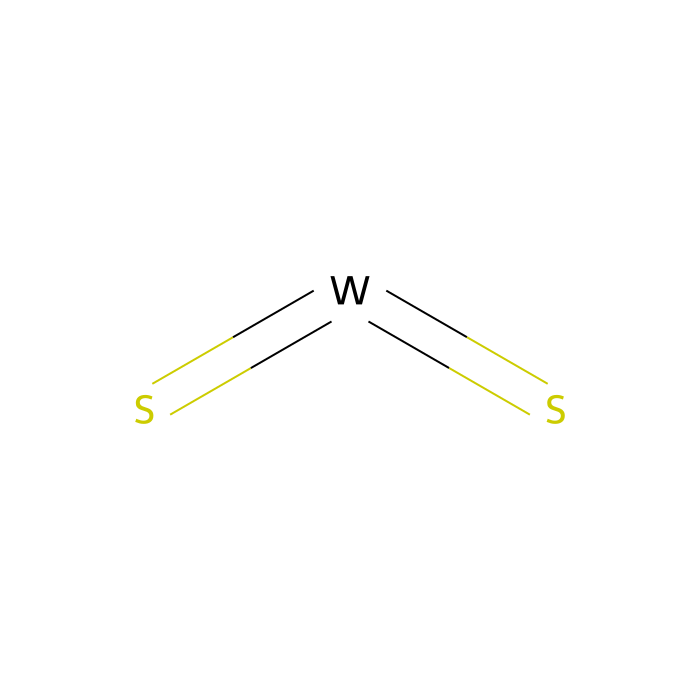
Tungsten(IV) sulfide is an inorganic chemical compound that occurs naturally as the rare mineral tungstenite. It is most commonly used as hydrogen and lithium storage material, as material for lithium battery cathodes, as a component of batteries and other electrochemical devices, as a dry lubricant, and as a catalyst in hydrodesulfurization of crude oil. Due to its layered structure, tungsten(IV) disulfide forms inorganic nanotubules, which are being investigated for potential applications such as epoxy reinforcement, uses in impact-absorbing materials, and as a means to preserve or guide nanometer-scale amounts of material. A component of catalysts and batteries
Transition metal sulfide - Inorganic sulfide - Inorganic salt
Description
This compound belongs to the class of inorganic compounds known as transition metal sulfides. These are inorganic compounds containing a sulfur atom of an oxidation state of -2, in which the heaviest atom bonded to the oxygen is a transition metal.
External Descriptors
sulfide salt
1. Djoumbou Feunang Y, Eisner R, Knox C, Chepelev L, Hastings J, Owen G, Fahy E, Steinbeck C, Subramanian S, Bolton E, Greiner R, and Wishart DS. ClassyFire: Automated Chemical Classification With A Comprehensive, Computable Taxonomy. Journal of Cheminformatics, 2016, 8:61.
We use cookies to ensure the website functions properly and, where permitted, to improve your experience. You can manage your preferences at any time in Settings. Learn more in our Cookie Policy.
Shall we send you a message when we have discounts available?
Remind me later
Thank you! Please check your email inbox to confirm.
Products are supplied to verified businesses, institutions, and qualified professionals for research and development use only. Not for use in humans, animals, diagnosis, or therapy.

 B2624476