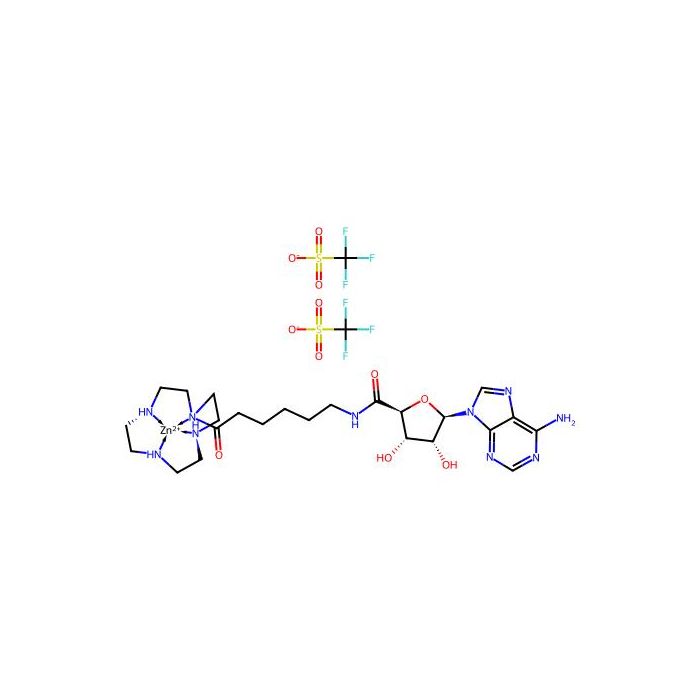
UBA5-IN-1 (compound 8.5) is a selective UBA5 inhibitor with an IC 50 value of 4.0 μM. UBA5-IN-1 inhibits cell proliferation of Sk-Luci6 cancer cells with high expression levels of UBA5
In Vitro
UBA5-IN-1 (0.1-1000 μM) shows dose-dependent inhibition effect to UBA5 with an IC 50 value of 4.0 μM, and inhibits UAE and NAE with IC 50 values of 78.5 and 66.8 μM, respectively. UBA5-IN-1 (0-5 μM) inhibits UBA5 non-competitively with respect to ATP. UBA5-IN-1 (10 μM) shows no effect on ATP binding to human kinase. UBA5-IN-1 (0-50 μM; 72 h) effects cell proliferation of Sk-Luci6 cancer cells with high expression levels of UBA5. MCE has not independently confirmed the accuracy of these methods. They are for reference only. Cell Proliferation AssayCell Line: Sk-Luci6 cancer cells with high expression levels of UBA5 Concentration: 0-50 μM Incubation Time: 0-72 h Result: Showed selective anti-proliferative activity for Sk-Luci6 cancer cells which expressed higher UBA5 protein levels, but showed no anti-proliferative activity to MRC9 lung fibroblasts and A549 carcinoma cells.
UBA5-IN-1 (compound 8.5) is a selective UBA5 inhibitor with an IC 50 value of 4.0 μM. UBA5-IN-1 inhibits cell proliferation of Sk-Luci6 cancer cells with high expression levels of UBA5.
Storage
Store at -20°C
Shipped In
Ice chest + Ice pads
This product requires cold chain shipping. Ground and other economy services are not available.
DMF : 100 mg/mL (109.63 mM; Need ultrasonic) DMSO : 50 mg/mL (54.81 mM; ultrasonic and warming and heat to 60°C)
Solution Calculators
Molarity Calculator
Determine the necessary mass, volume, or concentration for preparing a solution.
Dilution Calculator
Determine the dilution needed to prepare a stock solution.
Reconstitution Calculator
Reviews
Customer Reviews
Application Protocols
No vendor-validated protocols are provided for this item. The following are general, non-item-specific practices for small-molecule screening and profiling:
Stock preparation: Weigh the compound quickly at room temperature, limit air/moisture exposure, dissolve in anhydrous DMSO to prepare a 10–50 mM stock (as solubility permits). Filter if needed (0.2 μm PTFE) and aliquot to avoid freeze–thaw cycles.
Storage of stocks: Store aliquots at −20°C in tightly sealed tubes; protect from light if the compound is photosensitive. Thaw immediately before use and refreeze unused aliquots once.
Biochemical assays: Titrate over multiple concentrations (e.g., 8–12-point serial dilutions) and include vehicle controls matched for DMSO content. Keep final organic solvent ≤0.1–1% v/v unless validated otherwise.
Cell-based assays: Validate solvent tolerance of the specific cell line. Start with low micromolar to sub-micromolar ranges depending on literature for related chemotypes; confirm absence of overt cytotoxicity from vehicle.
Data quality: Include positive controls (known tool compounds, if available for the pathway) and orthogonal readouts to control for assay interference.
These guidelines are general and should be adapted after consulting the CoA/SDS and target-specific literature.
Biological Roles
Background context on the putative target pathway (general literature information, not an item-specific claim):
UBA5 is an E1-like activating enzyme for UFM1 (ubiquitin-fold modifier 1), catalyzing ATP-dependent adenylation and thioester formation during the ufmylation cascade (UBA5 → UFC1 (E2) → UFL1 (E3)).
Ufmylation is implicated in endoplasmic reticulum homeostasis, ribosome-associated quality control, and stress responses. Substrates include components associated with ER function and translation.
Chemical probes that modulate E1 enzymes are used to dissect conjugation kinetics, pathway wiring, and crosstalk with ubiquitin/UBL systems in biochemical and cell-based models.
Use considerations (general):
When studying E1/UBL pathways, include counterscreens against related E1s to evaluate selectivity and potential off-pathway effects.
Downstream readouts can include changes in UFM1-conjugate patterns, reporter assays, or proteomic profiling of modified substrates.
Note: No item-specific data on potency, selectivity, or mechanism are provided for this product. All biological context above is general and intended solely to guide experimental planning in research settings.
Buffer Applications
This product is a small-molecule research compound, not a buffering agent. As such, classical buffer system selection (e.g., phosphate, HEPES, Tris) does not directly apply.
General assay buffer guidance for small-molecule testing (not item-specific):
Choose a buffer compatible with the biological target (e.g., HEPES or Tris for cytosolic enzymes; pH typically 7.2–7.8 for many enzyme assays unless otherwise required).
Maintain ionic strength and cofactors (Mg2+, ATP, etc.) appropriate for E1/UBL enzymology if relevant.
Limit organic co-solvent (e.g., DMSO) to the lowest effective percentage to avoid perturbing enzyme kinetics; validate with vehicle controls.
Include detergents (0.01–0.05% Tween-20 or NP-40) only if needed to reduce aggregation or non-specific binding.
For exact buffer compositions and additive compatibilities, rely on target-specific literature and optimize empirically.
Green Alternatives
Green chemistry considerations are generally applied to solvents and process reagents. For small-molecule probe use at assay scale, environmental impact is dominated by solvent choice rather than the probe itself.
General guidance (not item-specific):
Prefer DMSO (readily biodegradable, relatively low volatility) over higher-toxicity dipolar aprotics where feasible.
Consider ethanol or 2-propanol as co-solvents when adequate solubility is achievable; they are more benign and easier to recover.
For chromatography/purification (if applicable), explore ethyl acetate/heptane systems as alternatives to chlorinated solvents. Replace DMF/NMP where possible with greener amide surrogates or short exposures in microscale procedures.
Trade-offs:
Greener solvents may reduce solubility and require higher volumes or warming/sonication.
Aqueous formulations reduce VOCs but may compromise stability or cause precipitation.
Recommendation:
Minimize overall solvent use via concentrated stock solutions and microplate miniaturization. Dispose of solvent waste according to local regulations and SDS guidance.
Pharmaceutical Uses
No pharmaceutical or excipient uses are specified for this product. It is designated for research use only.
Context (general):
Small-molecule chemical probes are commonly utilized in discovery biology, target validation, and mechanistic studies. They are not manufactured or qualified to pharmacopeial standards unless explicitly stated.
No USP/EP/JP monograph status, dosage form guidance, or GMP manufacturing information is provided for this listing.
Do not use in humans or for clinical applications. For formulation-type studies in vitro, follow standard research-grade handling and verify compound stability and compatibility independently.
Physical Properties
Item-specific physicochemical data have not been provided.
Appearance: Not specified for this item; refer to CoA/Spec Sheet.
Molecular weight: Not specified for this item; refer to CoA/Spec Sheet.
Melting point (MP): Not specified for this item; refer to CoA/Spec Sheet.
Boiling point (BP): Not specified for this item; refer to CoA/Spec Sheet.
Density: Not specified for this item; refer to CoA/Spec Sheet.
Solubility: Not specified for this item; refer to CoA/Spec Sheet.
logP/logD: Not specified for this item; refer to CoA/Spec Sheet.
pKa: Not specified for this item; refer to CoA/Spec Sheet.
Refractive index/UV cutoff: Not specified for this item; refer to CoA/Spec Sheet.
General laboratory guidance (literature/practice-based, not item-specific):
Many small-molecule inhibitors are supplied as off-white solids or films that dissolve in high-boiling polar aprotic solvents (e.g., DMSO, DMF) and sometimes in alcohols (EtOH, MeOH). Aqueous solubility often requires co-solvent or pH adjustment.
Prepare a small test dissolution (e.g., 1–10 mg/mL) to establish a practical solvent system before scaling.
Filter solutions through 0.2 μm PTFE/nylon if particulates are observed.
Always verify item-specific values on the CoA before method development.
Quality and Grades
Item-specific grade and purity are not provided in the current record.
Grade/Purity: Not specified for this item; refer to CoA/Spec Sheet.
Research use: For research use only (per product data). Not for human or veterinary use.
Guidance on grades (general context):
Research/Screening grade compounds prioritize identity and practical purity for discovery workflows. Where stated, analytical characterization may include NMR, LC–MS, and HPLC purity.
If “HPLC grade” or “BioUltra” is specified for solvents or reagents, it implies tight control of UV impurities/metals; such descriptors are not provided here.
If stabilizers or salt forms are present, they will be declared on the CoA; none are listed for this item.
Recommendations:
Request and review the CoA for assay-relevant details (identity confirmation, purity % method, residual solvents, water content, counterion/salt form if applicable).
For structure–activity studies, confirm batch-to-batch consistency by checking retention time and purity specifications on each lot’s CoA.
Reaction and Applications
Manufacturer-supplied application notes are not provided for this listing.
Research-context notes (general, not item-specific):
Compounds labeled as “IN” are often used as chemical probes in biochemical or cellular assays to interrogate target biology. For UBA5-related studies, assays may include enzyme activity measurements, ubiquitin-like modifier (UFM1) pathway readouts, or target engagement biophysics.
Typical workflows: compound pre-dissolution in DMSO, serial dilution, addition to enzyme or cell assay, and endpoint detection (e.g., fluorescence, luminescence, Western blot of pathway markers). Optimize exposure time and concentration empirically.
Orthogonal confirmation: thermal shift assays (DSF), CETSA, SPR/biolayer interferometry, or activity-based assays are often used to validate target engagement. These are suggestions from general practice, not validations for this product.
Caveats:
Without item-specific characterization and potency/selectivity data, experimental design should include appropriate positive/negative controls and counterscreens to deconvolute off-target or assay-interference effects.
Consult the CoA/SDS prior to initiating experiments.
Reaction Conditions
Classical reaction-condition guidance does not apply. This product is intended as a small-molecule research compound rather than a reagent or catalyst.
General laboratory handling (not item-specific specifications):
Prepare concentrated stocks in a suitable solvent (commonly DMSO), then dilute into assay buffer or media immediately before use.
If heat is used to aid dissolution, keep temperatures modest (e.g., 25–40°C) and avoid extended heating to limit degradation.
Monitor stability by LC–MS/HPLC where feasible when solutions are stored for more than a working day.
For any chemical transformations of this compound (derivatization, conjugation), obtain full structural information and refer to the CoA/SDS before developing reaction conditions.
Safety and Handling
Safety details are not provided for this listing; consult the SDS for authoritative guidance.
GHS classification: Not specified for this item; refer to SDS.
Signal word / Hazard statements / Pictograms: Not specified for this item; refer to SDS.
Primary storage condition: Store at −20°C (per product data). Avoid repeated freeze–thaw.
Handle in a fume hood with appropriate PPE: lab coat, safety glasses, and suitable chemical-resistant gloves.
Avoid inhalation of dust/aerosols; minimize skin/eye contact.
Keep container tightly closed; protect from moisture and, if the compound is photosensitive, from light (wrap in foil as a precaution unless otherwise specified).
Incompatibilities are unknown for this item; segregate from strong oxidizers/acids/bases until the SDS is reviewed.
First-aid overview (general):
Skin/eye contact: Rinse with water for at least 15 minutes; remove contaminated clothing; seek medical advice.
Inhalation: Move to fresh air; seek medical attention if symptoms persist.
Ingestion: Rinse mouth; seek medical attention.
Always defer to the product-specific SDS for hazards, exposure limits, spill response, and waste disposal.
Solvent Selection
No item-specific solubility data are available. The following are general practices for small-molecule inhibitors (not item-specific specifications):
Primary stock solvent (common): DMSO due to broad solvating power and compatibility with biochemical/cell assays at low final %.
Alternative solvents: DMF (strongly polar aprotic), ethanol or methanol (protic, more volatile), acetonitrile (miscible with water, lower viscosity), or mixtures thereof.
Aqueous systems: Many inhibitors require co-solvent to reach working concentrations; keep final DMSO ≤0.1–1% v/v for sensitive cells/enzymes, validating tolerance experimentally.
Quick comparison (general):
DMSO: excellent solvency; low volatility; good assay compatibility at low %; hygroscopic.
DMF: strong solvency; may extract plastics; less favored in live-cell assays.
Ethanol: greener; higher volatility; limited solvency for some heteroaromatics.
Acetonitrile: miscible with water; volatile; mid-range polarity.
Practical tips:
Warm gently (25–40°C) and vortex/sonicate to aid dissolution; avoid prolonged heating.
Filter or centrifuge to remove undissolved particulates.
Record exact solvent and concentration for reproducibility.
Verify final solvent choice against the item’s CoA and your assay’s tolerance to minimize precipitation or activity artifacts.
Storage and Reconstitution
Item-specific storage is provided; reconstitution details are general guidance only.
Storage (as supplied): Store at −20°C (per product data). Keep container tightly closed. Minimize exposure to air and moisture. Avoid repeated freeze–thaw cycles.
Stability: Not specified for this item; refer to CoA/Spec Sheet.
General reconstitution guidance (not item-specific specifications):
Dissolve in high-purity anhydrous solvent (commonly DMSO) to prepare a concentrated stock (e.g., 10–50 mM if soluble). Vortex/sonicate gently; avoid prolonged heating.
If preparing aqueous working solutions, dilute the DMSO stock into buffer/media with vigorous mixing to prevent precipitation. Keep final organic solvent content as low as practicable.
Aliquoting: Dispense single-use aliquots to prevent multiple freeze–thaw events. Label with solvent, concentration, lot, and date.
Light sensitivity: If uncertain, protect solutions and solids from light by using amber vials or foil wrapping.
For definitive shelf life, solution stability, and solubility limits, consult the product’s CoA and SDS.
Structure and Identity
Overview: UBA5-IN-1 (SKU: U649645) is listed as a small-molecule research compound. Detailed structural identifiers are not provided in the current product record.
Product name: UBA5-IN-1
CAS: 1831169-11-9
SKU: U649645
Category: Small molecules and compound libraries (research use)
Molecular formula: Not specified for this item; refer to CoA/Spec Sheet.
Molecular weight: Not specified for this item; refer to CoA/Spec Sheet.
SMILES: Not specified for this item; refer to CoA/Spec Sheet.
InChIKey: Not specified for this item; refer to CoA/Spec Sheet.
Structural features (general guidance):
No 2D/3D structure has been provided for this specific listing, so ring systems, functional groups, and stereochemistry cannot be described for this item.
The name “UBA5-IN-1” suggests a chemical probe/inhibitor candidate intended for studies involving UBA5 (UFM1-activating E1 enzyme) pathways; this is general context from the literature and not an item-specific claim of target selectivity.
Documentation:
For definitive identity parameters (exact structure, MF, MW, and analytical identifiers), consult the item’s Certificate of Analysis (CoA) or Specification Sheet and the Safety Data Sheet (SDS).
Synthetic Utility
This item is offered as a research compound (putative inhibitor). It is not positioned as a synthetic building block, and no structure is provided to assess functional group reactivity.
General notes (not item-specific):
Many bioactive small molecules contain heteroaromatic cores, amide linkages, or electrophilic motifs; without a disclosed structure, no conclusions can be drawn about coupling strategies, protection/deprotection, or derivatization.
If analog synthesis or SAR expansion is intended, request the structure (if available) or rely on literature precedents for UBA5-relevant chemotypes, and plan retrosynthesis accordingly.
Given the absence of structural data, treat this product as a ready-to-use research probe rather than a precursor for further synthesis.
Target Specificity
Target and application details must come from product-specific data. For this listing:
Target/Pathway: Not specified for this item; refer to CoA/Spec Sheet.
Assay-validated selectivity: Not specified for this item; refer to CoA/Spec Sheet.
Species reactivity / off-target profile: Not specified for this item; refer to CoA/Spec Sheet.
Note: The product name suggests relevance to UBA5 research in general, but no item-specific validation, potency, or selectivity data are provided here.
Frequently Asked Questions
What is the purity of this product?
This product is supplied at ≥98% purity (chemical assay). Lot-specific values are stated on the Certificate of Analysis.
How should this product be stored?
Store at ?20 °C. Freezer storage is required to maintain the specified shelf life.
How is this product shipped?
This product ships in an insulated container with ice pads. Unpack on arrival and transfer it to the storage condition stated above.
What are the CAS number, molecular formula and molecular weight?
The CAS Number is 1831169-11-9, the molecular formula is C26H40F6N10O11S2Zn, and the molecular weight is 912.16 g/mol.
What documentation is provided?
Available product documentation, including Certificates of Analysis (COA), Safety Data Sheets (SDS), and specification sheets, is shown in the product document area. Document availability and access follow the current site policy.
We use cookies to ensure the website functions properly and, where permitted, to improve your experience. You can manage your preferences at any time in Settings. Learn more in our Cookie Policy.
Shall we send you a message when we have discounts available?
Remind me later
Thank you! Please check your email inbox to confirm.
Products are supplied to verified businesses, institutions, and qualified professionals for research and development use only. Not for use in humans, animals, diagnosis, or therapy.