GRADE & PURITYMoligand™?Moligand™ — Aladdin's line of ligands and bioactive small molecules. Use for receptor, pathway, and binding studies needing defined small-molecule tools.10 mM in DMSO
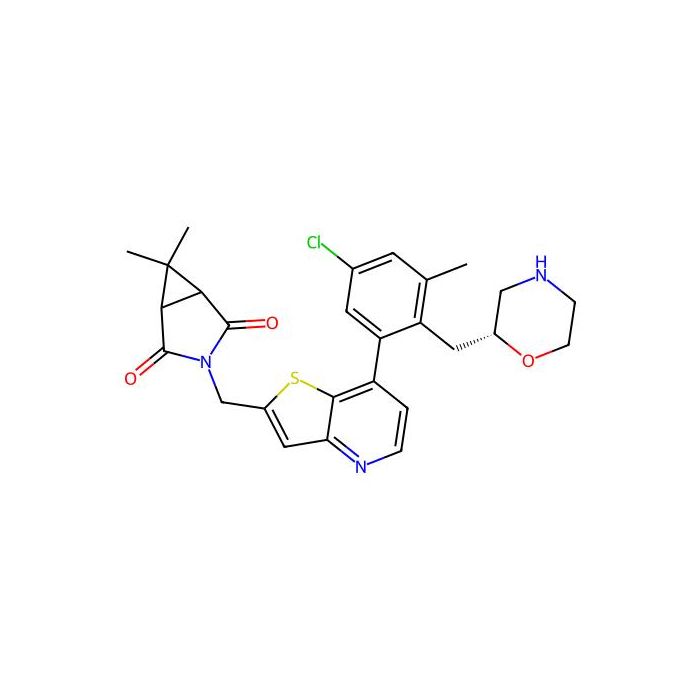
USP7-797 (USP7-IN-7) is an orally available, selective USP7 inhibitor ( IC 50 =0.5 nmol/L) with antitumor activity. USP7-797 reduces the level of MDM2 , thereby increasing the stability and activity of p53 , leading to cell cycle arrest and apoptosis . USP7-797 has low nanomolar cytotoxicity against p53 mutant cancer cell lines, p53 wild-type hematological tumors, and neuroblastoma cell lines .
Specifications
Specifications & Purity
Moligand™, 10 mM in DMSO
Storage
Protected from light,Store at -80°C
Shipped In
Dry ice packs + Cold packs
This product requires cold chain shipping. Ground and other economy services are not available.
Grade
Moligand™
Names and Identifiers
Molecular Weight
510.05
Advanced Data
Certificates (CoA,COO,BSE/TSE and Analysis Chart)
C of A & Other Certificates(BSE/TSE, COO):
Analytical Chart:
Solution Calculators
Molarity Calculator
Determine the necessary mass, volume, or concentration for preparing a solution.
Dilution Calculator
Determine the dilution needed to prepare a stock solution.
Reconstitution Calculator
Reviews
Customer Reviews
Application Protocols
Tested applications and recommended conditions are not provided in the Product Data for USP7-797.
Validated applications (WB, IHC, IF, FC, enzymatic assays, etc.): Not specified for this item; refer to CoA/Spec Sheet.
Recommended working concentrations/dilutions: Not specified.
Positive controls/standards: Not specified.
Please consult the item’s CoA/Spec Sheet and SDS for any available usage guidance. Establish laboratory-specific protocols through small-scale pilot experiments and appropriate controls.
Biological Roles
Item-specific:
No biological mechanism, target binding, or activity is disclosed for USP7-797 in the provided Product Data. This product is for research use only.
General context (literature; not an assertion about this item):
USP7 (Ubiquitin-Specific-Processing Protease 7) is a cysteine deubiquitinase implicated in regulation of protein stability within the ubiquitin–proteasome system. It is known to deubiquitinate several substrates involved in DNA damage response, epigenetic regulation, and cell-cycle checkpoints.
Small molecules developed for the USP family often aim to probe deubiquitinase activity, modulate substrate trafficking, or serve as chemical biology tools in target validation.
In research workflows, putative modulators are frequently profiled using enzymatic activity assays, thermal shift assays, cellular target engagement, and global ubiquitinome readouts.
Usage considerations (general):
When exploring biological roles, incorporate orthogonal assays to confirm on-target effects and rule out assay interference (aggregation, redox cycling, fluorescence artifacts).
Maintain low vehicle (DMSO) percentages and include appropriate controls to ensure observed phenotypes are not solvent-driven.
Note: No claim is made here regarding USP7-797’s activity, potency, or selectivity. Refer to primary documentation (CoA/Spec Sheet) for any item-specific biological characterization if available.
Buffer Applications
Applicability: USP7-797 is a small-molecule library compound, not a buffering reagent.
Item-specific buffer roles: Not applicable. No buffering capacity or buffer recipes are provided for this item.
Practical note (general): If used in biochemical assays, dissolve in an appropriate solvent (commonly DMSO) and dilute into assay buffers (e.g., PBS, HEPES, or Tris) at low vehicle percentages compatible with the system. Optimize pH, ionic strength, and any additives (e.g., Mg2+, reducing agents) according to the specific enzyme or cell model.
For actual buffer preparation guidance, consult dedicated buffering reagents and Good’s buffers.
Green Alternatives
Context: With structure and solvent requirements not disclosed for USP7-797, “green” considerations mainly concern solvent handling and assay vehicles rather than substitution of the active compound itself.
General greener-practice guidance (not item-specific specifications):
Stock solvent choice: If DMSO is required, minimize volume and use high-concentration stocks to reduce total solvent use across experiments.
Analytical methods: Favor water–acetonitrile gradients over water–methanol when appropriate to reduce energy in solvent recovery (lab-dependent) and consider buffer-free LC–MS where sensitivity allows.
Workflows: Adopt miniaturized assay formats (e.g., 384/1536-well plates) to cut reagent and solvent consumption.
Waste management: Segregate halogenated vs non-halogenated waste; neutralize aqueous buffers when possible for safer disposal according to institutional policy.
Comparison (general solvent alternatives for small-molecule handling):
DMSO (benchmark) vs glycerol/water cosolvents: glycerol–water can be greener but often inadequate for hydrophobic chemotypes.
Acetonitrile vs methanol for LC: acetonitrile typically offers lower backpressure and shorter runs; methanol is less toxic but may require longer gradients.
Note: No alternative chemical substitute for USP7-797 can be proposed without structural information. Apply institutional green chemistry policies to handling, analysis, and waste reduction.
Pharmaceutical Uses
This product is supplied strictly for research use only; it is not intended for human or veterinary use, clinical diagnosis, or therapeutic applications.
Item-specific pharmacopeial status: Not specified for this item; refer to CoA/Spec Sheet.
Formulation/excipient role: Not applicable based on the provided Product Data.
General R&D context (not item-specific claims):
Early-stage small molecules used in discovery research may be formulated for in vitro studies as concentrated DMSO stocks and for in vivo exploratory studies (where permitted by institutional oversight) in vehicles such as PEG400/saline, Captisol, or lipid-based systems; however, such use requires full characterization and ethics approvals. No such recommendations are made for this item.
Physical Properties
Item-specific properties (from Product Data):
Appearance: Not specified for this item; refer to CoA/Spec Sheet.
Molecular Weight: Not specified for this item; refer to CoA/Spec Sheet.
Molecular Formula: Not specified for this item; refer to CoA/Spec Sheet.
Melting Point (mp): Not specified for this item; refer to CoA/Spec Sheet.
Boiling Point (bp): Not specified for this item; refer to CoA/Spec Sheet.
Density/Refractive Index/LogP/pKa/Solubility: Not specified for this item; refer to CoA/Spec Sheet.
Practical handling guidance (general, not item-specific):
Stock solutions for library compounds: Frequently prepared in anhydrous DMSO (e.g., 10–50 mM) and stored at ultra-low temperatures to maintain integrity; verify solubility first using small-scale tests.
Aqueous work: If used in biochemical assays, small aliquots may be diluted into assay buffers containing a limited percentage of DMSO (commonly ≤0.1–1% v/v). The acceptable carrier percentage depends on biological system tolerance and should be optimized empirically.
Light/temperature sensitivity: This item requires protection from light and storage at −80°C (per Product Data), suggesting potential lability; minimize freeze–thaw cycles and exposure to ambient light.
Quality and Grades
Item-specific:
Grade: Moligand™ (per Product Data)
Interpretation (general explanation of grade; not a specification):
Moligand™ denotes a curated small-molecule research-grade reagent suitable for screening, chemical biology, and method development. Such offerings typically emphasize identity confirmation and handling/stability guidance for library use. Specific purity thresholds, impurity profiles, stabilizers, metal limits, and UV characteristics are not provided in the Product Data and must be confirmed on the CoA/Spec Sheet.
What this means for your lab:
Analytical confirmation: Expect to verify identity/purity in-house (e.g., LC–MS, 1H NMR, HPLC) prior to critical studies, especially when quantitative SAR or potency ranking will be performed.
Assay readiness: Items in this category are commonly supplied to support high-throughput or focused screening; confirm solubility in assay-relevant vehicles (e.g., DMSO) and check for aggregation or autofluorescence if using optical readouts.
Documentation: For any parameters not listed here—appearance, exact purity, water content, residual solvents, stabilizers—refer to the latest CoA/Spec Sheet. Do not infer unlisted specifications.
Reaction and Applications
Relevance: USP7-797 is offered as a Moligand small-molecule library member. It is not presented as a synthetic reagent or catalyst in the Product Data.
Item-specific:
Manufacturer Applications: Not provided in the listing; no reaction/catalysis roles are specified for this item.
General research applications (literature/context, not item-specific claims):
Compounds in collections named after targets (e.g., “USP7-…”) are often used in biochemical, biophysical, or cell-based screening to explore target engagement, structure–activity relationships (SAR), and chemical probe development.
Typical workflows include: preparing DMSO stocks, serial dilutions for dose–response, orthogonal counterscreens (e.g., aggregation, fluorescence interference), and analytical confirmation (LC–MS/NMR) before and after assays to monitor stability.
For mechanistic studies, researchers may combine activity assays with thermal shift (DSF), SPR/BLI, or nanoBRET target engagement assays when appropriate to the putative target class.
Practical tips (general):
Verify chemical stability in assay buffer over time and temperature; monitor for hydrolysis/oxidation or precipitation.
Implement controls: vehicle-only, known actives/inactives where available, and plate-position controls to mitigate edge effects.
For fluorescence-based assays, screen for inner filter effects and autofluorescence across excitation/emission ranges of interest.
Note: No specific application or mechanism is assigned to USP7-797 in the provided data.
Reaction Conditions
Item-specific reaction conditions: Not applicable/Not specified. USP7-797 is not presented as a reagent, substrate, or catalyst in the Product Data.
General guidance relevant to assay preparation (not synthetic reactions):
Stock preparation: If solubility allows, prepare concentrated stocks in anhydrous DMSO (e.g., 10–50 mM), filter if necessary (PTFE or PVDF, low-protein-binding), and aliquot.
Handling: Work under low light and keep samples cold as the item is stored at −80°C and protected from light. Thaw only what is needed to minimize freeze–thaw cycles.
Dilution: Add DMSO stocks to pre-chilled assay buffers with vigorous mixing to avoid local supersaturation/precipitation.
Stability checks: Use LC–MS before/after assay windows to verify integrity under your conditions.
If you require bona fide chemical reaction parameters (temperature, catalyst, yields), these are not available for this item; consult primary literature once the structure is known.
Safety and Handling
Item-specific hazard data (from Product Data):
Signal Word: Not specified for this item; refer to SDS.
H-Statements: Not specified for this item; refer to SDS.
GHS Classification: Not specified for this item; refer to SDS.
GHS Pictograms: Not specified for this item; refer to SDS.
General laboratory guidance (not item-specific; always defer to SDS):
PPE: Use lab coat, safety glasses, and appropriate chemically resistant gloves. Handle solids and powders in a certified fume hood to avoid inhalation of dust/aerosols.
Avoid: Contact with skin/eyes, inhalation of dust or vapors. Do not ingest. Avoid open flames and strong oxidizers until compatibility is known.
First aid (overview): If inhaled—move to fresh air; if skin contact—wash with soap and water; if eye contact—rinse cautiously with water for several minutes; if ingested—rinse mouth, seek medical advice. Bring SDS to medical personnel.
Spill response: Contain with inert absorbent, avoid dust generation, and dispose of in accordance with institutional and local regulations.
Storage per Product Data: Protect from light; store at −80°C. Shipments are on dry ice + cold packs to maintain low temperature.
Note: The definitive hazard classification and exposure limits for USP7-797 are not provided here. Consult the SDS and CoA for authoritative safety information.
Solvent Selection
Applicability: As a small-molecule library member with undisclosed structure in the Product Data, solvent choices should be guided by conservative, broadly compatible practices rather than structure-specific predictions.
Item-specific:
No solubility data provided. Storage guidance indicates light sensitivity and ultra-cold storage, which is consistent with maintaining integrity of small-molecule stocks.
General guidance (literature/practice, not item-specific specs):
Primary stock solvent: Anhydrous DMSO is commonly used due to wide solubilizing power and compatibility with many biochemical assays.
Secondary solvents for analytical work: Acetonitrile (LC–MS), methanol, or mixtures with water + 0.1% formic acid or ammonium acetate for LC methods.
Aqueous buffers: If needed for biology-facing assays, dilute DMSO stocks into PBS/HEPES buffers while keeping final DMSO low (often ≤0.1–1% v/v). Include nonionic surfactants at low levels only if justified by solubility behavior.
Comparison snapshot (general):
DMSO vs DMF: DMSO offers broader biological compatibility and lower volatility; DMF is less preferred for live-cell systems.
DMSO vs 2-MeTHF/EtOH: 2-MeTHF is greener but seldom used as an assay vehicle; ethanol can be viable at low % but may affect cells/enzymes.
Always validate solvent choice empirically for your assay and consult the CoA for any item-specific recommendations.
Storage and Reconstitution
Item-specific (from Product Data):
Storage Conditions: Protect from light; store at −80°C.
Shipped In:Dry ice packs + cold packs to maintain low temperature in transit.
General best practices (not item-specific specifications):
Reconstitution solvent: If compatible, dissolve in anhydrous DMSO to create a concentrated stock. Confirm solubility on a small scale before preparing bulk aliquots.
Aliquoting: Dispense into single-use, low-dead-volume vials or 96-well plates (foil-sealed) to minimize freeze–thaw cycles. Aim for volumes enabling one-time use.
Light protection: Use amber vials or wrap containers in aluminum foil; minimize exposure during weighing and transfers.
Labeling/traceability: Record lot number, concentration, solvent, preparation date, and operator initials. Note any observed precipitation or color change.
Freeze–thaw management: Avoid repeated thawing. Thaw on ice or at 4°C, mix gently to ensure homogeneity, and promptly return unused material to −80°C.
Stability monitoring: Periodically assess by LC–MS/HPLC to verify integrity over storage.
Note: Appearance, exact solubility, and concentration limits are not specified for this item; consult the CoA/Spec Sheet for any lot-specific recommendations before reconstitution.
Structure and Identity
Brief overview: USP7-797 is supplied as a Moligand small-molecule library member intended for research screening and method development.
Item-specific (from Product Data):
SKU: U1496546
Product Name: USP7-797
CAS: 2413944-70-2
Grade/Purity: Moligand™
InChIKey: Not specified for this item; refer to CoA/Spec Sheet.
SMILES: Not specified for this item; refer to CoA/Spec Sheet.
Molecular Formula: Not specified for this item; refer to CoA/Spec Sheet.
Molecular Weight: Not specified for this item; refer to CoA/Spec Sheet.
Structural description:
2D structural features (rings, heteroatoms, stereochemistry) are not disclosed in the provided data. Consult the CoA/Spec Sheet for definitive structure and identifiers.
General notes (literature/context):
The designation “USP7-” suggests relevance to the deubiquitinase USP7 research area; however, no structure or target-binding information is confirmed for this specific item in the supplied data. Always verify with the primary documentation before designing assays or analytical methods.
Synthetic Utility
USP7-797 is offered as a Moligand screening compound and is not described as a synthetic reagent, building block, or catalyst in the Product Data.
Item-specific utility in synthesis: Not specified. Without a disclosed structure, no guidance on functional group compatibility or derivatization can be provided.
General considerations (literature/practice, not item-specific):
When structural information is available for library compounds, researchers sometimes perform analogue synthesis to explore SAR (e.g., bioisosteres, heteroatom scans, ring expansions/contractions).
Typical workflows involve establishing robust analytical methods (LC–MS, NMR) to monitor modifications and ensure parent/analogue purity for biological testing.
If you intend to derivatize or immobilize this compound, obtain full structural data and permissions, and consult the CoA/Spec Sheet for any constraints (e.g., stability, reactive handles, or protected functionalities).
Target Specificity
Per Product Data, no target-binding, selectivity, or mechanistic information is provided for USP7-797.
Target, epitope, or binding site: Not specified for this item; refer to CoA/Spec Sheet.
Species reactivity/selectivity panel: Not specified.
Assay-validated potency or IC50/Ki: Not specified.
Note: While the naming suggests possible relevance to the USP7 research area, no specificity or activity claims are made or should be inferred for this product without supporting documentation.
Frequently Asked Questions
What is Moligand??
Moligand? is one of Aladdin Scientific's premium product lines, formulated for high-purity applications across multiple workflows. Compared to standard grades in the same workflow, Moligand? products typically offer tighter specifications, more rigorous QC, and stronger lot-to-lot consistency.
How should this product be stored?
Store at ?80 °C, protected from light. The material is light-sensitive — keep it in its original opaque or amber container.
How is this product shipped?
This product ships frozen with dry ice and cold packs. Unpack on arrival and transfer it to the storage condition stated above; handle dry ice with insulated gloves in a ventilated area.
What are the CAS number, molecular formula and molecular weight?
The CAS Number is 2413944-70-2, the molecular formula is C27H28ClN3O3S, and the molecular weight is 510.05 g/mol.
What documentation is provided?
Available product documentation, including Certificates of Analysis (COA), Safety Data Sheets (SDS), and specification sheets, is shown in the product document area. Document availability and access follow the current site policy.
Need help choosing the grade?
Our grade selection guide covers purity, stabilizer status, and application suitability for all variants in our catalog.
We use cookies to ensure the website functions properly and, where permitted, to improve your experience. You can manage your preferences at any time in Settings. Learn more in our Cookie Policy.
Shall we send you a message when we have discounts available?
Remind me later
Thank you! Please check your email inbox to confirm.
Products are supplied to verified businesses, institutions, and qualified professionals for research and development use only. Not for use in humans, animals, diagnosis, or therapy.