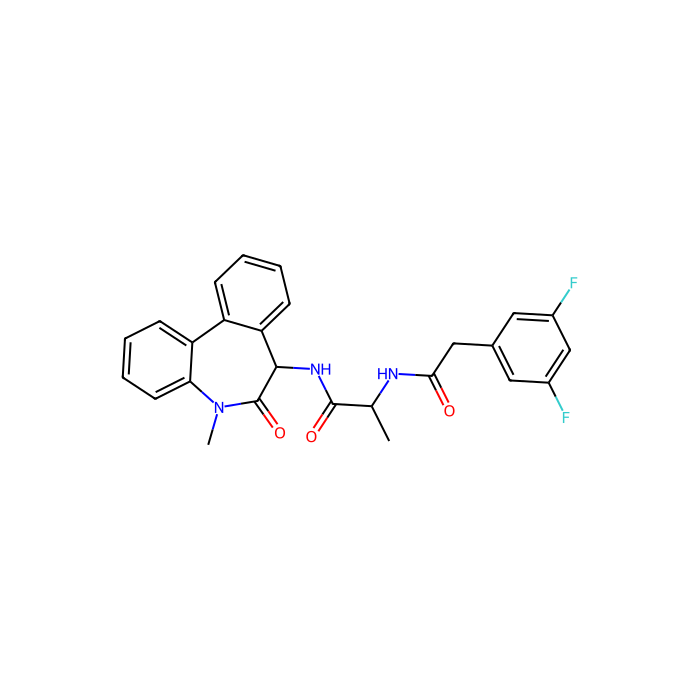
Potent gamma secretase inhbitor (IC 50 = 2.6 nM for APPL cleavage; IC 50 = 2.9 nM for Notch cleavage). Inhibits Notch signaling. Neuroprotective, anti-diabetic, anti-fibrotic and cardioprotective in animal models.
Storage
Store at -20°C
Shipped In
Ice chest + Ice pads
This product requires cold chain shipping. Ground and other economy services are not available.
Note
Refer to SDS for further information Need more advice on solubility, usage and handling? Please visit our frequently asked questions (FAQ) page for more details.
This compound belongs to the class of organic compounds known as dipeptides. These are organic compounds containing a sequence of exactly two alpha-amino acids joined by a peptide bond.
External Descriptors
Not available
1. Djoumbou Feunang Y, Eisner R, Knox C, Chepelev L, Hastings J, Owen G, Fahy E, Steinbeck C, Subramanian S, Bolton E, Greiner R, and Wishart DS. ClassyFire: Automated Chemical Classification With A Comprehensive, Computable Taxonomy. Journal of Cheminformatics, 2016, 8:61.
Determine the necessary mass, volume, or concentration for preparing a solution.
Dilution Calculator
Determine the dilution needed to prepare a stock solution.
Reconstitution Calculator
Reviews
Customer Reviews
Application Protocols
No manufacturer-validated protocols are provided for this item. The following general, research-use-only guidance can aid initial setup; adapt to your system.
Example workflow (cell-based assay; general):
Prepare a 10–50 mM stock in DMSO (as solubility allows). Vortex and, if needed, sonicate briefly to ensure complete dissolution.
Serially dilute the stock in DMSO to create an intermediate plate; transfer small volumes into pre-warmed media to achieve final solvent ≤0.1–0.5%.
Include vehicle controls matched to the highest DMSO level. Incubate cells as required and measure endpoints (e.g., reporter activity, protein expression) at defined time points.
Confirm absence of precipitation by visual inspection and, if critical, by light scattering or analytical sampling.
Biochemical assay notes (general):
Verify enzyme/assay buffer compatibility with the selected solvent.
Pre-incubate compound with the target protein where protocol suggests time-dependent effects; include time-matched controls.
Always consult the SDS and CoA for this lot before beginning work.
Biological Roles
General, literature-based context (no medical/clinical claims):
YO-01027 (CAS 209984-56-5) is commonly cited in the literature as a potent, cell-permeable small molecule used to modulate specific signaling pathways in mammalian systems. It is frequently utilized in stem cell differentiation studies and pathway-dissection experiments to interrogate signal transduction cascades. Exact molecular targets and Ki/IC50 values should be confirmed from the primary literature corresponding to this CAS.
Best practices for biological experiments:
Establish vehicle controls matched to the final solvent percentage in all assay wells or samples.
Determine concentration-response curves (e.g., 8–12 points) to estimate apparent potency under your specific assay conditions, as values can shift with protein content, serum, and cell line.
Evaluate compound stability in media (with and without serum) over the assay time course; adsorptive losses to plastics and serum proteins can alter free concentration.
If gene-expression endpoints are monitored, include time-course sampling to distinguish primary from secondary effects.
Important notes:
For this specific catalog item, target specificity and potency data are not provided; consult peer-reviewed references associated with CAS 209984-56-5 and confirm performance under your laboratory conditions.
Buffer Applications
This compound is not a buffering agent and is not used to control pH. However, buffers are central to its biological deployment.
Practical guidance for use in buffered systems:
Stock preparation: Prepare a concentrated DMSO stock (e.g., 10–50 mM as solubility allows), then dilute into pre-warmed, well-stirred buffer or cell culture medium. Keep final DMSO ≤0.1–0.5% v/v when possible.
Common assay buffers (examples): PBS, HEPES-buffered saline, Tris-based buffers, or complete cell culture media. Verify compatibility with your readout (e.g., fluorescence background, enzyme activity).
Order of addition: Add the compound stock last, under vigorous mixing, to minimize local supersaturation and precipitation. Consider adding a small amount of serum or carrier protein if compatible, noting that binding may reduce free concentration.
Filtration: If sterility is required, filter using 0.2 µm PES or PTFE membranes; confirm no significant adsorption losses.
Quality control:
Inspect for turbidity/precipitation after dilution; if observed, adjust dilution protocol or solvent content.
Confirm final concentration by back-calculation from accurately prepared stock, or analytically via LC–MS/UV where feasible.
Green Alternatives
As a bioactive small molecule used at micromolar levels, the principal environmental impact often arises from solvent selection and waste handling rather than from the compound itself.
Greener practice suggestions:
Prefer DMSO over chlorinated solvents for stock solutions when chemically compatible.
Minimize DMF usage due to regulatory and environmental concerns; if required, keep volumes minimal and segregate waste.
Use ethanol or aqueous cosolvent systems when feasible and compatible with the assay, recognizing tradeoffs in solubility and assay background.
Small comparison (general):
DMSO: High solvency, broad assay compatibility; potential to interfere at higher percentages.
Ethanol: More benign profile; lower solvency for many hydrophobic inhibitors; evaporation can shift concentrations.
DMF: Strong solvency; less preferable from EHS standpoint; ensure rigorous waste management.
Operational steps:
Scale experiments to minimize chemical use and waste generation.
Employ microplate formats and automated low-volume dispensing to reduce solvent consumption.
Consolidate and label solvent waste streams clearly to facilitate compliant disposal.
Pharmaceutical Uses
No excipient or pharmacopeial status is provided for this item. This product is supplied strictly for research use only.
Context (general, non-clinical):
YO-01027 is used in discovery research as a tool compound to modulate signaling pathways in vitro and in animal model studies reported in the literature. It is not formulated as a drug product under this listing, and no GMP, DMF, or pharmacopeial monograph support is indicated.
Formulation considerations for research:
For in vivo exploratory studies (research-only), vehicle systems often employ DMSO, PEG400, polysorbate, or cyclodextrins to enhance solubility; selection depends on route and tolerability. Validate stability and lack of precipitation.
For in vitro assays, maintain low solvent percentages to minimize confounding effects.
Compliance reminder:
Do not use for diagnostic, therapeutic, or human/animal consumption purposes. For any regulated use, obtain appropriate regulatory-grade material and documentation.
Physical Properties
Item-specific specifications are not provided in the Product Data.
Appearance: Not specified for this item; refer to CoA/Spec Sheet.
Melting point: Not specified for this item; refer to CoA/Spec Sheet.
Boiling point: Not applicable/unknown for a high-melting bioactive small molecule; refer to CoA/Spec Sheet.
Density: Not specified for this item; refer to CoA/Spec Sheet.
LogP/pKa: Not specified for this item; refer to CoA/Spec Sheet.
UV/Vis characteristics: Not specified for this item; refer to CoA/Spec Sheet.
Solubility:
Practical guidance (general): many hydrophobic research inhibitors are formulated as concentrated DMSO stocks (e.g., 10–50 mM), then diluted into aqueous systems with strong mixing to avoid precipitation. Confirm with CoA for this item.
Water solubility is often limited for nonpolar inhibitors; evaluate cosolvents (DMSO, DMF, ethanol) and perform a small-scale solubility screen.
Handling notes (general best practice):
Prepare analytical verification (HPLC/LC–MS) after dissolving to confirm integrity and concentration.
Filter sterilize stock solutions if intended for cell-based assays and if chemically compatible (PTFE or PES membranes are commonly used).
Quality and Grades
Grade/Purity: Not specified for this item; refer to CoA/Spec Sheet.
Interpretation and best practices:
For bioactive screening, purity of ≥95% (HPLC/UPLC) is commonly targeted in the literature to minimize off-target effects from impurities. Verify the actual purity, analytical method (e.g., area % by HPLC at a specified wavelength), and residual solvent levels on the CoA for this item.
Stabilizers/inhibitors: Not specified for this item; refer to CoA/Spec Sheet. If present, stabilizers may influence UV baselines or bioassay results; account for them in controls.
Lot-specific quality indicators to review:
Assay purity with chromatograms and method details (column, gradient, detection wavelength).
Identity confirmation (1H/13C NMR, HRMS, or MS with fragmentation; sometimes FTIR).
Water content (Karl Fischer) and residual solvents where applicable.
Counter-ion/solvate form, if any, which can affect solubility and potency.
Recommendations:
Request a CoA prior to critical studies, and perform an incoming verification (HPLC/LC–MS) using your assay solvent system.
For long-term studies, consider qualifying a single lot to avoid inter-lot variability in bioassay outcomes.
Reaction and Applications
This product is supplied as a bioactive research compound rather than a general-purpose synthetic reagent.
Laboratory applications (general, literature-based): YO-01027 is widely used as a pathway-modulating small molecule in cell-based and biochemical studies. Typical workflows involve preparation of DMSO stock solutions, serial dilutions, and treatment of cells or in vitro enzyme systems with appropriate vehicle controls.
Not typically used as a stoichiometric reagent, catalyst, ligand, or building block in standard organic synthesis. Consequently, conventional synthetic reaction families (e.g., cross-coupling, carbonyl additions) are not normally applicable to this item.
Practical guidance:
Verify compound identity and purity prior to critical studies (HPLC/LC–MS, 1H NMR in d6-DMSO or d6-acetone, if soluble).
Determine working concentration ranges via small pilot experiments, titrating from low nanomolar to mid-micromolar, with careful monitoring for solvent effects and cytotoxicity.
Include time-course and washout controls to assess reversibility and stability in the chosen biological matrix.
Note: For any mechanistic or pathway-specific application details, consult primary literature associated with CAS 209984-56-5 and adapt to the cell line or biochemical system in use.
Reaction Conditions
Not typically applicable. YO-01027 is supplied as a bioactive research compound, not as a reagent for chemical transformations.
For biological assays (general, literature-based operational conditions):
Stock solutions: Commonly prepared in DMSO at 10–50 mM (as solubility permits), stored frozen, and thawed immediately before use.
Working concentrations: Explore low-nanomolar to mid-micromolar ranges depending on the model system; determine empirically.
Temperature/exposure: Most cell assays are conducted at 37°C in humidified incubators with 5% CO2; biochemical assays at ambient temperature or 30–37°C depending on enzyme.
Exposure time: From 0.5–72 h in cell systems depending on endpoint; verify stability over the time course.
Note: The above are general guidance points and not item-specific specifications. Optimize conditions for your assay and confirm compound integrity throughout the experiment.
Safety and Handling
Authoritative safety information must be taken from the product SDS.
GHS classification: Not specified for this item; refer to SDS.
Signal word, H-statements, pictograms: Not specified for this item; refer to SDS.
General laboratory precautions for bioactive small molecules:
Wear appropriate PPE: lab coat, safety glasses, and nitrile gloves. Use double-gloving when preparing concentrated DMSO stocks.
Work in a chemical fume hood to avoid inhalation of dust or aerosols. Avoid skin/eye contact and ingestion.
Avoid generating dust; gently tap powders to minimize airborne particles during weighing.
Incompatibilities: Strong oxidizers and strong acids/bases may degrade many organic inhibitors; segregate from reactive reagents until compatibility is known (consult SDS).
First aid (general):
Skin/eye contact: Rinse with water for ≥15 minutes; remove contaminated clothing; seek medical attention if irritation persists.
Inhalation: Move to fresh air; obtain medical advice if symptoms occur.
Ingestion: Rinse mouth; do not induce vomiting; seek medical attention.
Environmental precautions: Prevent release to drains; collect spills with inert absorbent and dispose according to institutional and local regulations.
Disposal: Treat as organic hazardous waste per your facility’s chemical hygiene plan and the SDS guidance.
Solvent Selection
Purpose-driven solvent choices for bioassays and stock preparation:
Primary solvents (general/literature practice for hydrophobic inhibitors):
DMSO: Most common for 10–50 mM stocks due to broad solvating power and compatibility with cell assays at low final percentages (<0.1–0.5%).
DMF: Useful alternative when DMSO is insufficient; assess cytotoxicity at the intended final concentration.
Ethanol: Sometimes acceptable for biochemical assays; monitor precipitation upon aqueous dilution.
Aqueous media: Direct dissolution in water or buffers is often limited. Use cosolvent strategies and vigorous mixing; add compound stock into warmed, stirred media slowly to avoid local supersaturation.
Filtration: Use PTFE or PES syringe filters to remove particulates if needed; confirm no significant adsorption to membrane.
Light/air sensitivity: Not specified for this item; if sensitivity is unknown, protect from light and minimize air exposure during solution prep.
Selection guidance:
Choose the minimum DMSO percentage that ensures complete solubilization at assay concentration.
Prepare small test dilutions to check for precipitation or adsorption to plasticware; consider low-bind tubes/plates for hydrophobic compounds.
For biochemical assays, pre-screen solvent effects on enzyme readouts using matched vehicle controls.
Storage and Reconstitution
Storage conditions (as provided): Store at -20°C.
Shipping: Ice chest + ice pads (as provided). Upon receipt, place immediately at -20°C.
Appearance: Not specified for this item; refer to CoA/Spec Sheet.
Reconstitution (general guidance for bioactive small molecules):
Allow the container to equilibrate to room temperature in a desiccator before opening to minimize moisture condensation.
Weigh quickly and accurately. Prepare a concentrated stock in DMSO or another suitable solvent confirmed by a small solubility test.
Aliquot stocks into low-bind, airtight vials or tubes to avoid repeated freeze–thaw and adsorption losses. Typical aliquots: 10–100 µL.
Protect from light if photosensitivity is suspected; use amber vials/foil wrap as a precaution.
Stability considerations:
Freeze at -20°C (or below) for long-term storage of neat solid and DMSO stocks. Avoid frost-free freezers that cycle temperatures.
Minimize headspace and avoid repeated freeze–thaw cycles; thaw on ice and use promptly.
For aqueous working solutions, prepare fresh on the day of use unless stability has been verified analytically for your conditions.
Note: For definitive shelf-life, retest intervals, and solution stability, consult the item’s CoA and SDS.
Structure and Identity
Product name: YO-01027 (SKU: Y129283)
CAS: 209984-56-5
CID: 11454028
InChIKey: 305192 (as provided; note: this does not match the typical 27-character InChIKey format. Refer to CoA/Spec Sheet for the definitive identifier for this lot.)
Molecular formula: Not specified for this item; refer to CoA/Spec Sheet.
Molecular weight: Not specified for this item; refer to CoA/Spec Sheet.
SMILES: Not specified for this item; refer to CoA/Spec Sheet.
YO-01027 is widely referenced in the literature as a bioactive small molecule used in pathway inhibition studies. Detailed structural features (ring systems, stereocenters, functional groups) should be confirmed from the supplier CoA/SDS or primary literature for the exact synonym under this CAS.
Notes:
Because multiple trade names have been associated with pathway inhibitors, always cross-check CAS (209984-56-5) against your internal reference structure prior to method development.
For spectral identification (NMR, MS), consult the CoA/SDS and verify expected diagnostic signals for confirmation of identity before use in critical assays.
Synthetic Utility
This compound is not typically employed as a reagent, catalyst, or building block in organic synthesis.
Functional-group reactivity: Not specified for this item; refer to primary structural information if you plan derivatization or probe synthesis.
Derivatization: Researchers sometimes derivatize bioactive scaffolds to generate photoaffinity probes or biotinylated affinity reagents; if pursuing such routes, confirm the precise structure (from CoA and literature) to identify modification-tolerant positions.
Stability considerations: Without item-specific data, assume sensitivity to strong acids/bases and strong oxidants until proven otherwise. Conduct small-scale tests to map stability prior to synthetic manipulation.
If you require a synthetic intermediate or handle for conjugation, consider procuring the appropriate functionalized analog rather than modifying this research-use material ad hoc.
Target Specificity
Not specified for this item; refer to CoA/Spec Sheet and primary literature for CAS 209984-56-5. No antigen, epitope, clone, isotype, or species reactivity information applies, as this is a small-molecule compound rather than an antibody or protein.
Frequently Asked Questions
What is the purity of this product?
This product is supplied at ≥97% purity (chemical assay). Lot-specific values are stated on the Certificate of Analysis.
How should this product be stored?
Store at ?20 °C. Freezer storage is required to maintain the specified shelf life.
How is this product shipped?
This product ships in an insulated container with ice pads. Unpack on arrival and transfer it to the storage condition stated above.
What are the CAS number, molecular formula and molecular weight?
The CAS Number is 209984-56-5, the molecular formula is C26H23F2N3O3, and the molecular weight is 463.48 g/mol. InChIKey QSHGISMANBKLQL-OWJWWREXSA-N.
What documentation is provided?
Available product documentation, including Certificates of Analysis (COA), Safety Data Sheets (SDS), and specification sheets, is shown in the product document area. Document availability and access follow the current site policy.
We use cookies to ensure the website functions properly and, where permitted, to improve your experience. You can manage your preferences at any time in Settings. Learn more in our Cookie Policy.
Shall we send you a message when we have discounts available?
Remind me later
Thank you! Please check your email inbox to confirm.
Products are supplied to verified businesses, institutions, and qualified professionals for research and development use only. Not for use in humans, animals, diagnosis, or therapy.

 C2613080