Determine the necessary mass, volume, or concentration for preparing a solution.
| Activity Type | Relation | Activity value | Units | Action Type | Journal | PubMed Id | doi | Assay Aladdin ID |
|---|

Standard for GC, ≥99.5%(GC) Standard for GC for sensitive chromatographic and analytical workflows requiring minimal baseline interference.
Room temperature,Argon charged Ships Normal Check lot-specific COA for exact specifications.
SDS, COA, datasheet, and spec sheet available for download. Lot-specific COA accessible via lot number lookup.
Cited in 656 peer-reviewed publications across chromatography, organic synthesis, and cross-coupling reactions.
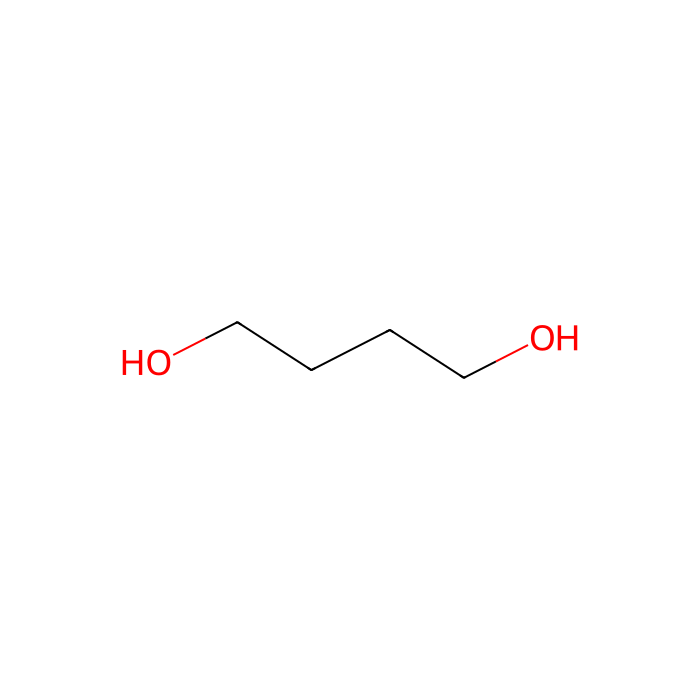
1,4-Butanediol can be used as a reactant to prepare:
Homoallyl alcohol (3-buten-1-ol) and tetrahydrofuran via vapor-phase dehydration using ZrO2 as a catalyst.
Poly(1,4-butanediol succinate) polymer by reacting with succinic anhydride.
Biodegradable homopolyesters [poly(butylene succinate) and poly(butylene adipate)] and copolyesters [poly(butylene succinate-co-butylene adipate)] by treating with succinic acid and adipic acid via esterification and deglycolization reaction.
Poly(1,4-butyl sebacate) by polyesterification reaction with sebacic acid or its derivatives.
Comprehensive hazard, handling, storage, and regulatory compliance document.
Download SDS →Lot-specific quality data. Enter your lot number to retrieve the exact COA.
Look up COA →Full quality attributes and acceptance criteria for this grade.
View spec sheet →Taxonomy Tree
| Kingdom | Organic compounds |
|---|---|
| Superclass | Organic oxygen compounds |
| Classe | Organooxygen compounds |
| Subclass | Alcohols and polyols |
| Intermediate Tree Nodes | Not available |
| Direct Parent | Primary alcohols |
| Alternative Parents | Hydrocarbon derivatives |
| Molecular Framework | Aliphatic acyclic compounds |
| Substituents | Hydrocarbon derivative - Primary alcohol - Aliphatic acyclic compound |
| Description | This compound belongs to the class of organic compounds known as primary alcohols. These are compounds comprising the primary alcohol functional group, with the general structure RCOH (R=alkyl, aryl). |
| External Descriptors | a glycol |
| Activity Type | Relation | Activity value | Units | Action Type | Journal | PubMed Id | doi | Assay Aladdin ID |
|---|
| Activity Type | Relation | Activity value | Units | Action Type | Journal | PubMed Id | doi | Assay Aladdin ID |
|---|
| Activity Type | Relation | Activity value | Units | Action Type | Journal | PubMed Id | doi | Assay Aladdin ID |
|---|
| Activity Type | Relation | Activity value | Units | Action Type | Journal | PubMed Id | doi | Assay Aladdin ID |
|---|
| Activity Type | Relation | Activity value | Units | Action Type | Journal | PubMed Id | doi | Assay Aladdin ID |
|---|
Find and download the COA for your product by matching the lot number on the packaging.
| Lot Number | Certificate Type | Date | Article |
|---|---|---|---|
 H2626150 | Certificate of Analysis | Sep 03, 2026 | B110395 |
| G2529083 | Certificate of Analysis | Aug 02, 2025 | B110395 |
| E2519115 | Certificate of Analysis | Mar 14, 2025 | B110395 |
| J2425418 | Certificate of Analysis | Sep 14, 2024 | B110395 |
| K2302191 | Certificate of Analysis | Oct 23, 2023 | B110395 |
| K2302190 | Certificate of Analysis | Oct 23, 2023 | B110395 |
| G2311193 | Certificate of Analysis | Jul 04, 2023 | B110395 |
| B2321168 | Certificate of Analysis | Feb 10, 2023 | B110395 |
| J2228286 | Certificate of Analysis | Oct 17, 2022 | B110395 |
| F2215055 | Certificate of Analysis | Jun 10, 2022 | B110395 |
| Solubilité | Slightly soluble in ether, miscible with water, soluble in ethanol, etc. |
|---|---|
| Sensibilité | Moisture sensitive. |
| Point de congélation (°C) | 20 °C |
| Indice de réfraction | 1.442-1.448 |
| Point d'éclair (°F) | 273.2 °F |
| Point d'éclair (°C) | 134℃ |
| Point d'ébullition (°C) | 230°C |
| Point de fusion (°C) | 16°C |
| Poids moléculaire | 90.120 g/mol |
| XLogP3 | -0.800 |
| Hydrogen Bond Donor Count | 2 |
| Hydrogen Bond Acceptor Count | 2 |
| Rotatable Bond Count | 3 |
| Exact Mass | 90.0681 Da |
| Monoisotopic Mass | 90.0681 Da |
| Topological Polar Surface Area | 40.500 Ų |
| Heavy Atom Count | 6 |
| Formal Charge | 0 |
| Complexity | 17.500 |
| Isotope Atom Count | 0 |
| Defined Atom Stereocenter Count | 0 |
| Undefined Atom Stereocenter Count | 0 |
| Defined Bond Stereocenter Count | 0 |
| Undefined Bond Stereocenter Count | 0 |
| The total count of all stereochemical bonds | 0 |
| Covalently-Bonded Unit Count | 1 |
Our grade selection guide covers purity, stabilizer status, and application suitability for all variants in our catalog.
View Standard for GC grade guide →