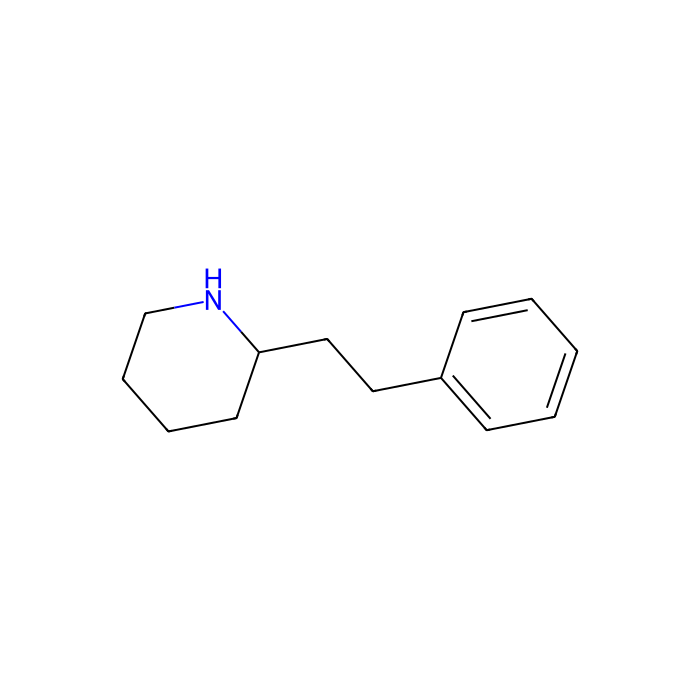
2-(2-Phenylethyl)piperidine , CAS No.159053-39-1

CAS: 159053-39-1 Cat. No.: P167633 Formule: C13H19N Poids moléculaire: 189.3 Numéro CE: 830-742-8 PubChem CID: 5190919
DISPONIBLE À COMMANDE
Synonyms
(R)-2-phenethylpiperidine hydrochloride|2-(2-phenylethyl)piperidine|2-phenethylpiperidine|2-Phenethyl-piperidine|Piperidine, 2-(2-phenylethyl)-|(S)-2-phenethylpiperidine hydrochloride
Storage
Room temperature
Shipped In
Normal
★
Taille
USA
Allemagne (EU)*
Prix
Qté
1g
P167633-1g
Sur commande · 8–12 semaines
551,90$US
Enter a quantity for the sizes you want to add.

Spécifications

Synonymes
(R)-2-phenethylpiperidine hydrochloride | 2-(2-phenylethyl)piperidine | 2-phenethylpiperidine | 2-Phenethyl-piperidine | Piperidine, 2-(2-phenylethyl)- | (S)-2-phenethylpiperidine hydrochloride
Conditions de stockage de stockage
Room temperature
Expédié en
Normal
Noms et identifiants
SMILES
C1CCNC(C1)CCC2=CC=CC=C2
IUPAC Name
2-(2-phenylethyl)piperidine
InChIKey
MOUYVILUKZKNDE-UHFFFAOYSA-N
InChI
1S/C13H19N/c1-2-6-12(7-3-1)9-10-13-8-4-5-11-14-13/h1-3,6-7,13-14H,4-5,8-11H2
Isomères SMILES
C1CCNC(C1)CCC2=CC=CC=C2
PubChem CID
5190919
Poids moléculaire
189.3

Données avancées

Taxonomic Classification

Taxonomy Tree

KingdomOrganic compounds
SuperclassAlkaloids and derivatives
ClasseNot available
SubclassNot available
Intermediate Tree Nodes Not available
Direct ParentAlkaloids and derivatives
Alternative Parents Aralkylamines  Piperidines  Benzene and substituted derivatives  Dialkylamines  Azacyclic compounds  Hydrocarbon derivatives  
Molecular FrameworkAromatic heteromonocyclic compounds
Substituents Alkaloid or derivatives - Aralkylamine - Benzenoid - Piperidine - Monocyclic benzene moiety - Azacycle - Organoheterocyclic compound - Secondary amine - Secondary aliphatic amine - Organic nitrogen compound - Hydrocarbon derivative - Organonitrogen compound - Amine - Aromatic heteromonocyclic compound
DescriptionThis compound belongs to the class of organic compounds known as alkaloids and derivatives. These are naturally occurring chemical compounds that contain mostly basic nitrogen atoms. This group also includes some related compounds with neutral and even weakly acidic properties. Also some synthetic compounds of similar structure are attributed to alkaloids. In addition to carbon, hydrogen and nitrogen, alkaloids may also contain oxygen, sulfur and more rarely other elements such as chlorine, bromine, and phosphorus.
External Descriptors Not available
Structure 3D
Modèle de structure chimique interactif


Certificats (CoA, COO, BSE/TSE et tableau d'analyse)
C of A & Other Certificates(BSE/TSE, COO):
Analytical Chart:
Propriétés chimiques et physiques
Poids moléculaire189.3
XLogP33.000
Hydrogen Bond Donor Count1
Hydrogen Bond Acceptor Count1
Rotatable Bond Count3
Exact Mass189.152 Da
Monoisotopic Mass189.152 Da
Topological Polar Surface Area12.000 Ų
Heavy Atom Count14
Formal Charge0
Complexity149.000
Isotope Atom Count0
Defined Atom Stereocenter Count0
Undefined Atom Stereocenter Count1
Defined Bond Stereocenter Count0
Undefined Bond Stereocenter Count0
The total count of all stereochemical bonds0
Covalently-Bonded Unit Count1
Sécurité et dangers (GHS)
Pictogramme(s)
Signal
Warning
Mentions de danger

H302:Harmful if swallowed

H315:Causes skin irritation

H319:Causes serious eye irritation

H335:May cause respiratory irritation

Conseils de prudence

P261:Avoid breathing dust/fume/gas/mist/vapors/spray.

P264:Wash hands [and …] thoroughly after handling.

P270:Do not eat, drink or smoke when using this product.

P271:Use only outdoors or in a well-ventilated area.

P280:Wear protective gloves/protective clothing/eye protection/face protection.

P321:Specific treatment (see ... on this label).

P330:Rinse mouth.

P302+P352:IF ON SKIN: wash with plenty of water.

P304+P340:IF INHALED: Remove person to fresh air and keep comfortable for breathing.

P305+P351+P338:IF IN EYES: Rinse cautiously with water for several minutes. Remove contact lenses if present and easy to do - continue rinsing.

P362+P364:Take off contaminated clothing and wash it before reuse.

P405:Store locked up.

P403+P233:Store in a well-ventilated place. Keep container tightly closed.

P501:Dispose of contents/container to an approved waste disposal plant.

P264+P265:Wash hands [and …] thoroughly after handling. Do not touch eyes.

P301+P317:IF SWALLOWED: Get medical help.

P337+P317:If eye irritation persists: Get medical help.

P332+P317:If skin irritation occurs: Get medical help.

P319:Get medical help if you feel unwell.

Calculateurs de solution
Avis

Avis des clients

Application Protocols

No application protocols (e.g., WB, IHC, IF, FC) apply to this small-molecule building block. For synthetic procedures, see the Reaction Conditions and Synthetic Utility sections for general laboratory guidance.

Biological Roles

This product is intended for research use as a chemical building block; no biological activity or clinical utility is claimed for the item itself.

  • General background (literature)
    • Piperidine motifs are prevalent in natural products and bioactive small molecules. The 2-substituted piperidine scaffold often contributes to basicity, solubility modulation (via salt formation), and target recognition in medicinal chemistry.
    • The phenethyl side chain can engage in aromatic and hydrophobic interactions in protein binding sites. Modifying the side chain and nitrogen substituents is a common strategy in SAR campaigns.
  • Biochemical behavior (general)
    • As a secondary amine, it can be protonated at physiological pH (pKaH typically ~10–11 for piperidines), forming water-soluble ammonium species; this underpins its frequent use as a cationic motif in probe and ligand design.

Item-specific biological roles, targets, or activities are not specified for this product. Any use in biological experiments should be as a research chemical with appropriate controls and safety measures.

Buffer Applications

2-(2-Phenylethyl)piperidine is not a conventional buffering reagent. While secondary amines can exhibit buffering capacity near the pKa of their conjugate acids (piperidine pKaH ~11, literature), this compound is typically used as a synthetic building block rather than as a buffer component.

  • If a basic environment is desired in a synthetic or analytical protocol, use established buffers (e.g., carbonate/bicarbonate, borate) or amine-based buffers specifically designed for biochemical compatibility (e.g., Tris, HEPES).
Green Alternatives

Although 2-(2-Phenylethyl)piperidine is a target building block rather than a solvent, greener choices can be made in the processes that use it.

  • Greener solvent substitutions (literature guidance)
    • Replace DCM with EtOAc, 2-MeTHF, CPME, or toluene where reaction compatibility permits.
    • Favor 2-MeTHF or CPME over THF/Et2O to reduce peroxide risk and improve safety metrics.
    • Use MeOH/EtOH (bio-derived where possible) for reductive aminations and salt formations.
  • Reagent choices
    • Prefer carbodiimide-free peptide coupling reagents with safer byproducts when feasible, or enzymatic acylations in green media.
    • In reductive amination, NaBH(OAc)3 in MeOH/EtOAc or catalytic hydrogenation with reusable Pd/C under H2 can reduce cyanide waste compared to NaBH3CN.
  • Workup and isolation
    • Form crystalline salts (e.g., HCl) to enable solvent-sparing purification (filtration/recrystallization) instead of silica chromatography.

Comparison snapshot (typical)

  • DCM vs EtOAc: EtOAc is less hazardous and biodegradable; suitable for many acylations though sometimes slower.
  • THF vs 2-MeTHF: similar solvency; 2-MeTHF is partially bio-based, less miscible with water (easier separations), and forms fewer peroxides.
  • MeCN vs MeOH/EtOH: alcohols are greener but can participate in reactions; choose case-by-case.

Note: Validate substitutions on small scale to confirm kinetics/selectivity.

Pharmaceutical Uses

No excipient or pharmacopeial status is specified for this item; it is supplied for research use only.

  • Typical roles in pharmaceutical R&D (general/literature)
    • Intermediate in the synthesis of piperidine-containing candidates or reference standards.
    • Precursor to amides, ureas, carbamates, and quaternary ammonium salts used in structure–activity relationship (SAR) exploration.
    • Formation of crystalline salts (e.g., HCl, mesylate) to tune physicochemical properties for screening or preformulation studies.
  • Formulation considerations
    • As a free base it is a volatile/basic liquid; not typically used directly as an excipient. Derivatives (salts, amides) are more common in formulated contexts.

No therapeutic or clinical claims are made for this product. For GMP or compendial needs, consult appropriate suppliers and pharmacopeial monographs for the specific derivative of interest.

Physical Properties

Item-specific physico-chemical specifications (bp, mp, density, refractive index, etc.) are not provided in the Product Data.

  • Item-specific values

    • Boiling point: Not specified for this item; refer to CoA/Spec Sheet.
    • Melting point: Not applicable/likely liquid; specific value not specified; refer to CoA/Spec Sheet.
    • Density (20–25 C): Not specified for this item; refer to CoA/Spec Sheet.
    • Refractive index: Not specified for this item; refer to CoA/Spec Sheet.
    • Solubility: Not specified for this item; refer to CoA/Spec Sheet.
  • Literature/typical information for related 2-substituted piperidines (for general guidance only)

    • State: typically colorless to pale liquid at ambient temperature.
    • Basicity: conjugate acid pKaH of piperidine ≈ 11.1; 2-arylalkyl substitution generally maintains high basicity (pKaH often ~10.5–11.5, literature).
    • Partitioning: presence of phenethyl increases lipophilicity relative to piperidine; logP commonly in the 2–3 range for analogous scaffolds (literature trends).
    • Solubility behavior: free base is miscible with many organic solvents (Et2O, THF, DCM, toluene, MeOH, EtOH, acetonitrile). As a free base, moderate water solubility; as a hydrochloride salt, high water/alcohol solubility (literature).

Note: For precise, item-specific physical constants and analytical limits, consult the product CoA/Spec Sheet.

Quality and Grades
  • Item-specific grade/purity: Not specified for this item; refer to CoA/Spec Sheet for exact assay, impurity profile, and any stabilizers.
  • What grade means in practice (general guidance)
    • Research-grade amines are typically supplied with assay by GC/GC–MS or NMR and residual solvent/moisture content listed on the CoA. Low non-volatile residue and defined limits for related amine impurities enhance reproducibility in synthesis.
    • Where applicable, “anhydrous” or “dry” grades indicate moisture control suitable for air-/moisture-sensitive reactions; if needed for organometallic chemistry, confirm water content on the CoA.
  • Stabilizers/antioxidants
    • None are specified for this item. If a stabilizer is present for a given lot, it will be declared on the CoA/Spec Sheet.
  • Identity and quality verification (recommended)
    • Typical release tests for this class: GC purity, 1H/13C NMR, water content (Karl Fischer), and appearance. For chiral applications, confirm enantiomeric composition (this product is not stated as chiral/resolved).
  • Practical note
    • Secondary amines can absorb CO2/acidic gases and form salts; keep containers tightly closed to preserve assay and minimize headspace exposure.
Reaction and Applications

Use 2-(2-Phenylethyl)piperidine as a versatile secondary amine scaffold and nucleophile.

  • Typical transformations (general/literature)
    • N-Acylation to amides with acyl chlorides/anhydrides/coupling reagents (EDC/HATU). Secondary amide formation proceeds rapidly in DCM/DMF with base (Et3N, DIPEA).
    • N-Alkylation via SN2 (alkyl halides/mesylates) or via reductive amination with aldehydes/ketones (NaBH(OAc)3, NaBH3CN, or catalytic hydrogenation).
    • Quaternization to ammonium salts using methylating agents (e.g., MeI, MeOTf) where desired.
    • Salt formation for isolation/handling (e.g., HCl, HBr, p-TsOH) to give crystalline salts with enhanced stability and aqueous solubility.
    • Benzylic functionalization: oxidation or halogenation on the phenethyl side chain’s benzylic position for further diversification (literature routes).
  • Strategic applications
    • As a building block in medicinal chemistry for generating piperidine-containing libraries; the 2-phenethyl side chain imparts hydrophobic/aromatic interaction potential.
    • Chiral derivative synthesis: since C-2 is stereogenic, enantioenriched variants can be prepared by chiral resolution or asymmetric synthesis when stereochemical control is required (this listing does not specify enantiomeric composition).
  • Practical notes
    • The free base is strongly basic; control exotherms during acylation/alkylation by cooling and slow addition.
    • For clean N-alkylation, use inorganic bases (K2CO3/Cs2CO3) in polar aprotics to suppress over-alkylation; phase-transfer conditions can also be effective.
    • Convert to a crystalline salt for storage/purification when needed.
Reaction Conditions

General guidance for common transformations of 2-(2-Phenylethyl)piperidine (literature-based; optimize per substrate):

  • N-Acylation
    • Conditions: acyl chloride or anhydride (1.05–1.2 equiv), base (Et3N or DIPEA, 2–3 equiv), solvent DCM or THF, 0–25 C, 0.5–2 h.
    • Workup: aqueous quench, wash, concentrate; purify or crystallize as needed.
  • Reductive amination (N-alkylation)
    • Conditions: carbonyl compound (1.1–1.5 equiv), NaBH(OAc)3 (2–3 equiv) in DCE/MeCN/MeOH with AcOH (0.5–1 equiv), 20–40 C, 2–16 h. Alternatively, NaBH3CN in MeOH with careful pH control (pH ~5–6) or H2 (1–5 bar) with Pd/C in EtOH.
  • Sulfonylation (tosylation/mesylation)
    • Conditions: sulfonyl chloride (1.1–1.5 equiv), base (Et3N, 2–3 equiv), DCM, 0–25 C.
  • Boc protection
    • Conditions: Boc2O (1.1–1.5 equiv), base (Na2CO3/Et3N), THF/MeOH/H2O mixed solvent, 0–25 C.
  • Quaternization
    • Conditions: MeI or alkyl triflate (1.5–2.0 equiv) in MeCN/acetone, 0–25 C to reflux; isolate as crystalline ammonium salts.
  • Benzylic functionalization (side chain)
    • Conditions: radical bromination (NBS, AIBN, reflux in CCl4 or greener alternatives like PhH/AcCN with photochemical initiation); or photoredox C–H functionalization using Ir/Ru catalysts (blue light) under oxygen or with radical traps.

Notes

  • Use dry solvents when moisture-sensitive reagents are present.
  • Control exotherms by slow addition and cooling when reacting with acylating/alkylating agents.
  • Monitor by TLC/LC–MS/GC; amine products often visualized by ninhydrin or anisaldehyde stains on TLC.
Safety and Handling
  • GHS information (item-specific): Not specified in Product Data; consult the SDS for authoritative classification, pictograms, hazard (H) and precautionary (P) statements.
  • Expected hazards for secondary amines (general/literature)
    • May cause skin and eye irritation; can be harmful if swallowed or inhaled.
    • Amines are often corrosive to certain plastics/coatings; may have strong amine odor.
  • Special risks and incompatibilities
    • Avoid strong oxidizers (risk of exotherm/oxidation) and acylating/alkylating agents unless intended for reaction.
    • Forms salts with strong acids; avoid contact with acid chlorides/anhydrides without appropriate controls.
    • Secondary amines can form nitrosamines in the presence of nitrosating agents; strictly avoid nitrite under acidic conditions.
  • PPE and engineering controls
    • Use in a fume hood. Wear safety glasses, lab coat, and suitable chemical-resistant gloves (e.g., nitrile). Consider splash protection when handling larger quantities.
  • First aid measures (general)
    • Inhalation: move to fresh air; seek medical attention if symptoms persist.
    • Skin contact: wash with soap and water; remove contaminated clothing.
    • Eye contact: rinse cautiously with water for several minutes; seek medical attention.
    • Ingestion: rinse mouth; do not induce vomiting; seek medical attention.
  • Fire safety
    • Many amine liquids are combustible. Use CO2, dry chemical, or foam. Avoid water jet streams on pools of liquid.

Always defer to the Aladdin SDS for this specific item.

Solvent Selection

This product is a building-block amine, not a solvent. Solvent selection considerations below pertain to using 2-(2-Phenylethyl)piperidine in reactions or purifications.

  • Polarity and miscibility (general)
    • As a lipophilic secondary amine, it dissolves readily in common organic media: DCM, chloroform, toluene, EtOAc, ethers (THF, MTBE), and polar aprotics (MeCN, DMF, DMSO). Alcohols (MeOH/EtOH/i-PrOH) also dissolve it well.
    • Aqueous solubility of the free base is moderate; protonated salts (e.g., HCl) are highly water-soluble.
  • Choosing solvents by task
    • Acylation/alkylation: DCM, THF, MeCN, or toluene are typical; add a non-nucleophilic base if needed.
    • Salt formation/purification: generate the HCl salt in Et2O/MTBE to induce crystallization; recrystallize from EtOH/EtOAc as needed (general practice).
    • Reductive amination/N-alkylation: MeOH, EtOH, or THF with NaBH(OAc)3, NaBH3CN, or H2/Pd depending on substrate (literature).
  • Comparison (general)
    • DCM: excellent for acylations; easy workup; nonpolar, volatile.
    • THF/2-MeTHF: good solvency and compatibility with hydrides; greener alternative: 2-MeTHF.
    • MeCN: polar aprotic, facilitates many SN1/SN2 processes; easy removal.
    • Alcohols: useful in reductive aminations and salt formations but can compete in acylations.
Storage and Reconstitution
  • Item-specific storage
    • Storage Conditions: Room temperature (as provided). Keep tightly closed in a dry, well-ventilated place.
    • Shipped In: Normal (as provided).
  • Handling and stability (general)
    • Protect from strong acids/oxidants. Minimize exposure to air/CO2 to prevent salt formation and to moisture to maintain assay.
    • If long-term storage is needed or if free base is inconvenient (odor/volatility), convert a portion to a crystalline acid salt (e.g., HCl salt) for stability and ease of handling; reconvert to free base as required.
  • Reconstitution
    • Not applicable as this is supplied neat (no reconstitution required). For making stock solutions, prepare in dry organic solvents (e.g., DCM, THF, MeOH, MeCN) at desired concentrations; store solutions in airtight containers, preferably under inert gas, at appropriate temperatures.
  • Shelf-life
    • Not specified for this item; refer to CoA/Spec Sheet. Periodically verify purity by GC/NMR if stored for extended periods.

Research Use Only: For research use only; not for human or veterinary use.

Structure and Identity

Brief description: 2-(2-Phenylethyl)piperidine is a secondary cyclic amine (piperidine) bearing a phenethyl substituent at the 2-position of the ring, creating a stereogenic center at C-2 (racemic unless otherwise specified).

  • Item-specific identifiers (from Product Data)
    • CAS: 159053-39-1
    • PubChem CID: 5190919
    • InChIKey: 224696 (as provided)
    • SKU: P167633
  • Molecular formula and mass
    • Molecular formula: C13H19N (computed from structure; literature/derived)
    • Molecular weight: ~189.30 g/mol (computed; literature/derived)
  • SMILES: Not specified for this item; refer to CoA/Spec Sheet.
  • Structural features (general/literature)
    • Core: saturated six-membered piperidine ring containing one secondary amine nitrogen.
    • Substituent: phenethyl group (–CH2–CH2–C6H5) at the 2-position of the ring carbon α to nitrogen.
    • Stereochemistry: the 2-substitution generates one stereocenter at C-2; material is typically supplied as racemate unless specifically stated otherwise (not specified for this item).
    • Functional groups: basic secondary amine (protonatable), benzylic methylenes amenable to oxidation/functionalization.
  • 2D description in words
    • A chair-like piperidine with the ring nitrogen and an adjacent ring carbon (C-2). The C-2 carbon bears a –CH2–CH2–phenyl chain extending from the ring; the nitrogen is secondary (–NH–) within the ring. The aromatic ring is a monosubstituted benzene at the terminus of a two-carbon linker.
Synthetic Utility

Key reactivity derives from the secondary amine and the benzylic positions of the phenethyl substituent.

  • Functional group chemistry
    • Nucleophilicity/basicity at nitrogen enables acylation, sulfonylation, carbamoylation, and alkylation to furnish diverse derivatives.
    • Quaternization provides onium salts useful for phase-transfer or as intermediates.
    • Benzylic activation: oxidation to ketones/alcohols, halogenation, or radical functionalization (e.g., NBS or photoredox-mediated reactions) at the side chain.
  • Retrosynthetic value
    • Serves as a convergent node: the piperidine ring (from lactam/hydrogenation routes or cyclizations) and the phenethyl fragment can be diversified independently. Downstream, the amine allows rapid analogue synthesis via modular N-substitution.
  • Named/representative transformations (literature)
    • Reductive amination with aldehydes/ketones to N-alkyl derivatives.
    • Amide formation via HATU/EDC coupling for library generation.
    • Buchwald–Hartwig amination is typically for aryl C–N formation; here, pre-formed aryl halides can be coupled after converting the amine to a suitable partner (e.g., through amide/urea linkers).
    • Formation of carbamates (e.g., Boc, Cbz) for protection/derivatization.
  • Protecting group strategy
    • Boc protection (Boc2O, base) to mask the amine for downstream C–C or C–X chemistry, then deprotect under acid.
  • Stereochemistry
    • The 2-position chiral center enables enantioselective derivatization; absent enantiomeric specification, treat as racemic.
Target Specificity

Not applicable. This product is a small-molecule amine building block, not a biological macromolecule or antibody. No target, epitope, clone, or isotype information applies.

Foire aux questions

How should this product be stored?
Store at room temperature.
How is this product shipped?
This product ships under standard ambient conditions. No temperature-controlled packaging is required.
What are the CAS number, molecular formula and molecular weight?
The CAS Number is 159053-39-1, the molecular formula is C13H19N, and the molecular weight is 189.3 g/mol. InChIKey MOUYVILUKZKNDE-UHFFFAOYSA-N.
What documentation is provided?
Available product documentation, including Certificates of Analysis (COA), Safety Data Sheets (SDS), and specification sheets, is shown in the product document area. Document availability and access follow the current site policy.

Souhaitez-vous que nous vous envoyions un message lorsque des réductions seront disponibles?

Me rappeler plus tard

Merci ! Veuillez vérifier votre boîte de réception e-mail pour confirmer.

Oups ! Les notifications sont désactivées.