This compound belongs to the class of organic compounds known as nitronaphthalenes. These are polycyclic aromatic compounds containing a naphthalene moiety substituted by one or more nitro groups.
External Descriptors
C-nitro compound - naphthols
1. Djoumbou Feunang Y, Eisner R, Knox C, Chepelev L, Hastings J, Owen G, Fahy E, Steinbeck C, Subramanian S, Bolton E, Greiner R, and Wishart DS. ClassyFire: Automated Chemical Classification With A Comprehensive, Computable Taxonomy. Journal of Cheminformatics, 2016, 8:61.
Determine the necessary mass, volume, or concentration for preparing a solution.
Dilution Calculator
Determine the dilution needed to prepare a stock solution.
Reconstitution Calculator
Avis
Avis des clients
Application Protocols
No vendor-tested biological assay protocols apply to this small-molecule reagent.
Practical laboratory guidance (general)
Preparation of stock solutions: Dissolve in DMSO, DMF, ethanol, or acetone to convenient concentrations (e.g., 10–100 mM); for aqueous use, dissolve in minimal base (e.g., 0.1–1.0 M NaOH) and dilute with water/buffer as needed.
UV–Vis studies: Record spectra of the neutral and basic forms to monitor deprotonation; use quartz cuvettes and control solvent composition.
Reaction setup: For O-alkylation or reductions, use anhydrous conditions as appropriate and inert atmosphere when using air-sensitive bases/reagents.
For any application-specific SOPs, develop and validate internally or consult the literature.
Biological Roles
This product is a synthetic aromatic nitrophenol and is not known to be a natural metabolite or biomolecule.
General context (literature)
Phenolic nitroaromatics do not have established physiological roles; they can interact with proteins and membranes due to hydrophobic aromatic cores and hydrogen-bonding capacity, but such interactions are non-specific.
Nitroaromatics may undergo bioreductive metabolism in microorganisms or under hypoxic conditions, forming hydroxylamines/anilines; these pathways are of environmental chemistry interest rather than intrinsic biological function.
Research use
Occasionally employed as a chromophore/acidic probe to study solvent effects and deprotonation equilibria (phenol vs phenolate UV–Vis shifts), but this is a physical-organic use, not a biological role.
No clinical or diagnostic claims are made for this product. Use is restricted to research and laboratory applications.
Buffer Applications
2,4-Dinitro-1-naphthol is not a buffering agent and is not typically used to prepare biological or analytical buffers.
Practical note
Its phenolic pKa (literature: lowered by nitro substitution) enables acid–base color/absorbance shifts in mixed solvent systems, which may be useful for titration endpoints or spectroscopic pKa determinations, but it does not constitute a standard buffer system.
For pH control, select conventional buffers (e.g., phosphate, acetate, Tris, HEPES) appropriate to your application.
Green Alternatives
While 2,4-dinitro-1-naphthol itself is the target substrate, greener decisions can be made around solvents and reagents used with it.
Solvent choices (general guidance)
Prefer bio-based or lower-toxicity solvents where feasible: ethanol, isopropanol, 2-methyltetrahydrofuran (2-MeTHF), cyclopentyl methyl ether (CPME), ethyl acetate.
Minimize or avoid high-boiling dipolar aprotics (DMF, NMP, DMSO) when alternatives provide acceptable rates/selectivity, due to worker exposure and EHS profiles.
Example comparisons
Greener option | Conventional | Tradeoffs
Ethanol | Acetonitrile/DMF | Lower toxicity/biogenic; protic may alter selectivity or rates.
2-MeTHF/CPME | THF/dioxane | Better safety/air stability; different polarity; may change solubility.
Water/aqueous base | DMSO | Excellent EHS; requires managing precipitation and phase behavior.
Reagent considerations
Reductions: Catalytic hydrogenation with recyclable Pd/C or Raney Ni in alcohols can replace stoichiometric tin/iron salts, reducing metal salt waste.
Alkylations: Use carbonate bases and greener solvents (acetone, ethanol) when compatible, and avoid halogenated electrophiles if an alternative leaving group (mesylates/tosylates) suffices.
Process intensification
Employ flow hydrogenation for safer handling of reductions and improved heat/mass transfer.
Optimize crystallization to minimize chromatography and solvent usage.
Note: Validate greener swaps at small scale to confirm purity, yield, and selectivity are maintained.
Pharmaceutical Uses
No pharmacopeial or excipient role is indicated for this compound.
Context
Aromatic nitrophenols are generally not used as pharmaceutical excipients due to toxicity and irritancy concerns.
If used at all in a pharmaceutical R&D context, it would be as a synthetic intermediate or analytical reference in process chemistry—not for formulation.
This product is supplied strictly for research use only and is not intended for human or veterinary use.
Physical Properties
Only item-specific values provided in Product Data are listed as such; additional values below are literature ranges for reference.
Item-specific (from Product Data)
Appearance: Not specified for this item; refer to CoA/Spec Sheet.
Physical state/color: typically yellow to orange crystalline solid (literature descriptions of nitro-naphthols).
Melting point: commonly reported in the ~180–200 °C range, often with decomposition; consult primary literature/CoA for the exact value for this lot.
Boiling point: not practical; aromatic nitrophenols generally decompose before boiling at 1 atm.
Density: not widely tabulated; expect >1 g/cm3 for nitroaromatics; verify experimentally if needed.
Solubility: sparingly soluble in water; soluble in polar organic solvents (ethanol, acetone, acetonitrile, DMF, DMSO). Readily soluble in aqueous base (phenolate formation).
pKa (phenolic OH, literature): typically in the acidic phenol range but lowered by two nitro groups; expect pKa roughly 5–7 for dinitro naphthols; confirm experimentally for precise value.
LogP/logD: elevated hydrophobicity due to naphthalene core, partially offset by phenol; consult predictive tools for exact values.
UV-Vis: strong absorption in the near-UV with bathochromic shift upon deprotonation to phenolate (indicator-like behavior in basic media).
Note: For specification-grade values (e.g., exact MP, purity, water, metals, UV cutoff), see CoA/Spec Sheet.
Quality and Grades
Item-specific (from Product Data)
Grade/Purity: Not specified for this item; refer to CoA/Spec Sheet.
Interpreting grades for this class of material (general guidance)
Research-grade nitroaromatics are often offered as technical, laboratory, or >95–98% purity. The choice affects background coloration, spectroscopic baselines, and reactivity (e.g., trace acids/bases can influence O-alkylation vs C-alkylation).
If HPLC or spectroscopy-grade is provided for similar compounds, it typically implies tight control of UV-absorbing impurities and low non-volatile residue, beneficial for analytical calibration or photophysical studies.
Stabilizers: Not typically required for nitrophenols; however, dryness and light exposure can affect assay reproducibility. If a stabilizer or inhibitor were present, it would be declared on the CoA.
What to check on receipt (practical tips)
Confirm appearance and any declared assay by appropriate techniques (qNMR, HPLC, or melting behavior).
Verify water content if moisture-sensitive applications are planned (Karl Fischer). Phenolic OH and hydrogen bonding can retain moisture; drying under vacuum at ambient to mild temperature is commonly effective.
For spectroscopic work, record UV–Vis in neutral and basic conditions to assess purity and expected bathochromic shift to the phenolate.
Always defer to the CoA/Spec Sheet for lot-specific specifications and acceptance criteria.
Reaction and Applications
This electron-deficient naphthol participates in a range of synthetic transformations leveraging its phenolic acidity and nitro substituents.
Phenolate chemistry (general)
O-alkylation/acylation: Deprotonation (e.g., K2CO3, NaH, Cs2CO3) affords the phenolate, which undergoes SN2 with alkyl halides or acyl transfer to give aryl ethers and esters. Nitro groups reduce the electron density, often favoring O- over C-alkylation under basic, polar aprotic conditions.
Salt formation: Alkali metal phenolates increase solubility in polar solvents and can serve as nucleophiles or ligands in metal-mediated processes.
Nitro group transformations
Reductive conversions: Each nitro can be chemoselectively reduced to anilines (e.g., catalytic hydrogenation, Fe/HCl, SnCl2, or transfer hydrogenation systems), enabling access to 2- and/or 4-aminonaphthol derivatives—useful dye and ligand precursors.
Nucleophilic aromatic substitution (SNAr): The strongly deactivated ring may undergo SNAr at activated positions if additional leaving groups are present; the nitro groups enhance susceptibility.
Meisenheimer complexes: Transient sigma complexes may form with strong nucleophiles; spectroscopically tractable in some systems.
Electrophilic substitution
The two nitro groups markedly reduce electrophilic aromatic substitution on the naphthalene core; harsh conditions are generally required and regioselectivity is altered relative to 1-naphthol.
Applications (general examples)
Intermediate toward azo dyes and pigments after reduction to amines and subsequent diazotization/coupling (via downstream derivatives).
Model compound for studying proton-coupled electron transfer and solvatochromism (phenol ↔ phenolate UV–Vis changes).
Ensure appropriate control of exotherm and gas evolution during reductions; scale cautiously.
Reaction Conditions
General literature guidance for typical transformations; optimize for your substrate and scale.
O-alkylation (ether formation)
Typical: 2,4-dinitro-1-naphthol (1.0 equiv), K2CO3 (2–3 equiv), alkyl bromide/iodide (1.2–1.5 equiv) in acetone or acetonitrile, 20–60 °C, 2–16 h. Oxygen-selectivity is favored by polar aprotic solvents and milder bases. Alternative bases: Cs2CO3, NaH (0–25 °C, THF/DMF; stricter anhydrous control).
O-acylation (ester formation)
Acid chloride/anhydride (1.1–1.5 equiv), base (pyridine or triethylamine), solvent (DCM, toluene, or acetonitrile), 0 °C to rt, 1–4 h. Carbonyldiimidazole (CDI) in acetonitrile/DMF offers a milder, halide-free option.
Nitro reduction to anilines
Catalytic hydrogenation: Pd/C (5–10 wt%), H2 (1–5 bar), EtOH/EtOAc, rt–50 °C, 2–8 h; monitor to avoid overreduction. Sequential reduction may be possible by kinetic control or protecting the other nitro.
Metal/acid: Fe or SnCl2 in EtOH/HCl or AcOH/H2O at 50–80 °C; 1–6 h; generates inorganic waste—consider greener alternatives.
Transfer hydrogenation: ammonium formate with Pd/C in MeOH/EtOH, reflux, 1–4 h.
Silylation (protection)
TBDMSCl (1.2–1.5 equiv), imidazole, DMF, rt, 2–6 h. Desilylation with TBAF (THF) at rt.
Crystallization and isolation
Recrystallize from ethanol or ethanol/water; avoid high-temperature drying to prevent decomposition. For bases/phenolates, neutralize carefully before isolation.
Note: Yields and selectivities depend on substrate and conditions; perform small-scale screens and monitor by TLC/HPLC.
Safety and Handling
Always consult the SDS for authoritative, up-to-date safety information. Product-specific GHS entries were not provided.
Item-specific (from Product Data)
GHS classification, signal word, pictograms, H-statements: Not specified for this item; refer to SDS.
Storage: Room temperature.
General hazards and precautions for nitroaromatic phenols (literature/general guidance)
Hazards: Nitroaromatics and phenols can be harmful if swallowed, inhaled, or in contact with skin; may cause irritation to skin, eyes, and respiratory tract. Some nitroaromatics have methemoglobinemia potential upon significant exposure. Avoid dust formation and inhalation.
PPE: Use lab coat, safety glasses/goggles, and appropriate chemical-resistant gloves (e.g., nitrile). Employ local exhaust/chemical fume hood during handling and weighing.
Incompatibilities: Strong bases will form phenolates (manage heat and solubility). Strong reducing agents (e.g., metals in acid, hydrides) can reduce nitro groups; control conditions. Strong oxidizers may present additional risk. Avoid contact with acylating/alkylating reagents unless intended.
Thermal stability: Aromatic nitro compounds may decompose exothermically upon strong heating; avoid unnecessary thermal stress and sources of ignition. Do not distill under reduced pressure; handle as a solid.
First aid (overview): If inhaled—move to fresh air; seek medical attention if symptoms occur. Skin—wash with soap and water. Eyes—rinse cautiously with water for several minutes; remove contact lenses if present and easy to do; seek medical attention if irritation persists. Ingestion—rinse mouth; do not induce vomiting; get medical attention.
Waste: Collect as hazardous organic waste (halogen-free nitroaromatic solid). Follow institutional and local regulations.
Solvent Selection
As a non-volatile, aromatic nitrophenol solid, 2,4-dinitro-1-naphthol is used dissolved in suitable organic solvents or in aqueous base.
Sparingly soluble in water at neutral pH; readily soluble in aqueous basic media via deprotonation (phenolate). Limited solubility in nonpolar solvents (hexanes, toluene) unless warmed or with cosolvents.
Choosing the medium
Spectroscopy/indicator studies: ethanol/water or methanol/water mixtures allow pH titrations and observation of phenol/phenolate spectra.
O-alkylation/acylation: polar aprotic solvents (acetone, acetonitrile, DMF) with a base (e.g., K2CO3, Cs2CO3) favor substitution. Avoid water if base-sensitive electrophiles are used.
Reductions of nitro groups: alcoholic solvents (EtOH, iPrOH) or protic/aprotic choices depending on catalyst/system; consider green alternatives like ethanol or 2-MeTHF where compatible.
Crystallization/purification: ethanol or isopropanol can be effective; anti-solvents (water) help precipitate the neutral phenol.
Quick comparison (general)
DMSO/DMF: highest solvating power; harder to remove; consider for challenging dissolutions.
Acetone/MeCN: good balance of polarity and volatility; useful in SN2 O-alkylations.
Alcohols (MeOH/EtOH): greener, protic; suitable for recrystallization and some catalytic reductions.
Always test small-scale solubility and maintain temperature control to avoid decomposition.
Storage and Reconstitution
Item-specific (from Product Data)
Storage conditions: Room temperature.
General storage guidance
Keep tightly closed in a dry, well-ventilated place, away from strong heat sources. Store in the original container or in amber glass to limit light exposure, as nitroaromatics can be light-sensitive over long periods.
Protect from moisture; the phenolic OH and nitro groups can promote hydrogen bonding with adsorbed water, affecting mass and assay. Desiccation (P2O5/silica gel) is beneficial.
Reconstitution and solution handling
Organic stocks: Prepare concentrated solutions in DMSO, DMF, acetone, ethanol, or acetonitrile. Filter if particulates are present. Label with solvent and concentration.
Aqueous/basic stocks: Dissolve in minimal NaOH or K2CO3 to form the phenolate; dilute with water or buffer. Adjust pH cautiously when neutralizing to avoid precipitation shocks.
Stability: Solutions in polar aprotic solvents are generally stable for days to weeks at 2–8 °C protected from light; aqueous basic solutions may slowly oxidize or discolor—prepare fresh when critical. Avoid prolonged exposure to elevated temperatures.
Freeze/thaw
For organic solutions, minimize freeze–thaw cycles; aliquot if repeated use is expected. For DMSO stocks, store at −20 °C in tightly sealed vials to limit water uptake.
Always consult the CoA/SDS for any lot-specific storage or stability notes.
Structure and Identity
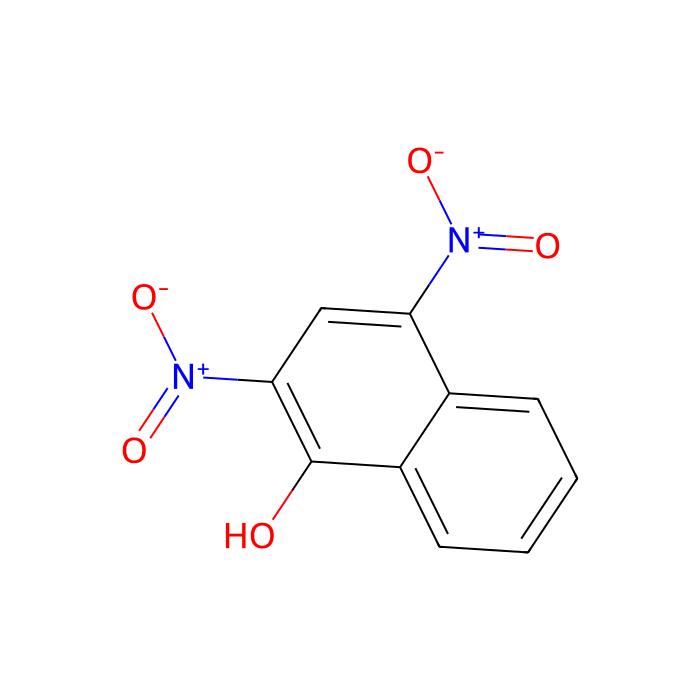
Brief overview: 2,4-Dinitro-1-naphthol is a nitro-substituted naphthol bearing two strongly electron-withdrawing nitro groups on the naphthalene core.
Item-specific (from Product Data)
SKU: D155719
CAS: 605-69-6
PubChem CID: 11802
InChIKey: 81579 (as provided; verify on CoA/SDS)
Storage: Room temperature
Shipping: FedEx DG Service
Research use note: For research use only
Literature/computed identifiers (for reference; not item specifications)
Molecular formula (literature): C10H6N2O5
Molecular weight (literature): ~234.16 g/mol
Preferred IUPAC name (literature): 2,4-dinitronaphthalen-1-ol
InChIKey (literature): commonly reported for this structure; consult primary databases (PubChem CID 11802)
Structural features (general description)
Core: bicyclic aromatic naphthalene system with a phenolic OH at C1 (naphthol).
Substituents: nitro groups at the 2- and 4-positions (adjacent and para to the OH on ring A).
Functional groups: phenol (acidic), two nitro groups (strong –I/–M, deactivating and meta-directing relative to OH).
2D topology: planar polyaromatic ring system; intramolecular H-bonding between the phenolic OH and an ortho nitro oxygen is possible, influencing acidity and spectroscopic behavior.
No stereocenters; no formal charge in the neutral solid (phenol), though phenolate forms in base.
Synthetic Utility
Key reactivity arises from the juxtaposition of a moderately acidic phenolic OH and two strongly deactivating nitro groups on a naphthalene scaffold.
Functional group handles
Phenolic OH: readily deprotonated to give phenolate; participates in O-alkylation, O-acylation, carbonate/carbamate formation, silylation (TBDMS/TMS) for protection.
Nitro groups: convertible to amines (stepwise chemoselective reductions), hydroxylamines, or can be replaced in certain SNAr manifolds if an additional leaving group is present.
Strategic roles
Divergent synthesis: Sequential, chemoselective reduction of one nitro group affords amino-nitro-naphthols, enabling subsequent diazotization/azo coupling or amidation.
Tuning electronics: The dinitro pattern dramatically reduces ring nucleophilicity, steering alkylation toward oxygen and enabling studies of intramolecular H-bonding effects.
Building block for dye/pigment chemistry: Via downstream amination and azo coupling (through derivatives), provides access to intensely colored materials.
Protecting group logic
Temporary masking of the phenol as a silyl ether or carbonate can allow transformations on the aromatic core or nitro groups without competitive O-reactivity.
Purification/characterization tips
Strong chromophore facilitates TLC/UV detection. Phenolate/phenol interconversion can shift Rf; standardize silica activity and mobile phase pH. For NMR, use dry DMSO-d6 or acetone-d6; phenolic OH may be broad and exchangeable.
Target Specificity
Not applicable. This product is a small-molecule chemical reagent, not a biological macromolecule or affinity reagent. There is no antigen/epitope or species specificity associated with it.
Foire aux questions
What is the purity of this product?
This product is supplied at ≥98% purity (chemical assay). Lot-specific values are stated on the Certificate of Analysis.
How should this product be stored?
Store at room temperature.
How is this product shipped?
This product is classified as dangerous goods and ships via FedEx DG Service. Ground and other economy services are not available, and delivery to some destinations or address types may be restricted.
What are the CAS number, molecular formula and molecular weight?
The CAS Number is 605-69-6, the molecular formula is C10H6N2O5, and the molecular weight is 234.17 g/mol. InChIKey FFRBMBIXVSCUFS-UHFFFAOYSA-N.
What documentation is provided?
Available product documentation, including Certificates of Analysis (COA), Safety Data Sheets (SDS), and specification sheets, is shown in the product document area. Document availability and access follow the current site policy.
Nous utilisons des cookies pour garantir le bon fonctionnement du site et, lorsque cela est autorisé, pour améliorer votre expérience. Vous pouvez gérer vos préférences à tout moment dans les Paramètres. Pour en savoir plus, consultez notre Politique relative aux cookies.
Souhaitez-vous que nous vous envoyions un message lorsque des réductions seront disponibles?
Me rappeler plus tard
Merci ! Veuillez vérifier votre boîte de réception e-mail pour confirmer.
Products are supplied to verified businesses, institutions, and qualified professionals for research and development use only. Not for use in humans, animals, diagnosis, or therapy.

 F2503315