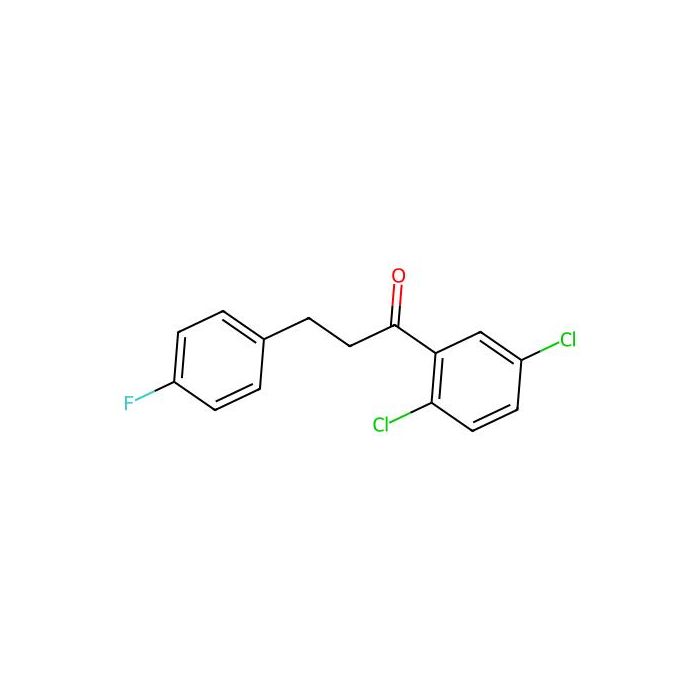
This compound belongs to the class of organic compounds known as retro-dihydrochalcones. These are a form of normal dihydrochalcones that are structurally distinguished by the lack of oxygen functionalities at the C2'- and C6'-positions.
External Descriptors
Not available
1. Djoumbou Feunang Y, Eisner R, Knox C, Chepelev L, Hastings J, Owen G, Fahy E, Steinbeck C, Subramanian S, Bolton E, Greiner R, and Wishart DS. ClassyFire: Automated Chemical Classification With A Comprehensive, Computable Taxonomy. Journal of Cheminformatics, 2016, 8:61.
Certificats (CoA, COO, BSE/TSE et tableau d'analyse)
C of A & Other Certificates(BSE/TSE, COO):
Analytical Chart:
Propriétés chimiques et physiques
Poids moléculaire
297.100 g/mol
XLogP3
4.900
Hydrogen Bond Donor Count
0
Hydrogen Bond Acceptor Count
2
Rotatable Bond Count
4
Exact Mass
296.017 Da
Monoisotopic Mass
296.017 Da
Topological Polar Surface Area
17.100 Ų
Heavy Atom Count
19
Formal Charge
0
Complexity
303.000
Isotope Atom Count
0
Defined Atom Stereocenter Count
0
Undefined Atom Stereocenter Count
0
Defined Bond Stereocenter Count
0
Undefined Bond Stereocenter Count
0
The total count of all stereochemical bonds
0
Covalently-Bonded Unit Count
1
Calculateurs de solution
Molarity Calculator
Determine the necessary mass, volume, or concentration for preparing a solution.
Dilution Calculator
Determine the dilution needed to prepare a stock solution.
Reconstitution Calculator
Avis
Avis des clients
Application Protocols
Not applicable to assay workflows such as WB, IHC, IF, or FC. For synthetic use:
Dissolve the compound in a suitable anhydrous organic solvent (e.g., DCM, THF, toluene, EtOAc) under inert atmosphere if required.
Follow representative conditions in the Reaction Conditions tab, then tailor to your transformation and substrate scope.
No validated bioassay protocols are provided for this item.
Biological Roles
This product is a synthetic, halogenated aryl ketone intended for chemical research. It has no established endogenous biological role.
Function in biology: None known; not a metabolite or cofactor (literature/general).
Use in life-science research: Serves as a small-molecule building block to assemble probe molecules, affinity tags, or halogenated scaffolds for SAR exploration. Any biological evaluation would be project-specific and outside the scope of this listing.
Note: No medical or clinical claims are made. For research use only.
Buffer Applications
Not typically applicable. 2',5'-Dichloro-3-(4-fluorophenyl)propiophenone is a hydrophobic organic building block, not a buffering agent.
If dissolution into aqueous media is required for assays, consider co-solvents (DMSO, EtOH) followed by dilution into buffered systems, keeping final organic content compatible with the biology (general guidance).
Green Alternatives
While the molecule itself is a halogenated aromatic (inherently persistent), greener choices can be made in the way it is used.
Greener process choices (literature/general):
Solvent selection: Prefer ethyl acetate, 2‑MeTHF, CPME, or toluene over chlorinated solvents when reaction compatibility allows. For extractions, EtOAc can often replace DCM.
Catalysis: Employ ligand-enabled Pd/Ni catalysis to operate at lower temperatures and lower catalyst loadings; consider heterogeneous Pd/C under flow to simplify metal removal.
Bases: Replace strong inorganic bases in polar aprotic solvents with milder or carbonate bases in greener media when feasible (e.g., K2CO3 in 2‑MeTHF for Suzuki couplings).
Energy efficiency: Microwave or flow chemistry can reduce reaction times and energy use.
Tradeoffs (balanced view):
Greener solvents may reduce substrate solubility, requiring higher temperature or longer times.
Replacing DCM with EtOAc can change phase behavior and extraction efficiency.
Small comparison (general):
DCM (hazardous, high volatility) vs EtOAc (biobased option, lower toxicity) for workup.
DMF/DMAc (effective polar aprotics, reproductive hazards) vs 2‑MeTHF/CPME (better EHS profile, sometimes lower coupling rates).
Pharmaceutical Uses
This material is not an excipient and has no pharmacopeial monograph specified here. It may serve as a research intermediate in medicinal chemistry or process-development campaigns.
Role: Synthetic intermediate for discovery-scale preparation of halogenated aryl derivatives (SAR libraries), prodrug motifs, or linker-bearing analogs (research use only).
Formulation note: When used in preclinical research as a reference material or intermediate, solubilization often relies on DMSO or PEG-containing vehicles; however, this product is not supplied for clinical or human use.
Physical Properties
Item-specific numerical specifications are not provided in the product data; consult the CoA/Spec Sheet for authoritative values.
Appearance: Not specified for this item; refer to CoA/Spec Sheet. (Aryl ketones of this class are commonly crystalline solids; literature generalization.)
Melting point / Boiling point: Not specified for this item; refer to CoA/Spec Sheet. (Literature values for related halogenated propiophenones vary widely with substitution.)
Density, refractive index: Not specified for this item; refer to CoA/Spec Sheet.
Good solubility in common organic solvents such as dichloromethane, chloroform, ethyl acetate, THF, acetone, toluene, and acetonitrile (literature/general for aryl ketones).
Poor solubility in water (literature/general for hydrophobic aryl ketones).
Acidity/basicity: Neutral ketone; no ionizable groups in neutral water (literature/general). Alpha‑C–H of the propionyl chain is mildly acidic and can be deprotonated with strong base (e.g., LDA) to form enolates (literature/general).
Important: Do not treat any literature/generalized property as a product specification. For method development or regulatory filings, rely on lot-specific CoA.
Quality and Grades
Grade/Purity: Not specified for this item; refer to CoA/Spec Sheet for assay, impurity profile, and residual solvent data.
What to expect on the CoA:
Identity confirmation by NMR/IR/MS and/or HPLC chromatographic purity.
Assay on anhydrous basis and limit tests for key process impurities (typical for research-grade fine chemicals; exact limits not specified for this item).
Implications for use:
For synthesis and method development, verify purity and impurity classes (e.g., regioisomeric impurities, halogenated byproducts) that could impact downstream coupling or enolate chemistry.
If using in photochemical or catalytic reactions, low UV-absorbing impurities and low halide salts are beneficial—confirm via CoA.
Stabilizers/inhibitors: Not specified for this item; refer to CoA/Spec Sheet.
Regulatory note: Research use only; not intended for human or veterinary use. This product is not supplied with pharmacopeial certification unless explicitly stated on the CoA.
Reaction and Applications
As a multi-halogenated aryl ketone, 2',5'-dichloro-3-(4-fluorophenyl)propiophenone is a versatile intermediate for preparing more complex scaffolds.
Key application families (literature/general):
Cross-coupling on aryl chlorides (Ar–Cl):
Suzuki–Miyaura, Buchwald–Hartwig, and Negishi couplings after activation with Pd(0)/Ni catalysts and tailored ligands (e.g., BrettPhos, XPhos). Differential reactivity of Ar–Cl vs Ar–F enables chemoselective functionalization.
Electrophilic aromatic substitution (EAS): The carbonyl exerts a meta-directing effect on the benzoyl ring; halogens direct ortho/para on their ring (planning point for nitration/sulfonation, if pursued).
Alpha‑position transformations:
Enolate chemistry (acylation, alkylation, aldol, Michael additions) from the CH2 of the propionyl chain.
Halogenation (e.g., alpha-bromination) to access benzylic halides for further substitution.
Carbonyl derivatization: Oxime/hydrazone formation, reductive amination, or Wolff–Kishner/Clemmensen reductions to hydrocarbons; NaBH4/LiAlH4 reductions to secondary alcohols; Baeyer–Villiger oxidation to aryl ethyl esters.
Photoredox and radical methods: Halogen substituents can engage in radical pathways; the ketone can serve as a chromophore/acceptor under visible-light catalysis (literature/advanced methods).
Practical tips:
Use rigorously anhydrous conditions for enolate or metal-catalyzed couplings; dry glassware, molecular sieves when appropriate.
Leverage the lower reactivity of Ar–F to achieve stepwise diversification: first elaborate Ar–Cl, then consider C–F activation with specialized catalysts if needed.
Reaction Conditions
General, literature-based conditions for representative transformations. Optimize for your substrate and scale.
Suzuki–Miyaura (Ar–Cl):
Catalyst: Pd2(dba)3 (1–2 mol%) with XPhos or SPhos (2–4 mol%).
Base: K3PO4 or K2CO3 (2–3 equiv).
Solvent: 2‑MeTHF, toluene/H2O, or dioxane/H2O (degassed).
Temp/Time: 80–110 °C, 4–16 h. Chemoselective vs Ar–F generally achievable.
Buchwald–Hartwig amination (Ar–Cl):
Catalyst/Ligand: Pd(OAc)2 (1–3 mol%) with BrettPhos/RuPhos.
Base: NaOtBu or Cs2CO3.
Solvent: Toluene, CPME, or dioxane. 80–110 °C, 8–18 h.
Enolate alkylation (alpha‑position):
Base: LDA (1.1–1.5 equiv) in dry THF at −78 to −20 °C.
Quench: Aqueous NH4Cl; isolate by standard workup.
Baeyer–Villiger oxidation:
Reagent: mCPBA (1.2–1.5 equiv) in DCM at 0–25 °C.
Workup: Wash with Na2S2O3/NaHCO3 solutions to remove acids/peroxides.
NaBH4 reduction to alcohol:
Solvent: MeOH/THF (anhydrous), 0–25 °C; monitor by TLC/HPLC; quench cautiously.
Note: Conditions are typical literature ranges, not product specifications. Screen ligands/bases and evaluate halogen chemoselectivity on small scale before scale-up.
Safety and Handling
Hazard classification and pictograms are not specified in the product data. Always consult the item’s SDS for definitive safety information.
GHS classification, signal word, H-statements, pictograms: Not specified for this item; refer to SDS.
General hazards (literature/general for halogenated aryl ketones): May cause irritation to skin, eyes, and respiratory tract; harmful if swallowed. Avoid dust or aerosol formation. Halogenated aromatics can be persistent in the environment—minimize releases.
Recommended PPE: Lab coat, safety glasses or splash goggles, and appropriate chemically resistant gloves (e.g., nitrile). Use in a fume hood to avoid inhalation of dust/vapors.
Handling:
Prevent exposure to strong bases/acids and strong oxidizers unless intended for reaction.
Avoid prolonged light/heat exposure to minimize potential degradation.
Weigh and transfer under local exhaust; wipe down balances to control residues.
First aid (summary; see SDS for details):
Inhalation: Move to fresh air; seek medical attention if symptoms persist.
Skin: Wash with soap and water; remove contaminated clothing.
Eyes: Rinse cautiously with water for several minutes; remove contact lenses; seek medical attention if irritation continues.
Ingestion: Rinse mouth; do not induce vomiting; seek medical advice.
Spills & disposal: Absorb small spills with inert material (silica, vermiculite); collect in suitable container for disposal per local regulations. Avoid discharge to drains.
Fire safety: Use CO2, dry chemical, or foam. Combustion may release corrosive/irritant halogenated fumes; firefighters should wear SCBA.
Solvent Selection
This product is a halogenated aryl ketone building block, not a solvent. Selection of reaction or workup solvents should be tailored to its hydrophobic and polarizable nature.
Polarity/miscibility (general behavior):
Hydrophobic; insoluble or sparingly soluble in water.
Readily soluble in moderately polar aprotic and aromatic solvents: DCM, chloroform, EtOAc, acetone, THF, acetonitrile, toluene.
Choosing solvents for common tasks:
Reaction medium for cross-coupling on aryl chlorides: toluene, dioxane, CPME, or DMAc/DMF with Buchwald-type ligands (literature/general).
Enolate formation/alpha-functionalization: anhydrous THF, MTBE, or toluene with strong base (e.g., LDA, LiHMDS) at low temperature (literature/general).
Crystallization/purification: hexanes/EtOAc or toluene/hexanes systems often give good resolution for diaryl ketones (practical general tip).
Comparison (typical choices):
DCM vs EtOAc: DCM offers faster dissolution; EtOAc is greener and suitable for extractions.
Toluene vs dioxane: Toluene is less polar and greener; dioxane can improve solubility at the expense of hazard classification.
Always confirm actual solubility and stability in the chosen solvent at target temperatures before scale-up.
Storage and Reconstitution
Storage conditions (from product data): Store at room temperature.
Container: Keep tightly closed in an inert, light-resistant container to minimize adventitious moisture or photolysis.
Inert atmosphere: Optional but recommended for long-term storage of highly functionalized aryl ketones if frequent openings occur.
Stability: No item-specific stability data are provided; refer to CoA/Spec Sheet. In general, aryl ketones are stable under dry, ambient conditions away from strong light and oxidants.
Reconstitution/dissolution:
For reaction use, dissolve in dry organic solvent (e.g., DCM, THF, toluene, EtOAc, MeCN). Gentle warming and sonication can aid dissolution.
For analytical solutions, prepare fresh in HPLC-grade solvents; filter (0.2 µm PTFE) if needed.
Freeze–thaw: Not typically required. If preparing stock solutions, store at 2–8 °C or −20 °C in amber vials; allow to warm to ambient before opening to avoid moisture condensation.
Shipping: Not specified for this item; typically shipped at ambient conditions unless otherwise stated.
Structure and Identity
Halogenated aryl–alkyl ketone building block featuring a propiophenone core and multiple aryl halogen substituents, suited for advanced organic synthesis.
InChIKey (catalog entry): 236614 (note: appears truncated; refer to CoA/Spec Sheet for the full key)
SMILES: Not specified for this item; refer to CoA/Spec Sheet.
Molecular formula: Not specified for this item; refer to CoA/Spec Sheet.
Molecular weight: Not specified for this item; refer to CoA/Spec Sheet.
Structural features (general, based on name):
Functional groups: Aryl–alkyl ketone (propiophenone), multiple aryl halides (2',5'-dichloro on one ring; para-fluoro on the other), conferring differentiated reactivity (Ar–Cl vs Ar–F) for cross-coupling.
Ring systems: Two benzene rings (diaryl ketone-like substitution pattern on a propiophenone backbone).
2D description: A benzoyl moiety (Ph–C(=O)–CH2–CH3) substituted meta to the carbonyl by a 4‑fluorophenyl group; the second aryl ring bears chlorine atoms at the 2′ and 5′ positions (as indicated by the prime notation). Exact regiochemistry should be confirmed from the CoA/Spec Sheet.
Notes:
Where precise identifiers (SMILES, full InChIKey, formula, MW) are required, consult the item’s certificate of analysis/specification sheet to avoid ambiguity.
Synthetic Utility
Key reactivity elements enable diverse downstream transformations (literature/general):
Differentiated aryl halides: Two Ar–Cl sites (2′,5′) and one Ar–F (para) provide a platform for sequential, chemoselective cross-couplings. Typical order: activate Ar–Cl first (Pd/Buchwald ligand), then consider C–F activation under more forcing or specialized conditions.
Propiophenone alpha‑chemistry: Enolate generation (LDA, LiHMDS) allows alpha‑alkylation, acylation, or aldol couplings, enabling installation of heteroatom handles or tethered nucleophiles.
Carbonyl transformations:
Reduction to secondary alcohols (NaBH4 for chemoselective reductions; LiAlH4 for more forcing conditions).
Reductive amination to beta‑phenethylamines (research-scale only; observe controlled-substance regulations where applicable).
Baeyer–Villiger oxidation to corresponding esters (mCPBA or biocatalytic BV monooxygenases).
Late-stage diversification: Site-selective C–H activation or photoredox Minisci-type variants can be explored leveraging halogen guidance and ketone polarity.
Strategic value:
Serves as a convergent node to access multi-substituted biaryl ethanones/ethanols and heteroaryl analogs, supporting rapid SAR iteration with orthogonal handles.
Target Specificity
Not applicable. This product is a small-molecule building block and does not possess biological target specificity like antibodies, enzymes, or inhibitors documented in this listing.
Foire aux questions
What is the purity of this product?
This product is supplied at ≥95% purity (chemical assay). Lot-specific values are stated on the Certificate of Analysis.
How should this product be stored?
Store at room temperature.
What are the CAS number, molecular formula and molecular weight?
The CAS Number is 898768-72-4, the molecular formula is C15H11Cl2FO, and the molecular weight is 297.15 g/mol. InChIKey NERURKHAQDRVSH-UHFFFAOYSA-N.
What documentation is provided?
Available product documentation, including Certificates of Analysis (COA), Safety Data Sheets (SDS), and specification sheets, is shown in the product document area. Document availability and access follow the current site policy.
Nous utilisons des cookies pour garantir le bon fonctionnement du site et, lorsque cela est autorisé, pour améliorer votre expérience. Vous pouvez gérer vos préférences à tout moment dans les Paramètres. Pour en savoir plus, consultez notre Politique relative aux cookies.
Souhaitez-vous que nous vous envoyions un message lorsque des réductions seront disponibles?
Me rappeler plus tard
Merci ! Veuillez vérifier votre boîte de réception e-mail pour confirmer.
Products are supplied to verified businesses, institutions, and qualified professionals for research and development use only. Not for use in humans, animals, diagnosis, or therapy.