This compound belongs to the class of organic compounds known as dicarboxylic acids and derivatives. These are organic compounds containing exactly two carboxylic acid groups.
External Descriptors
Not available
1. Djoumbou Feunang Y, Eisner R, Knox C, Chepelev L, Hastings J, Owen G, Fahy E, Steinbeck C, Subramanian S, Bolton E, Greiner R, and Wishart DS. ClassyFire: Automated Chemical Classification With A Comprehensive, Computable Taxonomy. Journal of Cheminformatics, 2016, 8:61.
Determine the necessary mass, volume, or concentration for preparing a solution.
Dilution Calculator
Determine the dilution needed to prepare a stock solution.
Reconstitution Calculator
Avis
Avis des clients
Application Protocols
No vendor-tested biological application protocols (e.g., WB, IHC, IF, FC) are applicable to this small-molecule reagent. For synthetic applications, refer to the Reaction Conditions and Synthetic Utility sections for literature-informed procedural guidance.
Analytical handling tips (general):
TLC: silica gel; visualize with KMnO4 or phosphomolybdic acid; Rf increases relative to lactic acid due to esterification.
HPLC: reverse phase with acidic modifier (e.g., 0.1% formic acid) to reduce tailing; UV detection possible at low wavelengths (strong carbonyl absorbance), though specific UV cutoff is not provided for this item.
NMR: verify integrity by diagnostic signals—acetate CH3 (~2.0–2.2 ppm), methine at C2 (~4–5 ppm), carboxylic OH (broad, exchangeable).
Biological Roles
Item-specific biological data: Not specified for this item; for research use only.
General biochemical context (literature; not product-specific):
2-Acetoxypropionic acid is an acetylated derivative of lactic acid. While lactate is a central metabolite in glycolysis and the Cori cycle, the acetylated ester is not a native metabolite.
In aqueous/physiological-like environments, the acetate ester can hydrolyze to yield lactic acid and acetic acid. Any observed biological effects in experimental systems are often attributable to the hydrolysis products rather than the ester itself.
As a chemical probe or pro-moiety (conceptually), α-acyloxy acids can be used to modulate membrane permeability or mask polarity of lactic-acid–derived scaffolds in biochemical studies; however, no application is specified for this catalog item.
Important: No medical, diagnostic, or clinical use is intended or implied. All handling should be in accordance with institutional biosafety and chemical safety protocols.
Buffer Applications
This compound is not typically used as a dedicated buffering agent. While it contains a carboxylic acid (which would nominally buffer near its pKa), the concurrent presence of a hydrolyzable acetate ester and the lack of a defined, widely used buffering range make it unsuitable as a standard buffer component.
Practical guidance:
If a carboxylate-buffered environment is desired, use established systems (e.g., acetate, citrate, MES) with well-characterized pKa and buffering capacity.
For work involving this compound in aqueous media, maintain mildly acidic conditions to limit ester hydrolysis, but rely on a separate buffer system optimized for your target pH.
Green Alternatives
Perspective: The molecule itself is a lactic acid derivative (lactic acid is bio-based), but the acetate protecting group and many conventional solvents/reagents can carry environmental burdens. Greener choices focus on solvent systems, coupling reagents, and protection strategies.
Greener solvent swaps (general guidance):
Replace DCM with ethyl acetate or cyclopentyl methyl ether (CPME) where feasible.
Use 2-MeTHF instead of THF; similar polarity with improved sustainability metrics and lower peroxide concerns.
Favor water/ethanol biphasic systems for workups; minimize halogenated waste.
Coupling chemistry alternatives:
Consider catalytic esterifications (e.g., lipase-catalyzed in green solvents) for selective transformations when compatible with the acetate group.
Employ EDC·HCl with OxymaPure as a safer alternative to HATU/HBTU (reduced explosivity/toxicity footprint).
Protecting-group strategy:
Evaluate whether acetate protection is necessary; direct chemoselective methods on α-hydroxy acids (e.g., boronate masking, or catalytic site-selective acylations) may reduce steps and waste.
Energy and process:
Run reactions at ambient temperature when possible; use flow or microwave judiciously to cut time/energy.
Comparison snapshot (literature-informed):
DCM (high EHS concern) vs EtOAc (biodegradable, low toxicity): EtOAc is preferred if reaction selectivity allows.
THF (petro-based, peroxide former) vs 2-MeTHF (bio-derived, lower miscibility with water, facilitates extraction): 2-MeTHF often improves sustainability without large performance penalties.
Pharmaceutical Uses
Item-specific pharmacopeial status or excipient role: Not specified for this item; refer to CoA/Spec Sheet.
General formulation/manufacturing context (no therapeutic claims):
As an α-hydroxy acid derivative protected as an acetate ester, 2-acetoxypropionic acid can serve as a synthetic intermediate in the preparation of API building blocks, prodrugs, or specialty excipients where the α-hydroxyl of lactic acid would otherwise interfere.
Potential roles in process chemistry:
Temporary masking of hydroxyl functionality to enable selective amidation/esterification, then deprotection under controlled conditions.
Precursor to lactic-acid–containing side chains in peptidomimetics or polymeric excipients after deacetylation.
Regulatory note: Any use in human or veterinary products requires appropriate GMP sourcing, impurity control, and regulatory assessment. This catalog item is designated for research use only and is not supplied with pharmacopeial certification.
Always verify residual solvents, enantiomeric composition (if relevant), and hydrolysis byproducts when qualifying for process development.
Physical Properties
Item-specific specifications: Not specified for this item; refer to CoA/Spec Sheet.
Literature/general properties (for reference only; not product specifications):
Phase/appearance: typically a low-melting solid or viscous liquid depending on purity and temperature; colorless to pale (literature, varies with samples).
Acid/base: monocarboxylic acid; expected pKa similar to α-alkoxycarboxylic acids (carboxyl pKa often ~3–4; literature estimates only). Ester moiety is neutral.
Polarity: polar, hydrogen-bond donor (acid) and acceptor (carbonyls/ether). LogP expected modestly positive due to esterification vs lactic acid (literature trend).
Solubility (qualitative, literature):
Miscible with many polar organic solvents (e.g., acetone, acetonitrile, ethyl acetate, methanol, dichloromethane).
Moderate to high solubility in water relative to typical esters due to the free acid; however, aqueous hydrolysis to lactic and acetic acids can occur over time—especially at elevated pH or temperature.
Thermal behavior: esters generally hydrolyze under strong acidic or basic conditions; avoid prolonged heating in aqueous media.
Density, refractive index, melting/boiling points, UV cutoff: Not reliably established here; consult primary literature or CoA for exact values.
Notes: Because the molecule contains both an acid and an ester, it can engage in intramolecular and intermolecular hydrogen bonding, influencing melting/boiling behavior and chromatographic retention.
Quality and Grades
Item-specific grade/purity: Not specified for this item; refer to CoA/Spec Sheet for actual assay, impurity profile, and stabilizers (if any).
What to expect in a quality listing for this molecule (general guidance):
Assay by GC/HPLC or qNMR to confirm purity and absence of lactic acid/acetic acid from hydrolysis.
Residual solvents and water content (Karl Fischer) are commonly controlled, as moisture promotes ester hydrolysis.
Acid number/titration can reflect partial hydrolysis; compare to CoA.
Stabilization/impurity considerations (general):
This α-acyloxy acid can slowly hydrolyze; rigorous exclusion of water and storage at 2–8 °C (as specified for this item) minimizes degradation.
No stabilizer is listed for this item. If a stabilizer were used, it would typically be a trace acid scavenger inhibitor—none is indicated here.
Choosing the right grade (context):
For synthetic transformations (amide couplings, esterifications), a high chemical purity/low water content grade improves yields and reproducibility.
For analytical or chiroptical work, an enantiopurity specification may be required; none is specified for this item, so assume racemic unless the CoA states otherwise.
Always defer to the item’s CoA/Specification Sheet for binding quality attributes of SKU A151194.
Reaction and Applications
Use-case themes (general chemistry; expand based on the functional motif):
Protected α-hydroxy acid synthon: 2-Acetoxypropionic acid is lactic acid in which the hydroxyl is masked as an acetate. This enables:
Selective formation of amides/esters at the carboxyl site without competing reactions at the α-OH.
Subsequent deprotection (acidic/basic hydrolysis) to reveal the α-hydroxyl, enabling stepwise synthesis of α-hydroxy amides/esters and oligomers.
Precursor to β- and α-functionalized derivatives:
α-Substitution via enol/oxazolone chemistry from the acid (after activation), allowing introduction of heteroatoms or carbon substituents.
Formation of mixed anhydrides or acyl chlorides for coupling to nucleophiles (amines, alcohols) under mild conditions.
Polymer and oligomer access:
Step-growth polyester formation with diols/diacids via the acid and protected alcohol logic; controlled deprotection allows post-polymer modification.
Resolution and stereocontrol:
If an enantioenriched starting material is used, the α-stereocenter is preserved through many transformations; neighboring-group participation from the acetate can influence reaction outcomes in acylations and substitutions (literature observation for α-acyloxy acids).
Typical laboratory applications:
Carbodiimide-mediated couplings (EDC, DIC) with catalytic DMAP for ester/amide formation.
Transesterification or direct hydrolysis to adjust protecting group strategy (Ac ↔ other acyls).
Preparation of 2-hydroxypropanamides after coupling then deacetylation.
Note: Manufacturer application specifics are not provided for this item; the above are literature-informed utilities of the functional group pattern.
Reaction Conditions
General conditions from literature practice (guidance only; not product specifications):
Carbodiimide couplings (amide/ester):
Solvent: DCM, DMF, or 2-MeTHF; 0–25 °C.
Reagents: EDC·HCl (1.1–1.5 eq) with Oxyma or HOBt (caution), or DIC (1.1–1.5 eq) with catalytic DMAP (0.05–0.2 eq).
Base: DIPEA or NMM (1–3 eq) as needed for amide couplings.
Time: 1–16 h; monitor by TLC/HPLC.
Steglich esterification:
DCC (1.1–1.5 eq), DMAP (0.05–0.1 eq), DCM or toluene, 0–25 °C; work up with filtration of DCU and mild acid wash.
Deacetylation (to lactic-acid derivatives):
Basic: Na2CO3 or K2CO3 in MeOH/H2O (pH 9–10), 0–25 °C, 0.5–4 h. Avoid strong base to prevent epimerization at C2.
Acidic: Dilute HCl or AcOH in MeOH/H2O, 0–25 °C; control time to limit over-acyl migration or lactonization.
Hydrolysis (carboxyl activation/hydrolysis):
Aqueous acid/base accelerates cleavage of the acetate; neutral to mildly acidic aqueous workups help preserve the ester.
Expected outcomes: Yields are substrate- and condition-dependent; for simple couplings, isolated yields of 70–90% are common in literature with careful control of moisture.
Cautions:
The α-stereocenter may epimerize under strongly basic or high-temperature conditions; use mild bases and low temperatures when stereochemistry matters.
Avoid prolonged heating in protic solvents to minimize acetate cleavage unless deprotection is desired.
Safety and Handling
GHS/SDS data for this specific item: Not specified for this item; refer to SDS for authoritative information.
General safety considerations for carboxylic acid esters (informational, not product-specific):
Likely hazards: may cause skin and eye irritation; prolonged exposure can cause respiratory irritation to vapors or aerosols. Free carboxylic acid confers corrosivity at high concentrations to sensitive tissues, though this compound is typically classified as irritant rather than corrosive (classification varies; defer to SDS).
Peroxide formation: not typically a peroxide-forming solvent.
Hydrolysis products: lactic acid and acetic acid—both acidic/irritant; control pH in aqueous work to limit exotherm and fumes.
Incompatibilities: strong bases (saponification), strong acids (accelerated hydrolysis), strong oxidizers, and reactive metals. Avoid prolonged contact with aqueous media when ester integrity is required.
Recommended PPE and engineering controls:
Wear safety glasses or goggles, lab coat, and appropriate chemical-resistant gloves (nitrile commonly used); use in a fume hood to avoid inhalation of vapors/aerosols.
Have eyewash and safety shower accessible.
First-aid overview (consult SDS for full guidance):
Skin/eye contact: rinse with water for at least 15 minutes; remove contaminated clothing; seek medical attention if irritation persists.
Inhalation: move to fresh air; support breathing; seek medical advice if symptoms occur.
Ingestion: rinse mouth; do not induce vomiting unless directed by medical personnel; seek medical attention.
Storage per Product Data: Store at 2–8 °C. Protect from moisture. Shipments are on wet ice.
Solvent Selection
Compound class considerations: a polar, bifunctional molecule (carboxylic acid + acetate ester). It behaves as a polar protic acid but is compatible with many aprotic organic media for synthesis and purification.
Good solubility in polar aprotic solvents (DCM, THF, EtOAc, MeCN, DMF, DMSO).
Soluble in lower alcohols (MeOH, EtOH), though these promote transesterification under acidic/basic catalysis.
Aqueous solubility is moderate to high for the free acid; however, hydrolysis can occur, especially above ambient temperature or outside mildly acidic pH.
When to choose specific solvents:
Dry DCM or THF: for acylation, coupling (EDC/HATU/DIC), and protection steps; minimizes hydrolysis.
EtOAc/hexanes: for workups and crystallizations; balances polarity and volatility.
MeCN: useful for SN- and coupling chemistry; relatively inert to ester exchange.
Avoid prolonged exposure to strong basic aqueous media that saponify the acetate.
Small comparison (general):
DCM vs EtOAc: DCM offers lower nucleophilicity and excellent solvating power; EtOAc is greener but can participate in transesterification under strongly basic/acidic conditions.
THF vs 2-MeTHF: both good for organics; 2-MeTHF offers greener profile with reduced peroxide risk and better phase behavior in extractions.
Note: For analytical HPLC, acidic modifiers (0.1% formic or phosphoric acid) suppress tailing of the carboxyl group; choose reverse-phase solvents compatible with your detector.
Storage and Reconstitution
Storage (from Product Data): Store at 2–8 °C. Shipped on wet ice.
Container and atmosphere (general best practice for this class):
Keep tightly sealed under dry, inert atmosphere (nitrogen/argon) to limit moisture ingress and hydrolysis of the acetate.
Use amber glass if long-term storage is anticipated to minimize any light-promoted degradation (no specific photolability is known, but this is good practice for esters/acids).
Stability considerations:
Avoid repeated freeze–thaw or warm–cold cycling; allow to equilibrate to room temperature before opening to prevent condensation.
Minimize exposure to strong acids/bases and to aqueous environments unless hydrolysis is intended.
Reconstitution/solution preparation:
Appearance for this item is not specified; prepare solutions directly in dry, compatible solvents (e.g., DCM, THF, EtOAc, MeCN, or alcohols as needed) at typical stock concentrations of 0.1–1.0 M.
Filter if particles are present; use anhydrous conditions for moisture-sensitive applications.
Shelf-life and specifications: Not specified for this item; refer to CoA/Spec Sheet and SDS for detailed stability and handling instructions.
Research Use Note: For research use only.
Structure and Identity
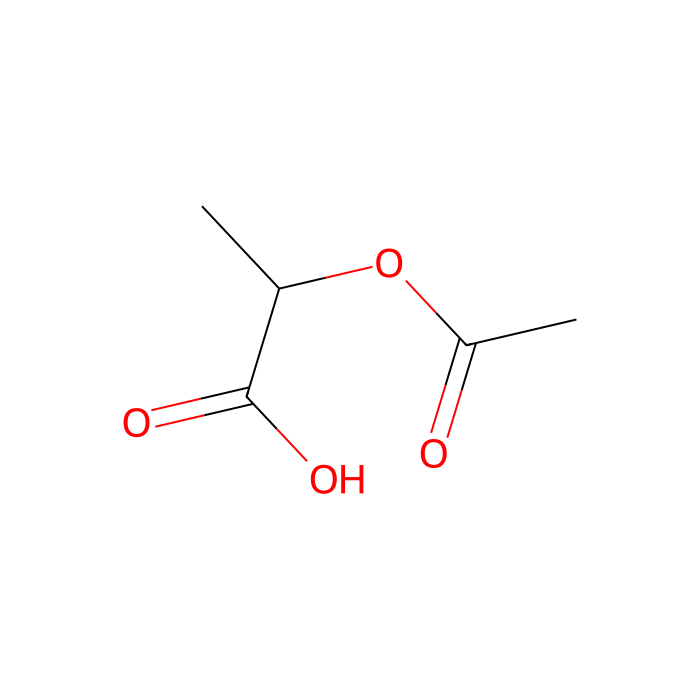
Concise overview: 2-Acetoxypropionic acid is the acetylated ester of lactic acid (an α-hydroxy acid), bearing both a terminal carboxylic acid and an internal acetate ester at the α-carbon, which is stereogenic.
Item-specific identifiers (from Product Data):
CAS: 535-17-1
CID (PubChem): 79041
InChIKey: 407648 (as provided; appears truncated—refer to CoA/SDS for full identifier)
SMILES: Not specified for this item; refer to CoA/Spec Sheet.
Literature/computed identifiers and descriptors (for reference only):
Preferred name (IUPAC): 2-acetyloxypropanoic acid (aka 2-acetoxypropionic acid)
Functional groups: one carboxylic acid (–C(=O)OH) and one acetate ester (–O–C(=O)–CH3) on the α-carbon.
Backbone: substituted propanoic acid; the C2 carbon is stereogenic. Commercial material is often racemic unless an enantiomeric excess is specified (not specified for this item).
2D description: a three-carbon chain terminating in a carboxylate; the middle carbon bears a methyl and an acetoxy substituent via an ether linkage to an acetyl group.
Synthetic Utility
Key reactive motifs:
Carboxylic acid: amenable to activation (acid chloride, mixed anhydride, carbodiimide coupling) leading to amides, esters, and anhydrides.
Internal acetate ester (on α-carbon): protects the α-hydroxyl of lactic acid, enabling orthogonal chemistry at the acid. The acetate can be removed under basic or acidic conditions post-transformation.
Amide coupling: EDCI/HOBt or EDCI/Oxyma, DIC/DMAP, or HATU-mediated couplings in DCM/DMF to give 2-acetoxypropanamides; subsequent deacetylation furnishes 2-hydroxypropanamides.
Ester formation: Steglich esterification (DCC/DMAP) with alcohol partners in DCM or toluene; minimize basic conditions that could saponify the acetate.
Deprotection: Mild Na2CO3/MeOH–H2O, or catalytic acid (AcOH, HCl in MeOH) at low temperature/time to regenerate the α-hydroxyl with control of epimerization.
Halogenation/oxidation at α-position: Through activated derivatives (e.g., formation of oxazolones or mixed anhydrides), α-functionalization can be achieved with electrophiles (NBS, halogenating agents) while monitoring for elimination or rearrangement.
Retrosynthetic value:
Serves as a protected equivalent of lactic acid, allowing stepwise installation of substituents on the carboxyl and subsequent unveiling of the 2-hydroxyl. Neighboring-group participation from acetate may aid some acyl transfer reactions.
Practical notes:
Maintain anhydrous conditions during coupling; include base scavengers where appropriate.
Monitor for hydrolysis (TLC/HPLC); store intermediates cold and dry to preserve the acetate.
Target Specificity
Not applicable. This product is a small-molecule chemical reagent, not a biological targeting agent or antibody. No antigen/epitope, species reactivity, clone, or isotype data apply.
Foire aux questions
What documentation is provided?
Available product documentation, including Certificates of Analysis (COA), Safety Data Sheets (SDS), and specification sheets, is shown in the product document area. Document availability and access follow the current site policy.
What is the purity of this product?
This product is supplied at ≥98% purity (chemical assay). Lot-specific values are stated on the Certificate of Analysis.
How should this product be stored?
Store at 2–8 °C. Refrigerated storage is required to maintain the specified shelf life.
How is this product shipped?
This product ships chilled on wet ice. Unpack on arrival and transfer it to the storage condition stated above.
What are the CAS number, molecular formula and molecular weight?
The CAS Number is 535-17-1, the molecular formula is C5H8O4, and the molecular weight is 132.12 g/mol. InChIKey WTLNOANVTIKPEE-UHFFFAOYSA-N.
Nous utilisons des cookies pour garantir le bon fonctionnement du site et, lorsque cela est autorisé, pour améliorer votre expérience. Vous pouvez gérer vos préférences à tout moment dans les Paramètres. Pour en savoir plus, consultez notre Politique relative aux cookies.
Souhaitez-vous que nous vous envoyions un message lorsque des réductions seront disponibles?
Me rappeler plus tard
Merci ! Veuillez vérifier votre boîte de réception e-mail pour confirmer.
Products are supplied to verified businesses, institutions, and qualified professionals for research and development use only. Not for use in humans, animals, diagnosis, or therapy.

 I2224068