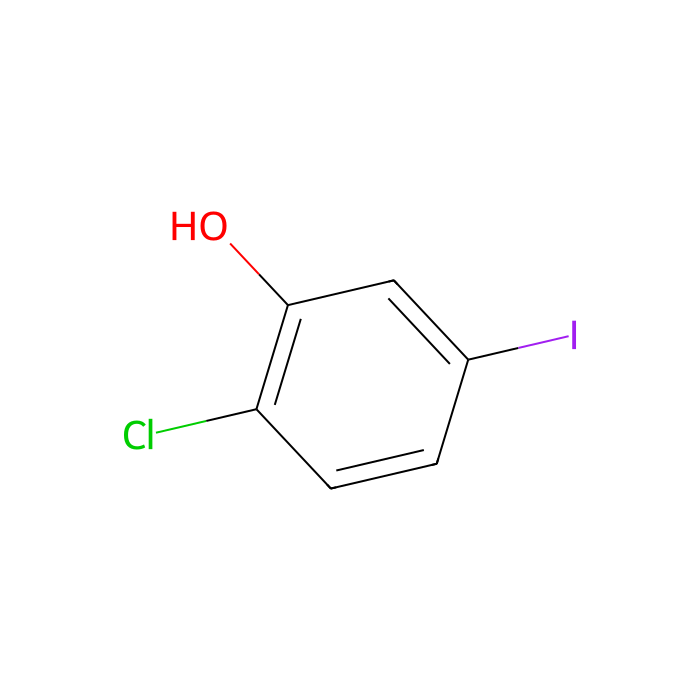
2-Chloro-5-iodophenol - ≥98% , CAS No.289039-26-5

CAS: 289039-26-5 Cat. No.: C183453 Formule: C6H4ClIO Poids moléculaire: 254.5 Numéro CE: 868-772-9
DISPONIBLE À COMMANDE
QUALITÉ & PURETÉ ≥98%
Synonyms
2-chloro-5-iodophenol|2-Chloro-5-iodopenol|2-(3-Pyridyl)-1,3-thiazole-4-carboxylicacid|Phenol, 2-chloro-5-iodo-
Storage
Protected from light,Room temperature
Shipped In
Normal
★
Taille
USA
Allemagne (EU)*
Prix
Qté
1g
C183453-1g
4 En stock
—

10,90$US

16,90$US
Enregistrer 6,00 $US (35.50%)
5g
C183453-5g
1 En stock
—

46,90$US

70,90$US
Enregistrer 24,00 $US (33.85%)
10g
C183453-10g
1 En stock
—

81,90$US

122,90$US
Enregistrer 41,00 $US (33.36%)
25g
C183453-25g
1 En stock
—

140,90$US

211,90$US
Enregistrer 71,00 $US (33.51%)
100g
C183453-100g
Sur commande · 8–12 semaines

538,90$US

808,90$US
Enregistrer 270,00 $US (33.38%)
Enter a quantity for the sizes you want to add.

Spécifications

Synonymes
2-chloro-5-iodophenol | 2-Chloro-5-iodopenol | 2-(3-Pyridyl)-1,3-thiazole-4-carboxylicacid | Phenol, 2-chloro-5-iodo-
Spécifications et pureté
≥98%
Conditions de stockage de stockage
Protected from light,Room temperature
Expédié en
Normal
Pureté
≥98%
Noms et identifiants
Pubchem Sid
Pubchem Sid Url
https://pubchem.ncbi.nlm.nih.gov/substance/488191988
SMILES
C1=CC(=C(C=C1I)O)Cl
IUPAC Name
2-chloro-5-iodophenol
InChIKey
NNZXUSFOILSDCS-UHFFFAOYSA-N
InChI
1S/C6H4ClIO/c7-5-2-1-4(8)3-6(5)9/h1-3,9H
Isomères SMILES
C1=CC(=C(C=C1I)O)Cl
Poids moléculaire
254.5
Reaxys
3236468
Reaxys-RN_link_address
https://www.reaxys.com/reaxys/secured/hopinto.do?context=S&query=IDE.XRN=3236468&ln=

Données avancées

Taxonomic Classification

Taxonomy Tree

KingdomOrganic compounds
SuperclassBenzenoids
ClassePhenols
SubclassHalophenols
Intermediate Tree Nodes Chlorophenols
Direct ParentO-chlorophenols
Alternative Parents M-iodophenols  Iodobenzenes  Chlorobenzenes  1-hydroxy-4-unsubstituted benzenoids  1-hydroxy-2-unsubstituted benzenoids  Aryl iodides  Aryl chlorides  Organooxygen compounds  Organoiodides  Organochlorides  Hydrocarbon derivatives  
Molecular FrameworkAromatic homomonocyclic compounds
Substituents 3-iodophenol - 2-chlorophenol - 1-hydroxy-4-unsubstituted benzenoid - 1-hydroxy-2-unsubstituted benzenoid - Chlorobenzene - Halobenzene - Iodobenzene - Aryl chloride - Aryl halide - Aryl iodide - Monocyclic benzene moiety - Hydrocarbon derivative - Organic oxygen compound - Organooxygen compound - Organoiodide - Organochloride - Organohalogen compound - Aromatic homomonocyclic compound
DescriptionThis compound belongs to the class of organic compounds known as o-chlorophenols. These are chlorophenols carrying a iodine at the C2 position of the benzene ring.
External Descriptors Not available
Structure 3D
Modèle de structure chimique interactif


Certificats (CoA, COO, BSE/TSE et tableau d'analyse)
C of A & Other Certificates(BSE/TSE, COO):
Analytical Chart:

Find and download the COA for your product by matching the lot number on the packaging.

6 results found

Lot NumberCertificate TypeDateArticle
C2619164C2619164Certificate of AnalysisMar 30, 2026 C183453
A2224042A2224042Certificate of AnalysisNov 07, 2024 C183453
A2224072A2224072Certificate of AnalysisNov 07, 2024 C183453
A2224075A2224075Certificate of AnalysisNov 07, 2024 C183453
A2224076A2224076Certificate of AnalysisNov 07, 2024 C183453
A2224079A2224079Certificate of AnalysisNov 07, 2024 C183453
Propriétés chimiques et physiques
Sensibilitélight sensitive
Poids moléculaire254.45
XLogP32.800
Hydrogen Bond Donor Count1
Hydrogen Bond Acceptor Count1
Rotatable Bond Count0
Exact Mass253.9 Da
Monoisotopic Mass253.9 Da
Topological Polar Surface Area20.200 Ų
Heavy Atom Count9
Formal Charge0
Complexity99.100
Isotope Atom Count0
Defined Atom Stereocenter Count0
Undefined Atom Stereocenter Count0
Defined Bond Stereocenter Count0
Undefined Bond Stereocenter Count0
The total count of all stereochemical bonds0
Covalently-Bonded Unit Count1
Sécurité et dangers (GHS)
Pictogramme(s)
GHS05,   GHS07
Signal
Danger
Mentions de danger

H302:Harmful if swallowed

H312:Harmful in contact with skin

H315:Causes skin irritation

H318:Causes serious eye damage

H332:Harmful if inhaled

H335:May cause respiratory irritation

Conseils de prudence

P261:Avoid breathing dust/fume/gas/mist/vapors/spray.

P264:Wash hands [and …] thoroughly after handling.

P270:Do not eat, drink or smoke when using this product.

P271:Use only outdoors or in a well-ventilated area.

P280:Wear protective gloves/protective clothing/eye protection/face protection.

P321:Specific treatment (see ... on this label).

P330:Rinse mouth.

P302+P352:IF ON SKIN: wash with plenty of water.

P304+P340:IF INHALED: Remove person to fresh air and keep comfortable for breathing.

P362+P364:Take off contaminated clothing and wash it before reuse.

P405:Store locked up.

P403+P233:Store in a well-ventilated place. Keep container tightly closed.

P501:Dispose of contents/container to an approved waste disposal plant.

P264+P265:Wash hands [and …] thoroughly after handling. Do not touch eyes.

P301+P317:IF SWALLOWED: Get medical help.

P305+P354+P338:IF IN EYES: Immediately rinse with water for several minutes. Remove contact lenses if present and easy to do. Continue rinsing.

P317:Get emergency medical help.

P332+P317:If skin irritation occurs: Get medical help.

P319:Get medical help if you feel unwell.

Reaxys
3236468
Reaxys-RN_link_address
https://www.reaxys.com/reaxys/secured/hopinto.do?context=S&query=IDE.XRN=3236468&ln=
Calculateurs de solution
Avis

Avis des clients

Application Protocols

No assay/application protocols are specified for this item. As a synthetic building block, conditions should be adapted from standard organic synthesis procedures (e.g., Suzuki, Sonogashira, Williamson etherification), with substrate-specific optimization.

For project reproducibility:

  • Record exact solvent grades, base hydration state, and catalyst/ligand lots.
  • Monitor by TLC/HPLC/GC and confirm identity/purity by NMR (1H/13C), LC–MS, and HRMS as appropriate.
  • Consult the Storage & Reconstitution section for handling before use.
Biological Roles

This compound is a synthetic halophenol building block with no established physiological role.

General context (literature):

  • Phenolic motifs are prevalent in natural products and biomolecules, where they engage in hydrogen bonding and π–π interactions. However, heavy halogenation (Cl/I) is uncommon in endogenous metabolites and typically reflects synthetic derivatization for SAR exploration.
  • Halophenols may exhibit nonspecific protein binding due to hydrophobic and halogen-bonding interactions; they can act as weak acids (phenolic pKa often ~9–10). Any biological activity is highly structure- and context-dependent and is not implied for this catalog item.

Use in life-science research:

  • As a building block for synthesizing probe molecules, ligands, or materials that will subsequently be evaluated in biochemical assays.

No medical, diagnostic, or therapeutic use is intended or implied. For research use only (per Product Data).

Buffer Applications

Not typically used as a buffer component. Phenolic halogenated aromatics do not form conventional biological or analytical buffers in aqueous media.

Practical note: If aqueous work is required (e.g., bioconjugation of derivatives), solubilize this compound in a water-miscible organic co-solvent (DMSO, DMF, or ethanol) before dilution into the buffered system, ensuring final co-solvent content is compatible with the assay.

Green Alternatives

Opportunities to improve sustainability center on solvent and catalyst/base choices rather than changing the building block itself.

  • Greener solvent substitutions (literature guidance):

    • Replace DMF/DMAc with 2-MeTHF, CPME, propylene carbonate, or water/ethanol mixtures when compatible with the coupling system.
    • Use EtOAc or toluene instead of DCM/chloroform for extractions and chromatography when feasible.
  • Base/catalyst considerations:

    • Employ ligand-efficient Pd systems (e.g., Pd/C with recyclable supports, or low-load PEPPSI-type catalysts) to reduce metal usage.
    • Explore Ni-catalyzed couplings of aryl iodides with suitable partners to lower precious metal demand.
  • Process-intensification:

    • Micellar catalysis (aqueous surfactant media) can enable Suzuki couplings of aryl iodides under milder, aqueous conditions.
    • Flow chemistry may reduce solvent volumes and improve heat/mass transfer.

Comparison (typical trade-offs):

  • 2-MeTHF vs THF: 2-MeTHF is bio-based and less miscible with water (easier separations) but can show different solvation, affecting rates/selectivity.
  • CPME vs Dioxane: CPME offers a better EHS profile and peroxide resistance but may require temperature adjustments.

Note: Green substitutions should be verified experimentally for this specific substrate/coupling partner combination; kinetics and selectivity can vary with solvent and base.

Pharmaceutical Uses

No direct role as a pharmacopeial excipient is known or implied. This product is intended for research use only.

Relevant context for process chemists (general):

  • Serves as a bifunctional aromatic building block in the synthesis of API intermediates, enabling rapid installation of diverse substituents via Ar–I cross-couplings while preserving Ar–Cl for subsequent transformations.
  • The phenolic OH can be masked (e.g., benzyl, silyl) as a protecting group to traverse multi-step sequences, then unveiled under selective deprotection.
  • Iodide leaving group generally allows milder coupling conditions and higher chemoselectivity compared to bromides/chlorides, aiding late-stage diversification in medicinal chemistry campaigns.

Any application in human or veterinary medicine would require separate development, analytical qualification, and regulatory evaluation that are outside the scope of this research-grade product.

Physical Properties

Item-specific physicochemical specifications (bp/mp/density/assay/UV cutoff, etc.): Not specified for this item; refer to CoA/Spec Sheet.

General/literature-based guidance for 2-halophenols (context only):

  • Aggregate state: Typically a crystalline solid for dihalophenols of this molecular weight.
  • Solubility (qualitative, literature): Sparingly soluble in water; soluble in common organic solvents such as dichloromethane, chloroform, acetone, ethyl acetate, THF, DMF, and DMSO. Limited solubility in aliphatic hydrocarbons.
  • Acidity: Phenolic pKa values are typically ~9–10; electron-withdrawing halogens can modestly lower pKa compared to phenol (literature trend). Actual pKa for this specific isomer not provided here.
  • Lipophilicity: Halogenation (especially iodine) increases hydrophobicity and polarizability; expect higher logP than phenol (qualitative literature expectation).
  • Volatility: Low relative volatility expected for aryl iodides; thermal sensitivity should be evaluated before high-temperature operations.

Notes for practical handling (general):

  • Dissolve in dry, oxygen-free solvents when using in air/moisture-sensitive cross-couplings.
  • Refractive index and exact density are not typically reported for solids of this class; verify on CoA if required.

Always consult the item-specific CoA/SDS for definitive properties before designing quantitative processes.

Quality and Grades
  • Declared grade/purity for this SKU: Not specified for this item; refer to CoA/Spec Sheet.

How to interpret common grades (general guidance):

  • Research/technical grade: Suitable for most synthetic applications; impurity profile adequate for routine chemistry.
  • ≥98–99% purity (if specified on CoA): Typical for building blocks used in cross-coupling; may include limits on related halophenol isomers, residual solvents, and halide contaminants.
  • HPLC grade (solvents) vs. reagent grade (solids): For this solid building block, low-UV specifications are generally not applicable; rather, identity (1H/13C NMR), HPLC/GC purity, and water content (Karl Fischer) may be reported on the CoA.

Stabilizers/inhibitors:

  • None indicated in Product Data. If present (rare for this class), stabilizers would be declared on the CoA and may influence reactivity in metal-catalyzed couplings.

Recommendation:

  • For chromatography-sensitive or medicinal chemistry campaigns, request batch-specific CoA including isomeric purity, halide content, and residual metal levels as needed.
Reaction and Applications

The aryl iodide moiety is highly reactive in cross-coupling, while the phenolic OH provides orthogonal derivatization. Representative applications (literature/general):

  • Pd-catalyzed cross-coupling at Ar–I:

    • Suzuki–Miyaura with boronic acids/esters to rapidly access 5-substituted-2-chlorophenol motifs.
    • Sonogashira coupling with terminal alkynes (Pd/Cu co-catalysis) to install alkynyl groups; the ortho-chloro remains available for sequential couplings or SNAr if activated.
    • Buchwald–Hartwig arylation with amines (often feasible at Ar–I under mild conditions) to introduce anilines; phenol can be protected if needed.
  • Orthogonal functionalization strategies:

    • Protect the phenol (e.g., as TBS, TIPS, benzyl) to prevent O-arylation during metal-catalyzed C–N/C–C couplings.
    • Convert phenol to aryl ether/ester (Williamson etherification or acylation) to tune electronics and solubility.
  • Metal–halogen exchange:

    • Rapid I/Li exchange at low temperature (e.g., n-BuLi, −78 °C) enables trapping with electrophiles (carbonyls, CO2, electrophilic halogens), while the aryl chloride can persist for later diversification.
  • Directed ortho chemistry:

    • The phenolic oxygen can direct certain metalations or serve in intramolecular cyclizations (e.g., diaryl ether formation) after prior activation.

These features make 2-chloro-5-iodophenol a valuable bifunctional building block for iterative C–C/C–N/O-functionalization sequences in medicinal and materials chemistry.

Reaction Conditions

General literature conditions for aryl iodides and phenols (guidance; optimize per substrate):

  • Suzuki–Miyaura coupling:

    • Catalyst: Pd(PPh3)4 (1–2 mol%) or Pd-PEPPSI-type (0.5–1 mol%).
    • Base: K2CO3, K3PO4, or Cs2CO3 (2–3 equiv).
    • Solvent: Toluene/H2O, dioxane/H2O, 2-MeTHF/H2O, or EtOH/H2O.
    • Temperature/time: 50–90 °C, 1–12 h. Aryl iodides often reach full conversion faster than bromides/chlorides.
  • Sonogashira coupling (terminal alkyne):

    • Catalyst/co-catalyst: PdCl2(PPh3)2 (1–2 mol%), CuI (2–5 mol%).
    • Base/solvent: Et3N, i-Pr2NH, or DBU in THF, DMF, or MeCN.
    • Temperature: rt–60 °C; degas and exclude moisture/oxygen.
  • Buchwald–Hartwig amination:

    • Catalyst: Pd2(dba)3 or Pd(OAc)2 with dialkylbiarylphosphine ligand (e.g., XPhos, tBuBrettPhos).
    • Base: NaOtBu, K3PO4, or Cs2CO3.
    • Solvent: Toluene, dioxane, or t-AmylOH; 60–100 °C.
  • Williamson etherification (O-alkylation):

    • Base: NaH (1.1–1.5 equiv) or K2CO3 (3–5 equiv) for milder conditions.
    • Solvent: DMF, DMSO, or THF; 0–25 °C (NaH) or 50–80 °C (K2CO3).
  • Halogen–lithium exchange at Ar–I:

    • Reagent: n-BuLi or s-BuLi (1.1–1.5 equiv) at −78 °C in THF or Et2O, then electrophile addition.

Note: Protect or manage the phenolic OH as needed to avoid competitive O-arylation or deprotonation under basic or organolithium conditions.

Safety and Handling
  • GHS/CLP classification, signal word, pictograms, and H-statements: Not specified for this item; refer to the product SDS for authoritative safety information.

General safety considerations for halogenated phenols (informational, not item-specific):

  • Hazards: May cause skin/eye irritation and respiratory tract irritation; harmful if swallowed. Phenolic compounds can be absorbed through skin—avoid contact.
  • PPE: Wear lab coat, appropriate chemical-resistant gloves (e.g., nitrile), safety glasses or face shield in splash-risk operations. Use in a fume hood to avoid inhalation of dust or vapors from heated processes.
  • Handling: Avoid dust generation. For cross-coupling work, ensure proper inert-atmosphere technique. Keep away from strong bases/acids and strong oxidizers unless intended for reaction.
  • Incompatibilities (general): Strong oxidants, strong bases (can promote salt formation or undesired side reactions), and reactive metals; avoid halogen–metal exchange conditions unless planned and controlled.
  • First aid (summary; consult SDS):
    • Skin: Wash with soap and water; remove contaminated clothing.
    • Eyes: Rinse cautiously with water for several minutes; seek medical attention if irritation persists.
    • Inhalation: Move to fresh air; seek medical attention if symptoms occur.
    • Ingestion: Rinse mouth; do not induce vomiting; seek medical attention.
  • Fire: Use CO2, dry chemical, or alcohol-resistant foam. Combustion may release HCl/HI and other irritating fumes.

Always defer to the current SDS for this specific catalog item.

Solvent Selection

This compound is a moderately polar, halogenated aromatic phenol. It is generally handled as a solid and dissolved for reactions or analyses.

  • Polarity/miscibility (general):

    • Sparingly water-soluble; enhanced solubility in polar aprotic and chlorinated organic solvents (e.g., DCM, chloroform, acetone, acetonitrile, THF, DMF, DMSO).
    • Limited solubility in nonpolar alkanes (hexanes, heptane); solubility improves with temperature and in mixtures (e.g., hexanes/EtOAc for crystallization).
  • Typical choices by use case:

    • Cross-coupling (Suzuki/Sonogashira/Buchwald): Toluene, dioxane, THF, or CPME; often with water or alcohol co-solvent and base (K2CO3, Cs2CO3, K3PO4). Polar amide solvents (DMF/DMAc/NMP) aid in difficult couplings.
    • Nucleophilic O-alkylation (Williamson ether synthesis): DMF, DMSO, or MeCN with NaH/K2CO3.
    • Purification: Normal-phase silica using hexanes/EtOAc or toluene/EtOAc; avoid strongly basic eluents to prevent phenoxide formation.
  • Comparison (practical):

    • DCM vs. EtOAc: DCM provides higher solubility and faster evaporation; EtOAc is greener and suitable for workups.
    • THF vs. 2-MeTHF: 2-MeTHF offers better sustainability and higher boiling point, aiding elevated-temperature couplings.

Dry, oxygen-free solvents are recommended for metal-catalyzed reactions and base-sensitive operations.

Storage and Reconstitution
  • Item-specific storage (from Product Data):
    • Store protected from light at room temperature.
    • Shipped: Normal conditions.

Practical guidance (general):

  • Keep container tightly closed in a dry place. Minimize headspace or backfill with inert gas for long-term storage to limit oxidation or iodide discoloration.
  • Avoid prolonged exposure to elevated heat and direct light; amber bottles or foil overwrap recommended.
  • If supplied as a solid, no reconstitution is required. For stock solutions (for screening):
    • Prepare in dry DMSO, DMF, MeCN, THF, or DCM as needed.
    • Typical screening stocks: 10–100 mM in DMSO; store aliquots at 2–8 °C or −20 °C, protected from light. Assess stability before extended storage; precipitates may form upon cooling.
  • Allow solids and solutions to equilibrate to room temperature before opening to reduce moisture condensation.

Always refer to the batch-specific CoA/SDS for any additional storage constraints or stability information.

Structure and Identity

An ortho/meta-disubstituted halophenol featuring a phenolic OH with adjacent chloro (2-position) and a meta iodo (5-position) on the benzene ring.

  • Item-specific identifiers (from Product Data):

    • SKU: C183453
    • CAS: 289039-26-5
    • Product Name: 2-Chloro-5-iodophenol
    • Storage note: Protected from light; Room temperature (see Storage & Reconstitution)
    • InChIKey (catalog field): Not specified for this item; refer to CoA/Spec Sheet.
    • SMILES (catalog field): Not specified for this item; refer to CoA/Spec Sheet.
  • Computed/literature structural data (general, not item-specific specs):

    • Molecular formula (calculated): C6H4ClIO
    • Formula weight (calculated): ~254.45 g/mol
    • Functional groups: phenol (Ar–OH), aryl chloride (Ar–Cl), aryl iodide (Ar–I)
    • Structural description (2D): A benzene ring bearing an OH at C1 (phenol), a Cl substituent at C2 (ortho to OH), and an I at C5 (meta to OH). The iodo substituent renders the aryl iodide site highly reactive toward Pd-catalyzed cross-coupling; the phenolic OH can serve as a handle for ether/ester formation or be protected.
  • Stereochemistry: None (achiral, planar aromatic core).

Synthetic Utility

Key reactivity elements:

  • Aryl iodide (highly coupling-active): Prioritized site for Pd/Ni-catalyzed C–C and C–N bond formation (Suzuki, Sonogashira, Heck, Buchwald–Hartwig). Facilitates sequential, regioselective functionalization.
  • Phenolic OH: Versatile handle for O-alkylation (Williamson), O-acylation, Mitsunobu etherification/inversion strategies (with appropriate alcohol partners), and protecting group chemistry (TBS, TBDPS, benzyl, carbonate).
  • Aryl chloride: Latent functionality for a second-stage cross-coupling or nucleophilic aromatic substitution (if ring electronics are adjusted post-coupling).

Retrosynthetic value:

  • Acts as a convergence point enabling assembly of densely substituted phenyl scaffolds through orthogonal transformations (I first, then Cl; or protect OH, then iterate couplings).

Typical transformations (literature examples):

  • Suzuki with boronic acids (K2CO3, Pd(PPh3)4, toluene/H2O, 60–90 °C).
  • Sonogashira with terminal alkynes (PdCl2(PPh3)2, CuI, Et3N or i-Pr2NH, rt–60 °C).
  • Buchwald–Hartwig amination (Pd2(dba)3 or PEPPSI-type Pd, dialkylbiarylphosphine ligands, K3PO4/Cs2CO3).
  • Williamson etherification (NaH, DMF or THF, 0–25 °C), or carbonate formation (triphosgene/Boc2O analogs under base).
  • I/Li exchange (n-BuLi, −78 °C) followed by electrophile quench to access elaborated phenols while retaining the aryl chloride.
Target Specificity

Not applicable. This product is a small-molecule chemical building block, not a biological affinity reagent. No antigen/epitope, clone, isotype, or species reactivity data apply.

Foire aux questions

How is this product shipped?
This product ships under standard ambient conditions. No temperature-controlled packaging is required.
What is the purity of this product?
This product is supplied at ≥98% purity (chemical assay). Lot-specific values are stated on the Certificate of Analysis.
How should this product be stored?
Store at room temperature, protected from light. The material is light-sensitive — keep it in its original opaque or amber container.
What are the CAS number, molecular formula and molecular weight?
The CAS Number is 289039-26-5, the molecular formula is C6H4ClIO, and the molecular weight is 254.5 g/mol. InChIKey NNZXUSFOILSDCS-UHFFFAOYSA-N.
What documentation is provided?
Available product documentation, including Certificates of Analysis (COA), Safety Data Sheets (SDS), and specification sheets, is shown in the product document area. Document availability and access follow the current site policy.

Souhaitez-vous que nous vous envoyions un message lorsque des réductions seront disponibles?

Me rappeler plus tard

Merci ! Veuillez vérifier votre boîte de réception e-mail pour confirmer.

Oups ! Les notifications sont désactivées.