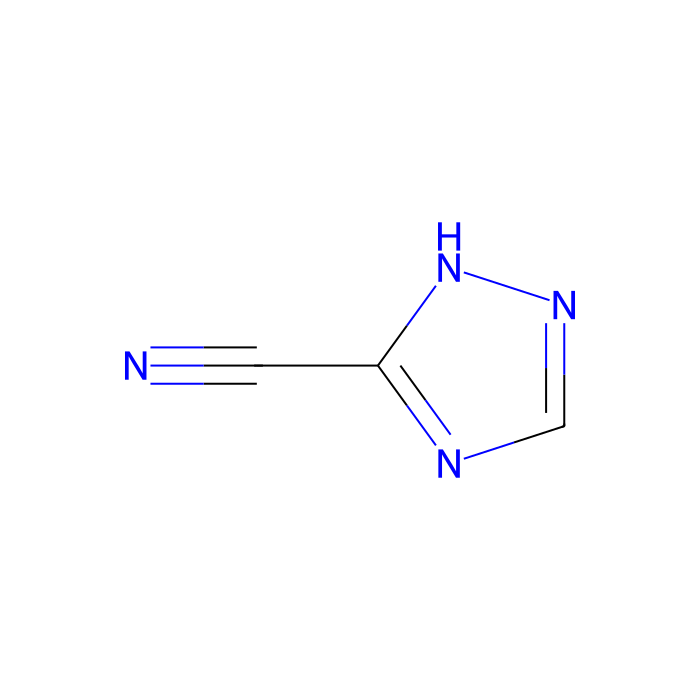
3-Cyano-1,2,4-triazole - ≥97% , CAS No.3641-10-9

CAS: 3641-10-9 Cat. No.: C193003 Formule: C3 H2 N4 Poids moléculaire: 94.07 Numéro CE: 609-243-2
DISPONIBLE À COMMANDE
QUALITÉ & PURETÉ ≥97%
Storage
Room temperature
Shipped In
Normal
★
Taille
USA
Allemagne (EU)*
Prix
Qté
5g
C193003-5g
1 En stock
—

9,90$US

14,90$US
Enregistrer 5,00 $US (33.56%)
25g
C193003-25g
5 En stock
—

31,90$US

47,90$US
Enregistrer 16,00 $US (33.40%)
100g
C193003-100g
3 En stock
—

113,90$US

170,90$US
Enregistrer 57,00 $US (33.35%)
500g
C193003-500g
1 En stock
—

427,90$US

641,90$US
Enregistrer 214,00 $US (33.34%)
Enter a quantity for the sizes you want to add.

Spécifications

Spécifications et pureté
≥97%
Conditions de stockage de stockage
Room temperature
Expédié en
Normal
Pureté
≥97%
Noms et identifiants
Pubchem Sid
Pubchem Sid Url
https://pubchem.ncbi.nlm.nih.gov/substance/504764690
SMILES
C1=NNC(=N1)C#N
IUPAC Name
1H-1,2,4-triazole-5-carbonitrile
InChIKey
GUQHFZFTGHNVDG-UHFFFAOYSA-N
InChI
1S/C3H2N4/c4-1-3-5-2-6-7-3/h2H,(H,5,6,7)
Isomères SMILES
C1=NNC(=N1)C#N
Poids moléculaire
94.07
Reaxys
774455
Reaxys-RN_link_address
https://www.reaxys.com/reaxys/secured/hopinto.do?context=S&query=IDE.XRN=774455&ln=

Données avancées

Taxonomic Classification

Taxonomy Tree

KingdomOrganic compounds
SuperclassOrganoheterocyclic compounds
ClasseAzoles
SubclassTriazoles
Intermediate Tree Nodes Not available
Direct ParentTriazoles
Alternative Parents Heteroaromatic compounds  Nitriles  Azacyclic compounds  Hydrocarbon derivatives  
Molecular FrameworkAromatic heteromonocyclic compounds
Substituents Heteroaromatic compound - 1,2,4-triazole - Azacycle - Nitrile - Carbonitrile - Organic nitrogen compound - Cyanide - Hydrocarbon derivative - Organonitrogen compound - Aromatic heteromonocyclic compound
DescriptionThis compound belongs to the class of organic compounds known as triazoles. These are compounds containing a five-member aromatic ring of two carbon atoms and three nitrogen atoms.
External Descriptors Not available
Structure 3D
Modèle de structure chimique interactif


Certificats (CoA, COO, BSE/TSE et tableau d'analyse)
C of A & Other Certificates(BSE/TSE, COO):
Analytical Chart:

Find and download the COA for your product by matching the lot number on the packaging.

10 results found

Lot NumberCertificate TypeDateArticle
F2605120F2605120Certificate of AnalysisAug 01, 2025 C193003
F2608091F2608091Certificate of AnalysisAug 01, 2025 C193003
H2519186H2519186Certificate of AnalysisAug 01, 2025 C193003
H2519187H2519187Certificate of AnalysisAug 01, 2025 C193003
H2519188H2519188Certificate of AnalysisAug 01, 2025 C193003
H2519189H2519189Certificate of AnalysisAug 01, 2025 C193003
G2228521G2228521Certificate of AnalysisMay 12, 2025 C193003
G2228522G2228522Certificate of AnalysisMay 12, 2025 C193003
G2228682G2228682Certificate of AnalysisMay 12, 2025 C193003
I1817071I1817071Certificate of AnalysisApr 07, 2024 C193003
Propriétés chimiques et physiques
Point de fusion (°C)185°C-187°C
Poids moléculaire94.08
XLogP30.000
Hydrogen Bond Donor Count1
Hydrogen Bond Acceptor Count3
Rotatable Bond Count0
Exact Mass94.0279 Da
Monoisotopic Mass94.0279 Da
Topological Polar Surface Area65.400 Ų
Heavy Atom Count7
Formal Charge0
Complexity101.000
Isotope Atom Count0
Defined Atom Stereocenter Count0
Undefined Atom Stereocenter Count0
Defined Bond Stereocenter Count0
Undefined Bond Stereocenter Count0
The total count of all stereochemical bonds0
Covalently-Bonded Unit Count1
Sécurité et dangers (GHS)
Pictogramme(s)
GHS06,   GHS07
Signal
Danger
Mentions de danger

H301:Toxic if swallowed

H311:Toxic in contact with skin

H315:Causes skin irritation

H319:Causes serious eye irritation

H331:Toxic if inhaled

H335:May cause respiratory irritation

Conseils de prudence

P261:Avoid breathing dust/fume/gas/mist/vapors/spray.

P264:Wash hands [and …] thoroughly after handling.

P270:Do not eat, drink or smoke when using this product.

P271:Use only outdoors or in a well-ventilated area.

P280:Wear protective gloves/protective clothing/eye protection/face protection.

P321:Specific treatment (see ... on this label).

P330:Rinse mouth.

P302+P352:IF ON SKIN: wash with plenty of water.

P304+P340:IF INHALED: Remove person to fresh air and keep comfortable for breathing.

P305+P351+P338:IF IN EYES: Rinse cautiously with water for several minutes. Remove contact lenses if present and easy to do - continue rinsing.

P361+P364:Take off immediately all contaminated clothing and wash it before reuse.

P362+P364:Take off contaminated clothing and wash it before reuse.

P405:Store locked up.

P403+P233:Store in a well-ventilated place. Keep container tightly closed.

P501:Dispose of contents/container to an approved waste disposal plant.

P264+P265:Wash hands [and …] thoroughly after handling. Do not touch eyes.

P301+P316:IF SWALLOWED: Get emergency medical help immediately.

P337+P317:If eye irritation persists: Get medical help.

P332+P317:If skin irritation occurs: Get medical help.

P316:Get emergency medical help immediately.

P319:Get medical help if you feel unwell.

Reaxys
774455
Reaxys-RN_link_address
https://www.reaxys.com/reaxys/secured/hopinto.do?context=S&query=IDE.XRN=774455&ln=
FAQ et articles
Citations of This Product
Calculateurs de solution
Avis

Avis des clients

Application Protocols

No application protocols are specified for this item. As a heteroaromatic building block, usage will depend on the intended synthetic transformation.

General best practices (non-specific):

  • Reaction setup: Use oven-dried glassware and anhydrous solvents for base-mediated N-alkylations or moisture-sensitive steps. Purge with nitrogen or argon when required.
  • Analytical monitoring: Track reaction progress via TLC (polar eluents), HPLC, or LC-MS. For nitrile transformations, IR monitoring of the C≡N stretch is rapid and informative.
  • Purification: Due to polarity, reverse-phase HPLC or silica gel with polar modifiers often provides clean separations. Add 0.1–1% NH3 or Et3N to suppress tailing on silica.
  • Documentation: Record exact stoichiometries, temperatures, and times for reproducibility. Retain spectra and chromatograms with the final material.

For any specialized application (e.g., tetrazole synthesis, amidoxime formation), consult primary literature and scale cautiously after bench-top optimization.

Biological Roles

This listing is a chemical reagent for research use only. No biological activity testing is provided for this item.

General background (literature/context; not specific to this product):

  • 1,2,4-Triazoles occur in numerous bioactive scaffolds as hydrogen-bond donors/acceptors and metabolic stability elements. The cyano substituent modulates electronics and can serve as a latent amide/acid or tetrazole bioisostere after transformation.
  • The parent 1,2,4-triazole ring is weakly acidic (N–H) and can engage in polar interactions with biomacromolecules; however, intrinsic biological roles of the isolated small molecule are not established.
  • Metabolic fates of nitriles in vivo often involve oxidative or hydrolytic pathways to amides/acids, but such information pertains to specific compounds and systems and is not provided for this item.

Note: No claims of efficacy, potency, or therapeutic action are made. For biochemical screening or target-based studies, users should generate their own activity and ADME/T data.

Buffer Applications

Not typically applicable. 3-Cyano-1,2,4-triazole is a heteroaromatic building block rather than a buffering agent. It does not form a defined conjugate acid/base pair in the physiological pH range with well-characterized buffer capacity suitable for standard buffer systems.

Practical note:

  • If dissolution in aqueous media is needed for assays, use co-solvents (e.g., DMSO, MeCN) or adjust pH to aid solubility, then dilute into your working buffer. Validate that the compound does not perturb the buffer’s pH or components.
  • For all buffer preparations and compatibility, rely on your experimental system and conduct small-scale solubility and stability tests.
Green Alternatives

Greener considerations focus on solvent and reagent choices because the substrate is fixed. Options (literature best practices):

  • Solvent selection:

    • Prefer acetonitrile, ethanol, isopropanol, 2-MeTHF, or water/EtOH mixtures when feasible over DMF/DMSO/NMP for improved EHS profiles and easier work-up.
    • For tetrazole formation, explore water or water–ethanol with benign catalysts; avoid heavy-metal Lewis acids where possible.
  • Reagent choices:

    • N-alkylations: Use carbonate bases (K2CO3, Cs2CO3) and phase-transfer catalysts in greener solvents instead of NaH/DMF.
    • Hydrolysis: Employ aqueous conditions with catalytic acid/base under reflux rather than stoichiometric harsh reagents.
    • Tetrazole synthesis: TMSN3 is effective but hazardous; consider in situ NaN3 protocols with safer activation, rigorous containment, and avoidance of heavy metals.

Small comparison (illustrative; not product-specific):

  • DMF vs MeCN: DMF offers superior solubilization but has reproductive toxicity concerns and difficult removal; MeCN is more volatile and accepted in many green solvent guides.
  • DMSO vs 2-MeTHF: DMSO dissolves polar azoles well but is hard to remove; 2-MeTHF is biorenewable and easier to separate, though solubility may be lower.

Operational tips:

  • Minimize solvent volumes via high-solids reactions or use flow chemistry for exotherm control in azide/nitrile cycloadditions.
  • Apply solvent recycling when using MeCN and alcohols.
  • Design crystallization-driven purifications to reduce chromatographic solvent use.
Pharmaceutical Uses

No pharmacopeial or excipient role is specified for this item; it is supplied for research use only.

General context (literature; not product-specific):

  • 1,2,4-Triazoles are common motifs in discovery chemistry owing to their hydrogen-bonding patterns and metabolic robustness. The nitrile substituent can act as a synthetic handle to generate carboxamides, carboxylic acids, amidines, amidoximes, or tetrazoles—functional groups frequently explored in medicinal chemistry as bioisosteres.
  • In formulation science, small polar heteroaromatics seldom act as excipients; instead, they are treated as drug-substance candidates or building blocks in intermediate stages. No compendial monographs are known for 3-cyano-1,2,4-triazole.

Compliance reminder:

  • This product is not intended for use in humans or animals, nor for diagnostic or therapeutic applications. Any use in a regulated context would require independent qualification and GMP-grade sourcing.
Physical Properties

Item-specific specifications (this product):

  • Appearance: Not specified for this item; refer to CoA/Spec Sheet.
  • Purity/Grade: Not specified for this item; refer to CoA/Spec Sheet.

Literature/general physico-chemical data for 3-cyano-1,2,4-triazole (for context only; not product specifications):

  • Molecular formula: C3H2N4 (literature)
  • Molecular weight: ~94.08 g/mol (calculated from atomic weights)
  • Physical state: Typically a crystalline solid for analogous nitrile-substituted azoles (literature trend)
  • Acidity/basicity: 1,2,4-Triazoles display weakly acidic N–H (pKa of parent 1,2,4-triazole ~10.2 in water, literature). The electron-withdrawing cyano further stabilizes the conjugate base, often lowering pKa modestly (qualitative literature expectation). Exact pKa for this derivative: Not firmly established in standard references.
  • Solubility: Heteroaromatic nitriles are commonly soluble in polar aprotic solvents (DMSO, DMF, acetonitrile) and variably soluble in alcohols; aqueous solubility is expected to be low to moderate depending on tautomeric ionization state (literature guidance). No item-specific solubility is provided here.
  • LogP: Expected low to moderate due to high nitrogen content and nitrile polarity; no consensus numerical value identified (literature perspective only).
  • Melting point, boiling point, density, refractive index, UV cutoff: Not specified for this item; refer to CoA/Spec Sheet.

Notes:

  • Always verify melting point and solubility with the item’s CoA when planning purification, crystallization, or formulation work.
  • Hygroscopicity is not typically pronounced, but dry-box handling can benefit moisture-sensitive downstream chemistry (general practice).
Quality and Grades

Item-specific grade/purity information: Not specified for this item; refer to CoA/Spec Sheet.

Guidance on grades (general information for professional chemists):

  • Research grade: Common for heteroaromatic building blocks. Typically suitable for synthesis, method development, and screening. May contain trace inorganic/organic impurities; verify by NMR/LC-MS as needed.
  • Purity reporting: For small heterocycles, catalog purities are often by HPLC area% or GC%, plus identity by NMR/HRMS. If UV-sensitive synthetic steps or catalysis are planned, request UV-cutoff and trace metal data from the CoA.
  • Stabilizers: Not commonly required for triazole nitriles. If stabilizers or inhibitors are added, these would be explicitly stated on the CoA/label. None are indicated for this item’s Product Data.
  • Practical QC tips:
    • Confirm identity via 1H/13C NMR; characteristic signals include deshielded ring C/N environments and a downfield N–H (if present), and a nitrile carbon around ~110–125 ppm (weak in 13C, often enhanced via DEPTQ).
    • Monitor purity by HPLC (C18, ACN/H2O with 0.1% formic acid or ammonium formate for MS-compatibility) or by GC if thermal stability allows.
    • Water and residual solvent levels: Not specified for this item; refer to CoA/Spec Sheet.

Recommendation: For air/moisture-sensitive sequences (e.g., strong base-mediated couplings), consider a quick dry under vacuum over P2O5 or in a desiccator before use; confirm no degradation by re-checking HPLC/NMR.

Reaction and Applications

This heteroaromatic nitrile serves as a compact, electron-poor azole building block. Typical synthetic applications (literature/general) include:

  • N-Functionalization of the triazole:

    • N-alkylation or N-acylation at the more nucleophilic ring nitrogen under basic conditions (e.g., K2CO3/Cs2CO3 in DMF, or NaH in THF/DMF). Regioselectivity can depend on base/solvent and protecting strategies; characterize isomers by NMR.
    • N-oxide or N-halogenation is uncommon relative to imidazoles but can be accessed under strong oxidizing/halogenating conditions.
  • Nitrile transformations at C-3 substituent:

    • Hydrolysis to amide/carboxylic acid under acidic or basic conditions; stepwise control (nitrile → amide → acid) with temperature and time.
    • Amidoxime formation with hydroxylamine (NH2OH) in alcoholic solvent; useful handle for subsequent cyclizations.
    • Tetrazole formation via [3+2] cycloaddition of azide to the nitrile (e.g., TMSN3/Lewis acid or NaN3 with activators), delivering triazolyl-tetrazole frameworks valued in medicinal and coordination chemistry.
    • Nitrile reduction to amine (e.g., catalytic hydrogenation or borane; be mindful of ring stability and potential over-reduction).
  • Cross-coupling relevance:

    • While no halogen is present, the ring can be further elaborated after introducing leaving groups (e.g., N-alkyl halides off-triazole), enabling downstream Suzuki/Heck on appended aryls.
  • Applications context:

    • Useful in discovery chemistry as an electron-withdrawing azole motif, in ligand scaffolds, energetic materials research (nitrogen-rich), and as a synthon en route to tetrazoles and amides bearing a 1,2,4-triazolyl group.

Practical tips:

  • Dry, oxygen-free conditions improve outcomes for strong-base N-alkylations.
  • Monitor nitrile conversions by IR (sharp C≡N ~2220–2260 cm−1) and LC-MS; tetrazole formation typically abolishes the nitrile band.
Reaction Conditions

General conditions reported in the literature for functionalizing 1,2,4-triazole nitriles (guidance only; optimize per substrate):

  • N-alkylation/N-acylation of the triazole N–H:

    • Base: K2CO3, Cs2CO3, or NaH (more forcing) in dry DMF, DMSO, or MeCN.
    • Temperature: 20–80 °C; NaH protocols often 0–25 °C for initiation, then to rt or mild heat.
    • Time: 1–16 h depending on electrophile.
    • Notes: Carefully dry solvents; exclude moisture to avoid hydrolysis or side reactions. Regioisomer mixtures may form; chromatographic or crystallization separation may be required.
  • Hydrolysis of the nitrile:

    • Acidic: H2SO4 or HCl in water/alcohol (50–100 °C) to amide/acid.
    • Basic: NaOH/KOH in water/EtOH (reflux) to amide/acid; control by time and temperature.
    • Workup: Neutralization, extraction; possible salt formation with the azole.
  • Amidoxime formation:

    • Reagents: Hydroxylamine hydrochloride + base (Na2CO3/Et3N) in EtOH/MeOH or MeCN/H2O.
    • Temperature: 25–70 °C; 2–12 h.
  • Tetrazole synthesis from nitrile:

    • Reagents: TMSN3 with catalytic Lewis acid (e.g., Zn(OTf)2) or NaN3 with activators.
    • Solvents: MeCN, DMF, sulfolane; 60–120 °C (batch or sealed tube).
    • Safety: Rigorous azide handling protocols; avoid heavy-metal azides.
  • Nitrile reduction:

    • Options: BH3·THF (0–25 °C), catalytic hydrogenation (Raney Ni, Pd/C) under H2 (1–10 bar), or DIBAL-H for partial reductions.
    • Considerations: Preserve azole integrity by avoiding over-reduction and strong acid conditions post-reaction.

Expected yields: Highly substrate- and setup-dependent; consult primary literature for the chosen transformation. Always confirm identity and purity (NMR, LC-MS, HRMS).

Safety and Handling

Item-specific hazard data:

  • GHS classification, signal word, hazard statements, pictograms: Not specified for this item; refer to the SDS for authoritative safety information.

General safety considerations for nitrile-bearing azoles (literature/practice; not product-specific):

  • Likely hazards: May cause irritation to skin, eyes, and respiratory tract. Avoid dust formation and inhalation of particulates. Some azoles show mild acute toxicity; consult SDS for exact classifications and exposure limits.
  • Peroxide formation: Not expected (no ether functionality). No special peroxide testing required.
  • Thermal stability: Aromatic azoles are generally thermally stable solids; avoid excessive heating and contact with strong oxidizers or strong acids/bases that could lead to decomposition or ring opening.
  • Incompatibilities: Strong oxidizing agents, strong reducing agents, and powerful dehydrating reagents may cause unwanted reactions with the nitrile or the ring.
  • PPE: Laboratory coat, safety glasses or goggles, and appropriate chemical-resistant gloves (e.g., nitrile). Handle powders in a fume hood to minimize inhalation exposure.
  • First aid (overview; defer to SDS):
    • Inhalation: Move to fresh air; seek medical advice if symptoms persist.
    • Skin contact: Wash with soap and water; remove contaminated clothing.
    • Eye contact: Rinse cautiously with water for several minutes; remove contact lenses if present and easy to do; seek medical attention if irritation continues.
    • Ingestion: Rinse mouth; do not induce vomiting; seek medical attention.
  • Spill/cleanup: Avoid dust; sweep up with minimal dust generation; place in suitable container for disposal per local regulations.
  • Fire fighting: Use water fog, CO2, dry chemical, or foam as appropriate to surroundings; combustion may produce nitrogen oxides and cyanide-containing fumes—firefighters should wear SCBA.
Solvent Selection

Polarity and miscibility (general guidance for 3-cyano-1,2,4-triazole):

  • Polarity class: Polar, heteroatom-rich aromatic; favors polar aprotic media.
  • Likely good solvents (literature/practice): DMSO, DMF, DMAc, NMP, acetonitrile, acetone, methanol/ethanol (varying solubility), and aqueous-organic mixtures when deprotonated or at elevated temperatures.
  • Poor solvents: Nonpolar hydrocarbons (hexanes, heptane) generally provide low solubility; toluene/xylene may dissolve minimally upon heating.

When to choose which solvent:

  • SNAr or base-mediated N-alkylations: Dry, polar aprotics (DMF/DMSO); add 18-crown-6 if using K2CO3/Cs2CO3 for rate enhancement.
  • Nitrile transformations (hydrolysis, amidoxime formation): Protic solvents (MeOH, EtOH) or mixed aqueous-organic media with acid/base catalysts.
  • Cycloaddition to tetrazoles from nitriles: Often uses polar aprotic solvents with Lewis acids or TMSN3; consider MeCN, DMF, or sulfolane depending on temperature.
  • Purification: Reverse-phase HPLC works well due to polarity; normal-phase silica may require polar modifiers (EtOAc/MeOH, DCM/MeOH with 0.1–1% NH3) to avoid tailing.

Comparison notes (literature):

  • DMSO vs DMF: DMSO offers higher polarity and broader solubility; DMF is easier to remove but can decompose under strong base at high temperature.
  • MeCN: Volatile and relatively green; may have limited solubility for strongly hydrogen-bonding azoles.
  • Alcohols: Enable acid/base catalyzed transformations of the nitrile; may compete in alkylation reactions as solvents/nucleophiles.
Storage and Reconstitution

Item-specific storage/shipping (from Product Data):

  • Storage conditions: Room temperature
  • Shipped in: Normal

General handling and storage guidance for this class of compounds:

  • Keep container tightly closed in a dry, well-ventilated place. Protect from prolonged exposure to strong light and moisture to maintain assay and minimize hydrolysis.
  • If long-term storage is planned, consider desiccation and inert-atmosphere packaging (e.g., in a desiccator or with desiccant sachets) to preserve quality.
  • Reconstitution/dissolution:
    • Solvents: DMSO, DMF, or acetonitrile typically provide rapid dissolution; alcohols (MeOH/EtOH) may also work depending on scale and required concentration.
    • Preparation: Weigh quickly to minimize ambient moisture uptake; sonication or gentle warming (≤40 °C) can aid dissolution.
    • Filtration: If preparing stock solutions, pass through 0.2 µm PTFE syringe filters to remove particulates.
  • Solution stability: Not specified for this item; refer to CoA/Spec Sheet. As general practice, prepare fresh solutions or store aliquots at 2–8 °C or −20 °C (tightly sealed, protected from moisture) and equilibrate to room temperature before opening to avoid condensation.

Disposal: Follow institutional and local regulations for disposal of organic nitrogen-containing compounds; avoid release to the environment.

Structure and Identity

Brief overview: 3-Cyano-1,2,4-triazole is a nitrile-substituted 1,2,4-triazole heteroaromatic used as a compact, nitrogen-rich building block for heterocycle elaboration and nitrile transformations.

  • Item-specific identifiers (from Product Data):
    • SKU: C193003
    • CAS: 3641-10-9
    • InChIKey: 111995 (as provided; note that typical InChIKeys are 27 characters—refer to CoA/SDS for the definitive identifier)
    • Storage: Room temperature; shipped under normal conditions
  • Structure description (literature):
    • Core ring: Five-membered 1,2,4-triazole (three ring nitrogens at positions 1, 2, and 4; two sp2 ring carbons at positions 3 and 5)
    • Substitution: A cyano (–C≡N) group at C-3 of the ring
    • Functional groups: Aromatic azole (weakly acidic N–H tautomerism possible), nitrile (electrophilic carbon, strong –I/−M effect)
    • Stereochemistry: None (achiral, planar aromatic system)
  • Molecular formula and mass (literature/computed for 3-cyano-1,2,4-triazole):
    • Formula: C3H2N4
    • Molecular weight: ~94.08 g/mol
  • Line notations:
    • SMILES: Not specified for this item; refer to CoA/Spec Sheet.
    • InChI/InChIKey: Not specified for this item; refer to CoA/Spec Sheet.
  • 2D structure in words: A 1,2,4-triazole ring with nitrogens at N1, N2, and N4; the carbon at position 3 bears a linear cyano substituent (C≡N); the remaining ring carbon (C5) is unsubstituted. The ring N at position 1 can exist as N–H in tautomeric forms typical of 1,2,4-triazoles.
Synthetic Utility

Key functional groups and reactivity (literature/general):

  • Nitrile at C-3: Electrophilic carbon amenable to hydrolysis (amide/acid), reduction (primary amine), imidoyl halide formation, Pinner reactions (imidate esters), amidoxime formation with hydroxylamine, and [3+2] cycloaddition to tetrazoles with azide.
  • 1,2,4-Triazole ring: Weakly acidic N–H allows selective N-alkylation or N-acylation under base; the ring is electron-poor and can stabilize adjacent negative charge in anions generated transiently during functionalization.

Typical transformations using 3-cyano-1,2,4-triazole:

  • N-alkylation (K2CO3/Cs2CO3, DMF/MeCN) to access N-substituted triazoles that retain the nitrile for further diversification.
  • Stepwise nitrile hydrolysis to amide (mild base, 50–80 °C) then to acid (stronger base/acid, reflux), enabling entry into triazolyl carboxamides/acids.
  • Tetrazole formation (TMSN3 + Lewis acid or NaN3 with activating conditions), yielding triazolyl-tetrazoles—useful as metal-binding motifs and bioisosteres of carboxylic acids.
  • Chemoselective reductions (e.g., BH3·THF for nitriles) while preserving the azole ring under controlled conditions.

Retrosynthetic value:

  • Serves as a convergent synthon introducing both an azole core and a convertible nitrile handle in a single step, streamlining SAR campaigns where both ring electronics and side-chain functionality are tuned.

Practical considerations:

  • Control regioselectivity in N-alkylation by base/solvent choice and, when necessary, by temporary protection or using stepwise deprotonation strategies.
  • Monitor conversions by IR (C≡N ~2220–2260 cm−1) and LC-MS; protect from strong acids/bases for prolonged periods to avoid ring degradation.
Target Specificity

Not applicable. This product is a small-molecule chemical reagent and not a biological targeting agent (e.g., antibody, enzyme inhibitor with defined target profiling in this catalog entry). No antigen, epitope, or species reactivity information is provided for this item.

Souhaitez-vous que nous vous envoyions un message lorsque des réductions seront disponibles?

Me rappeler plus tard

Merci ! Veuillez vérifier votre boîte de réception e-mail pour confirmer.

Oups ! Les notifications sont désactivées.