This compound belongs to the class of organic compounds known as phenol esters. These are aromatic compounds containing a benzene ring substituted by a hydroxyl group and an ester group.
External Descriptors
acetate ester - benzaldehydes
1. Djoumbou Feunang Y, Eisner R, Knox C, Chepelev L, Hastings J, Owen G, Fahy E, Steinbeck C, Subramanian S, Bolton E, Greiner R, and Wishart DS. ClassyFire: Automated Chemical Classification With A Comprehensive, Computable Taxonomy. Journal of Cheminformatics, 2016, 8:61.
Determine the necessary mass, volume, or concentration for preparing a solution.
Dilution Calculator
Determine the dilution needed to prepare a stock solution.
Reconstitution Calculator
Avis
Avis des clients
Application Protocols
Not applicable. No validated bioassay protocols (e.g., WB, IHC, IF, FC) are associated with this small-molecule reagent in the Product Data. For synthetic use, consult the Reaction Conditions and Synthetic Utility sections for representative procedures and conditions.
Biological Roles
Item-specific biological/biochemical roles: Not specified for this item; for laboratory research use only.
General/literature context
4-Acetoxybenzaldehyde is a synthetic aromatic aldehyde and is not known as a native metabolite. It can serve as a protected form of 4-hydroxybenzaldehyde, a phenolic aldehyde that occurs in plant metabolism and as a degradation product of lignin-related compounds.
The acetoxy group masks phenolic acidity and hydrogen-bonding capacity, which can modulate lipophilicity and permeability in probe or intermediate molecules used in chemical biology studies.
In biochemical assays, aryl aldehydes may react with nucleophilic amino groups (e.g., lysine) to form imines (Schiff bases) under certain conditions; such interactions are typically reversible and condition-dependent.
No clinical or therapeutic claims are made; this product is intended strictly for research and laboratory use.
Buffer Applications
This compound is not a buffering reagent and does not form defined buffer systems. It is hydrophobic and lacks appropriate acid/base pairs in the physiological pH range.
If aqueous compatibility is required, use co-solvents (e.g., DMSO, ethanol) at low percentages and maintain pH with standard buffers (phosphate, HEPES, acetate) appropriate to your biological system.
For work focused on this substrate, see Reaction & Applications and Synthetic Utility sections.
Green Alternatives
Because this product is a building block rather than a solvent, “green alternatives” focus on route design and protecting-group strategy (literature/guidance).
Protection strategy
Replace acetate with greener/benign protecting groups only when justified. Carbonates (e.g., phenyl or dimethyl carbonate) can be formed under milder, catalytic conditions and cleaved under similarly mild conditions, avoiding stoichiometric acid chlorides. Tradeoff: Carbonates can be less robust than acetates in basic condensations.
Avoid protecting groups entirely by using chemoselective conditions on 4-hydroxybenzaldehyde when possible (biocatalytic or orthogonal reagents). Tradeoff: Free phenol may interfere with bases/nucleophiles and metal catalysts.
Solvent choices for transformations involving this substrate
Prefer EtOAc, MeOH/EtOH, 2-MeTHF, CPME, propylene carbonate over chlorinated solvents when reactivity allows.
Oxidation/reduction choices
Oxidation to acid: Use TEMPO/bleach or Pinnick (NaClO2/NaH2PO4) systems in aqueous mixed solvents instead of Cr(VI)/Mn(VII) reagents. Tradeoff: Halogenated oxidants require careful quench and can chlorinate sensitive substrates.
Reduction: Catalytic hydrogenation (H2/Pd, EtOAc/EtOH) or transfer hydrogenation (isopropanol, Ru/Ir catalysts) instead of metal hydride excess where compatible.
Workup/waste minimization
Favor crystallization over chromatography; employ aqueous bisulfite adduct formation for aldehyde purification as a reversible, low-solvent alternative.
Pharmaceutical Uses
Item-specific pharmacopeial status: Not specified for this item; refer to CoA/Spec Sheet.
General formulation/manufacturing context (no therapeutic claims)
Role as intermediate: 4-Acetoxybenzaldehyde serves as a protected-phenol aromatic aldehyde intermediate in the preparation of more complex scaffolds (e.g., phenolic API intermediates, imaging agents, polymerizable monomers) where stepwise functionalization requires temporary masking of the phenol.
Protecting group strategy: The acetate can survive many electrophilic aromatic substitutions and base-catalyzed condensations on the aldehyde, then be removed under relatively mild conditions (alkoxide or aqueous base), facilitating late-stage unveiling of a phenolic handle for further derivatization (etherification, esterification to drug-conjugate linkers).
Impurity control: For GMP-directed routes, monitor for hydrolysis to 4-hydroxybenzaldehyde and oxidation to 4-acetoxybenzoic acid; establish robust specifications for aldehyde content and residual solvents.
Any application in drug substance or product manufacturing must be justified by internal development data and supported by appropriate regulatory documentation; this catalog product is provided for research use only.
Physical Properties
Item-specific specs
Appearance: Not specified for this item; refer to CoA/Spec Sheet.
Grade/Purity: Not specified for this item; refer to CoA/Spec Sheet.
Literature/general values (for context; not item-specific specifications)
Phase at ambient conditions: Typically a crystalline solid for para-acetylated benzaldehydes.
Solubility: Low in water; soluble in common organic solvents (e.g., dichloromethane, acetone, ethyl acetate, toluene, THF, alcohols) owing to aromatic core and ester functionality.
Acidity/basicity: Lacks titratable groups in neutral range; aldehyde is not basic; phenyl acetate oxygen is weakly basic; no relevant pKa for bulk solution behavior.
Partitioning: Expected moderate lipophilicity (aromatic ring + acetate); logP positive (literature trend for aryl acetates and aryl aldehydes).
UV characteristics: Aromatic π→π* absorption near 200–280 nm typical of benzenoids; n→π* from carbonyls around 280–320 nm (literature, not item-specific). Useful for chromatographic UV detection (e.g., 254 nm).
Not specified for this item; refer to CoA/Spec Sheet
Melting point, boiling point/decomposition, density, refractive index, water content, residual solvents, metal content, UV cutoff.
Quality and Grades
Item-specific information
Grade/Purity: Not specified for this item; refer to CoA/Spec Sheet.
Guidance on interpreting grades (general)
Analytical/AR grade: Tight limits on non-volatile residue, metals, and assay; suitable for quantitative analysis and synthesis.
Reagent grade: Suitable for most synthetic applications where ultra-trace impurities are not critical.
HPLC grade: Low UV absorbance background and particulates; typically specified for solvents rather than solids but sometimes used to denote high purity suitable for chromatography sample prep.
“For synthesis”/technical: Adequate for routine transformations; verify impurity profile if using in metal-catalyzed couplings or sensitive steps.
Aldehyde-specific quality notes (general)
Stabilizers: Aldehydes are sometimes sold without stabilizers; check CoA for assay by titration/GC and for common degradants (acid oxidation product). If stabilizer is present, be aware of its potential impact on downstream reactions.
Trace acid content: Oxidation to the corresponding benzoic acid derivative can occur in storage; a quick TLC/GC check prior to use is prudent for exacting applications (e.g., polymerizations or base-sensitive steps).
For project-critical work (e.g., medicinal chemistry SAR or scale-up), request the latest CoA/SDS and confirm key parameters (assay, residual solvents, water, metals) before use.
Reaction and Applications
4-Acetoxybenzaldehyde combines an electrophilic aryl aldehyde with a removable acetyl protecting group for the para-phenol, providing a versatile handle set for synthesis.
Carbon–carbon bond formation: Wittig and Horner–Wadsworth–Emmons olefinations to give para-acetoxy-stilbenes/cinnamates; Knoevenagel condensations with active methylenes (e.g., malononitrile) using weak bases (piperidine, ammonium acetate).
Nucleophilic additions: Cyanohydrin formation (HCN surrogates), bisulfite adduct formation (purification aid), and organometallic additions (RMgX, RLi) cautiously under controlled conditions.
Reductions/oxidations: NaBH4 or catalytic hydrogenation to the corresponding benzyl alcohol; chemoselective reductions (e.g., NaBH(OAc)3 typically spares the aldehyde; conversely, BH3·THF or DIBAL can reduce the aldehyde in non-protic media). Oxidation to 4-acetoxybenzoic acid (e.g., Pinnick with NaClO2 or TEMPO/bleach).
Acetoxy group as a protecting/functional handle (literature/general)
Deprotection to p-hydroxybenzaldehyde via base-catalyzed methanolysis (K2CO3/MeOH) or aqueous NaOH/EtOH; also acid-catalyzed solvolysis possible.
Transesterification: Exchange acetate for other esters (e.g., benzoate, pivalate) to tune stability.
Cross-coupling via C–O activation: Aryl O-acetates can participate in nickel/palladium-catalyzed cross-couplings (e.g., Kumada/Negishi/Suzuki) through acyl–oxygen activation under specialized conditions (literature-advanced), though aryl halides remain more reliable electrophiles.
Applications
Intermediate toward para-hydroxybenzaldehyde derivatives, polyarylates, and functional monomers.
Precursor for ligand scaffolds and dyes where a protected phenol is advantageous during multi-step sequences.
Reaction Conditions
General literature guidance (not item-specific specifications). Optimize for scale and substrate.
Olefination
Wittig: 1.0–1.5 equiv ylide; dry THF or toluene; 0 °C to rt, 2–16 h. Typical isolated yields: 60–85% depending on ylide stability and substituents.
Horner–Wadsworth–Emmons: Phosphonate (1.2–1.5 equiv), base (NaH, K2CO3, or DBU), THF/DMF/MeCN, 0–25 °C, 1–6 h; E-selectivity common with stabilized anions.
Condensations
Knoevenagel (with malononitrile/ethyl cyanoacetate): Piperidine or ammonium acetate catalyst, EtOH or toluene, rt to reflux, 1–8 h; 70–95% literature yields are common with activated methylenes.
Reductions
To benzyl alcohol: NaBH4 (1.1–2.0 equiv) in MeOH/EtOH at 0–25 °C, 0.5–2 h; or H2 (1–3 atm), Pd/C (5–10 wt%) in EtOAc/EtOH at rt, 1–4 h. Acetate generally survives NaBH4; hydrogenolysis unlikely under mild conditions.
Oxidations
To acid: Pinnick oxidation (NaClO2, NaH2PO4, 2-methyl-2-butanol/H2O, rt, 1–3 h) or TEMPO/NaOCl (pH ~9–10, 0–10 °C), good selectivity for aldehyde over aryl acetate.
Deprotection/transesterification of acetate
K2CO3 (1–2 equiv) in MeOH at rt, 0.5–4 h; or NaOMe (0.1–0.5 M) in MeOH, 0–25 °C, minutes to hours. Acid-catalyzed methanolysis (H2SO4, cat.) also possible.
Purification tips
Bisulfite adduct formation (NaHSO3, aq.) for aldehyde enrichment/purification; reverse by basification (Na2CO3) and extraction.
Silica gel chromatography with hexanes/EtOAc; avoid extended exposure to strongly basic silica to limit acetate cleavage.
Safety and Handling
Item-specific hazard data
GHS Classification, Signal Word, Pictograms, H-Statements: Not specified for this item; refer to SDS.
General safety considerations for aromatic aldehydes and aryl acetates (literature/practice)
Hazards: Aldehydes can be irritating to skin, eyes, and respiratory tract; may cause sensitization in susceptible individuals. Aryl acetates are generally of low acute toxicity but can hydrolyze to release acetic acid (irritant) under strong basic/acidic conditions.
Peroxide formation: Not typically a concern (non-ether); however, avoid prolonged exposure to air/alkali to limit oxidative degradation of the aldehyde to the corresponding acid.
Wear safety glasses or goggles, lab coat, and nitrile gloves; handle in a chemical fume hood to avoid inhalation of vapors/dust.
Avoid contact with skin and eyes; prevent inhalation of dust/particulates.
First-aid overview (consult SDS for authoritative guidance)
Inhalation: Move to fresh air; seek medical attention if symptoms persist.
Skin/eye contact: Rinse with plenty of water for at least 15 minutes; remove contaminated clothing; seek medical advice if irritation continues.
Ingestion: Rinse mouth; do not induce vomiting; get medical attention.
Always consult the current SDS for definitive hazard classification and response.
Solvent Selection
This compound is a moderately polar aromatic solid with both aldehyde and aryl ester functionalities.
Polarity and miscibility (general/literature)
Prefers moderately polar organic solvents: dichloromethane, chloroform, ethyl acetate, acetone, acetonitrile, THF; also soluble in toluene and alcohols.
Water solubility: Low; use co-solvent if aqueous workup retention is a concern.
Practical selection by use case (guidance)
Chromatography: Normal-phase silica with hexanes/ethyl acetate or toluene/EtOAc systems works well; UV-active at 254 nm.
Wittig/Horner–Wadsworth–Emmons: Anhydrous THF, toluene, or CH2Cl2 under inert atmosphere.
Reductive transformations (NaBH4): Methanol, ethanol, or isopropanol at 0–25 °C; for chemoselective reductions, CH2Cl2/EtOAc with borane or DIBAL variants.
Hydrolysis/deprotection of the acetate: Methanol or ethanol with K2CO3 or NaOMe; aqueous-organic biphasic systems (THF/H2O) under basic conditions also effective.
Comparison snapshot (general)
CH2Cl2: Excellent solubility and inertness; not green.
EtOAc: Good solubility, greener, easy removal.
THF/2-MeTHF: Broad solubility; 2-MeTHF offers greener profile and water separability.
Toluene: Non-polar option for higher-temperature reactions.
Always dry aprotic solvents (molecular sieves) for base- or nucleophile-sensitive steps to minimize background hydrolysis/oxidation.
Storage and Reconstitution
Item-specific instructions (from Product Data)
Storage Conditions: Room temperature.
Shipped In: Normal.
General handling for aromatic aldehydes (guidance)
Keep container tightly closed in a dry, well-ventilated place. Protect from moisture and prolonged exposure to air/light to minimize slow oxidation of the aldehyde to the corresponding acid.
If long-term storage is planned, consider storing under inert gas (argon or nitrogen) with desiccant. Avoid strong bases or acids in the storage environment to prevent ester cleavage.
Reconstitution
Solid; no special reconstitution required. For solution preparation, dissolve in suitable anhydrous organic solvent (e.g., CH2Cl2, EtOAc, THF, MeOH/EtOH as appropriate). Prepare fresh solutions for air-/base-sensitive transformations.
Stability checks (good practice)
Prior to critical use, verify purity by NMR/GC/HPLC; check for hydrolysis product (4-hydroxybenzaldehyde) or oxidation product (4-acetoxybenzoic acid).
Always follow your institution’s chemical hygiene plan and consult the current SDS for definitive storage and handling guidance.
Structure and Identity
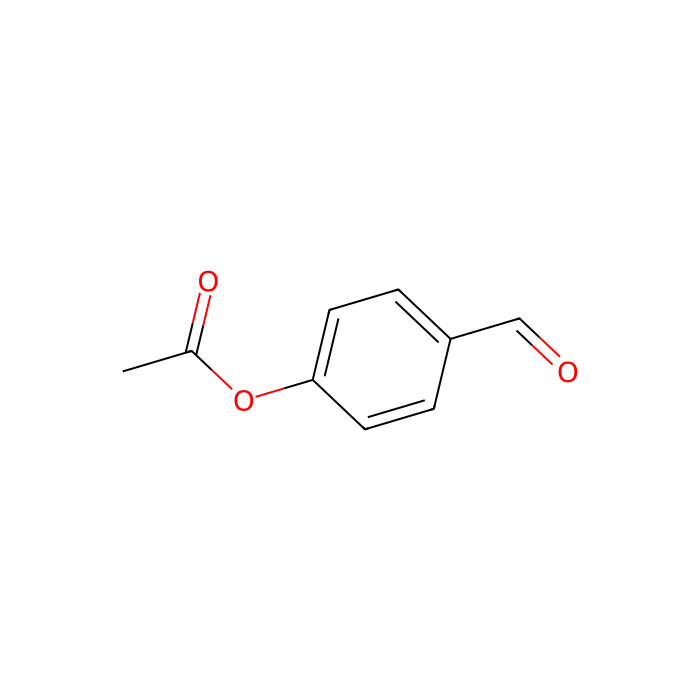
Brief description: 4-Acetoxybenzaldehyde is a para-substituted aromatic aldehyde bearing an acetoxy (phenyl acetate) protecting group opposite the formyl group on a benzene ring.
Item-specific (from Product Data)
CAS: 878-00-2
CID: 70144
Storage note: Room temperature (Product Data)
Shipped: Normal (Product Data)
SMILES: Not specified for this item; refer to CoA/Spec Sheet.
InChIKey: Not specified for this item; refer to CoA/Spec Sheet.
Literature identity (general reference; not item-specific)
2D structural description: A benzene ring bearing a formyl group (–CHO) at C-1 and an acetoxy substituent (–O–C(O)CH3) at C-4 (para to the aldehyde). Functional groups: aromatic ring, aldehyde, aryl ester (acetate). No stereocenters.
Structural features of relevance (general)
Electrophilic aldehyde carbonyl conjugated to the aromatic ring (reduced innate reactivity vs aliphatic aldehydes).
The acetoxy is a prototypical protecting group for a para-phenol; readily cleaved under basic or acidic solvolysis to give 4-hydroxybenzaldehyde.
Synthetic Utility
Functional group repertoire
Aldehyde: Entry to olefination (Wittig/HWE), reductive amination (post-reduction), cyanation (cyanohydrins), and oxidation to acids. Aromatic conjugation moderates reactivity, allowing controlled C–C bond formation with good chemoselectivity.
Acetoxy (phenyl acetate): Classic protecting group for phenols; readily removed under alkaline or acidic solvolysis. Amenable to transesterification to modify protecting-group robustness (e.g., benzoate or pivalate).
Retrosynthetic value (general)
Serves as a branch point to p-hydroxybenzaldehyde and its derivatives. From 4-acetoxybenzaldehyde, late-stage deprotection gives access to ethers (Williamson), carbamates/urethanes, and sulfonate esters on the phenolic oxygen, enabling further cross-coupling (via aryl triflates/mesylates).
The aldehyde enables convergent assembly of styrenes/cinnamates (HWE), diaryl ethylenes (Wittig), and alcohols/ethers (via reduction then substitution), facilitating modular library synthesis in medicinal chemistry.
Selectivity notes
The acetate typically withstands many base-mediated olefinations and mild hydride reductions; strongly basic nucleophiles (alkoxides, thiolates) can induce transesterification or cleavage—adjust conditions accordingly.
Bisulfite adduct formation provides a convenient handle for purification and temporary masking of the aldehyde under aqueous conditions.
Not applicable. This product is a small-molecule building block, not a biological macromolecule or affinity reagent. No antigen/epitope specificity, species reactivity, clone, or isotype applies.
We use cookies to ensure the website functions properly and, where permitted, to improve your experience. You can manage your preferences at any time in Settings. Learn more in our Cookie Policy.
Shall we send you a message when we have discounts available?
Remind me later
Thank you! Please check your email inbox to confirm.
Products are supplied to verified businesses, institutions, and qualified professionals for research and development use only. Not for use in humans, animals, diagnosis, or therapy.

 F2126001