Determine the necessary mass, volume, or concentration for preparing a solution.
Taxonomy Tree
| Kingdom | Organic compounds |
|---|---|
| Superclass | Phenylpropanoids and polyketides |
| Classe | Cinnamic acids and derivatives |
| Subclass | Cinnamic acids |
| Intermediate Tree Nodes | Not available |
| Direct Parent | Cinnamic acids |
| Alternative Parents | Styrenes Aniline and substituted anilines Amino acids Monocarboxylic acids and derivatives Carboxylic acids Primary amines Organopnictogen compounds Organic oxides Hydrocarbon derivatives Carbonyl compounds |
| Molecular Framework | Aromatic homomonocyclic compounds |
| Substituents | Cinnamic acid - Aniline or substituted anilines - Styrene - Monocyclic benzene moiety - Benzenoid - Amino acid or derivatives - Amino acid - Carboxylic acid derivative - Carboxylic acid - Monocarboxylic acid or derivatives - Amine - Organooxygen compound - Organonitrogen compound - Primary amine - Hydrocarbon derivative - Organic oxide - Organopnictogen compound - Carbonyl group - Organic oxygen compound - Organic nitrogen compound - Aromatic homomonocyclic compound |
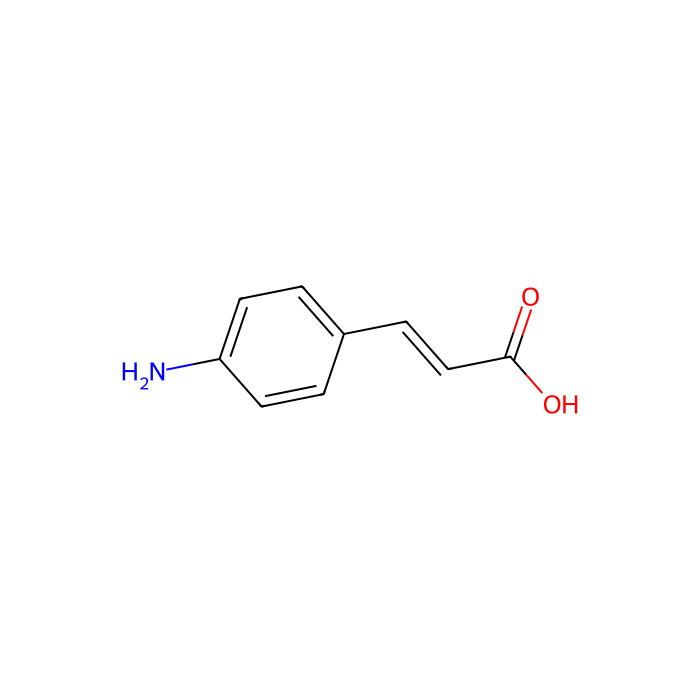
| Description | This compound belongs to the class of organic compounds known as cinnamic acids. These are organic aromatic compounds containing a benzene and a carboxylic acid group forming 3-phenylprop-2-enoic acid. |
| External Descriptors | Not available |
Find and download the COA for your product by matching the lot number on the packaging.
| Lot Number | Certificate Type | Date | Article |
|---|---|---|---|
| Certificate of Analysis | Oct 13, 2025 | A151768 | |
| Certificate of Analysis | Oct 13, 2025 | A151768 | |
| Certificate of Analysis | Oct 13, 2025 | A151768 | |
| Certificate of Analysis | Mar 04, 2025 | A151768 | |
| Certificate of Analysis | Jan 30, 2024 | A151768 | |
| Certificate of Analysis | Dec 20, 2021 | A151768 |
| Solubilité | Solubility in dilute HCl almost transparency; |
|---|---|
| Poids moléculaire | 163.17 |
| XLogP3 | 1.100 |
| Hydrogen Bond Donor Count | 2 |
| Hydrogen Bond Acceptor Count | 3 |
| Rotatable Bond Count | 2 |
| Exact Mass | 163.063 Da |
| Monoisotopic Mass | 163.063 Da |
| Topological Polar Surface Area | 63.300 Ų |
| Heavy Atom Count | 12 |
| Formal Charge | 0 |
| Complexity | 181.000 |
| Isotope Atom Count | 0 |
| Defined Atom Stereocenter Count | 0 |
| Undefined Atom Stereocenter Count | 0 |
| Defined Bond Stereocenter Count | 1 |
| Undefined Bond Stereocenter Count | 0 |
| The total count of all stereochemical bonds | 1 |
| Covalently-Bonded Unit Count | 1 |
H315:Causes skin irritation
H319:Causes serious eye irritation
H335:May cause respiratory irritation
P261:Avoid breathing dust/fume/gas/mist/vapors/spray.
P305+P351+P338:IF IN EYES: Rinse cautiously with water for several minutes. Remove contact lenses if present and easy to do - continue rinsing.
P280:Wear protective gloves/protective clothing/eye protection/face protection.
P302+P352:IF ON SKIN: wash with plenty of water.
P321:Specific treatment (see ... on this label).
P405:Store locked up.
P501:Dispose of contents/container to an approved waste disposal plant.
P312:Call a POISON CENTER or doctor/... if you feel unwell.
P233:Keep container tightly closed.
P264:Wash hands [and …] thoroughly after handling.
P260:Do not breathe dust/fume/gas/mist/vapors/spray.
P271:Use only outdoors or in a well-ventilated area.
P304:IF INHALED:
P340:Remove victim to fresh air and keep at rest in a position comfortable for breathing.
P362:Take off contaminated clothing.
P403:Store in a well-ventilated place.
P304+P340:IF INHALED: Remove person to fresh air and keep comfortable for breathing.
P337+P313:IF eye irritation persists: Get medical advice/attention.
P403+P233:Store in a well-ventilated place. Keep container tightly closed.
P332+P313:IF SKIN irritation occurs: Get medical advice/attention.
Not applicable. No immunoassay or bioassay application protocols (WB, IHC, IF, FC, etc.) are defined for this small-molecule reagent. For use in synthesis or materials research, refer to the Reaction Conditions and Synthetic Utility sections for practical guidance.
This product is intended for research use only. No clinical or therapeutic claims are made.
General biochemistry context (literature; not item-specific):
Note: 4-Aminocinnamic acid itself is not a natural metabolite to our knowledge; its use in biology is as a synthetic building block, chromophore, or crosslinker precursor in assay development and materials interfacing. Any biological testing should be designed and interpreted within appropriate laboratory safety and ethical frameworks.
Not a dedicated buffering agent. As a weak carboxylic acid with an aniline group, it does not form a classical buffer system with a well-defined pKa window commonly used in biochemistry.
Practical notes (general):
Greener choices focus on solvent and reagent selection, as the substrate itself is a solid aromatic acid/amine.
Greener solvent options (literature/general):
Coupling reagents and strategies:
Energy and protection:
Comparison snapshot (general; not item-specific):
Waste minimization:
No therapeutic or clinical claims are made. This product is for research use only.
Formulation/manufacturing context (literature/general):
Regulatory status:
Item-specific (from Product Data):
Literature/general values (for reference; not item specifications):
Notes for practitioners:
If exact numerical values (mp, pKa, logP, refractive index, density) are required for your method validation, consult primary literature or request the CoA/Spec Sheet for this specific lot.
Item-specific quality information (from Product Data):
How to interpret grades (general guidance):
Stabilizers and isomer content:
Recommended QC checks (user side):
Key application domains (literature/general; expandable from typical catalog uses):
Practical tips:
General literature guidance (not item specifications; optimize per system):
Amide coupling (to form cinnamamides):
Esterification (to cinnamate esters):
Hydrogenation of C=C:
Diazotization/azo coupling (aniline functionalization):
Photochemical crosslinking (as esters on polymers):
Always perform small-scale trials and confirm conditions by literature precedents for your substrate class.
Item-specific hazard information (from Product Data):
General safety guidance (literature/typical for aromatic amino acids; defer to SDS as authoritative):
Always consult the product-specific SDS prior to use. Research use only.
Solubility and polarity considerations (literature/general):
Practical dissolution strategies:
Comparison to alternatives (selection guide):
Item-specific (from Product Data):
General guidance (literature/practice; not item specifications):
Research Use Note: For research use only.
Overview: 4-Aminocinnamic acid (p-aminocinnamic acid) is a para-anilide-substituted, α,β-unsaturated carboxylic acid. It combines an aniline (–NH2) on a para-substituted phenyl ring conjugated to an acrylic acid side chain (–CH=CH–CO2H), offering dual functional handles (amine and carboxylate) and a conjugated C=C.
Item-specific (from Product Data):
Literature/computed identifiers and features (for reference; not item specifications):
2D structure in words:
Functional group leverage:
Retrosynthetic value:
Representative transformations (literature):
Not applicable. This product is a small-molecule chemical and is not an antibody, protein, or nucleic acid probe. No target, epitope, species reactivity, clone, or isotype information applies.