This compound belongs to the class of organic compounds known as cinnamic acids. These are organic aromatic compounds containing a benzene and a carboxylic acid group forming 3-phenylprop-2-enoic acid.
External Descriptors
Not available
1. Djoumbou Feunang Y, Eisner R, Knox C, Chepelev L, Hastings J, Owen G, Fahy E, Steinbeck C, Subramanian S, Bolton E, Greiner R, and Wishart DS. ClassyFire: Automated Chemical Classification With A Comprehensive, Computable Taxonomy. Journal of Cheminformatics, 2016, 8:61.
Determine the necessary mass, volume, or concentration for preparing a solution.
Dilution Calculator
Determine the dilution needed to prepare a stock solution.
Reconstitution Calculator
Avis
Avis des clients
Application Protocols
Item-specific tested applications and dilutions are not applicable for a small-molecule reagent and are not provided. For practical use:
Preparation of stock solutions for screening: Dissolve in anhydrous DMSO (e.g., 10–100 mM), vortex/sonicate, filter if needed (0.22 µm PTFE), store aliquots protected from light. Verify solubility upon dilution into assay media.
For synthesis: See Reaction Conditions for typical coupling and functionalization procedures. Adjust stoichiometry and scale according to your experimental design.
Biological Roles
Item-specific biological data are not provided. The following points are general, literature-based context for cinnamic acid derivatives and para-alkoxy substitutions; they are not product specifications and are not clinical claims.
Phenylpropanoid scaffold: Cinnamic acid is a central intermediate in the phenylpropanoid pathway in plants. Para-alkoxy substitutions, such as propoxy, increase hydrophobicity and modulate membrane association in model studies.
Protein/ligand interactions: The conjugated aryl–acrylic acid motif can engage in π–π and hydrophobic interactions, while the carboxylate provides ionic/hydrogen-bonding capability; affinity is system-dependent (literature).
Photochemical behavior: Cinnamate chromophores absorb in the near-UV; para-alkoxy groups often red-shift and intensify absorption, useful in designing photoresponsive materials used in biochemical tooling (e.g., photo-crosslinkable surfaces), not as therapeutics.
Metabolic considerations: In biotransformations, cinnamic acids can undergo β-oxidation-like side-chain shortening, reduction of the C=C, or conjugation (glucuronidation) in biological systems (literature). Para-alkoxy groups can affect metabolic rate and distribution.
Note: This product is labeled For research use only. It is not intended for diagnostic or therapeutic use. For any work involving biological systems, assess cytotoxicity and solvent carryover (e.g., DMSO) independently under your specific assay conditions.
Buffer Applications
4-Propoxycinnamic acid is not commonly employed as a buffering agent. As a monocarboxylic acid with pKa in the typical cinnamic acid range (~4.2–4.6, literature), it could in principle buffer near pH ~4–5, but it lacks widespread usage in standard biochemical buffer systems.
Practical guidance:
For aqueous work, it is generally dissolved in a co-solvent (DMSO/EtOH) or converted to its sodium salt to increase solubility; this is formulation, not buffering.
Established buffers (acetate, citrate, MES, MOPS, phosphate) are recommended for precise pH control.
If you require an aromatic carboxylate at defined pH for specific binding or spectroscopic studies, prepare the corresponding salt in water or mixed solvent and verify pH by direct measurement. Otherwise, see Solvent Selection for dissolution strategies.
Green Alternatives
Greener choices relate primarily to solvent and reagent selection rather than the substrate itself.
Preferable solvents (relative to DCM/DMF):
2-Methyltetrahydrofuran (2-MeTHF): Bio-based, lower toxicity than THF/DCM; good solvency for cinnamates; forms azeotropes to assist water removal in esterifications.
Ethyl acetate and propylene carbonate: Viable for extractions and some couplings; EtOAc is readily biodegradable and low toxicity.
CPME (cyclopentyl methyl ether): Broad solvency, low peroxide formation rate vs THF/Et2O, water-tolerant for some couplings.
Green alcohols: Ethanol (bioethanol) as a benign medium for esterifications or recrystallizations.
Reagent choices:
Use EDCI/DMAP or CDI for amide/ester formations to avoid carbodiimide urea waste handling issues (DCC) and minimize chlorinated byproducts from acid chloride routes.
Enzymatic esterification (lipases) in green solvents or solvent-free conditions can form cinnamate esters under mild conditions (literature), reducing energy input.
Energy and waste minimization:
Microwave-assisted couplings shorten reaction times and reduce solvent volumes.
Solvent recycling (EtOAc, 2-MeTHF) and crystallization-based purifications decrease silica waste from chromatography.
Trade-offs (balanced view):
2-MeTHF/CPME may alter reaction rates/selectivities vs DCM/THF and can retain water; drying protocols (molecular sieves) may be required.
Propylene carbonate has high boiling point; removal may need reduced pressure/heat, which could risk E↔Z isomerization if overheated.
Pharmaceutical Uses
No pharmacopeial status or excipient role is specified for this item; refer to CoA/Spec Sheet. The points below are general, literature-based and do not imply therapeutic use.
Synthetic intermediate: Para-alkoxy cinnamic acids can serve as intermediates to UV-absorbing cinnamate esters used in topical formulations (sunscreen filters) and as photostabilizers in materials. 4-Propoxycinnamic acid may be esterified to yield derivatives with tuned lipophilicity.
Excipients and materials: Cinnamate-bearing polymers are employed as photoresists and crosslinkable coatings; small-molecule cinnamates can act as UV absorbers in packaging. Any incorporation would be as a functional additive in materials, not as an active pharmaceutical ingredient.
Salt and pro-form considerations: Formation of sodium or tromethamine salts can enhance aqueous processability for manufacturing intermediates (general formulation practice).
Compliance notes:
This product is for research use only and is not intended for use in humans or animals. If a regulated application is contemplated (e.g., GMP synthesis of an intermediate), request full quality documentation and assess residual solvents, impurities, and photostability under relevant guidelines.
Physical Properties
Only general/literature properties are provided below for context. They are NOT item specifications.
Aggregation state/appearance: Not specified for this item; refer to CoA/Spec Sheet.
Melting point: Often crystalline solids of p-alkoxy cinnamic acids melt in the ~150–200 °C range (literature, compound-dependent). Specific MP for this item: Not specified; refer to CoA/Spec Sheet.
Boiling point: Not typically distilled; such aromatic carboxylic acids decompose before boiling at 1 atm (literature). Specific BP for this item: Not specified; refer to CoA/Spec Sheet.
pKa: Carboxylic acid functionality typically pKa ~4.2–4.6 for cinnamic acids; para-alkoxy substitution can slightly modulate acidity (literature).
LogP (octanol/water): Expected moderate lipophilicity due to p-alkoxy substituent; literature estimates for similar compounds are in the ~2–3 range. Specific value for this item: Not specified; refer to CoA/Spec Sheet.
Solubility (qualitative, literature):
Water: low at neutral pH; increases in basic media (formation of carboxylate salts).
Organic: soluble in polar aprotic solvents (DMSO, DMF), alcohols (MeOH, EtOH), chlorinated solvents, and esters; sparingly soluble in alkanes.
UV/Vis: Conjugated cinnamate chromophore shows strong π→π* absorption in the near-UV; exact λmax depends on solvent and E/Z ratio (literature). Specific UV cutoff/λmax for this item: Not specified; refer to CoA/Spec Sheet.
Density/refractive index: Not applicable/Not specified for this item; refer to CoA/Spec Sheet.
Quality and Grades
Item-specific grade/purity: Not specified for this item; refer to CoA/Spec Sheet.
Guidance on typical grades for small-molecule research reagents (general):
Research grade: Suitable for most synthetic and materials research. Purity is typically specified on the CoA; trace impurities (e.g., residual solvents, inorganic salts) can vary by lot.
HPLC grade (for solvents) or LC/MS grade: Low nonvolatile residue and low UV background; generally not applicable to solid reagents unless specified for chromatography standards.
BioUltra/BioXtra: Tight limits on trace metals/bioburden; relevant if using for enzyme assays or materials contacting biological systems.
Considerations specific to cinnamic acid derivatives:
E/Z isomer ratio can influence optical properties and reactivity. If photochemical performance or stereospecific transformations are critical, request the E:Z ratio on the CoA.
Stabilizers: Typically not required for solid cinnamic acids; however, light exposure can promote E↔Z isomerization. If your application is photoactive, verify handling in low light and consider requesting dark packaging.
Metals/UV cutoff/peroxide levels: Not specified for this item; refer to CoA/Spec Sheet.
Recommendations:
For analytical or photoresponsive applications, obtain lot-specific CoA data (purity assay method, residual solvents, water content by KF, and E:Z ratio) and, if needed, perform a brief recrystallization to optimize optical clarity.
Reaction and Applications
Cinnamic acid derivatives are versatile building blocks in organic synthesis and functional materials. The p-propoxy substituent modulates electronics (para-EDG) and solubility.
Representative research applications (literature/general):
Ester and amide formation: Access to 4-propoxycinnamates and amides via Steglich (DCC/DMAP), EDCI/DMAP, or acid chloride routes for materials (e.g., liquid-crystalline, photo-crosslinkable cinnamate polymers) and surface modifiers.
Photochemistry: Cinnamate esters undergo [2+2] cycloadditions under UV (≈300–365 nm) enabling reversible photodimerization in polymer networks and photoresists. The para-alkoxy group enhances conjugation and UV absorbance.
Hydrogenation/reduction: Selective hydrogenation of the C=C affords 3-(4-propoxyphenyl)propionic acid; full reduction (e.g., BH3) yields alcohol derivatives. Chemoselectivity (C=C vs C=O) can be tuned by catalyst and conditions.
Conjugate addition/activation: As an α,β-unsaturated acid, it participates in Michael additions after activation (e.g., as mixed anhydrides or activated esters) or under catalytic conditions (Cu, organocatalysts) to install soft nucleophiles.
Cross-coupling as alkene partner: Acts as the olefin component in Heck-type reactions with aryl/vinyl halides (often using the corresponding ester for better compatibility), enabling elaboration at the β-position.
Cyclopropanation/epoxidation: Facile alkene functionalization using Simmons–Smith or peracids (epoxidation), followed by ring-opening strategies to diversify functionality.
Practical notes:
Dry, oxygen-free conditions are usually unnecessary for simple coupling, but exclude moisture for carbodiimide couplings to avoid urea byproducts.
Protect from strong UV during handling if E:Z ratio is critical. Use amber glassware for photoactive applications.
Reaction Conditions
The following are representative literature-style conditions for transformations of cinnamic acids and should be optimized for your system. They are general guidance, not product specifications.
SOCl2 (2–4 equiv) with catalytic DMF, reflux 1–2 h; remove volatiles; react acid chloride with nucleophile in pyridine or Et3N at 0–25 °C
Catalytic hydrogenation of C=C:
5–10 wt% Pd/C (5–10 mol% Pd rel.), H2 1–3 atm, EtOH/EtOAc, 20–50 °C, 1–6 h → 3-(4-propoxyphenyl)propionic acid
For selective C=C reduction over C=O, use mild conditions and monitor closely
Epoxidation:
mCPBA (1.1–1.5 equiv), DCM, 0 °C to rt, 1–4 h; quench with Na2SO3/NaHCO3, isolate epoxide ester/acid (depending on protection)
Heck as alkene partner:
With aryl bromide/iodide, Pd(OAc)2 (1–3 mol%), PPh3 (5–10 mol%), Et3N or DIPEA, DMF/MeCN, 80–120 °C, 6–24 h; often use the corresponding ester for improved compatibility
Photodimerization (in polymers/films):
UV 300–365 nm, solid-state or concentrated films; monitor conversion by UV/IR; reversible on shorter-wavelength irradiation depending on matrix
Note: Protect from strong UV during solution-phase synthesis to preserve E stereochemistry.
Safety and Handling
GHS/CLP status (item-specific): Not specified for this item; refer to the SDS.
Signal word, hazard statements, pictograms (item-specific): Not specified for this item; refer to the SDS.
General laboratory safety guidance for aromatic carboxylic acids and cinnamate derivatives (informational; defer to SDS):
Likely hazards: May cause skin/eye irritation and respiratory tract irritation if dust is generated. Avoid dust formation and inhalation of particulates.
PPE: Wear lab coat, safety glasses or goggles, and appropriate chemically resistant gloves (e.g., nitrile). Use dust mask or local exhaust if dusting may occur.
Handling: Work in a fume hood. Avoid contact with strong oxidizers and strong bases/acids unless intended for reaction. Prevent dust accumulation on hot surfaces.
Storage: Room temperature per Product Data; keep tightly closed in a dry place, protected from moisture and prolonged light to maintain E:Z integrity.
Inhalation: Move to fresh air; seek medical attention if symptoms persist.
Skin/eyes: Rinse with water for several minutes; remove contaminated clothing; seek medical attention if irritation persists.
Ingestion: Rinse mouth; do not induce vomiting; seek medical advice.
Fire fighting: Treat as an organic combustible solid; use CO2, dry chemical, or foam. Combustion may produce CO/CO2 and irritating fumes.
Solvent Selection
Solubility behavior (literature, qualitative): 4-Propoxycinnamic acid is a moderately lipophilic aromatic acid that dissolves well in polar organic solvents and bases, but only sparingly in neutral water.
Polar aprotic (preferred for stock solutions/synthesis): DMSO, DMF, NMP, acetone, acetonitrile, ethyl acetate. DMSO/DMF enable high-concentration stocks for screening; dilute promptly into media or buffer containing co-solvent to avoid precipitation.
Alcohols: Methanol, ethanol, isopropanol – good solvency; can participate in esterification under acidic or coupling conditions (be mindful in reactions).
Chlorinated/ethers: Dichloromethane, chloroform, THF – good to excellent solvency; THF/ethers may aid in coupling reactions but avoid prolonged exposure to light.
Aqueous systems: Poor solubility at neutral pH; forms soluble carboxylate salts in basic media (e.g., 0.01–0.1 M NaOH). For biological assays, dissolve in DMSO, then dilute into buffered systems to ≤1% v/v DMSO.
When to choose alternatives:
If water-only formulations are required, derivatize to a salt (e.g., sodium 4-propoxycinnamate) or use cyclodextrin inclusion complexes (literature strategies) rather than forcing high pH in sensitive systems.
For greener profiles, consider 2-MeTHF or CPME in place of DCM/THF where compatible (see Green Alternatives).
Practical tips:
Slight warming (30–40 °C) and sonication expedite dissolution in DMSO/EtOH.
For chromatographic purification, hexanes/EtOAc or toluene/EtOAc gradients typically provide good separation due to moderate polarity.
Storage and Reconstitution
Storage (item-specific from Product Data): Store at room temperature. Ship under normal conditions.
Light/moisture: Keep tightly closed in a dry container. Protect from prolonged light exposure to minimize E↔Z isomerization of the cinnamate double bond.
Stability: Specific shelf-life and degradation pathways are not specified for this item; refer to CoA/Spec Sheet. As a general guide, solid cinnamic acids are stable for many months when kept dry and dark.
Reconstitution and stock preparation (general guidance):
Solvents: DMSO, DMF, ethanol, or ethyl acetate typically dissolve readily. For aqueous systems, prepare the sodium salt (neutralize with equimolar NaOH) or use mixed solvents.
Concentration: For bioassays, prepare 10–100 mM stocks in DMSO; for synthetic use, dissolve to convenient molarity based on reaction needs.
Technique: Warm gently (30–40 °C) and sonicate if needed. Filter through 0.22 µm PTFE to remove particulates for analytical applications.
Freeze–thaw: If storing DMSO stocks, aliquot to avoid repeated freeze–thaw; store at −20 °C protected from light. Inspect for precipitation before use and redissolve with gentle warming.
Always consult the lot-specific CoA and SDS for definitive guidance on storage limits, stability, and safe handling.
Research Use Note: For research use only.
Structure and Identity
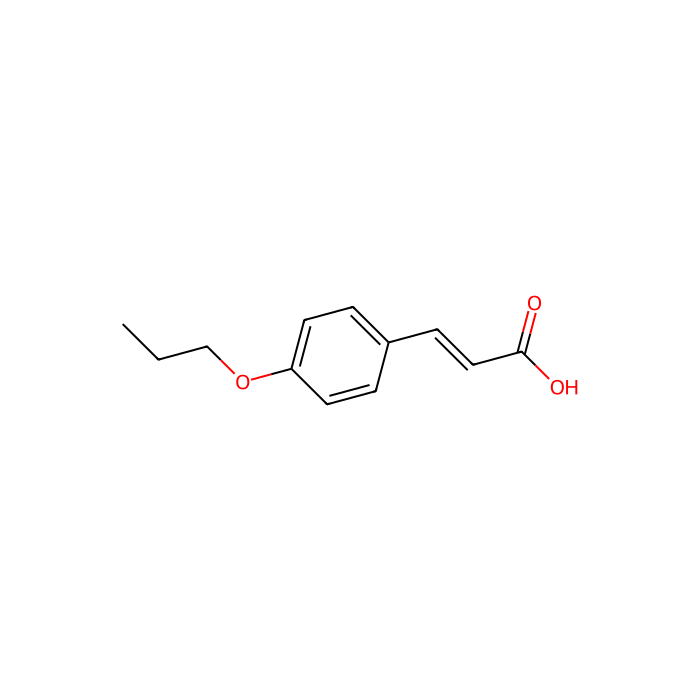
Brief description: 4-Propoxycinnamic acid is a para-alkoxy–substituted cinnamic acid (an E-aryl acrylic acid) featuring a conjugated styryl–carboxylate motif and a p-propoxy substituent on the phenyl ring.
Item-specific identifiers (from Product Data)
CAS: 69033-81-4
SKU: P124316
Storage Conditions: Room temperature (as provided)
InChIKey: Not specified for this item; refer to CoA/Spec Sheet.
SMILES: Not specified for this item; refer to CoA/Spec Sheet.
Literature/computed structural identifiers and formula (for reference; not item specifications)
Common name: 4-Propoxycinnamic acid (p-propoxy-trans-cinnamic acid)
Molecular formula (literature): C12H14O3
Molecular weight (literature): ~206.24 g/mol
Example SMILES (literature): CCCOc1ccc(cc1)/C=C/C(=O)O (E isomer shown)
A benzene ring bearing a para-propoxy substituent (–O–CH2–CH2–CH3) and a trans-ethenylcarboxylic acid chain (–CH=CH–CO2H) at the 1- and 4-positions. The alkene is typically encountered in the E configuration for cinnamic acids, extending conjugation from the anisole-like ring through the double bond into the carbonyl.
Synthetic Utility
Functional group set and reactivity (general/literature):
Carboxylic acid: amenable to activation (acid chlorides, mixed anhydrides, CDI) for ester/amide synthesis; engages in peptide-type couplings (EDCI/HATU) to furnish cinnamamides/cinnamates.
Conjugated alkene (α,β-unsaturation): undergoes hydrogenation (chemo-/regioselective), epoxidation (peracids), dihydroxylation (OsO4/NMO), cyclopropanation (Simmons–Smith), and serves as a Michael acceptor when suitably activated/catalyzed.
Para-alkoxy arene: electron-donating, activates ring toward electrophilic aromatic substitution (EAS) at ortho/para; however, para is occupied, so ortho positions may be further derivatized under Friedel–Crafts conditions (with care to avoid acid-catalyzed side reactions at the alkene/carboxyl).
Strategic uses:
Handle as a linchpin to introduce cinnamate chromophores into polymers via esterification of diols/diacrylates, enabling UV-crosslinkable materials.
Reductive routes from the acid provide access to 4-propoxy-styrene derivatives (via decarboxylation after reduction/activation) or to saturated propionic acid analogs for SAR studies.
Late-stage diversification at the double bond allows installation of heteroatom functionality (aziridination/epoxidation followed by opening) with regiocontrol from the electron-withdrawing carboxyl.
Orthogonality/practical tips:
Prefer esterification before strong Lewis-acidic EAS to protect the acid and control solubility.
Employ bases (DIPEA, pyridine) judiciously to avoid E/Z isomerization under prolonged basic conditions or light exposure.
For cross-couplings where poor solubility is limiting, convert to the methyl/ethyl ester to improve handling, then hydrolyze post-transformation.
Target Specificity
Not applicable. This product is a small-molecule organic reagent, not a biological affinity reagent or antibody. No antigen/epitope, species reactivity, clone, or isotype information applies.
We use cookies to ensure the website functions properly and, where permitted, to improve your experience. You can manage your preferences at any time in Settings. Learn more in our Cookie Policy.
Shall we send you a message when we have discounts available?
Remind me later
Thank you! Please check your email inbox to confirm.
Products are supplied to verified businesses, institutions, and qualified professionals for research and development use only. Not for use in humans, animals, diagnosis, or therapy.

 H2218471