Determine the necessary mass, volume, or concentration for preparing a solution.
| Activity Type | Relation | Activity value | Units | Action Type | Journal | PubMed Id | doi | Assay Aladdin ID |
|---|

Ultra pure, ≥99.5%(HPLC) Ultra pure pour les flux de travail chromatographiques et analytiques sensibles nécessitant une interférence de ligne de base minimale.
Room temperature Expédition Normal. Consultez le COA spécifique au lot pour les spécifications exactes.
SDS, COA, fiche technique et fiche de spécifications disponibles au téléchargement. COA spécifique au lot accessible via la recherche par numéro de lot.
Cité dans 143 publications à comité de lecture couvrant la chromatographie, la synthèse organique et les réactions de couplage croisé.
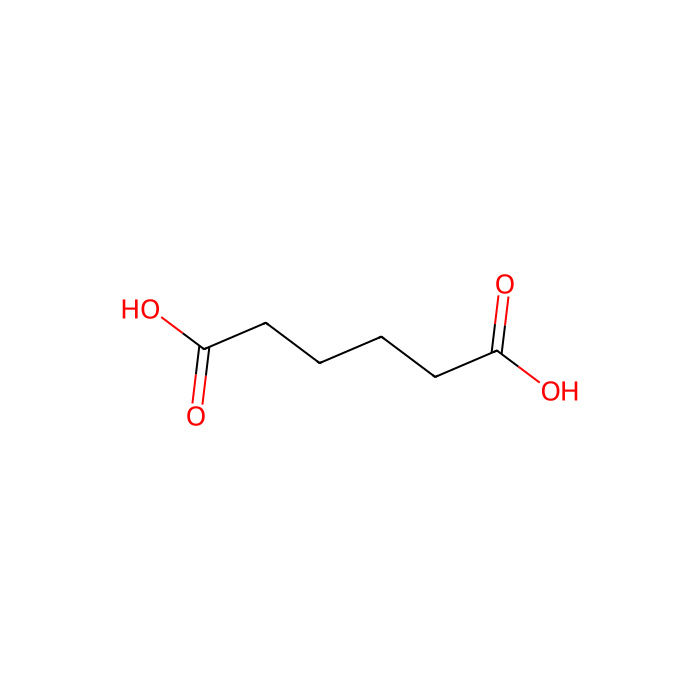
Adipic acid is a straight-chain aliphatic dicarboxylic acid, commonly used in the manufacturing of nylon-6,6 and plasticizers. Conventionally it was manufactured from petrochemicals but in recent days it can be synthesized from renewable substrates by means of biological methods.
Application
Adipic acid can be used as a starting material in the preparation of:
Aliphatic polyesters by reacting with ethyleneglycol/1,3 propyleneglycol/1,4-butanediol using inorganic acid as a catalyst.
Cyclopentanone using a weak base such as Na2CO3.
Linear polybutylene adipate (PBA) having carboxylic acids at the terminals by reacting with 1,4-butanediol.
Document complet couvrant les dangers, la manipulation, le stockage et la conformité réglementaire.
<<<<<<< HEAD Télécharger la SDS → ======= Télécharger la SDS → >>>>>>> release248-p3Données qualité spécifiques au lot. Saisissez votre numéro de lot pour récupérer le COA exact.
Rechercher le COA →Résumé de référence rapide des spécifications et applications du produit.
Voir la fiche technique →Attributs de qualité complets et critères d'acceptation pour cette qualité.
Voir la fiche de spécifications →Taxonomy Tree
| Kingdom | Organic compounds |
|---|---|
| Superclass | Lipids and lipid-like molecules |
| Classe | Fatty Acyls |
| Subclass | Fatty acids and conjugates |
| Intermediate Tree Nodes | Not available |
| Direct Parent | Medium-chain fatty acids |
| Alternative Parents | Dicarboxylic acids and derivatives Carboxylic acids Organic oxides Hydrocarbon derivatives Carbonyl compounds |
| Molecular Framework | Aliphatic acyclic compounds |
| Substituents | Medium-chain fatty acid - Dicarboxylic acid or derivatives - Carboxylic acid - Carboxylic acid derivative - Organic oxygen compound - Organic oxide - Hydrocarbon derivative - Organooxygen compound - Carbonyl group - Aliphatic acyclic compound |
| Description | This compound belongs to the class of organic compounds known as medium-chain fatty acids. These are fatty acids with an aliphatic tail that contains between 4 and 12 carbon atoms. |
| External Descriptors | Dicarboxylic acids |
| Activity Type | Relation | Activity value | Units | Action Type | Journal | PubMed Id | doi | Assay Aladdin ID |
|---|
| Activity Type | Relation | Activity value | Units | Action Type | Journal | PubMed Id | doi | Assay Aladdin ID |
|---|
| Activity Type | Relation | Activity value | Units | Action Type | Journal | PubMed Id | doi | Assay Aladdin ID |
|---|
| Activity Type | Relation | Activity value | Units | Action Type | Journal | PubMed Id | doi | Assay Aladdin ID |
|---|
| Activity Type | Relation | Activity value | Units | Action Type | Journal | PubMed Id | doi | Assay Aladdin ID |
|---|
| Activity Type | Relation | Activity value | Units | Action Type | Journal | PubMed Id | doi | Assay Aladdin ID |
|---|
| Activity Type | Relation | Activity value | Units | Action Type | Journal | PubMed Id | doi | Assay Aladdin ID |
|---|
| Activity Type | Relation | Activity value | Units | Action Type | Journal | PubMed Id | doi | Assay Aladdin ID |
|---|
| Activity Type | Relation | Activity value | Units | Action Type | Journal | PubMed Id | doi | Assay Aladdin ID |
|---|
| Activity Type | Relation | Activity value | Units | Action Type | Journal | PubMed Id | doi | Assay Aladdin ID |
|---|
Find and download the COA for your product by matching the lot number on the packaging.
| Lot Number | Certificate Type | Date | Article |
|---|---|---|---|
 G2629137 | Certificate of Analysis | Jun 01, 2026 | A108266 |
| G2629152 | Certificate of Analysis | Jun 01, 2026 | A108266 |
| A2607203 | Certificate of Analysis | Dec 26, 2025 | A108266 |
| A2607204 | Certificate of Analysis | Dec 26, 2025 | A108266 |
| I2509144 | Certificate of Analysis | Aug 18, 2025 | A108266 |
| I2509229 | Certificate of Analysis | Aug 18, 2025 | A108266 |
| A2521067 | Certificate of Analysis | Dec 20, 2024 | A108266 |
| A2521068 | Certificate of Analysis | Dec 20, 2024 | A108266 |
| I2429123 | Certificate of Analysis | Aug 29, 2024 | A108266 |
| I2429124 | Certificate of Analysis | Aug 29, 2024 | A108266 |
| F2427088 | Certificate of Analysis | Jun 05, 2024 | A108266 |
| F2427089 | Certificate of Analysis | Jun 05, 2024 | A108266 |
| A2329142 | Certificate of Analysis | Dec 29, 2022 | A108266 |
| A2329145 | Certificate of Analysis | Dec 29, 2022 | A108266 |
| G2213017 | Certificate of Analysis | Jun 14, 2022 | A108266 |
| E2218079 | Certificate of Analysis | Mar 12, 2022 | A108266 |
| Solubilité | Adipic acid is freely soluble in ethanol and methanol. It also dissolves in boiling water, and acetone. Additionally, the product is slightly soluble in water and cyclohexane and is practically insoluble in benzene and petroleum ether. |
|---|---|
| Sensibilité | Moisture sensitive. |
| Point d'éclair (°F) | 384.8 °F |
| Point d'éclair (°C) | 196℃ |
| Point d'ébullition (°C) | 265°C |
| Point de fusion (°C) | 153°C |
| Poids moléculaire | 146.140 g/mol |
| XLogP3 | 0.100 |
| Hydrogen Bond Donor Count | 2 |
| Hydrogen Bond Acceptor Count | 4 |
| Rotatable Bond Count | 5 |
| Exact Mass | 146.058 Da |
| Monoisotopic Mass | 146.058 Da |
| Topological Polar Surface Area | 74.600 Ų |
| Heavy Atom Count | 10 |
| Formal Charge | 0 |
| Complexity | 114.000 |
| Isotope Atom Count | 0 |
| Defined Atom Stereocenter Count | 0 |
| Undefined Atom Stereocenter Count | 0 |
| Defined Bond Stereocenter Count | 0 |
| Undefined Bond Stereocenter Count | 0 |
| The total count of all stereochemical bonds | 0 |
| Covalently-Bonded Unit Count | 1 |
Notre guide de sélection des qualités couvre la pureté, le statut du stabilisant et l'adéquation à l'application pour toutes les variantes de notre catalogue.
Voir le guide des qualités Ultra pure →