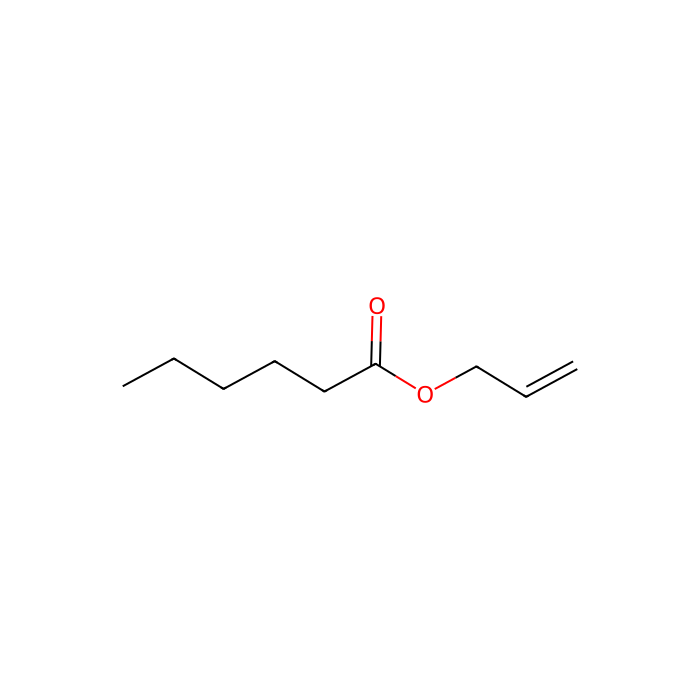
Allyl hexanoate - ≥98% , CAS No.123-68-2

CAS: 123-68-2 Cat. No.: A109767 Formule: C9H16O2 Poids moléculaire: 156.22 Beilstein Registry Number: 2(4)924 Numéro CE: 204-642-4
DISPONIBLE À COMMANDE
QUALITÉ & PURETÉ ≥98%
Synonyms
prop-2-en-1-yl hexanoate|ALLYL CAPROATE [INCI]|2-Propenyl n-hexanoate|Allyl n-hexanoate|Allyl hexanoate (natural)|Hexanoic Acid Allyl Ester|AllOCOPen|ALLYL HEXANOATE [FHFI]|prop-2-enyl hexanoate|Allyl caproate|allylhexanoate|2-PROPENYL HEXANOATE|Hexanoic acid, allyl ester|Hexanoic acid, 2-propenyl ester|Allyl hexanoate|ALLYL HEXANOATE [FCC]|Allylester kyseliny kapronove|Allyl n-caproate
Storage
Room temperature
Shipped In
Normal
★
Taille
USA
Allemagne (EU)*
Prix
Qté
25ml
A109767-25ml
4 En stock
—
14,90$US
100ml
A109767-100ml
5 En stock
3 En stock
24,90$US
500ml
A109767-500ml
1 En stock
—
97,90$US
Enter a quantity for the sizes you want to add.

Spécifications

Synonymes
prop-2-en-1-yl hexanoate | ALLYL CAPROATE [INCI] | 2-Propenyl n-hexanoate | Allyl n-hexanoate | Allyl hexanoate (natural) | Hexanoic Acid Allyl Ester | AllOCOPen | ALLYL HEXANOATE [FHFI] | prop-2-enyl hexanoate | Allyl caproate | allylhexanoate | 2-PROPENYL HEXANOATE | Hexanoic acid, allyl ester | Hexanoic acid, 2-propenyl ester | Allyl h Afficher plus
Spécifications et pureté
≥98%
Conditions de stockage de stockage
Room temperature
Expédié en
Normal
Pureté
≥98%
Noms et identifiants
Pubchem Sid
Pubchem Sid Url
https://pubchem.ncbi.nlm.nih.gov/substance/504753447
SMILES
CCCCCC(=O)OCC=C
IUPAC Name
prop-2-enyl hexanoate
InChIKey
RCSBILYQLVXLJG-UHFFFAOYSA-N
InChI
1S/C9H16O2/c1-3-5-6-7-9(10)11-8-4-2/h4H,2-3,5-8H2,1H3
Isomères SMILES
CCCCCC(=O)OCC=C
WGK Allemagne
2
RTECS
MO6125000
Numéro ONU
2810
Poids moléculaire
156.22
Beilstein
2(4)924
Reaxys
1761920
Reaxys-RN_link_address
https://www.reaxys.com/reaxys/secured/hopinto.do?context=S&query=IDE.XRN=1761920&ln=

Données avancées

Taxonomic Classification

Taxonomy Tree

KingdomOrganic compounds
SuperclassLipids and lipid-like molecules
ClasseFatty Acyls
SubclassFatty acid esters
Intermediate Tree Nodes Not available
Direct ParentFatty acid esters
Alternative Parents Carboxylic acid esters  Monocarboxylic acids and derivatives  Organic oxides  Hydrocarbon derivatives  Carbonyl compounds  
Molecular FrameworkAliphatic acyclic compounds
Substituents Fatty acid ester - Carboxylic acid ester - Monocarboxylic acid or derivatives - Carboxylic acid derivative - Organic oxygen compound - Organic oxide - Hydrocarbon derivative - Organooxygen compound - Carbonyl group - Aliphatic acyclic compound
DescriptionThis compound belongs to the class of organic compounds known as fatty acid esters. These are carboxylic ester derivatives of a fatty acid.
External Descriptors Not available
Structure 3D
Modèle de structure chimique interactif


Cibles associées (non humaines)
Acyrthosiphon pisum (40 Activities)
Activity TypeRelationActivity valueUnitsAction TypeJournalPubMed IddoiAssay Aladdin ID
Tribolium castaneum (596 Activities)
Activity TypeRelationActivity valueUnitsAction TypeJournalPubMed IddoiAssay Aladdin ID
Mécanismes d'action
Certificats (CoA, COO, BSE/TSE et tableau d'analyse)
C of A & Other Certificates(BSE/TSE, COO):
Analytical Chart:

Find and download the COA for your product by matching the lot number on the packaging.

7 results found

Lot NumberCertificate TypeDateArticle
J2630081J2630081Certificate of AnalysisNov 03, 2026 A109767
E2311076E2311076Certificate of AnalysisOct 09, 2026 A109767
E2311085E2311085Certificate of AnalysisOct 09, 2026 A109767
F1920007F1920007Certificate of AnalysisAug 13, 2026 A109767
H2218027H2218027Certificate of AnalysisFeb 04, 2026 A109767
H2218029H2218029Certificate of AnalysisFeb 04, 2026 A109767
H2218028H2218028Certificate of AnalysisMay 07, 2024 A109767
Propriétés chimiques et physiques
SolubilitéInsoluble in water; Soluble in Ether,Alcohol
Indice de réfraction1.424
Point d'éclair (°F)150.8 °F
Point d'éclair (°C)66°C
Point d'ébullition (°C)75-76°C
Poids moléculaire156.22
XLogP32.700
Hydrogen Bond Donor Count0
Hydrogen Bond Acceptor Count2
Rotatable Bond Count7
Exact Mass156.115 Da
Monoisotopic Mass156.115 Da
Topological Polar Surface Area26.300 Ų
Heavy Atom Count11
Formal Charge0
Complexity119.000
Isotope Atom Count0
Defined Atom Stereocenter Count0
Undefined Atom Stereocenter Count0
Defined Bond Stereocenter Count0
Undefined Bond Stereocenter Count0
The total count of all stereochemical bonds0
Covalently-Bonded Unit Count1
Sécurité et dangers (GHS)
Pictogramme(s)
GHS06,   GHS07,   GHS09
Signal
Danger
Mentions de danger

H301:Toxic if swallowed

H311:Toxic in contact with skin

H315:Causes skin irritation

H319:Causes serious eye irritation

H331:Toxic if inhaled

H400:Very toxic to aquatic life

H410:Very toxic to aquatic life with long lasting effects

H411:Toxic to aquatic life with long lasting effects

H412:Harmful to aquatic life with long lasting effects

Conseils de prudence

P261:Avoid breathing dust/fume/gas/mist/vapors/spray.

P264:Wash hands [and …] thoroughly after handling.

P270:Do not eat, drink or smoke when using this product.

P271:Use only outdoors or in a well-ventilated area.

P273:Avoid release to the environment.

P280:Wear protective gloves/protective clothing/eye protection/face protection.

P321:Specific treatment (see ... on this label).

P330:Rinse mouth.

P391:Collect spillage.

P302+P352:IF ON SKIN: wash with plenty of water.

P304+P340:IF INHALED: Remove person to fresh air and keep comfortable for breathing.

P305+P351+P338:IF IN EYES: Rinse cautiously with water for several minutes. Remove contact lenses if present and easy to do - continue rinsing.

P361+P364:Take off immediately all contaminated clothing and wash it before reuse.

P362+P364:Take off contaminated clothing and wash it before reuse.

P405:Store locked up.

P403+P233:Store in a well-ventilated place. Keep container tightly closed.

P501:Dispose of contents/container to an approved waste disposal plant.

P264+P265:Wash hands [and …] thoroughly after handling. Do not touch eyes.

P301+P316:IF SWALLOWED: Get emergency medical help immediately.

P337+P317:If eye irritation persists: Get medical help.

P332+P317:If skin irritation occurs: Get medical help.

P316:Get emergency medical help immediately.

WGK Allemagne
2
RTECS
MO6125000
Reaxys
1761920
Reaxys-RN_link_address
https://www.reaxys.com/reaxys/secured/hopinto.do?context=S&query=IDE.XRN=1761920&ln=
Citations of This Product
Calculateurs de solution
Avis

Avis des clients

Application Protocols

Item-specific, tested application protocols are not provided for this product.

General protocol outlines (literature-inspired; adapt to your system):

  • Pd-catalyzed allylation using allyl hexanoate:

    1. Charge oven-dried flask with nucleophile (e.g., diethyl malonate, 1.2–1.5 equiv), base (Cs2CO3, 1.2–1.5 equiv), and solvent (THF or MeCN).
    2. Add Pd(PPh3)4 (2 mol%) under N2, stir 10 min.
    3. Add allyl hexanoate (1.0 equiv) dropwise at rt; stir 1–4 h, 20–50 °C.
    4. Quench, filter through silica/celite, concentrate, and purify by column chromatography.
  • Acid-catalyzed transesterification to allylate an alcohol:

    1. Combine alcohol (2–3 equiv), allyl hexanoate (1.0 equiv), and p-TsOH (2 mol%).
    2. Heat to reflux in toluene with Dean–Stark or add 3 Å molecular sieves.
    3. Monitor by GC; neutralize, extract, and purify.
  • Basic hydrolysis (saponification):

    1. Dissolve in EtOH/H2O, add NaOH (1.2–1.5 equiv), stir at 25–50 °C until complete.
    2. Remove EtOH, dilute with water, extract allyl alcohol into MTBE/Et2O; acidify aqueous layer to pH ~2 and extract hexanoic acid.

Note: These are generalized literature-style procedures provided for research planning; they are not validated methods for this specific catalog item.

Biological Roles

Item-specific biological roles are not designated; this product is for research use only.

General/literature context (non-clinical):

  • Occurrence and metabolism: Allyl esters, including allyl hexanoate, are encountered in flavor/fragrance contexts. In biological systems, esterases typically hydrolyze such esters to allyl alcohol and the corresponding fatty acid (hexanoic acid). Both metabolites enter known pathways: allyl alcohol can be oxidized to acrolein or glycerol derivatives; hexanoate can be activated to hexanoyl-CoA and undergo β-oxidation.
  • Biointeraction characteristics: The hydrophobic chain favors partitioning into lipid phases, while the ester linkage is susceptible to enzymatic and chemical hydrolysis. No specific receptor or enzyme targeting is inherent to the parent molecule.
  • Sensory relevance: Many medium-chain allyl esters have fruity/pineapple-like notes. In lab research, such compounds are sometimes used as benchmarks in olfaction, volatilization, and controlled-release studies.

Caution: Do not extrapolate these general biological notes to any medical or clinical utility. Handle exclusively as a research chemical and consult institutional biosafety protocols where applicable.

Buffer Applications

This compound is a hydrophobic allylic ester and is not used as a buffer component or pH control reagent.

  • Not typically applicable: It lacks acid/base functionality in the physiological pH range and is poorly water soluble, making it unsuitable for preparing aqueous buffers or electrophoresis/media buffers.
  • Recommendation: For aqueous buffering needs, select established systems (e.g., phosphate, Tris, HEPES, acetate) described in buffer preparation guides. If this ester is present in a biphasic or emulsion study, consult Reaction & Applications and Solvent Selection for appropriate media choices.
Green Alternatives

Perspective: When using allyl hexanoate as an allylating agent or model ester, consider greener surrogates that improve safety, environmental fate, or process efficiency. The best choice depends on the transformation.

Comparison (literature/general; not item-specific):

  • Allyl acetate

    • Pros: Lower boiling point and viscosity; widely studied in Pd-catalyzed allylation; easy removal of acetate. Broad literature precedent.
    • Cons: Higher flammability and VOC burden; acetic acid byproduct may need neutralization.
  • Allyl carbonates (e.g., allyl methyl carbonate, allyl ethyl carbonate)

    • Pros: Benign leaving groups (CO2 + alcohol); can enable milder conditions; often good atom economy in decarboxylative pathways.
    • Cons: Stability/handling considerations; sometimes costlier.
  • Dimethyl carbonate (as solvent/reagent adjunct)

    • Pros: Green solvent profile; can participate in carbonate exchange processes.
    • Cons: Different reactivity; not a direct replacement as an allyl donor.
  • Bio-based esters with shorter chains (e.g., allyl acetate from bio-acetic acid)

    • Pros: Renewable feedstocks; reduced environmental footprint.
    • Cons: May alter reaction rates/selectivity; different odor profiles.

Process greening tips:

  • Use solvent selection guides (e.g., replace chlorinated solvents with 2-MeTHF, CPME, or ethyl acetate where compatible).
  • Employ flow chemistry for Pd-catalyzed allylations to minimize catalyst loading and improve safety.
  • Implement solvent recycling and in-process controls to limit overuse of bases/acids.
Pharmaceutical Uses

Item-specific pharmacopeial/excipient status is not provided for this product.

General formulation context (non-therapeutic, literature/general):

  • Role: Aliphatic esters with allyl groups are sometimes employed as flavor/fragrance components in non-sterile consumer products or in research on palatability/odor masking. Their use in regulated pharmaceutical products would require conformance to stringent impurity and residual solvent profiles, which are not specified here.
  • Considerations: Odor strength, potential for hydrolysis to allyl alcohol/hexanoic acid, and extractables/leachables compatibility with packaging must be evaluated. Volatility and sorption into elastomers or plastics can influence shelf-life and organoleptic consistency.

Compliance note:

  • This listing is for research use only. Do not use for drug, household, or other applications without appropriate regulatory qualification and documentation (e.g., meeting USP/EP monographs if applicable, which are not claimed here).
Physical Properties

Item-specific specifications (from Product Data):

  • Appearance: Not specified for this item; refer to CoA/Spec Sheet.
  • Grade/Purity: Not specified for this item; refer to CoA/Spec Sheet.

Literature/general values (for reference; not product specifications):

  • Physical state: Colorless to pale yellow liquid (literature, typical for aliphatic allyl esters).
  • Boiling point: ~185–195 °C at 1 atm (literature; values vary by source and purity).
  • Melting point: Expected to be well below 0 °C; remains liquid at room temperature (literature).
  • Density: ~0.86–0.88 g/mL at 20–25 °C (literature).
  • Refractive index (n20/D): ~1.420–1.430 (literature).
  • Vapor pressure: Low at ambient temperature relative to short-chain allyl esters (literature trend).
  • Solubility: Low solubility in water; miscible with common organic solvents (e.g., ethers, hydrocarbons, chlorinated solvents, esters) (literature).
  • LogP (octanol/water): Expected 3–4 (literature estimates for C9 aliphatic esters).
  • pKa: Not applicable (no ionizable centers in neutral range; ester is not appreciably acidic/basic).

Practical notes (general knowledge):

  • As a mid-chain aliphatic ester, it exhibits moderate volatility and a pleasant fruity odor (common for flavor/fragrance esters). Use adequate ventilation to control odor and vapors.
  • Refractive index and density are practical QC checks for identity/purity screening in the absence of full spectroscopic data.
Quality and Grades

Item-specific quality information:

  • Grade/Purity: Not specified for this item; refer to CoA/Spec Sheet.

Guidance on interpreting grades for this compound class (general information):

  • Research grade: Suitable for general synthesis and materials R&D; may have broader limits on GC purity and odorants.
  • High-purity or GC-grade: Tighter GC area% specs, low non-volatile residue (NVR), and better-defined refractive index/density windows—useful for kinetic studies and analytical method development.
  • Flavor/fragrance grade: Sometimes controlled by organoleptic specs and impurity profiles relevant to aroma; not necessarily aligned with analytical reagent criteria.

Stabilizers and inhibitors:

  • Not specified for this item; refer to CoA/Spec Sheet. Allylic esters are occasionally shipped inhibitor-free; if an inhibitor is present, it should be disclosed on the CoA. Absence/presence can influence polymerization risk and downstream catalysis (e.g., Pd-catalyzed allylations).

Quality control suggestions (general):

  • Confirm identity by GC–MS and 1H/13C NMR (allylic protons ~4.5–6.0 ppm; –O–CH2– near 4.5–4.7 ppm; aliphatic chain 0.9–2.5 ppm).
  • Check GC purity and key volatiles (allyl alcohol, hexanoic acid, allyl acetate) that may arise from hydrolysis/transesterification during storage.
  • Physical constants (density, nD) can serve as quick incoming QC checks alongside chromatographic purity.
Reaction and Applications

This compound is an allyl ester, combining an allylic electrophile with a medium-chain carboxylate. Its dual reactivity underpins several uses in organic synthesis and materials work.

  • Allylic substitution (Tsuji–Trost, literature):

    • Allyl hexanoate can act as an allylating agent under Pd(0)-catalyzed conditions. Formation of a π-allyl–Pd intermediate enables nucleophilic attack to introduce the allyl group, releasing hexanoate as the leaving group. Nucleophiles include stabilized anions (malonates, β-ketoesters), amines, and soft heteroatom nucleophiles.
    • Practical tips: Dry, oxygen-free conditions favor catalyst longevity; use 1–5 mol% Pd(PPh3)4 or Pd2(dba)3/P(Ph)3. Base choice tunes selectivity (e.g., Cs2CO3 for softer nucleophiles).
  • Transesterification and interesterification (literature):

    • Under acid or base catalysis, the hexanoate can be exchanged for other alcohols to access diverse allyl esters. Removing coproduct alcohol or using sieves/Dean–Stark drives equilibrium.
  • Hydrolysis (literature):

    • Acidic or basic hydrolysis yields allyl alcohol and hexanoic acid. Enzymatic esterases also cleave allyl esters under mild conditions for biocatalytic routes.
  • Radical and polymer chemistry (literature/general):

    • The allyl double bond can participate in radical additions or copolymerizations (less reactive than acrylates). It may be used as a reactive diluent or comonomer in specialty coatings where lower polymerization exotherm is desired.
  • Flavor/fragrance materials science (general):

    • Commonly encountered as a fruity note in formulations; in research settings it can serve as a model ester for volatility–odor studies and controlled-release matrices.
Reaction Conditions

General literature guidance for common transformations involving allyl hexanoate (reference ranges; optimize per substrate):

  • Pd-catalyzed allylic substitution (Tsuji–Trost):

    • Catalyst: Pd(PPh3)4 (1–5 mol%) or Pd2(dba)3 (1–2 mol%) + PPh3 (5–10 mol%) or bidentate ligands.
    • Base: Na2CO3, K2CO3, or Cs2CO3 (1–2 equiv) for C–C bond formation with active methylene nucleophiles; amines sometimes proceed without added base.
    • Solvent: THF, toluene, MeCN, or DMF.
    • Temperature: 20–60 °C; reactions often complete within 1–6 h depending on nucleophile.
    • Notes: Inert atmosphere recommended; monitor by GC/LC. Leaving group effects may require slightly higher temperature vs allyl acetate.
  • Transesterification:

    • Catalyst: p-TsOH (1–5 mol%) or catalytic NaOMe/KOtBu; enzymatic lipases for mild/enantioselective variants.
    • Solvent: The product alcohol as solvent, or toluene/hexanes with azeotropic water removal; 3 Å molecular sieves can drive equilibrium.
    • Temperature: 40–110 °C (depending on system and volatility constraints).
  • Hydrolysis:

    • Basic (KOH/NaOH, aq. alcohol/water mixtures) at 20–60 °C; acidic (HCl/H2SO4 cat.) in aqueous-organic biphasic mixtures.
    • Workup: Phase separation, extraction, and neutralization to isolate allyl alcohol and hexanoic acid.

Yield expectations: Highly substrate- and condition-dependent; consult primary literature for specific transformations. All ranges above are typical literature conditions and are not product specifications.

Safety and Handling

GHS/SDS information for this specific item:

  • Signal Word: Not specified for this item; refer to SDS.
  • H-Statements: Not specified for this item; refer to SDS.
  • GHS Classification: Not specified for this item; refer to SDS.
  • Pictograms: Not specified for this item; refer to SDS.

General safety guidance for allylic aliphatic esters (literature/general information; not a substitute for the SDS):

  • Hazards: Typically combustible/flammable liquid with eye/skin/respiratory irritation potential; strong odor. Avoid inhalation of vapors and skin contact.
  • Incompatibilities: Strong oxidizers (risk of exotherm), strong bases/acids (hydrolysis), and radical initiators (allyl group can polymerize under radical conditions). Avoid prolonged exposure to light/heat if polymerization is a concern.
  • PPE: Lab coat, safety glasses/goggles, and appropriate chemical-resistant gloves (e.g., nitrile). Use in a fume hood to manage vapors.
  • First aid (general):
    • Inhalation: Move to fresh air; seek medical attention if symptoms persist.
    • Skin contact: Wash with soap/water; remove contaminated clothing.
    • Eye contact: Rinse cautiously with water for several minutes; seek medical attention if irritation persists.
    • Ingestion: Rinse mouth; do not induce vomiting; seek medical advice.
  • Fire-fighting: Use dry chemical, CO2, or foam. Cool containers with water spray.
  • Spill response: Absorb with inert material, collect for disposal; ventilate area. Prevent release to drains.

Always consult the item-specific SDS for authoritative safety, toxicology, and regulatory information.

Solvent Selection

Context: Allyl hexanoate is typically used as a reagent/building block rather than as a bulk solvent.

  • Polarity and miscibility (literature/general):

    • Non-polar to mildly polar aprotic; expected to be immiscible with water and miscible with common organic solvents (ethers, esters, hydrocarbons, chlorinated solvents).
    • Dielectric constant: Not well tabulated for this specific ester; as a C9 aliphatic ester it would be low-to-moderate compared with short-chain esters (general trend).
  • Selecting a medium when using allyl hexanoate as a substrate:

    • For Pd-catalyzed allylic substitution (Tsuji–Trost) of allyl esters: THF, MeCN, DMF, DMSO, toluene, or dioxane are common; base selection (e.g., Na2CO3, Cs2CO3) and nucleophile dictate solvent choice (literature).
    • For transesterification: Alcoholic solvents (MeOH, EtOH, i-PrOH) with acid or base catalysts are typical; molecular sieves or azeotropic removal of alcohol/byproducts improves conversion.
    • For hydrolysis: Aqueous-organic biphasic systems (e.g., THF/H2O, MTBE/H2O) help manage phase behavior.
  • Comparison to alternatives (general):

    • Allyl acetate: More volatile, widely used as an allyl source in Pd catalysis; easier removal but more flammable.
    • Allyl carbonate (e.g., allyl methyl carbonate): Greener leaving group profile (CO2/methanol), but different reactivity.
    • Allyl benzoate: Higher bp; aromatic leaving group can alter rates/selectivity.

Note: This section addresses solvent/media selection for reactions involving allyl hexanoate; the compound itself is not typically chosen as a process solvent.

Storage and Reconstitution

Item-specific storage and shipping:

  • Storage Conditions: Room temperature (per Product Data).
  • Shipped In: Normal (per Product Data).

Additional handling guidance (general):

  • Keep container tightly closed in a cool, well-ventilated place. Minimize exposure to air and moisture to prevent hydrolysis to allyl alcohol and hexanoic acid.
  • Light/heat: Store away from direct sunlight and heat sources. Although not typically inhibitor-stabilized, verify CoA for any listed stabilizers; none are specified here.
  • Container compatibility: Glass with PTFE-lined caps is preferred for long-term integrity; avoid permeable polymers that may absorb odorants.

Reconstitution:

  • Not applicable. This product is supplied as a neat liquid; no reconstitution is required.

Shelf-life and QC:

  • Not specified for this item; refer to CoA/Spec Sheet. For long-term projects, periodically check GC purity and acid value to track any hydrolysis during storage.

Note: Follow institutional chemical hygiene plans and consult the SDS for full storage and incompatibility details.

Structure and Identity

Brief: Allyl hexanoate (allyl caproate) is a linear aliphatic ester featuring an allylic ether moiety conjugated to a hexanoyl carbonyl.

  • Item-specific identifiers (from Product Data):

    • SKU: A109767
    • Product Name: Allyl hexanoate
    • CAS: 123-68-2
    • CID: 31266
    • InChIKey: 312932 (as provided)
    • SMILES: Not specified for this item; refer to CoA/Spec Sheet.
  • Literature/typical identifiers and composition (for reference only; not item-specific):

    • Synonyms: Allyl caproate; hexanoic acid allyl ester
    • Molecular formula: C9H16O2 (literature)
    • Molecular weight: 156.22 g/mol (literature)
    • Canonical SMILES (literature): C=CCOC(=O)CCCCC
    • Standard InChIKey (literature): not specified here; consult public databases (e.g., PubChem) if needed.
  • Structural features (general description):

    • Functional groups: allyl ether fragment (–CH2–CH=CH2 attached through oxygen), ester carbonyl (–COO–) linked to a linear C6 aliphatic chain.
    • No rings, no stereocenters; overall an achiral, unsaturated aliphatic ester.
    • 2D description: CH2=CH–CH2–O–C(=O)–(CH2)4–CH3. The π-bond is terminal and isolated from the carbonyl (no conjugation), making the allyl group available for typical allylic reactions while the ester undergoes standard nucleophilic acyl substitutions.
Synthetic Utility

Allyl hexanoate is a useful bifunctional substrate: an allylic electrophile coupled to a medium-chain carboxylate leaving group. This combination enables multiple synthetic strategies.

  • Allylic substitution chemistry (literature):

    • Under Pd(0) catalysis, allyl esters form π-allyl–Pd intermediates, allowing C–C and C–X bond formation with soft nucleophiles (malonates, enolates, thiols, amines). The hexanoate serves as the leaving group, sometimes conferring different rate/selectivity versus acetate or carbonate.
  • Ester transformations (literature):

    • Hydrolysis to allyl alcohol and hexanoic acid (acidic/basic/enzymatic conditions).
    • Transesterification to furnish libraries of allyl esters or to exchange the allyl group onto different acid moieties.
  • Polymer and materials chemistry (general):

    • Allyl groups polymerize more slowly than acrylates, offering lower-shrinkage networks and potential use as reactive diluents or comonomers in UV/thermal cure formulations.
  • Retrosynthetic value:

    • As a masked allyl alcohol precursor: hydrolysis delivers allyl alcohol under controlled conditions.
    • As an allyl donor: functions analogously to allyl acetate in Pd-catalyzed allylation where leaving group identity can modulate chemoselectivity.

Practical notes:

  • Control moisture to avoid unintended hydrolysis during catalytic reactions.
  • Impurities such as free hexanoic acid or allyl alcohol can poison metal catalysts; brief pre-treatment (e.g., wash with bicarbonate or distillation) may be beneficial when stringent conditions are required.
Target Specificity

Not applicable. This product is a small-molecule ester, not a biological targeting reagent or antibody.

  • No antigen/epitope, clone, isotype, or species reactivity information applies.
  • For functional selectivity in catalysis (e.g., Pd-allylation), see Reaction & Applications and Reaction Conditions for guidance on chemoselectivity and nucleophile scope.

Foire aux questions

What is the purity of this product?
This product is supplied at ≥98% purity (chemical assay). Lot-specific values are stated on the Certificate of Analysis.
How should this product be stored?
Store at room temperature.
How is this product shipped?
This product ships under standard ambient conditions. No temperature-controlled packaging is required.
What are the CAS number, molecular formula and molecular weight?
The CAS Number is 123-68-2, the molecular formula is C9H16O2, and the molecular weight is 156.22 g/mol. InChIKey RCSBILYQLVXLJG-UHFFFAOYSA-N.
What documentation is provided?
Available product documentation, including Certificates of Analysis (COA), Safety Data Sheets (SDS), and specification sheets, is shown in the product document area. Document availability and access follow the current site policy.

Souhaitez-vous que nous vous envoyions un message lorsque des réductions seront disponibles?

Me rappeler plus tard

Merci ! Veuillez vérifier votre boîte de réception e-mail pour confirmer.

Oups ! Les notifications sont désactivées.