ARGX-117 (anti-Complement C2) - Primary antibody, specific to C2, Human IgG1

CAS: 2579031-19-7 Cat. No.: Ab190121
DISPONIBLE À COMMANDE
QUALITÉ & PURETÉ Animal Free ? Animal-free — produced without animal-derived components to reduce contamination risk. Use in biomanufacturing and culture avoiding animal-origin material. Carrier Free ? Carrier-free — supplied without added carrier protein/stabilizer. Use when carriers (e.g. BSA) would interfere with conjugation or sensitive assays. Recombinant ? Recombinant — produced via recombinant expression for defined sequence and consistency. Use for reproducible, animal-free proteins of known origin. ExactAb™ ? ExactAb™ — Aladdin's antibody line emphasizing precision and validated quality. Use for reliable, specificity-validated antibody applications. Low Endotoxin ? Low-endotoxin grade — endotoxin reduced to low controlled levels. Use in sensitive biological work where high endotoxin would interfere. Azide Free ? Azide-free — without sodium azide preservative. Use in conjugations, cell work, or assays where azide is toxic or inhibitory. Validated ? Validated grade — performance confirmed in defined applications before release. Use when you want documented assurance the reagent works as stated. ≥95%(SDS-PAGE&SEC-HPLC) See COA
Application
Animal Model, ELISA, Flow Cytometry, Functional Assay
Host species
Human
Reactive species
Cynomolgus monkey, Human
Isotype
Human IgG1
Conjugation
Unconjugated
★
Taille
USA
Allemagne (EU)*
Prix
Qté
100μg
Ab190121-100μg
5 En stock
—
115,90$US
1mg
Ab190121-1mg
2 En stock
—
571,90$US
5mg
Ab190121-5mg
1 En stock
—
1 425,90$US
10mg
Ab190121-10mg
Fabrication sur commande aux États-Unis · 2–4 semaines ·
—
2 281,90$US
Enter a quantity for the sizes you want to add.
🧪
Pourquoi cette qualité

Carrier Free, Recombinant, ExactAb™, Low Endotoxin, Azide Free, Validated, Animal Free, ≥95%(SDS-PAGE&SEC-HPLC), See COA Animal Free,Azide Free,Carrier Free,ExactAb™,Low Endotoxin,Recombinant,Validated pour les flux de travail chromatographiques et analytiques sensibles nécessitant une interférence de ligne de base minimale.

🌡

Stockage & expédition

Store at -80°C,Avoid repeated freezing and thawing Expédition Dry ice packs + Cold packs. Consultez le COA spécifique au lot pour les spécifications exactes.

📋

Documents qualité

SDS, COA, fiche technique et fiche de spécifications disponibles au téléchargement. COA spécifique au lot accessible via la recherche par numéro de lot.

📚

Preuve documentaire

Cité dans 0 publications à comité de lecture couvrant la chromatographie, la synthèse organique et les réactions de couplage croisé.

Vue d’ensemble

ARGX-117 (anti-Complement C2) a humanized inhibitory monoclonal antibody against complement C2. ARGX-117 (anti-Complement C2) prevents the formation of the C3 proconvertase and inhibits classical and lectin pathway activation upstream of C3 activation through binding to the Sushi-2 domain of C2. ARGX-117 (anti-Complement C2) exhibits pH- and calcium-dependent target binding. ARGX-117 (anti-Complement C2) prevents complement-mediated cytotoxicity in in vitro models for autoimmune hemolytic anemia and antibody-mediated rejection of organ transplants.
Purity
≥95% (SDS-PAGE&SEC)
Endotoxin Level
≤1.0EU/mg
Protein Function
Component C2 which is part of the classical pathway of the complement system is cleaved by activated factor C1 into two fragments: C2b and C2a. C2a, a serine protease, then combines with complement factor 4b to generate the C3 or C5 convertase.

Spécifications

Product Name
ARGX-117 (anti-Complement C2) - Primary antibody, specific to C2, Human IgG1
Synonymes
C2 antibody | ARMD14 antibody | C3/C5 convertase antibody | CO2 antibody | CO2_HUMAN antibody | Complement C2 antibody | Complement C2a fragment antibody | complement component 2 antibody | DKFZp779M0311 antibody | C2 | C3/C5 convertase | CO2 | complement
Spécifications et pureté
Carrier Free, Recombinant, ExactAb™, Low Endotoxin, Azide Free, Validated, Animal Free, ≥95%(SDS-PAGE&SEC-HPLC), See COA
Espèce hôte
Human
Spécificité
C2
Conjugation
Unconjugated
Grade
Animal Free, Azide Free, Carrier Free, ExactAb™, Low Endotoxin, Recombinant, Validated
Isotype
Human IgG1
Type de chaîne lumineuse
kappa
SDS-PAGE
146.12 kDa
Méthode de purification
Protein A purified
Concentration
See COA
CAS
2579031-19-7
Product Line
Produits biologiques
Stockage et expédition
Conditions de stockage de stockage
Store at -80°C,Avoid repeated freezing and thawing
Expédié en
Dry ice packs + Cold packs
Stabilité et stockage
Store at -80℃ for 24 months. Upon receipt, it is recommended to aliquot. Avoid freeze/thaw cycle.
Images

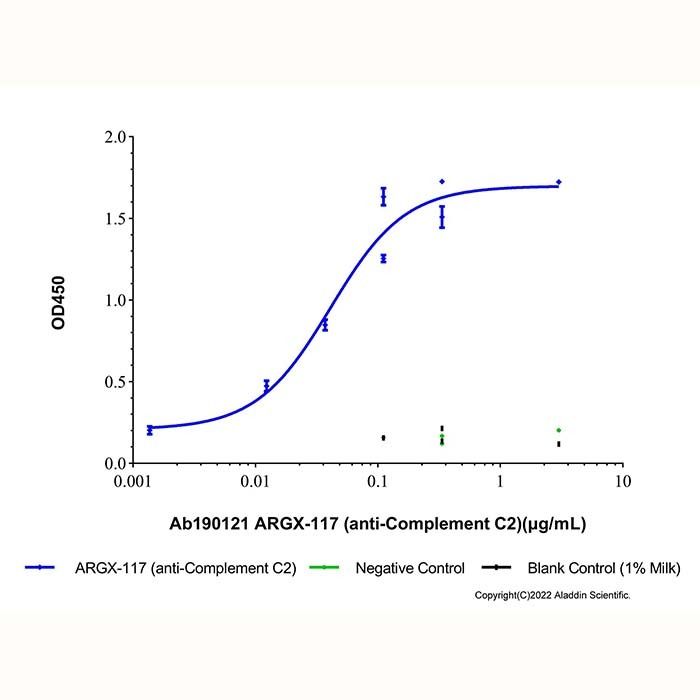
ARGX-117 (anti-Complement C2) (Ab190121) - ELISA
Immobilized Human Complement C2 Protein at 2.0 μg/mL can bind ARGX-117 (anti-Complement C2) (Ab190121) with the EC ₅₀ of 41.04 ng/mL.

ARGX-117 (anti-Complement C2) (Ab190121) - SEC
The purity of ARGX-117 (anti-Complement C2) (Ab190121) is more than 95% verified by HPLC.

Documentation

📋 Fiche de données de sécurité (FDS)

Document complet couvrant les dangers, la manipulation, le stockage et la conformité réglementaire.

<<<<<<< HEAD Télécharger la SDS → ======= Télécharger la SDS → >>>>>>> release248-p3

✅ Certificat d'analyse (COA)

Données qualité spécifiques au lot. Saisissez votre numéro de lot pour récupérer le COA exact.

Rechercher le COA →

📊 Fiche technique

Résumé de référence rapide des spécifications et applications du produit.

Voir la fiche technique →

🔬 Fiche de spécifications

Attributs de qualité complets et critères d'acceptation pour cette qualité.

Voir la fiche de spécifications →

Données avancées

Cibles associées (humaines)
C2 Tchem Complement C2 (0 Activities)
Activity TypeActivity Value -log(M)Mechanism of ActionActivity ReferencePublications (PubMed IDs)
Mécanismes d'action
Certificats (CoA, COO, BSE/TSE et tableau d'analyse)
C of A & Other Certificates(BSE/TSE, COO):
Analytical Chart:

Find and download the COA for your product by matching the lot number on the packaging.

3 results found

Lot NumberCertificate TypeDateArticle
ZJ24F0809764ZJ24F0809764Certificate of AnalysisJun 22, 2026 Ab190121
ZJ24F0809765ZJ24F0809765Certificate of AnalysisJun 22, 2026 Ab190121
ZJ24F0809766ZJ24F0809766Certificate of AnalysisJun 22, 2026 Ab190121
FAQ et articles
Calculateurs de solution
Avis

Avis des clients

Application Protocols

Tested/validated applications, recommended dilutions, positive controls, and sample preparation details are not specified for this item; refer to the CoA/Spec Sheet.

Because the product is Carrier Free and Azide Free (item-specific), users may adapt it for a range of assay formats once validated in-house. However, no specific protocols are supplied in this catalog entry.

Biological Roles

Antigen background (literature/general): Complement component C2 is a key serine protease zymogen in the classical and lectin pathways of the complement system. Upon activation by C1s (classical) or MASP (lectin pathway), C2 is cleaved into C2a and C2b. The fragment C2a associates with C4b to form the C3 convertase (C4b2a), driving cleavage of C3 and amplification of downstream complement effector functions (opsonization, inflammation, membrane attack complex formation). C2 thus occupies a pivotal position in early complement cascade signaling and contributes to immune complex processing and microbial defense.

Relevance for research antibodies (general):

  • Detection and quantification: Anti‑C2 antibodies enable study of C2 expression, processing, and pathway activation in cell lysates, sera, or conditioned media. Distinguishing between pro‑form and fragments (C2, C2a, C2b) requires epitope‑specific validation not specified for this item.
  • Pathway mapping: Monitoring C4b2a formation and C3 cleavage products alongside C2 measurements helps dissect classical vs lectin pathway contributions. Use carefully validated pairs (capture/detection) for sandwich ELISA if quantifying C2 or its fragments; such configurations are not specified here.

What is not specified for this item:

  • Species reactivity, epitope (linear vs conformational), affinity (KD), and ability to distinguish C2 zymogen from cleavage fragments. Please consult the CoA/Spec Sheet for item-specific biological performance characteristics.
Buffer Applications

No specific buffer system, formulation, or recommended diluents are provided for this item; refer to the CoA/Spec Sheet.

General laboratory practice for antibody buffers (literature/general):

  • Common working buffers: PBS or TBS, with optional 0.05–0.1% nonionic surfactant (e.g., Tween‑20) for ELISA/WB wash buffers to minimize nonspecific binding. For storage of azide‑free antibodies, maintain strict aseptic technique; optional low concentrations of compatible preservatives may be considered by the user for short-term storage, understanding potential assay interferences.
  • Conjugation considerations: For NHS‑ester labeling, exchange into amine‑free buffers (e.g., PBS without Tris/primary amines). For thiol-directed chemistry, avoid reducing agents unless generating free thiols deliberately.
  • pH and ionic strength: Many antibodies are stable in pH 6.5–7.5 with ~100–150 mM ionic strength; optimize empirically for your assay. These are general guidelines and not specifications for this item.

Note: Because this product is Carrier Free and Azide Free (item-specific), verify that your chosen buffer system preserves activity and sterility without introducing interfering components for your downstream assay.

Green Alternatives

Although antibodies are not chemical solvents, sustainability and ethical sourcing considerations are relevant.

Greener/ethical considerations for this item (item-specific and general):

  • Animal Free (item-specific): Avoids animal-derived components during manufacture, reducing reliance on animal sourcing and variability.
  • Recombinant production (item-specific): Enables controlled expression and consistent quality, often with lower resource intensity compared to maintaining large hybridoma/animal facilities.
  • Carrier Free and Azide Free: Minimizes additive load, simplifying downstream processing and reducing hazardous preservative usage in the lab.

Comparison (general perspective):

  • Hybridoma‑derived monoclonals vs recombinant: Recombinant approaches can improve lot-to-lot consistency and may reduce biological waste streams; however, they require bioreactor infrastructure and energy input.
  • Sodium azide preservation vs aseptic handling: Removing azide eliminates disposal concerns for azide-containing aqueous waste and improves cell compatibility; it places greater emphasis on sterile technique and cold-chain integrity.

Practical suggestions:

  • Order quantities aligned with near-term needs to minimize cold-chain burden and potential waste from expired materials.
  • Aliquot to avoid repeated freeze–thaw and extend useful life, reducing reorders and associated shipping emissions.
  • Consolidate shipments when possible; this product ships on dry ice + cold packs (item-specific), so plan receiving accordingly to minimize logistic impacts.
Pharmaceutical Uses

This product is designated For research use only (item-specific) and is not intended for human or veterinary use, diagnostic procedures, or as a therapeutic.

General formulation/CMC relevance of recombinant antibodies in R&D (literature/general):

  • Reference materials and controls: Recombinant, sequence-defined antibodies are often used as in‑house reference standards, assay controls, or spike‑in reagents during method development for bioanalytical assays (e.g., ligand‑binding assays assessing complement components). Any such use must be validated internally; no pharmacopeial status is claimed for this item.
  • Excipient compatibility screening: Carrier Free, Azide Free material allows formulation scientists to screen excipients without interference from carriers/preservatives; however, this item provides no specifications regarding formulation robustness.
  • Analytical development: Low Endotoxin material may be advantageous in cell‑based potency/neutralization assays during exploratory research. Exact endotoxin limits for this item are not specified and must be verified on the CoA before sensitive use.

Not specified for this item:

  • Regulatory grade, GMP status, pharmacopeial monograph compliance, viral safety validation, residual host‑cell impurity limits, and release/stability specifications. This catalog entry represents a research‑grade reagent only.
Physical Properties

Antibody products are macromolecular proteins; conventional small‑molecule physical constants are generally not applicable.

Item-specific physical data:

  • Appearance: Not specified for this item; refer to CoA/Spec Sheet.
  • Molecular weight: Not specified for this item; refer to CoA/Spec Sheet.
  • Molecular formula: Not specified for this item; refer to CoA/Spec Sheet.
  • Concentration, excipients, buffer, pH, and osmolality: Not specified for this item; refer to CoA/Spec Sheet.
  • Refractive index, density, logP, pKa, UV cutoff: Not applicable/Not specified for this item; refer to CoA/Spec Sheet.

Literature/general values (for typical IgG-class antibodies; informative only):

  • Approximate native molecular mass: ~150 kDa for full-length IgG; ~50 kDa for heavy chain; ~25 kDa for light chain under reducing SDS‑PAGE. The exact mass depends on isotype, sequence, and glycosylation.
  • Isoelectric point (pI): often in the 6–9 range, highly sequence-dependent.
  • Solubility: Generally water-soluble in physiological buffers (PBS, TBS). Solubility and stability are influenced by pH, ionic strength, and excipients (e.g., sugars, amino acids, surfactants). Not specified for this item.
  • Thermal stability: Antibodies typically exhibit Tm values ~60–75°C, varying by subclass and formulation. Not specified for this item.

Notes for users:

  • For any performance-critical physical parameters (e.g., exact concentration, endotoxin level threshold, buffer composition), consult the item’s CoA/Spec Sheet as they are not specified here.
Quality and Grades

Item-specific quality attributes (from Product Data):

  • Animal Free: Manufactured without animal‑derived components, reducing risk of adventitious agents and improving batch-to-batch consistency.
  • Carrier Free: No protein carriers (e.g., BSA) are added, enabling clean conjugation and minimizing background in sensitive assays.
  • Recombinant: Produced via recombinant expression for defined sequence control and improved lot consistency compared with hybridoma-derived antibodies.
  • ExactAb™: Denotes a defined, sequence‑controlled antibody format (manufacturer designation). Consult the CoA/Spec Sheet for exact construct details.
  • Low Endotoxin: Suitable for applications sensitive to endotoxin (e.g., certain cell-based assays). Exact endotoxin specification is not listed here; refer to CoA/Spec Sheet.
  • Azide Free: Sodium azide is not included, increasing cell compatibility and enabling downstream conjugation chemistries that are azide‑incompatible.
  • Validated: Indicates the product has undergone internal functional/quality checks. Specific validated applications are not listed here; refer to CoA/Spec Sheet.

How to interpret these grades (general guidance):

  • Animal Free and Recombinant minimize variability and regulatory concerns for research workflows.
  • Carrier Free and Azide Free facilitate custom labeling (e.g., NHS ester dyes, click chemistry) and reduce extraneous signals in mass spectrometry or ELISA.
  • Low Endotoxin is important for primary cell assays; always verify the lot-specific EU/mg value on the CoA before sensitive use cases.

What is not specified for this item:

  • Isotype/subclass, concentration, buffer composition, residual host-cell protein/DNA levels, and specific validated assay types. Consult the CoA/Spec Sheet for those details.
Reaction and Applications

For an antibody reagent, “reactions” pertain to biochemical binding and detection workflows rather than small‑molecule transformations. No application list is specified for this item; consult the CoA/Spec Sheet.

General/literature applications for anti‑Complement C2 antibodies (informative only):

  • Immunodetection: Potential use in Western blotting, ELISA, or immunoprecipitation to detect complement C2 in research samples. Optimal assay type, dilutions, and antigen retrieval are not specified for this item.
  • Imaging and localization: If suitably validated and conjugated, antibodies can be used for immunofluorescence or immunohistochemistry to study C2 distribution in tissues and cells. Conjugation and validation status for this item are not specified.
  • Functional studies: In vitro neutralization/depletion assays or pathway interrogation in complement research may be explored, contingent on antibody isotype/affinity and experimental design. Any such use must be validated by the end user; no specific functional claims are made for this item.

Practical tips (general):

  • Maintain antibody integrity by avoiding freeze–thaw cycles; aliquot upon receipt (item-specific guidance).
  • For conjugations (e.g., HRP, fluorophores), the Carrier Free and Azide Free attributes are advantageous. Desalt into compatible buffers (amine‑free for NHS ester reactions). Verify concentration by A280 (ε depends on sequence; not specified for this item).
Reaction Conditions

Classical reaction condition parameters (solvent, catalyst, temperature, yield) are not applicable to antibody reagents. No assay conditions are specified for this item; refer to the CoA/Spec Sheet.

General guidance for antibody-based assays (literature/general; not item-specific):

  • Incubation conditions: Many immunoassays use 1–2 h at room temperature or overnight at 4°C for primary antibody incubations; exact times/dilutions require optimization.
  • Buffers: Use appropriate blocking buffers (e.g., BSA- or serum‑based) unless interference with complement components is a concern. This product is Carrier Free and Azide Free; choose buffers accordingly.
  • Washing: Incorporate multiple wash steps with PBS‑T or TBS‑T to reduce background in ELISA/WB. Detergent type/concentration should be optimized.
  • Temperature: Keep antibody solutions on ice during setup to minimize degradation. Avoid elevated temperatures that can denature proteins.

These are literature-based practices. Specific validated conditions for ARGX‑117 are not provided here and should be established empirically or obtained from the CoA/Spec Sheet.

Safety and Handling

Item-specific hazard information (from Product Data):

  • GHS classification, signal word, pictograms, H‑statements: Not specified for this item; refer to the SDS.

General safety guidance for laboratory antibodies (literature/general; not a substitute for SDS):

  • Antibodies are proteinaceous reagents and are typically handled at Biosafety Level 1 in standard research laboratories. Avoid inhalation of aerosols, ingestion, and contact with eyes/skin. Wear appropriate PPE: lab coat, gloves, and safety glasses.
  • Microbial contamination can degrade protein quality; use aseptic technique when opening vials and preparing dilutions. For azide‑free materials (this item is Azide Free), ensure sterile technique or add a suitable preservative in your laboratory workflow if long-term storage in liquid is intended (user’s discretion; validate compatibility with downstream assays).
  • Avoid repeated freeze–thaw cycles (item-specific instruction); aliquot upon first thaw to maintain activity and minimize aggregation.
  • Incompatibilities: Strong oxidants, extreme pH, or high shear can denature proteins. Avoid exposure to elevated temperatures and proteases. Do not vortex aggressively; gentle mixing is preferred.
  • First aid (general): In case of contact with eyes/skin, rinse with water. If inhaled or ingested, seek medical attention. Provide SDS to healthcare personnel.

Always consult the product’s SDS and institutional safety policies for authoritative hazard and handling information.

Solvent Selection

This product is a protein antibody reagent and is not used as an organic solvent. Traditional solvent selection guidelines (polarity, dielectric constant, miscibility) do not apply.

Practical notes for users (general):

  • Use physiological aqueous buffers (e.g., PBS, TBS) appropriate to your assay. Buffer composition for this item is not specified; check the CoA/Spec Sheet before making compatibility assumptions.
  • For conjugation or cell-based work, ensure buffers lack amines (for NHS chemistry) or reducing agents (for maleimide/thiol chemistry) as required by your protocol. These considerations are assay-specific rather than solvent-selection in the classical sense.
Storage and Reconstitution

Item-specific storage and shipping conditions:

  • Storage: Store at −80°C (from Product Data). Avoid repeated freezing and thawing; aliquot upon initial thaw.
  • Shipping: Shipped on dry ice packs + cold packs (from Product Data). Maintain the cold chain upon receipt.

Reconstitution and formulation details: Not specified for this item; refer to CoA/Spec Sheet.

General handling guidance (literature/general):

  • If received frozen in liquid form, thaw on ice and mix gently by inversion; avoid vigorous vortexing.
  • If received lyophilized (appearance not specified), reconstitute with sterile, buffered aqueous solution appropriate for your application (e.g., PBS) and allow complete dissolution on ice. Filter‑sterilize (0.22 µm) if sterility is critical and compatible with your use.
  • Prepare single‑use aliquots in low‑protein‑binding tubes. Store aliquots at −80°C. Avoid frost‑free freezers that cycle temperatures.
  • For short‑term use (days to a week), 2–8°C storage may be acceptable depending on buffer/preservatives; this is general guidance only and not a specification for this item.

Always defer to the CoA/Spec Sheet for lot-specific buffer composition, concentration, and any additional storage instructions.

Structure and Identity

Item-specific identifiers and a small-molecule line notation are not applicable to this protein biologic.

  • SKU: Ab190121
  • Product name: ARGX-117 (anti-Complement C2)
  • CAS: 2579031-19-7 (registry entry for this biologic; not a small-molecule identifier)
  • Grade/Purity (item-specific): Animal Free; Carrier Free; Recombinant; ExactAb™; Low Endotoxin; Azide Free; Validated
  • Molecular formula: Not specified for this item; refer to CoA/Spec Sheet.
  • Molecular weight: Not specified for this item; refer to CoA/Spec Sheet.
  • SMILES/InChI/InChIKey: Not applicable to antibodies; not specified for this item.

General structural description (literature/general):

  • ARGX-117 is described as an anti-Complement C2 antibody; antibodies are Y‑shaped glycoproteins built from two heavy and two light chains with inter- and intra-chain disulfide bonds. Domains are arranged as variable regions (VH/VL) forming the antigen-binding fragment (Fab) and constant domains forming the Fc.
  • Typical IgG architecture comprises β‑sandwich immunoglobulin folds; glycosylation may occur in Fc (e.g., at Asn297 for human IgG). Exact subclass, sequence, and glycoform for this item are not specified here.
  • Target epitope: Complement component C2 (exact epitope, affinity, and species reactivity are not specified for this item; see CoA/Spec Sheet).

2D/primary-structure description (literature/general):

  • Linear polypeptide sequences for heavy and light chains with conserved cysteines forming disulfide bridges; hypervariable CDR loops in VH/VL mediate antigen recognition. The precise sequence and CDR composition for ARGX-117 are not provided in this entry.
Synthetic Utility

Not applicable to this product type. ARGX‑117 (anti‑Complement C2) is a recombinant antibody reagent rather than a small‑molecule building block. It does not participate as a reagent or substrate in organic synthesis in the classical sense.

For practical laboratory relevance, please see:

  • Biological Roles: background on the complement C2 target.
  • Reaction & Applications and Application Protocols: considerations for immunoassay and detection workflows.
  • Storage & Reconstitution: handling guidance for maintaining antibody integrity.
Target Specificity

Item-specific information:

  • Antigen/Target: Complement component C2 (anti‑Complement C2), as indicated by the product name.
  • Clone, isotype/subclass, host species, epitope mapping, affinity, and species reactivity: Not specified for this item; refer to CoA/Spec Sheet.
  • Grade attributes supporting specificity: Recombinant; ExactAb™; Validated; Animal Free; Carrier Free; Low Endotoxin; Azide Free (from Product Data). These attributes support consistency and suitability for sensitive applications but do not replace empirical specificity data.

Literature/general background on the antigen:

  • C2 is a zymogen cleaved into C2a and C2b in the classical and lectin complement pathways. Complex formation with C4b yields the C3 convertase (C4b2a). Antibody epitopes may be conformational or linear and located within domains that differ between pro‑form and fragments. The specific epitope for this item is not provided here.

Besoin d'aide pour choisir la qualité ?

Notre guide de sélection des qualités couvre la pureté, le statut du stabilisant et l'adéquation à l'application pour toutes les variantes de notre catalogue.

Voir le guide des qualités Animal Free → Voir le guide des qualités Carrier Free → Voir le guide des qualités Recombinant → Voir le guide des qualités Validated → Voir le guide des qualités ExactAb™ → Voir le guide des qualités Low Endotoxin → Voir le guide des qualités Azide Free →

Produits apparentés

Mouse Anti-Human IgM Antibody - Secondary antibody, for ELISA various applications, from Human, generated in Mouse, IgG1
Mouse Anti-Human IgG H&L (HRP) - Secondary antibody, for ELISA various applications, from Human, generated in Mouse, IgG1
Goat Anti-Human IgG H&L (HRP) - Secondary antibody, for WB,ELISA,IHC various applications, from Human, generated in Goat, IgG
Mouse Anti-Human IgG Antibody - Secondary antibody, for ELISA,CLIA various applications, from Human, generated in Rat, IgG1
Human IgG - Isotype Control Antibody, for WB,CLIA,LF,EIA,PRTIA various applications, generated in Human, >95%, IgG
Goat Anti-Human IgG Antibody - Secondary antibody, ≥ 95%
Mouse Anti-Human IgA H&L Antibody - Secondary antibody, Mouse IgG1
Goat Anti-Human IgG (HRP) - Secondary antibody
Goat Anti-Human IgG (Biotin) - Secondary antibody
Goat Anti-Human IgG (Cy5) - Secondary antibody
Goat Anti-Human IgG (APC) - Secondary antibody
Goat Anti-Human IgG (PE) - Secondary antibody
Goat Anti-Human IgG (TRITC) - Secondary antibody
Goat Anti-Human IgG (FITC) - Secondary antibody
Mouse Anti-Human IgE epsilon chain Antibody - Secondary antibody
Goat Anti-Human IgG Fc Antibody - Secondary antibody, Goat IgG
Human IgG2-Kappa - Isotype Control Antibody, Human IgG2
Human IgG3-kappa - Isotype Control Antibody, Human IgG3
Human IgG1-kappa, anti-Spike RBD - Isotype Control Antibody, specific to Spike RBD, Human IgG1
Human IgG4-kappa - Isotype Control Antibody, IgG4
Goat Anti-Human IgG (AF647) - Secondary antibody, IgG
Goat Anti-Human IgG (AF405) - Secondary antibody, IgG
Human IgG (FITC) - Isotype Control Antibody, IgG
Human IgG (APC) - Isotype Control Antibody, IgG
Human IgG (PE) - Isotype Control Antibody, IgG
Human IgG1(P331S/E430G)-kappa, anti-HEL - Isotype Control Antibody, specific to HEL, Human IgG1(P331S/E430G)
Human IgG1(D265A/N297A)-kappa, anti-HEL - Isotype Control Antibody, specific to HEL, Human IgG1(D265A/N297A)
Human IgG1(K409R/E356D/M358L)-kappa, anti-HEL - Isotype Control Antibody, specific to HEL, Human IgG1(K409R/E356D/M358L)
Human IgG1(P329G/E356D/M358L)-kappa, anti-HEL - Isotype Control Antibody, specific to HEL, Human IgG1(P329G/E356D/M358L)
Human IgG1(F405L)-kappa, anti-HEL - Isotype Control Antibody, specific to HEL, Human IgG1(F405L)
Human IgG1(N297Q)-kappa, anti-HEL - Isotype Control Antibody, specific to HEL, Human IgG1(N297Q)
Human IgG (Biotin) - Isotype Control Antibody, IgG
Human IgG1(N297S)-kappa, anti-HEL - Isotype Control Antibody, specific to HEL, Human IgG1(N297S)
Human IgG1(E233A/L235A)-kappa, anti-HEL - Isotype Control Antibody, specific to HEL, Human IgG1(E233A/L235A)
Human IgG1(K214R/N297A)-kappa, anti-HEL - Isotype Control Antibody, specific to HEL, Human IgG1(K214R/N297A)
Human IgG1(K214R/L234A/L235A)-kappa, anti-HEL - Isotype Control Antibody, specific to HEL, Human IgG1(K214R/L234A/L235A)
Human IgG1(N297A/E356D/M358L)-kappa, anti-HEL - Isotype Control Antibody, specific to HEL, Human IgG1(N297A/E356D/M358L)
Human IgG1(L234F/L235E)-kappa, anti-HEL - Isotype Control Antibody, specific to HEL, Human IgG1(L234F/L235E)
Human IgG1(D265A)-kappa, anti-HEL - Isotype Control Antibody, specific to HEL, Human IgG1(D265A)
Human IgG1(K214R/L234F/L235E/P331S)-kappa, anti-HEL - Isotype Control Antibody, specific to HEL, Human IgG1(K214R/L234F/L235E/P331S)
Human IgG1(K214R/E356D/M358L)-kappa, anti-HEL - Isotype Control Antibody, specific to HEL, Human IgG1(K214R/E356D/M358L)
Human IgG1(L234A/L235A/G237A)-kappa, anti-HEL - Isotype Control Antibody, specific to HEL, Human IgG1(L234A/L235A/G237A)
Human IgG1(L234A/L235A/F405L)-kappa, anti-HEL - Isotype Control Antibody, specific to HEL, Human IgG1(L234A/L235A/F405L)
Human IgG1(D270N)-kappa, anti-HEL - Isotype Control Antibody, specific to HEL, Human IgG1(D270N)
Human IgG4(S228P)-kappa, anti-HEL - Isotype Control Antibody, specific to HEL, Human IgG4(S228P)
Human IgG1(N297A)-kappa, anti-HEL - Isotype Control Antibody, specific to HEL, Human IgG1(N297A)
Human IgG4(S228P/L235E/P329G)-kappa, anti-HEL - Isotype Control Antibody, specific to HEL, Human IgG4(S228P/L235E/P329G)
Human IgG1-lambda1, anti-Spike RBD - Isotype Control Antibody, specific to Spike RBD, Human IgG1
Human IgG1-lambda2, anti-Spike RBD - Isotype Control Antibody, specific to Spike RBD, Human IgG1
Goat Anti-Human IgG (AF555) - Secondary antibody, IgG
Human IgG1-kappa (AF405), anti-Spike RBD - Isotype Control Antibody, specific to Spike RBD
Human IgG1-kappa (AF647), anti-Spike RBD - Isotype Control Antibody, specific to Spike RBD
Human IgG1-kappa (APC), anti-Spike RBD - Isotype Control Antibody, specific to Spike RBD
Human IgG1-kappa (Biotin), anti-Spike RBD - Isotype Control Antibody, specific to Spike RBD
Human IgG1-kappa (AF700), anti-Spike RBD - Isotype Control Antibody, specific to Spike RBD
Human IgG1-kappa (FITC), anti-Spike RBD - Isotype Control Antibody, specific to Spike RBD
Human IgG1-kappa (AF555), anti-Spike RBD - Isotype Control Antibody, specific to Spike RBD
Centrose patent anti-dysadherin (anti-Dysadherin) - Primary antibody, specific to FXYD5
Human IgG (AF647) - Isotype Control Antibody
Human IgG (AF488) - Isotype Control Antibody
Human IgG (AF700) - Isotype Control Antibody
Human IgG (AF405) - Isotype Control Antibody
Goat Anti-Human IgG (AF488) - Secondary antibody
Goat Anti-Human IgG Fc (Cy5) - Secondary antibody
Goat Anti-Human IgG Fc (AF555) - Secondary antibody, specific to Human IgG Fc
Goat Anti-Human IgG Fc (TRITC) - Secondary antibody
Goat Anti-Human IgG Fc (AF700) - Secondary antibody, specific to Human IgG Fc
Goat Anti-Human IgG Fc (AF405) - Secondary antibody
Goat Anti-Human IgG Fc (Biotin) - Secondary antibody, specific to Human IgG Fc
Goat Anti-Human IgG Fc (AF647) - Secondary antibody
Goat Anti-Human IgG Fc (FITC) - Secondary antibody, specific to Human IgG Fc
Human IgG (AF555) - Isotype Control Antibody

Souhaitez-vous que nous vous envoyions un message lorsque des réductions seront disponibles?

Me rappeler plus tard

Merci ! Veuillez vérifier votre boîte de réception e-mail pour confirmer.

Oups ! Les notifications sont désactivées.