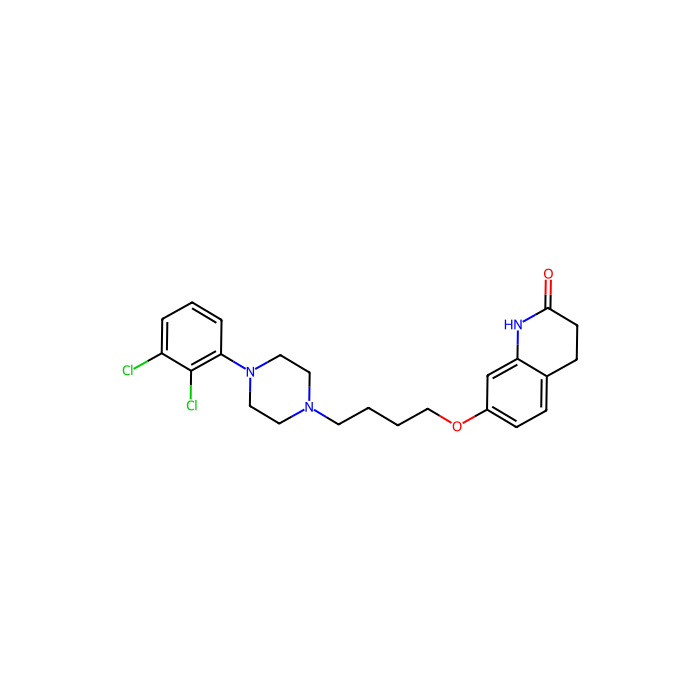
Determine the necessary mass, volume, or concentration for preparing a solution.
| Activity Type | Activity Value -log(M) | Mechanism of Action | Activity Reference | Publications (PubMed IDs) |
|---|

Moligand™, 10mM in DMSO Moligand™ pour les flux de travail chromatographiques et analytiques sensibles nécessitant une interférence de ligne de base minimale.
Store at -80°C Expédition Dry ice packs + Cold packs. Consultez le COA spécifique au lot pour les spécifications exactes.
SDS, COA, fiche technique et fiche de spécifications disponibles au téléchargement. COA spécifique au lot accessible via la recherche par numéro de lot.
Cité dans 1 publications à comité de lecture couvrant la chromatographie, la synthèse organique et les réactions de couplage croisé.
Information
Aripiprazole (OPC-14597) is a novel atypical antipsychotic drug that is reported to be a high-affinity5-HT receptorpartial agonist.
In vitro
Aripiprazole binds with high affinity to both the G protein-coupled and uncoupled states of receptors. Aripiprazole potently activates D2 receptor-mediated inhibition of cAMP accumulation. Aripiprazole has highest affinity for h5-HT(2B)-, hD(2L)-, and hD(3)-dopamine receptors, but also has significant affinity (5-30 nM) for several other 5-HT receptors (5-HT(1A), 5-HT(2A), 5-HT(7)), as well as alpha(1A)-adrenergic and hH(1)-histamine receptors. Aripiprazole has less affinity (30-200 nM) for other G protein-coupled receptors, including the 5-HT(1D), 5-HT(2C), alpha(1B)-, alpha(2A)-, alpha(2B)-, alpha(2C)-, beta(1)-, and beta(2)-adrenergic, and H(3)-histamine receptors. Aripiprazole is an inverse agonist at 5-HT(2B) receptors and displays partial agonist actions at 5-HT(2A), 5-HT(2C), D(3), and D(4) receptors.
In vivo
Aripiprazole reduces extracellular 5-HIAA concentrations in the medial prefrontal cortex and striatum of drug-naive rats, but not in chronic Aripiprazole-pretreated rats. Aripiprazole, 0.1 mg/kg and 0.3 mg/kg, significantly increases dopamine release in the hippocampus of rats. Aripiprazole, 0.3 mg/kg, slightly but significantly increases dopamine release in the medial prefrontal cortex but not in the nucleus accumbens. Aripiprazole, 3.0 mg/kg and 10 mg/kg, significantly decreases dopamine release in the nucleus accumbens but not the medical prefrontal cortex. Aripiprazole, 0.3 mg/kg, transiently potentiates haloperidol (0.1 mg/kg)-induced dopamine release in the medial prefrontal cortex but inhibited that in the nucleus accumbens.
Cell Data
cell lines:
Concentrations:
Incubation Time:
Powder Purity:≥98%
Document complet couvrant les dangers, la manipulation, le stockage et la conformité réglementaire.
<<<<<<< HEAD Télécharger la SDS → ======= Télécharger la SDS → >>>>>>> release248-p3Données qualité spécifiques au lot. Saisissez votre numéro de lot pour récupérer le COA exact.
Rechercher le COA →Résumé de référence rapide des spécifications et applications du produit.
Voir la fiche technique →Attributs de qualité complets et critères d'acceptation pour cette qualité.
Voir la fiche de spécifications →| Activity Type | Activity Value -log(M) | Mechanism of Action | Activity Reference | Publications (PubMed IDs) |
|---|
| Activity Type | Activity Value -log(M) | Mechanism of Action | Activity Reference | Publications (PubMed IDs) |
|---|
| Activity Type | Activity Value -log(M) | Mechanism of Action | Activity Reference | Publications (PubMed IDs) |
|---|
| Activity Type | Activity Value -log(M) | Mechanism of Action | Activity Reference | Publications (PubMed IDs) |
|---|
| Activity Type | Activity Value -log(M) | Mechanism of Action | Activity Reference | Publications (PubMed IDs) |
|---|
| Activity Type | Activity Value -log(M) | Mechanism of Action | Activity Reference | Publications (PubMed IDs) |
|---|
| Activity Type | Activity Value -log(M) | Mechanism of Action | Activity Reference | Publications (PubMed IDs) |
|---|
| Activity Type | Activity Value -log(M) | Mechanism of Action | Activity Reference | Publications (PubMed IDs) |
|---|
| Activity Type | Activity Value -log(M) | Mechanism of Action | Activity Reference | Publications (PubMed IDs) |
|---|
| Activity Type | Activity Value -log(M) | Mechanism of Action | Activity Reference | Publications (PubMed IDs) |
|---|
| Activity Type | Activity Value -log(M) | Mechanism of Action | Activity Reference | Publications (PubMed IDs) |
|---|
| Activity Type | Activity Value -log(M) | Mechanism of Action | Activity Reference | Publications (PubMed IDs) |
|---|
| Activity Type | Activity Value -log(M) | Mechanism of Action | Activity Reference | Publications (PubMed IDs) |
|---|
| Activity Type | Activity Value -log(M) | Mechanism of Action | Activity Reference | Publications (PubMed IDs) |
|---|
| Activity Type | Activity Value -log(M) | Mechanism of Action | Activity Reference | Publications (PubMed IDs) |
|---|
| Activity Type | Activity Value -log(M) | Mechanism of Action | Activity Reference | Publications (PubMed IDs) |
|---|
| Activity Type | Activity Value -log(M) | Mechanism of Action | Activity Reference | Publications (PubMed IDs) |
|---|
| Activity Type | Activity Value -log(M) | Mechanism of Action | Activity Reference | Publications (PubMed IDs) |
|---|
| Activity Type | Activity Value -log(M) | Mechanism of Action | Activity Reference | Publications (PubMed IDs) |
|---|
| Activity Type | Activity Value -log(M) | Mechanism of Action | Activity Reference | Publications (PubMed IDs) |
|---|
| Activity Type | Activity Value -log(M) | Mechanism of Action | Activity Reference | Publications (PubMed IDs) |
|---|
| Solubilité | Solubility (25°C) In vitro DMSO: 37 mg/mL (198.65 mM); |
|---|---|
| Point de fusion (°C) | 149 °C |
Notre guide de sélection des qualités couvre la pureté, le statut du stabilisant et l'adéquation à l'application pour toutes les variantes de notre catalogue.
Voir le guide des qualités Moligand™ →